Stuart's Golden
Apple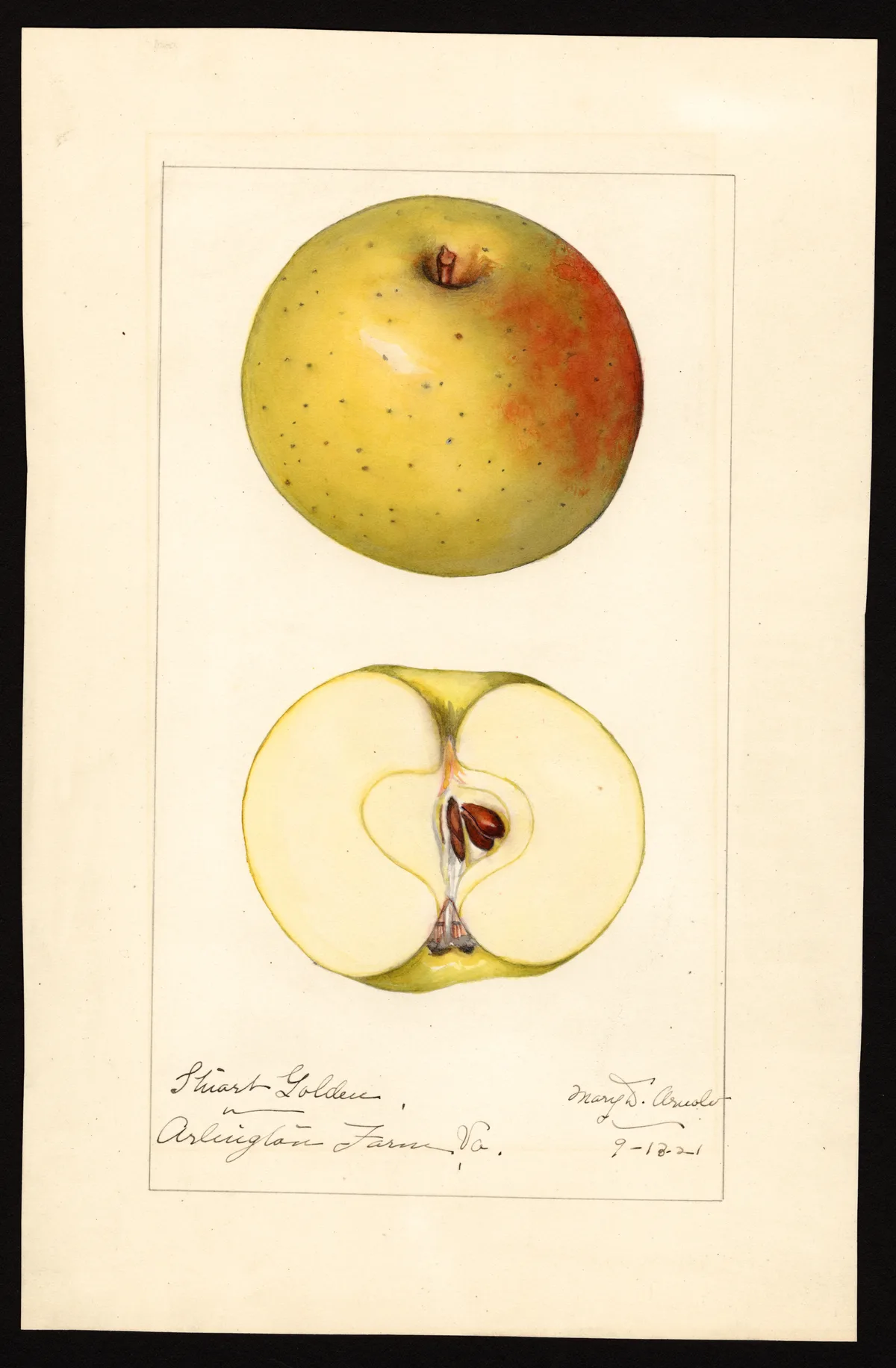
USDA Pomological Watercolor Collection
Stuart's Golden
Origin / History
Originated on the farm of the late William Stuart, Rush Creek, Ohio, where it grew near a stump many years since. Downing says it is very popular, where known, for home use and a near market. Beach reports it disseminated to some extent in the Middle West and, so far as he knew, not grown in New York except at the Station. Beach calls it rather attractive in color for a yellow apple, a very late keeper, and of excellent dessert quality.
Tree
Tree small to medium size (Beach), medium (Downing); low, with short, stout branches. Form spreading, very much so and open (Beach). Hardy, healthy, moderately vigorous, with tough, close-grained shoots (Downing). Twigs below medium to short, straight or slightly curved, moderately stout to slender; internodes short. Bark smooth, clear reddish-brown tinged with olive-green, lightly streaked with scarf-skin, pubescent. Lenticels clear in color, scattering, small to medium, oblong, usually not raised. Buds prominent, medium in size, plump, acute, free, slightly pubescent.
An early and prolific bearer in alternate years, producing fair fruit (Downing). Beach says it comes into bearing moderately young and is a reliable cropper, yielding full crops biennially.
Fruit
Size: Below medium, of uniform size (Downing); usually below medium but sometimes medium or above (Beach).
Form: Oblate to roundish oblate, or inclined to oblong truncate; nearly regular, sometimes a little oblique (Downing), often slightly oblique (Beach).
Stem: Short and small to slender, often short; sometimes with a fleshy protuberance (Beach).
Cavity: Medium (Downing); moderately shallow to deep, varying from acuminate and narrow to acute and rather wide (Beach); usually symmetrical; often thinly russeted, sometimes slight russet.
Calyx: Small to medium, closed. Calyx tube rather small, rather short, cone-shape, sometimes approaching funnel-form (Beach).
Basin: Moderately deep. Downing gives it rather large, saucer-like, and smooth. Beach gives it rather narrow to moderately wide, somewhat abrupt, usually symmetrical, and often wrinkled.
Skin: Thin, tough, smooth, waxy; bright yellow (Downing), pale yellow or greenish with orange blush (Beach), sometimes deepening to pinkish-red (Beach); deep orange red in the sun (Downing).
Dots: A few, brown (Downing). Beach describes them as often submerged, pale or russet, numerous and rather small toward the basin, becoming larger, more scattering, and often areolar toward the cavity.
Flesh and flavor: Whitish yellow, or whitish tinged with yellow; firm, half fine to moderately fine, rather crisp, tender, juicy to very juicy. Flavor pleasant, agreeably mild subacid, rich, aromatic. Downing calls the quality "excellent"; Beach, "very good for dessert".
Core and seeds: Core small (Downing); rather small to above medium, abaxile (Beach). Cells open; core lines meeting or slightly clasping. Carpels broadly elliptical. Seeds below medium to medium, plump, rather obtuse, moderately dark brown.
Season
December to May or June. Downing gives December to April and says it keeps well; Beach calls it a very late keeper.
Uses
Dessert apple of excellent quality; valued for home use and a near market (Downing). Beach finds it not large enough for a good commercial variety and does not recommend it for commercial planting in New York.
Subtypes / Variants
Not described in source.
Other
Not described in source.
Book Sources
Described in 2 period pomological works
- Downing, Fruits and Fruit Trees of America (1900)
- Beach, The Apples of New York Vol. 1 (1905) — listed as Stuart Golden
Nursery Catalog Sources
Found in 5 catalogs (1891–1913) from Illinois, Missouri
- Missouri Nursery Co. , Louisiana , Missouri — 1891
- J.V. Cotta (Cotta Nursery) , Carroll County , Illinois — 1898
- Central Experimental Farm , Dominion Department of Agriculture, Agassiz, British Columbia (under test; Bulletin No. 3, Second Series) — 1900
- Benjamin Buckman (personal inventory) , Farmingdale , Illinois — 1901
- Benjamin Buckman (personal inventory) , Farmingdale , Illinois — 1913
View original book sources (2)
— A.J. Downing, The Fruits and Fruit Trees of America (1900)Stuart's Golden.
Stump (incorrectly).
Originated on the farm of the late William Stuart, Rush Creek, O., where it grew near a stump many years since. It is said to be very popular, where known, for home use and a near market. Tree hardy, healthy, moderately vigorous, spreading, making a tree of medium size, with tough, close-grained shoots; an early and prolific bearer, alternate years, of fair fruit of uniform size, and keeps well.
Fruit below medium, oblate, sometimes a little oblique, nearly regular; skin bright yellow, deep orange red in the sun, with a few brown dots; stalk short, small; cavity medium, sometimes slight russet; calyx small, closed; basin rather large, moderately deep, saucer-like shape, smooth; flesh whitish yellow, half fine, tender, juicy, pleasant subacid, rich, and of excellent quality; core small. Season, December to April.
— S.A. Beach, The Apples of New York, Vol. 1 (1905)STUART GOLDEN.
REFERENCES. 1. Downing, 1881:108 app. fig. 2. Mo. Hort. Soc. Rpt., 1886:232. 3. Bailey, An. Hort., 1892:250. 4. Dickens and Greene, Kan. Sta. Bul., 106:55. 1902. 5. Powell and Fulton, U. S. B. P. I. Bul., 48:57. 1903. 6. Farrand, Mich. Sta. Bul., 205:46. 1903.
SYNONYMS. STUART (6). STUART'S GOLDEN (1, 2, 3, 4). Stump, incorrectly (1).
Fruit rather attractive in color for a yellow apple, not large enough for a good commercial variety but a very late keeper and of excellent dessert quality. The tree is not large, comes into bearing moderately young and is a reliable cropper, yielding full crops biennially. Not recommended for commercial planting in New York.
Historical. Originated on the farm of Wm. Stuart, Rush Creek, Ohio (1). It has been disseminated to some extent in the Middle West; but, so far as we know, it is not grown in New York except at this Station.
TREE.
Tree small to medium size, low with short, stout branches. Form very much spreading, open. Twigs below medium to short, straight or slightly curved, moderately stout to slender; internodes short. Bark smooth, clear reddish-brown tinged with olive-green, lightly streaked with scarf-skin, pubescent. Lenticels clear in color, scattering, small to medium, oblong, usually not raised. Buds prominent, medium in size, plump, acute, free, slightly pubescent.
FRUIT.
Fruit usually below medium but sometimes medium or above. Form roundish oblate or inclined to oblong truncate, often slightly oblique. Stem slender, often short, sometimes with fleshy protuberance. Cavity moderately shallow to deep, varying from acuminate and narrow to acute and rather wide, usually symmetrical, often thinly russeted. Calyx small to medium, closed. Basin moderately deep, rather narrow to moderately wide, somewhat abrupt, usually symmetrical, often wrinkled.
Skin thin, tough, smooth, waxy, pale yellow or greenish with orange blush, sometimes deepening to pinkish-red. Dots often submerged, pale or russet, numerous and rather small toward the basin, becoming larger, more scattering and often areolar toward the cavity.
Calyx tube rather small, rather short, cone-shape, sometimes approaching funnel-form.
Core rather small to above medium, abaxile; cells open; core lines meeting or slightly clasping. Carpels broadly elliptical. Seeds below medium to medium, plump, rather obtuse, moderately dark brown.
Flesh whitish tinged with yellow, firm, moderately fine, rather crisp, tender, very juicy, agreeably mild subacid, rich, aromatic, very good for dessert.
Season December to May or June.