Summer Beurre d'Aremberg
Pear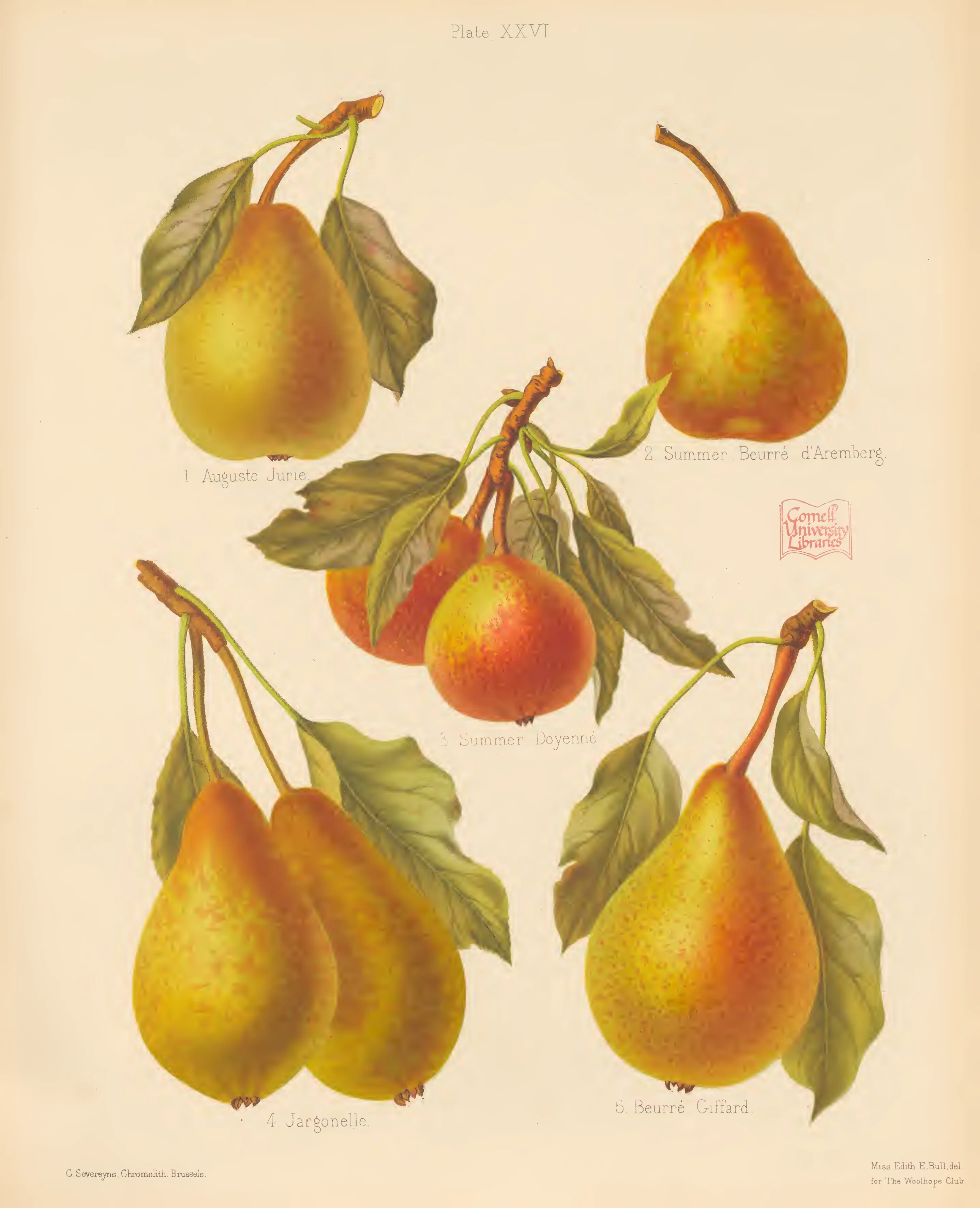
Summer Beurré d'Aremberg
Origin/History
Raised by Thomas Rivers of Sawbridgeworth, Hertfordshire, England. The tree bore fruit for the first time in 1863. The variety was not widely known at the time of the Herefordshire Pomona's publication (1885), but was praised by cultivators who grew it. Mr. Ward of Stoke Edith wrote: "It is one of my favourite pears. It deserves a wall with a south, or south-eastern aspect, and I give it this position. It is but little known at present, but it will make its way, for it is really a sweetmeat when fully ripe. It ought also to be successful as a standard on a warm soil and situation." Cited in Downing from the Gardeners' Chronicle.
Tree
Hardy and very productive. Herefordshire Pomona describes the tree as growing freely and bearing well; Downing characterizes it as moderately vigorous and upright. Will succeed equally well as a wall tree, pyramid, or espalier. If grown as a pyramid or espalier, it should be double grafted on the pear stock.
Fruit
Size and Form: Small to medium or below. Herefordshire Pomona gives precise dimensions of two inches wide and two inches high. Form is turbinate and even; Downing adds the alternative description of short obovate. Outline smooth.
Stem: Long. Herefordshire Pomona describes it as stout and fleshy, and curved. Downing concurs that it is rather long. The two sources conflict on the stem insertion: Herefordshire Pomona states it is inserted without depression, while Downing describes it as inserted in a small cavity.
Cavity: Small (Downing).
Calyx: Very small (Downing). Herefordshire Pomona describes the eye as wanting segments and very deeply set in a narrow hole.
Basin: Deep and narrow (Downing).
Skin: The two sources give conflicting accounts. Herefordshire Pomona describes the skin as entirely covered with a thin crust of cinnamon-colored russet. Downing describes the ground color as lemon, with only slight nettings and patches of russet, particularly concentrated around the stem.
Flesh and Flavor: Yellowish or buttery in color (Herefordshire Pomona). Tender, melting, and very juicy in both accounts. Herefordshire Pomona characterizes the flavor as sweet, richly flavored, and with a musky aroma; Downing describes it as brisk, vinous, and perfumed. Downing adds a caution: the flesh is apt to rot at the core unless gathered early.
Core/Seeds: Not described in source.
Season
Downing gives the season as the first of September. Herefordshire Pomona places ripening at about the middle of September, but specifies that the fruit should be gathered and put in the fruit room for a fortnight before being sent to table.
Uses
Dessert. Herefordshire Pomona calls it "really a delicious Pear, one of the richest and best of its season," and a "sweetmeat when fully ripe." Best suited to a wall with a south or south-eastern aspect; may also succeed as a standard on warm soil and in a warm situation.
Subtypes/Variants
Not described in source.
Other
Not described in source.
Book Sources
Described in 2 period pomological works
View original book sources (2)
— Woolhope Naturalists Field Club, The Herefordshire Pomona (1885)PLATE XXVI. 2. SUMMER BEURRÉ D'AREMBERG.
This excellent Pear was raised by Mr. Rivers, of Sawbridgeworth, and the tree bore fruit for the first time in 1863.
Description.—Fruit : small, two inches wide and the same high ; turbinate, even, and smooth in its outline. Skin : entirely covered with a thin crust of cinnamon coloured russet. Eye : wanting segments, very deeply set in a narrow hole. Stalk : long, stout and fleshy, curved, and inserted without depression. Flesh : yellowish or buttery, tender, melting, and very juicy, sweet, richly flavoured and with a musky aroma.
This is really a delicious Pear, one of the richest and best of its season. It ripens about the middle of September, but should be gathered and put in the fruit room for a fortnight before being sent to table.
The tree grows freely, is very hardy and bears well. It will succeed equally well as a wall tree, pyramid, or espalier. If grown as a pyramid, or espalier, it should be double grafted on the pear stock. "It is one of my favourite pears," says Mr. Ward, of Stoke Edith, "It deserves a wall with a south, or south-eastern aspect, and I give it this position. It is but little known at present, but it will make its way, for it is really a sweetmeat when fully ripe. It ought also to be successful as a standard on a warm soil and situation."
— A.J. Downing, The Fruits and Fruit Trees of America (1900)Summer Beurre d'Aremberg.
Raised by Thomas Rivers, of Sawbridgeworth, Herts, England. Tree hardy, moderately vigorous, upright, very productive. Fruit medium or below, somewhat turbinate or short obovate. Skin of a lemon color, slight nettings and patches of russet, particularly around the stem. Stalk rather long, inserted in a small cavity. Calyx very small. Basin deep and narrow. Flesh tender, melting, juicy, brisk, vinous and perfumed, apt to rot at the core unless gathered early. First of September. (Gard. Chron.)