Surprise
Apple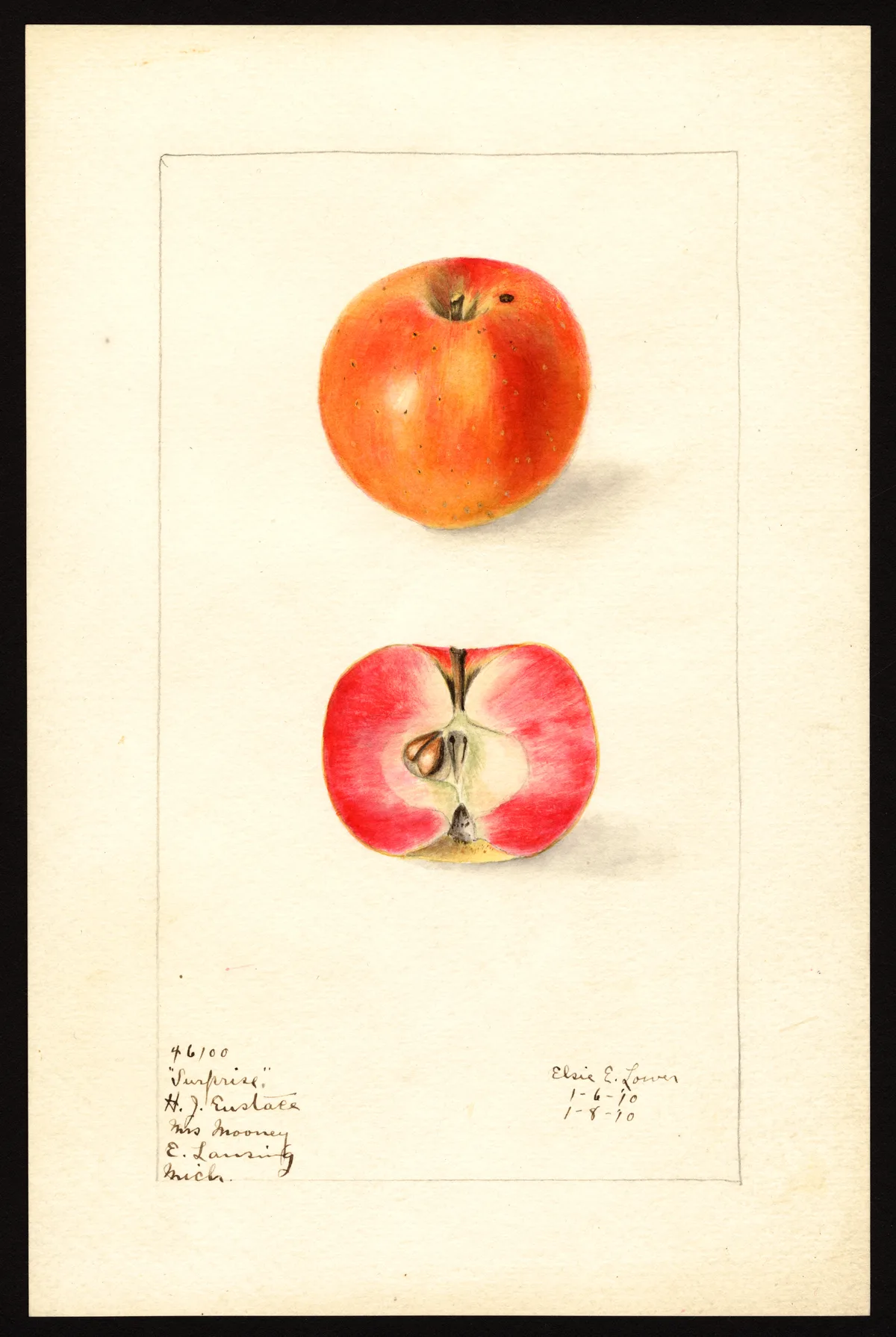
USDA Pomological Watercolor Collection
Origin/History
Origin undiscovered (Bunyard). Elliott (1865) identifies it as foreign. Bunyard (1920) explicitly notes that his Surprise is not the Surprise of Downing — indicating at least two distinct varieties have circulated under this name in period literature.
Tree
Not described in source.
Fruit
Size: Small (Downing, Elliott, Thomas); medium, 2¼ by 2¾ inches (Bunyard).
Form: Round (Downing, Elliott); roundish (Thomas); round conical, tapering much to the eye (Bunyard).
Stem: Moderately long and stout (Bunyard).
Cavity: Rather deep and wide, faintly russet-lined (Bunyard).
Calyx/Eye: Open, almost on a level with the surface (Bunyard).
Basin: A little wrinkled (Bunyard).
Skin: Whitish yellow (Downing, Elliott); yellow (Thomas); pale creamy-yellow with a slight brown-red flush, smooth and a little greasy (Bunyard).
Flesh/Flavor: Sources conflict on flesh color. Downing and Elliott describe the flesh as stained with red — this being the defining peculiarity that gave the variety its name and its only point of admiration. Thomas likewise says "flesh red." Bunyard, however, describes the flesh as soft, juicy, slightly yellow, and a little sweet — with no mention of red staining, consistent with his note that this is a different variety from Downing's Surprise.
Core/Seeds: Not described in source.
Season
November to January (Downing); November, December (Elliott); October to November, culinary use (Bunyard).
Uses
Culinary (Bunyard). Downing judges it "of little or no value, but admired by some for its singularity" on account of the red-stained flesh. Thomas likewise calls it "of little value."
Subtypes/Variants
Bunyard's Surprise is explicitly distinguished from Downing's Surprise — effectively two different varieties sharing the name. Downing's/Elliott's/Thomas's version is a small, round, whitish-yellow apple with red-stained flesh, ripening November–January, prized only as a curiosity. Bunyard's version is a medium, round-conical, pale creamy-yellow culinary apple with a slight brown-red flush and soft, juicy, slightly yellow (not red) flesh, ripening October–November.
Other
Not described in source.
Book Sources
Described in 4 period pomological works
Nursery Catalog Sources
Found in 4 catalogs (1898–1913) from Illinois, Oregon
- Dane County Nursery , F.H. Chappel, Proprietor, Oregon , Oregon — 1898
- Central Experimental Farm , Dominion Department of Agriculture, Agassiz, British Columbia (under test; Bulletin No. 3, Second Series) — 1900
- Benjamin Buckman (personal inventory) , Farmingdale , Illinois — 1901
- Benjamin Buckman (personal inventory) , Farmingdale , Illinois — 1913
View original book sources (4)
— A.J. Downing, The Fruits and Fruit Trees of America (1900)Surprise.
A small, round, whitish yellow Apple, of little or no value, but admired by some for its singularity, the flesh being stained with red. November to January.
— F.R. Elliott, The Western Fruit Book (1865)Surprise.
Foreign. Small, round, whitish yellow; flesh, stained with red. November, December.
— John J. Thomas, The American Fruit Culturist (1903)Surprise. Small, roundish, yellow; flesh red. Of little value.
— E.A. Bunyard, A Handbook of Hardy Fruits (1920)SURPRISE. Culinary, October to November, medium, 2¼ by 2¾, round conical, tapering much to eye. Colour, pale creamy-yellow with slight brownred flush; skin smooth a little greasy. Flesh, soft, juicy, slightly yellow, a little sweet. Eye, open, almost on level with surface, basin a little wrinkled. Stem, moderately long and stout, in a rather deep and wide cavity which is faintly russet lined. Origin, undiscovered. This is not the Surprise of Downing.