Terry
Apple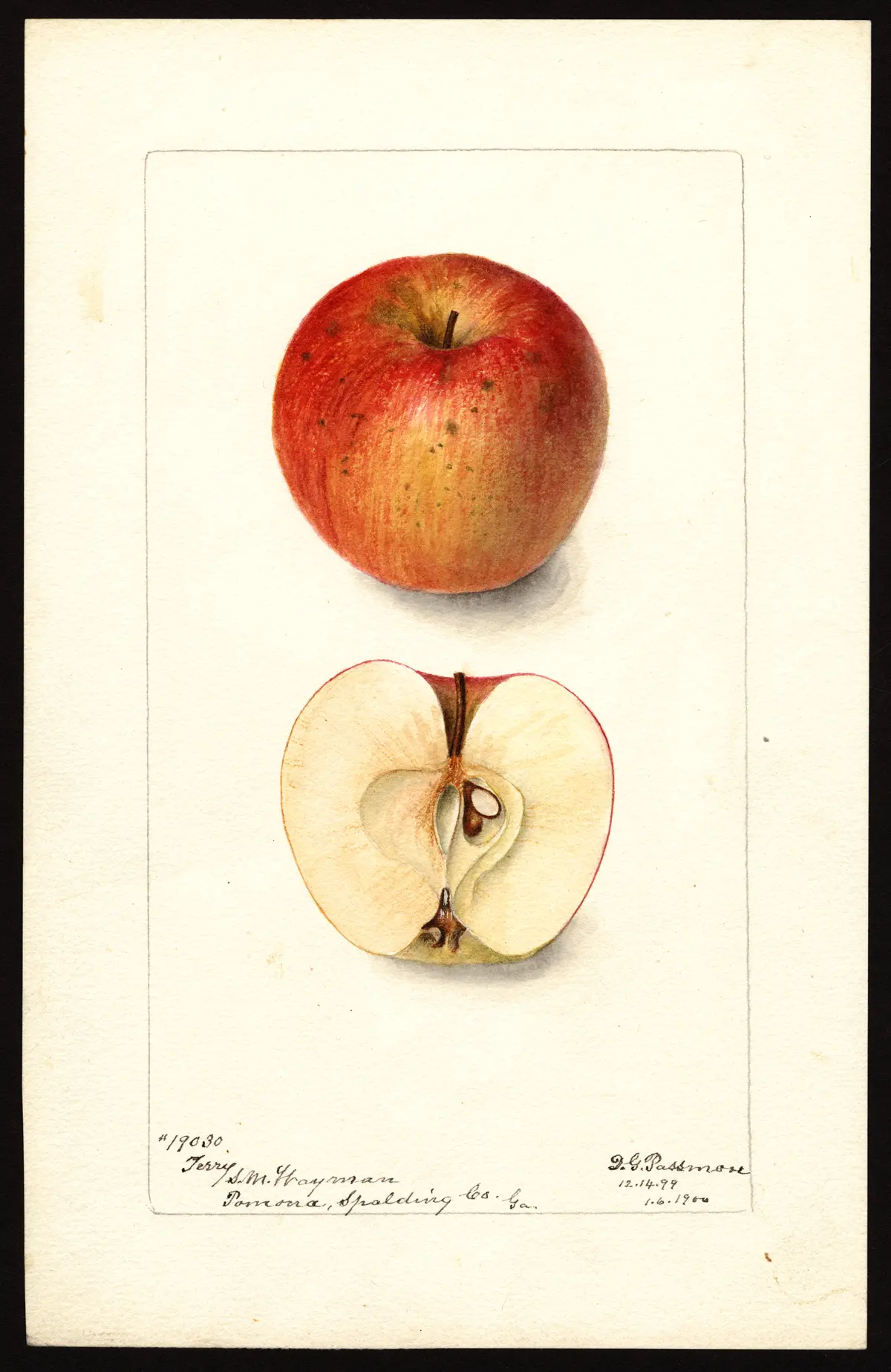
USDA Pomological Watercolor Collection
Terry
Origin/History
Terry originated in Clayton County, Georgia, approximately twenty-five miles south of Atlanta. The exact date and precise circumstances of origin are unrecorded. Hedrick (1922) notes it is "an old sort that seems to be losing in popularity," despite being very generally recommended for the cotton-belt of the South, usually with the advice that it be more largely planted. Prof. H. N. Starnes of the Georgia Experiment Station reported it valuable for the South owing to its very late keeping, good quality, and extreme productiveness; its noted faults are its want of size — produced by its tendency to overbear — and its too firm texture in early winter.
Tree
Tree moderately vigorous, of rather slender open growth, with abundant healthy foliage. An early and heavy annual bearer.
Fruit
Size and Form
Sources conflict on size: Budd & Hansen describe the fruit as medium or below; Lowther describes it as small; Hedrick (citing catalog descriptions) as medium. Form roundish conical (Lowther) or oblate, regular (Budd & Hansen).
Stem
Stem medium.
Cavity
Cavity regular, obtuse, often russeted.
Calyx
Calyx closed; segments flat, convergent.
Basin
Basin smooth, wide, shallow or medium depth.
Skin
Surface a clear light yellow, mostly covered with fine dark red, with carmine splashes and stripes. Hedrick's catalog sources describe the ground color as pale yellow overspread with rich red and russet. Dots distinct, many, minute, yellow; some large russet dots also present.
Flesh and Flavor
Flesh yellow, fine-grained, firm, juicy, mild, pleasant, saccharine, subacid; quality very good.
Core and Seeds
Core closed; cells ovate, axile; tube funnel-shaped; stamens marginal; seeds few, short, plump.
Season
Budd & Hansen place the season in late winter and spring, with keeping quality extending even to July. Hedrick's catalog sources give November through March. Lowther describes the season as early autumn — this conflicts substantially with the other sources and with the variety's well-attested character as a long-keeping winter apple; Lowther's entry may refer to harvest time rather than eating season, or may reflect an error.
Uses
Market. Particularly valued in the South for late keeping and good quality.
Subtypes/Variants
Not described in source.
Other
Not described in source.
Book Sources
Described in 3 period pomological works
Nursery Catalog Sources
Found in 2 catalogs (1901–1913) from Illinois
- Benjamin Buckman (personal inventory) , Farmingdale , Illinois — 1901
- Benjamin Buckman (personal inventory) , Farmingdale , Illinois — 1913
View original book sources (3)
— Granville Lowther (ed.), Encyclopedia of Practical Horticulture (1914)Terry (also known as T. Winter). Size: small. Form: roundish conical. Color: yellow-red. Quality: good. Use: market. Season: early autumn.
— J.L. Budd & N.E. Hansen, American Horticultural Manual, Part II: Systematic Pomology (1914)Terry Winter. — Origin, Clayton Co., Georgia, some twenty-five miles south of Atlanta; tree moderately vigorous, of rather slender open growth, with abundant healthy foliage; an early and heavy annual bearer. Prof. H. N. Starnes, of Georgia Experiment Station, reports it valuable for the South, owing to its very late keeping, good quality, and extreme productiveness; its faults are its want of size, produced by its tendency to overbear, and its too firm texture in early winter.
Fruit medium or below, oblate, regular; surface a clear light yellow, mostly covered with fine dark red, with carmine splashes and stripes; dots distinct, many, minute, yellow, some large russet dots; cavity regular, obtuse, often russeted; stem medium; basin smooth, wide, shallow or medium depth; calyx closed; segments flat convergent. Core closed; cells ovate, axile; tube funnel-shaped; stamens marginal; seeds few, short, plump; flesh yellow, fine-grained, firm, juicy, mild, pleasant, saccharine, subacid, very good. Late winter and spring, even keeping till July.
— U.P. Hedrick, Cyclopedia of Hardy Fruits (1922)TERRY.
Terry Winter.
Terry is very generally recommended for the cotton-belt of the South, usually with the advice that it be more largely planted. It is, however, an old sort that seems to be losing in popularity. The qualities that particularly recommend it for the South are that the crop ripens late and keeps well. Terry is said to have originated in Georgia a good many years ago, but when or where does not appear; neither are there full descriptions of the variety. Catalogs describe the fruits as of medium size, pale yellow overspread with rich red and russet; the quality is said to be good; the season is from November until March.