Texas
Apple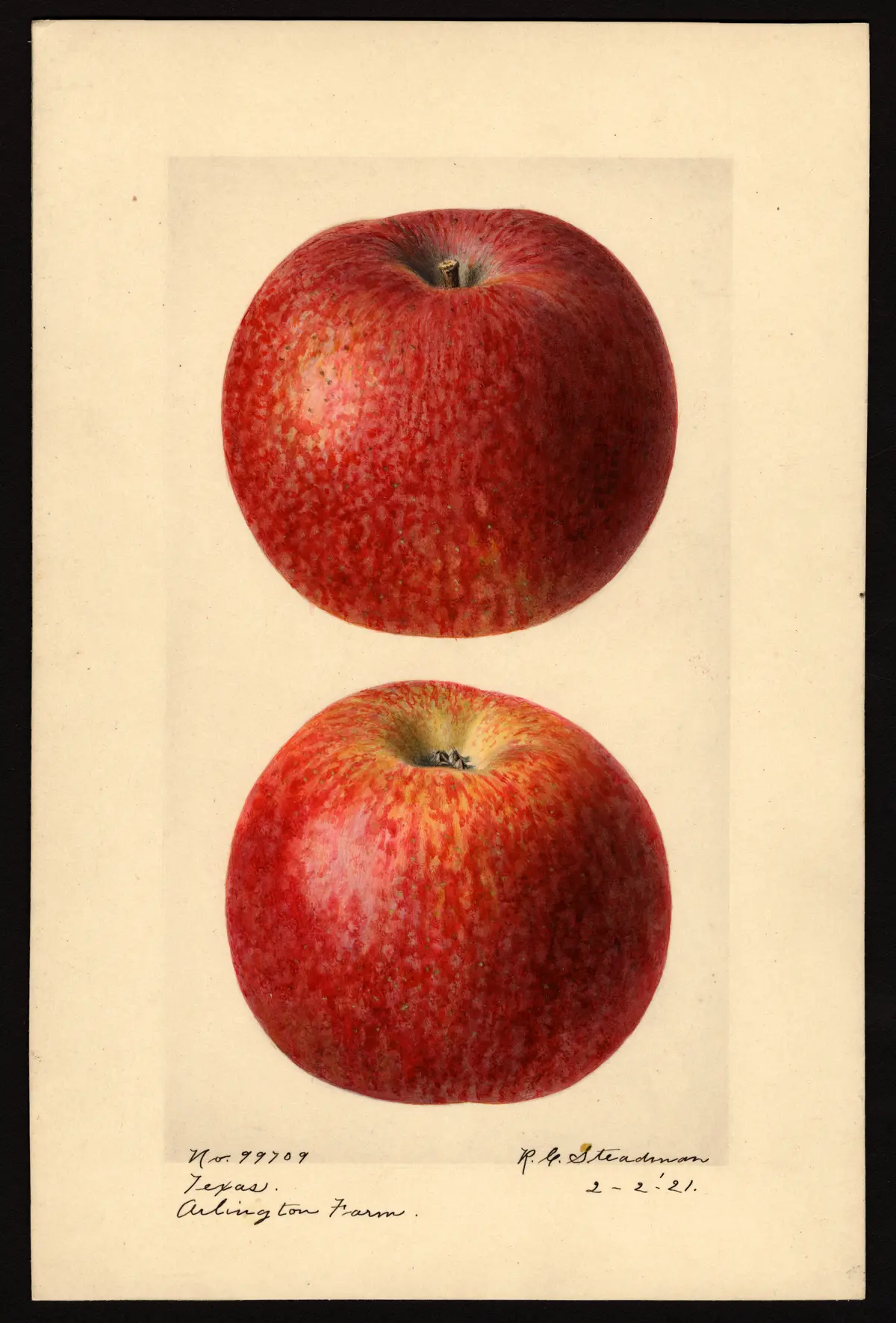
USDA Pomological Watercolor Collection
Origin/History
Received from Benjamin Buckman, Farmingdale, Illinois, in 1880, for testing at the New York State Agricultural Experiment Station. A late-keeping southern apple that has been propagated by some southern nurserymen. Practically unknown among New York fruit growers.
Tree
Rather vigorous. Form roundish or somewhat spreading, rather dense. Twigs moderately long, slender, straight or slightly curved; internodes medium to long. Bark rather clear brownish-red mingled with olive-green, slightly streaked with grayish scarf-skin; somewhat pubescent. Lenticels moderately numerous, conspicuous, medium to large, elongated, raised. Buds below medium to large, rather prominent, plump, acute, free or nearly so, somewhat pubescent.
Fruit
Size and Form
Medium in size. Form slightly oblate to roundish or roundish conic, somewhat ribbed; pretty uniform in size and shape.
Stem
Medium to long.
Cavity
Acute to acuminate, rather narrow to moderately wide, moderately shallow to deep, usually partly russeted.
Calyx
Small, closed or slightly open.
Basin
Very shallow, rather narrow, wrinkled.
Skin
Smooth, clear light yellow, largely washed with faint red splashed and striped with carmine, in highly colored specimens becoming deep red on the exposed cheek; streaks of whitish scarf-skin are conspicuous over the base. Dots whitish or pale russet, especially numerous toward the basin.
Calyx Tube and Stamens
Calyx tube long, funnel-form. Stamens basal or nearly so.
Core and Seeds
Core medium, axile or nearly so; cells closed or partly open; core lines clasping the funnel cylinder. Seeds large to very large, long, rather flat, acute, dark, often tufted. Carpels broadly roundish inclined to roundish cordate.
Flesh and Flavor
Yellowish, sometimes tinged with red, firm, crisp, moderately juicy, breaking, mild subacid eventually becoming nearly sweet, good in quality and flavor.
Season
At Geneva, January to May or June.
Uses and Storage
Only moderately attractive in general appearance, mildly subacid, good in flavor and quality. Usually a considerable portion of the crop may be held in good condition in cellar storage till early summer. The tree is a good grower, comes into bearing young, is a reliable cropper and productive. Not recommended for planting in New York.
Subtypes/Variants
Not described in source.
Other
Not described in source.
Book Sources
Described in 1 period pomological work
Nursery Catalog Sources
Found in 2 catalogs (1901–1913) from Illinois
- Benjamin Buckman (personal inventory) , Farmingdale , Illinois — 1901 — listed as Pride of Texas
- Benjamin Buckman (personal inventory) , Farmingdale , Illinois — 1913 — listed as Pride of Texas
View original book sources (1)
— S.A. Beach, The Apples of New York, Vol. 1 (1905)TEXAS.
REFERENCES. 1. Churchill, N. Y. Sta. An. Rpt., 8:355. 1889. 2. Bailey, An. Hort., 1892:247. 3. Beach, Paddock and Close, N. Y. Sta. An. Rpt., 15:274. 1896. 4. Powell and Fulton, U. S. B. P. I. Bul., 48:58. 1903. 5. Beach and Clark, N. Y. Sta. Bul., 248:146. 1904. 6. Ragan, U. S. B. P. I. Bul., 56:242, 309. 1905.
SYNONYM. PRIDE OF TEXAS (1, 2, 3). Pride of Texas (4, 5, 6).
A late-keeping southern apple (1, 2, 3, 6). As fruited at this Station it is only moderately attractive in general appearance, medium in size, yellow, shaded and striped with red, mildly subacid, good in flavor and quality. Usually a considerable portion of the crop may be held in good condition in cellar storage till early summer (3, 5). The tree is a good grower, comes into bearing young, is a reliable cropper and productive. Not recommended for planting in New York.
Historical. Received from Benjamin Buckman, Farmingdale, Illinois, in 1880, for testing here (1). It has been propagated by some southern nurserymen (2, 6). It is practically unknown among New York fruit growers.
TREE.
Tree rather vigorous. Form roundish or somewhat spreading, rather dense. Twigs moderately long, slender, straight or slightly curved; internodes medium to long. Bark rather clear brownish-red mingled with olive-green, slightly streaked with grayish scarf-skin; somewhat pubescent. Lenticels moderately numerous, conspicuous, medium to large, elongated, raised. Buds below medium to large, rather prominent, plump, acute, free or nearly so, somewhat pubescent.
FRUIT.
Fruit medium in size. Form slightly oblate to roundish or roundish conic, somewhat ribbed; pretty uniform in size and shape. Stem medium to long. Cavity acute to acuminate, rather narrow to moderately wide, moderately shallow to deep, usually partly russeted. Calyx small, closed or slightly open. Basin very shallow, rather narrow, wrinkled.
Skin smooth, clear light yellow, largely washed with faint red splashed and striped with carmine, in highly colored specimens becoming deep red on the exposed cheek; streaks of whitish scarf-skin are conspicuous over the base. Dots whitish or pale russet, especially numerous toward the basin.
Calyx tube long, funnel-form. Stamens basal or nearly so.
Core medium, axile or nearly so; cells closed or partly open; core lines clasping the funnel cylinder. Seeds large to very large, long, rather flat, acute, dark, often tufted. Carpels broadly roundish inclined to roundish cordate.
Flesh yellowish, sometimes tinged with red, firm, crisp, moderately juicy, breaking, mild subacid eventually becoming nearly sweet, good in quality and flavor.
Season at Geneva, January to May or June.