Theodore Van Mons
Pear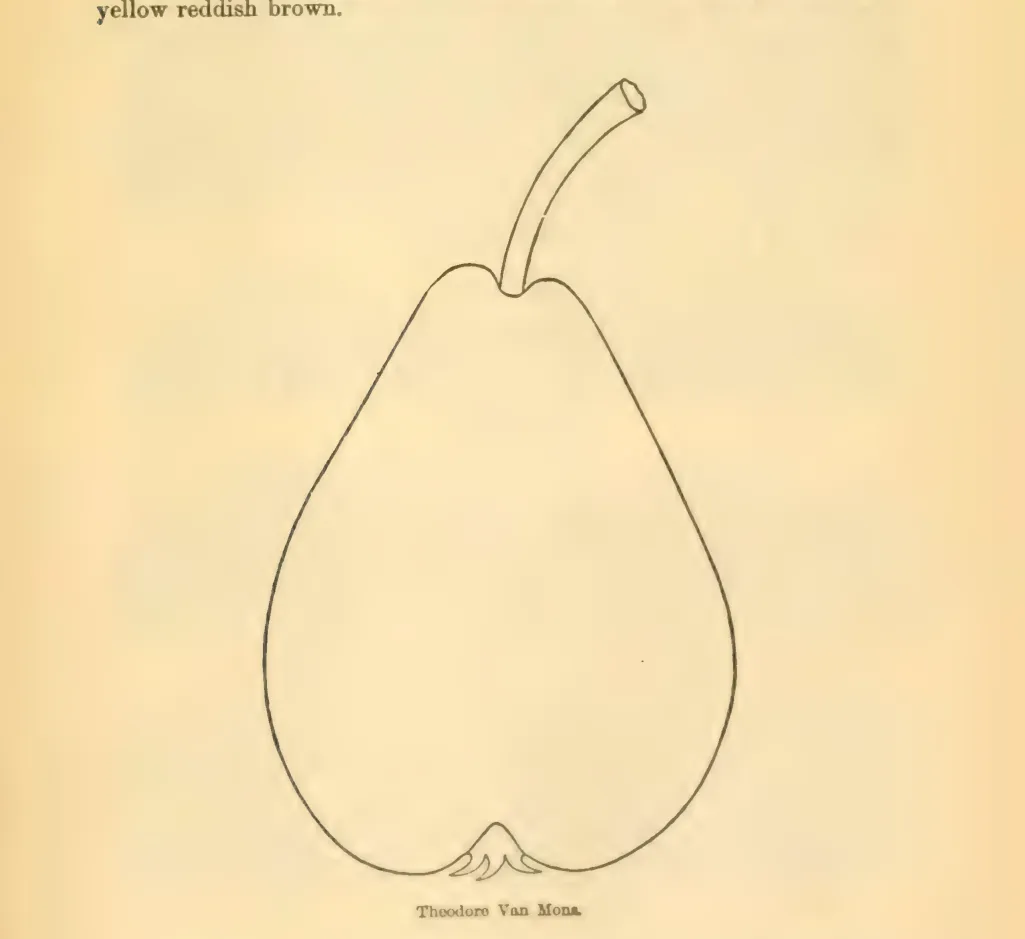
Origin/History
A Belgian pear, supposed one of Van Mons' seedlings, originated about 1827 but was not brought to notice until about 1843 (Downing). Hedrick dates the origin to 1827 as well.
Tree
Vigorous, upright grower, quite productive (Downing). Hedrick describes the tree as vigorous, pyramidal, and productive. Thomas notes the tree is vigorous and productive on both pear and quince. Young wood is light yellow reddish brown (Downing).
Fruit
Size: Medium or above (Downing, Hedrick). Thomas describes it as rather large.
Form: Oblong pyriform (Downing). Hedrick gives obovate-pyriform to oblong-pyriform. Elliott describes it as obovate pyriform. Thomas gives obovate-pyriform, sometimes long pyriform.
Skin: Greenish or pale yellow, with traces and patches of russet, and many gray and green dots (Downing). Hedrick describes it as greenish-yellow, russeted, with gray-green dots, numerous. Elliott gives yellow with russet spots. Thomas describes it as greenish yellow, somewhat russeted.
Stem: Curved (Downing, Hedrick). Hedrick specifies about an inch long. Elliott describes the stem as long, with little or no depression. Thomas gives the stalk as an inch long, scarcely sunk.
Cavity: Slight, russeted (Downing). Hedrick notes the cavity as slight.
Calyx: Open, with short segments (Downing). Hedrick gives open. Elliott describes it as large, open, with broad segments. Thomas gives large, open.
Basin: Not described in source.
Flesh/Flavor: Whitish, rather coarse, juicy, melting, vinous; good to very good (Downing). Hedrick gives yellowish-white, rather coarse, juicy, melting, vinous; good to very good. Elliott describes the flesh as whitish, melting, and rated "very good" on quince. Thomas describes the flesh as granular, juicy, melting, varying from good to very good.
Core/Seeds: Not described in source.
Season
September and October (Downing, Hedrick, Thomas). Elliott gives November.
Uses
Elliott notes it is "very good" on quince. Thomas confirms it performs well on both pear and quince stock.
Subtypes/Variants
Not described in source.
Other
Thomas references Fig. 706 as an illustration. Hedrick cites Am. Pom. Soc. Rpt. 164, 234 (1854) and Ann. Pom. Belge 4:29, fig. (1856).
Book Sources
Described in 4 period pomological works
View original book sources (4)
— A.J. Downing, The Fruits and Fruit Trees of America (1900)Theodore Van Mons.
This Belgian Pear, supposed one of Van Mons' seedlings, originated about 1827, but was not brought to notice until about 1843. The tree is a vigorous, upright grower, quite productive. The young wood light yellow reddish brown.
Fruit medium or above, oblong pyriform. Skin greenish or pale yellow, with traces and patches of russet, and many gray and green dots. Stalk curved. Cavity slight, russeted. Calyx open. Segments short. Flesh whitish, rather coarse, juicy, melting, vinous. Good to very good. September, October.
— U.P. Hedrick, The Pears of New York (1921)Theodore Van Mons.
- Am. Pom. Soc. Rpt. 164, 234. 1854. 2. Ann. Pom. Belge 4:29, fig. 1856.
Originated by Van Mons in 1827. Tree vigorous, pyramidal, productive. Fruit medium to above, obovate-pyriform to oblong-pyriform, greenish-yellow, russeted; dots gray-green, numerous; stem curved, about an inch long; cavity slight; calyx open; flesh yellowish-white, rather coarse, juicy, melting, vinous; good to very good; Sept. and Oct.
— F.R. Elliott, The Western Fruit Book (1865)Theodore Van Mons. Foreign. Fruit, medium, obovate pyriform, yellow, with russet spots ; stem, long, little or no depression ; calyx, large, open, broad segments ; flesh, whitish, melting ; "very good" on Quince. November.
— John J. Thomas, The American Fruit Culturist (1903)Theodore Van Mons. Rather large, obovate-pyriform, sometimes long pyriform; greenish yellow, somewhat russeted; stalk an inch long, scarcely sunk; calyx large, open; flesh granular, juicy, melting, varying from good to very good. September, October. Tree vigorous and productive on pear or quince. Fig. 706.