Thurston's Red
Pear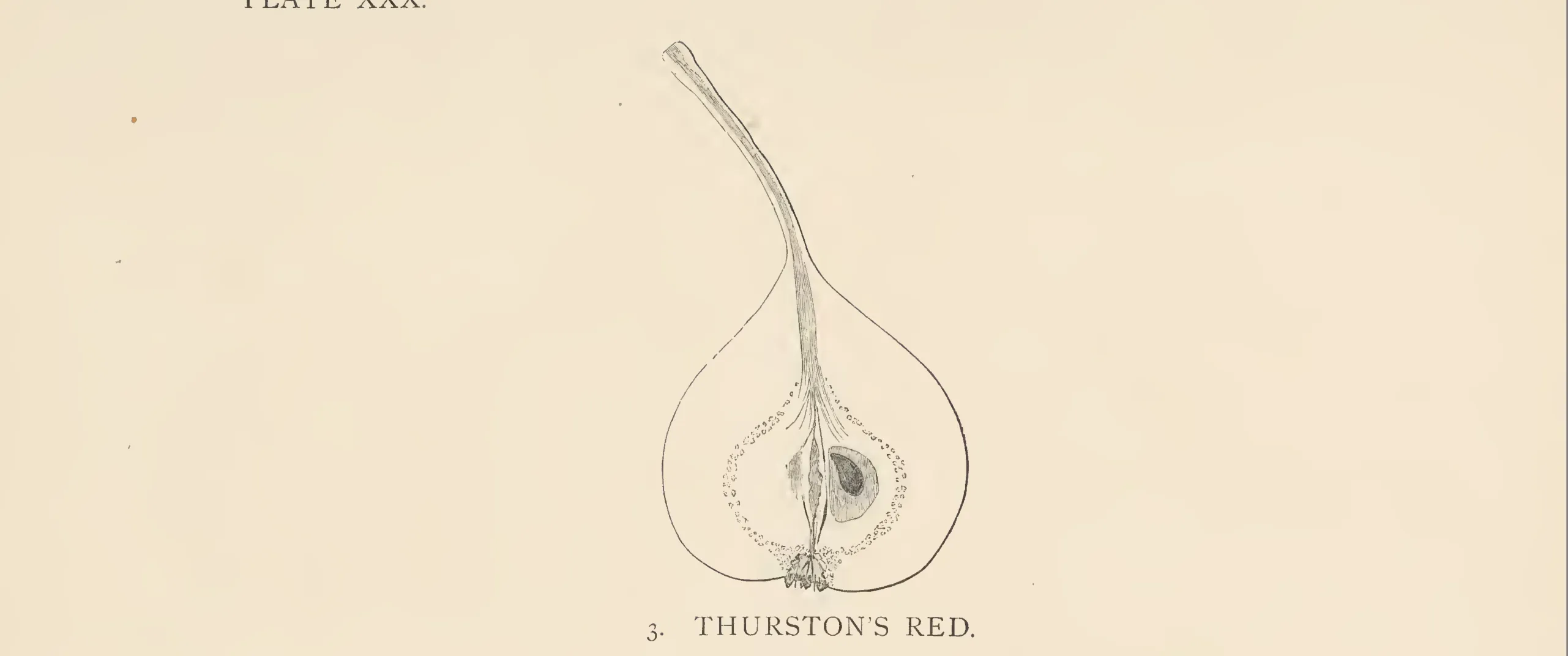
Thurston's Red
Origin / History
Thurston's Red is an ancient perry pear of Herefordshire origin, believed to have originated at the Whitehouse estate in the parish of Dymock, Gloucestershire — long the seat of the Thurston family. Mr. William Thurston, a 19th-century occupant, reported that his father told him Mr. John Hiatt, formerly of Merrables Farm, Dymock, a noted fruit grower of his day, had grafted young stocks from the Whitehouse trees. Some eight or nine trees at the Whitehouse had already died of old age at the time of the Herefordshire Pomona's writing (1885), establishing the variety as ancient, though it has no documented written history prior to that publication, in which it was described and figured for the first time. Hogg (1884) characterizes it as "a new Herefordshire perry pear of some repute."
The Whitehouse at Dymock is also credited as the birthplace of John Kyrle, the Man of Ross; Pauntley Court, one of the centers of Thurston's Red cultivation, was long associated with the Whittington family, ancestors of Richard Whittington, thrice Lord Mayor of London. The variety is now known under the synonym Dymock Red.
Tree
Hardy, with a nice upright growth habit. Bears well. Cultivated extensively at Pauntley in Gloucestershire, Newent, and the surrounding district.
Fruit
Size: Small.
Form: Turbinate, even in outline, though often fuller on one side than the other (Herefordshire Pomona).
Stem: Slender, an inch and a quarter long. Set on the point of the fruit without depression; cavity none.
Calyx / Eye: Small and open.
Basin: Saucer-like.
Skin: Smooth. Greenish yellow with a thin red cheek on the side next the sun. Often has a large patch of thin pale-brown russet, especially around the eye (calyx end), and a few spots here and there over the surface.
Flesh / Flavor: Flesh yellowish (Herefordshire Pomona) or yellow (Hedrick/Hogg), and firm. Juice thin, deep straw colour, sweetish with an astringent aromatic flavour. Mr. With's chemical analysis of the juice (season 1880) is as follows:
| Measurement | Value |
|---|---|
| Density of fresh juice | 1.035 |
| Density after 24 hours' exposure to air | 1.036 |
| Sugar (per 100 parts by weight) | 9.20 |
| Tannin, Mucilage, Salts, &c. | 2.84 |
| Water | 87.96 |
This analysis was judged unfavorable by the Herefordshire Pomona's editors, who noted the juice to be thin and poor, not bearing out the favorable character which many growers seemed disposed to give it.
Core / Seeds: Not described in source.
Season
Not described in source.
Uses
A perry pear. The fruit clings to the tree and keeps well, making it useful for this quality despite the thin juice. It is, however, a very local variety.
Subtypes / Variants
Not described in source.
Other
Not described in source.
Book Sources
Described in 2 period pomological works
View original book sources (2)
— Woolhope Naturalists Field Club, The Herefordshire Pomona (1885)THURSTON'S RED.
[Syn: Dymock Red.]
The old family of the Thurstons held the estate of the Whitehouse, in the parish of Dymock, for several generations. Mr. Wm. Thurston now lives there, and has several fine trees of Thurston Red Pear. He was told by his father that Mr. John Hiatt, formerly of Merrables Farm, Dymock, a great fruit grower in his day, had grafted the young stocks there from the Whitehouse trees. This Whitehouse has the credit of being the birthplace of John Kyrle, the Man of Ross. It is believed also to be the place in which the Pear that bears the family name of Thurston originated. Some eight or nine trees have died there from old age; so the variety is ancient though it has no history. It is now described and figured for the first time.
Description.—Fruit: small, turbinate, even in its outline, but often fuller on one side than the other. Skin: smooth, greenish yellow with a thin red cheek on the side next the sun; has often a large patch of thin pale brown russet, especially round the eye, and a few spots here and there over the surface. Eye: small and open, set in a saucer-like basin. Stalk: slender, an inch and a quarter long, set on the point of the fruit without depression. Flesh: yellowish and firm. Juice: thin, deep straw colour, sweetish with an astringent aromatic flavour.
Mr. With's analysis of the Thurston's Red Pear (season 1880), is as follows:—
Density of fresh juice ... ... ... ... 1·035 Ditto after 24 hours exposure to air ... ... 1·036 One hundred parts by weight of the juice contains:— Sugar ... ... ... ... ... 9·20 Tannin, Mucilage, Salts, &c. ... ... ... 2·84 Water ... ... ... ... ... 87·96
This analysis is not favourable. It proves the juice to be thin and poor, and thus does not bear out the favourable character which many growers seem disposed to give it. The fruit clings to the tree, and keeps well, and hence is very useful for this quality. It is however a very local variety.
The tree is hardy with a nice upright growth and bears well. It is cultivated extensively at Pauntley in Gloucestershire, Newent, and the surrounding district. Pauntley Court was long in the possession of the Whittingtons, from whom came the celebrated Richard, thrice Lord Mayor of London—thus Thurstons Red Pear would seem to affect places of note.
— U.P. Hedrick, The Pears of New York (1921)Thurston Red.
- Hogg Fruit Man. 655. 1884.
Hogg says, "a new Herefordshire perry pear of some repute." Fruit small, turbinate, even in outline, greenish-yellow, with a thin red cheek and a large patch of thin, pale-brown russet, especially around the calyx; calyx small and open; stem an inch and a quarter long, slender; cavity none; flesh yellow.