Tinmouth
Apple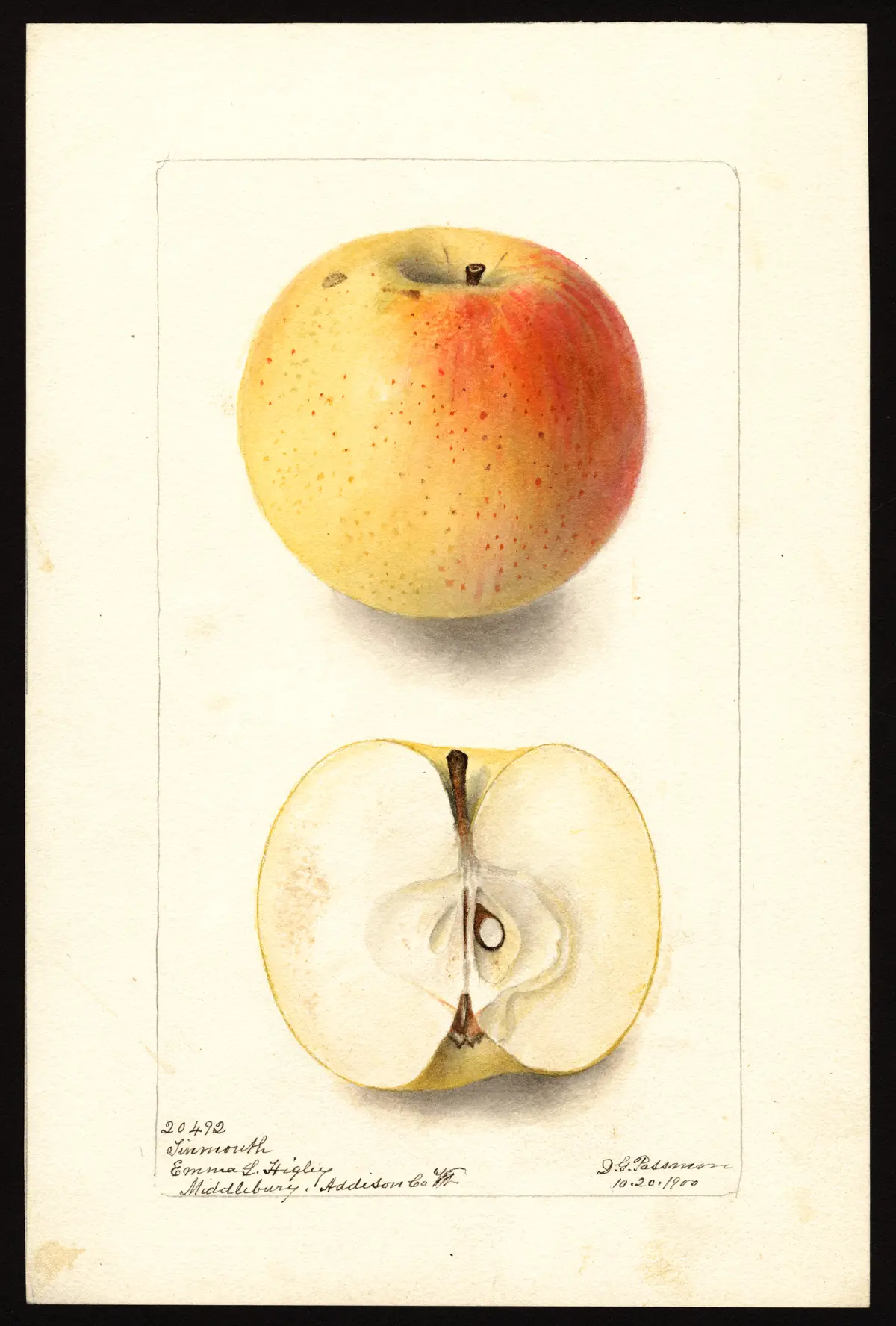
USDA Pomological Watercolor Collection
Tinmouth
Origin/History
Tinmouth originated at Tinmouth, Vermont. Downing notes that this fine apple is much esteemed in the region of its origin. Waugh calls it a good apple and states that it is almost unknown in Grand Isle county but is much more common in other parts of Vermont. Beach reports that, so far as has been discovered, it is but little known in New York, and does not seem to be desirable for general commercial planting there.
Tree
The tree is a good grower and productive (Elliott, Downing); Downing further calls it very productive and a profitable sort. Beach describes it as a good grower with an upright habit, a regular cropper, and very productive. Young shoots are dull brownish red, slightly downy (Downing).
Fruit
Size: Above medium (Elliott, Downing); medium to large (Beach); medium (Lowther). Beach characterizes it overall as an apple of good size.
Form: Oblate (Elliott, Downing); oblate to roundish, regular or obscurely ribbed, sides often distinctly unequal (Beach); flat (Lowther).
Stem: Short, inserted in a deep cavity (Elliott, Downing — Downing uses "stalk"). Beach describes the stem as often bracted, short to medium, usually not exserted.
Cavity: Deep (Elliott, Downing). Beach describes it as large, acute or approaching acuminate, deep, broad, russeted and with outspreading russet rays.
Calyx: Partially closed (Elliott, Downing). Beach describes the calyx as small, partly closed or open, with lobes often small, sometimes long, acute, recurved. The calyx tube is rather small, cone-shape or approaching funnel-form; stamens median (Beach).
Basin: Rather large (Elliott); deep and open (Downing); rather large, deep, moderately wide, abrupt to moderately abrupt, often somewhat wrinkled (Beach).
Skin: Whitish yellow, considerably shaded with carmine, and sprinkled with a few brown dots (Elliott, Downing). Beach describes the skin as tender, pale yellow or greenish, often with a bright deep blush and overspread with thin bloom; dots numerous, greenish or russet, giving the surface a somewhat rough appearance; prevailing effect yellow. Lowther gives the color as green-red.
Flesh/Flavor: Whitish, juicy, tender, pleasant, mild sub-acid (Elliott). Downing adds a peculiar melon-like aroma and rates it good to very good. Beach describes the flesh as whitish tinged with yellow, moderately fine, tender, rather juicy, mild subacid with a peculiar flavor, sprightly, good in quality. Lowther rates the quality very good.
Core/Seeds: Core rather small, axile or nearly so; cells closed; core lines clasping. Carpels roundish to obcordate, emarginate, mucronate. Seeds rather large, broad, somewhat obtuse (Beach).
Season
November to February (Elliott, Downing). Beach gives the season as October to early winter or midwinter. Lowther gives it as winter. Beach characterizes Tinmouth overall as a fall and early winter apple.
Uses
Family (Lowther). Downing calls it a profitable sort; Beach notes it does not seem desirable for general commercial planting in New York.
Subtypes/Variants
Not described in source.
Other
Not described in source.
Book Sources
Described in 5 period pomological works
Nursery Catalog Sources
Found in 2 catalogs (1901–1913) from Illinois
- Benjamin Buckman (personal inventory) , Farmingdale , Illinois — 1901
- Benjamin Buckman (personal inventory) , Farmingdale , Illinois — 1913
View original book sources (5)
— F.R. Elliott, The Western Fruit Book (1865)Tinmouth.
Origin, Tinmouth, Vt. Tree, a good grower and productive. Fruit, above medium, oblate ; skin, whitish yellow, considerably shaded with carmine, and sprinkled with a few brown dots ; stem, short, inserted in a deep cavity ; calyx, partially closed, set in a rather large basin : flesh, whitish, juicy, tender, pleasant, mild sub-acid. November to February.
— A.J. Downing, The Fruits and Fruit Trees of America (1900)Tinmouth. Teignmouth. Vermont Pippin. Origin, Tinmouth, Vt. This fine Apple is much esteemed in the region of its origin. The tree is a good grower, very productive, and a profitable sort. Young shoots dull brownish red, slightly downy. Fruit above medium, oblate, whitish yellow, considerably shaded with carmine, and sprinkled with a few brown dots. Stalk short, inserted in a deep cavity. Calyx partially closed, set in a deep open basin. Flesh whitish, juicy, tender, pleasant, mild subacid, with a peculiar melon-like aroma. Good to very good. November to February.
— John J. Thomas, The American Fruit Culturist (1903)Vermont Pippin. See Tinmouth.
— S.A. Beach, The Apples of New York, Vol. 2 (1905)TINMOUTH.
REFERENCES. 1. Downing, 1857:197. 2. Am. Pom. Soc. Cat., 1862. 3. Downing, Horticulturist, 19:145. 1864. figs. 4. Warder, 1867:734. 5. Downing, 1869:383. 6. Thomas, 1875:514. 7. Taylor, Am. Pom. Soc. Rpt., 1895:193. 8. Burrill and McCluer, Ill. Sta. Bul., 45:343. 1896. 9. Waugh, Vt. Sta. An. Rpt., 14:310. 1901.
SYNONYMS. TEIGNMOUTH (3). Teignmouth (5, 6). TINMOUTH (1, 2, 4, 5, 6, 7, 8, 9). Tinmouth Sweet (8). Vermont Pippin (3, 5).
Tinmouth is a fall and early winter apple of good size, good quality and rather attractive appearance. The tree is a good grower, with an upright habit. It is a regular cropper and very productive. It does not seem to be desirable for general commercial planting in New York.
Historical. Downing remarked that this variety originated at Tinmouth, Vt., and was much esteemed in the region of its origin (5). Waugh calls it a good apple and states that it is almost unknown in Grand Isle county but is much more common in other parts of Vermont (9). So far as we have discovered it is but little known in New York.
FRUIT.
Fruit medium to large. Form oblate to roundish, regular or obscurely ribbed; sides often distinctly unequal. Stem often bracted, short to medium, usually not exserted. Cavity large, acute or approaching acuminate, deep, broad, russeted and with outspreading russet rays. Calyx small, partly closed or open; lobes often small, sometimes long, acute, recurved. Basin rather large, deep, moderately wide, abrupt to moderately abrupt, often somewhat wrinkled. Skin tender, pale yellow or greenish, often with a bright deep blush and overspread with thin bloom. Dots numerous, greenish or russet, giving the surface a somewhat rough appearance. Prevailing effect yellow.
Calyx tube rather small, cone-shape or approaching funnel-form. Stamens median. Core rather small, axile or nearly so; cells closed; core lines clasping. Carpels roundish to obcordate, emarginate, mucronate. Seeds rather large, broad, somewhat obtuse. Flesh whitish tinged with yellow, moderately fine, tender, rather juicy, mild subacid with a peculiar flavor, sprightly, good in quality.
Season October to early winter or midwinter.
— Granville Lowther (ed.), Encyclopedia of Practical Horticulture (1914)Tinmouth. Size: medium. Form: flat. Color: green-red. Quality: very good. Use: family. Season: winter.