Tom Putt
Apple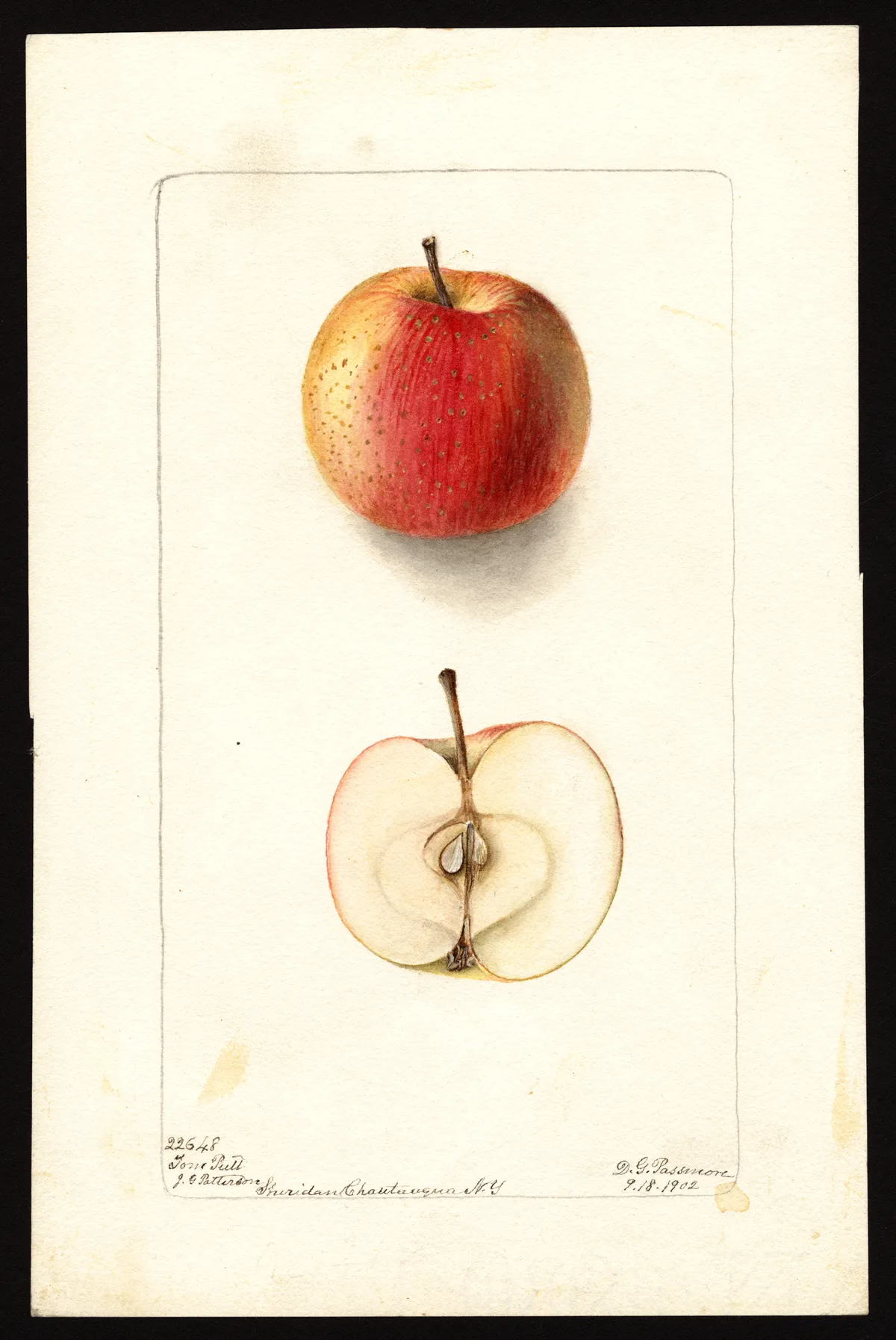
USDA Pomological Watercolor Collection
Tom Putt
Origin / History
Tom Putt is an old English variety. According to Bunyard, it was raised by the Rev. Tom Putt, Rector of Trent, Somerset, at the end of the eighteenth century, and became a great favourite in the Western counties. The Herefordshire Pomona reports that the origin of this well-known apple — called "Tom Putt" in Herefordshire and "Tom Potter" in Devonshire — has been lost, and notes that it is very generally cultivated in both counties. Downing describes it (under "Tom Potter") as a Devonshire, England apple, described by Ronalds. Beach lists it as an old English variety, with references to the London Horticultural Society Catalogue of 1831 (No. 1299) and Hogg (1884:229); in 1892 it was received for testing at the New York Agricultural Experiment Station from W. and T. Smith of Geneva, New York. Bunyard adds a critical historical note: "The fruit described by Hogg is not, I think, the true variety."
Tree
The tree is vigorous (Herefordshire Pomona) / robust in growth (Bunyard) / a moderately vigorous grower (Beach) / healthy (Downing). Bearing habit is reported differently by source and locality: in Herefordshire (as "Tom Putt") it is very prolific and an annual bearer (Herefordshire Pomona); Beach reports it comes into bearing rather early and yields full crops annually or nearly annually; Bunyard rates fertility as fair. By contrast, in Devonshire (as "Tom Potter") Ronalds speaks of it as "uncertain in bearing" (Herefordshire Pomona), and Downing likewise calls it an "uncertain bearer."
Leaf (Bunyard)
Broad, round, upfolded, sharply crenate or serrate, very large.
Fruit
Size
About three inches wide and two and a quarter inches high (Herefordshire Pomona). Medium, 3 by 2½ (Bunyard). Medium (Downing). Good size (Beach). Medium size (Veitch).
Form
Roundish ovate, ribbed on the sides and terminated abruptly towards the eye in a narrow puckered apex (Herefordshire Pomona). Round conical, much ribbed around eye (Bunyard). Roundish oblate conical (Downing). Broad (Veitch).
Stem / Stalk and Cavity
Stalk from a quarter to half an inch long, set in an uneven funnel-shaped cavity which is slightly russetty (Herefordshire Pomona). Stem short and stout, in a medium russet cavity (Bunyard).
Eye / Calyx and Basin
Eye set in a narrow puckered basin; segments connivent; tube funnel-shaped; stamens median inclining to marginal (Herefordshire Pomona). Eye closed, in a medium much ribbed basin (Bunyard).
Skin / Colour
Skin smooth and shining, almost entirely covered with broken stripes and mottled blotches of deep bright crimson which becomes paler towards the shaded side, where the colour is lemon yellow (Herefordshire Pomona). Covered with red flush, broad blotches and stripes (Bunyard). Yellow, shaded and striped with red in the sun (Downing). A rather attractive red apple (Beach). An excellent fruit coloured variety (Veitch).
Flesh and Flavour
White, very tender, sweet and with a pleasant acidity (Herefordshire Pomona). Crisp, acid, greenish white, cooking excellently (Bunyard). Juicy, high-flavored (Downing). Moderately coarse, subacid (Beach). The Herefordshire Pomona adds that it is juicy and high flavoured, and that when ripe it exudes a pleasant and powerful fragrance and has usually a beautiful colour.
Core / Seeds
Cells of the core all quite open (Herefordshire Pomona). Otherwise not described in source.
Season
September till November (Herefordshire Pomona). September to November (Bunyard). September, October (Downing). September and October (Veitch).
Uses
An excellent culinary apple (Herefordshire Pomona). Culinary (Bunyard), cooking excellently. Fair to good for culinary uses (Beach). In Herefordshire cottage gardens it is perhaps an equal favourite with the Blenheim Orange, and it certainly bears more regularly (Herefordshire Pomona). Beach judged that, as compared with standard varieties of its season, it does not appear to be worthy of the attention of New York fruit growers.
Subtypes / Variants
Not described in source.
Other
Not described in source.
Book Sources
Described in 4 period pomological works
Nursery Catalog Sources
Found in 3 catalogs (1897–1911) from England
- Kelway & Son , Langport, Somerset , England — 1897
- Central Experimental Farm , Dominion Department of Agriculture, Agassiz, British Columbia (under test; Bulletin No. 3, Second Series) — 1900
- James Veitch & Sons , Ltd., Royal Exotic Nursery, Chelsea, London (also Coombe Wood, Langley, and Feltham) , England — 1911
View original book sources (5)
— Woolhope Naturalists Field Club, The Herefordshire Pomona (1885)
- TOM PUTT. [Syn: Tom Potter.]
The origin of this well-known apple, "Tom Putt" in Herefordshire and "Tom Potter" in Devonshire, has been lost. It is very generally cultivated in both counties.
Description.—Fruit; about three inches wide and two and a quarter inches high; roundish ovate, ribbed on the sides and terminated abruptly towards the eye in a narrow puckered apex. Skin; smooth and shining, almost entirely covered with broken stripes and mottled blotches of deep bright crimson which becomes paler towards the shaded side, where the colour is lemon yellow. Eye; set in a narrow puckered basin; segments connivent; tube funnel-shaped; stamens median inclining to marginal. Stalk; from a quarter to half an inch long, set in an uneven funnel-shaped cavity which is slightly russetty. Flesh; white, very tender, sweet and with a pleasant acidity. Cells of the core all quite open.
An excellent culinary apple, juicy and high flavoured, when ripe it exudes a pleasant and powerful fragrance and has usually a beautiful colour. The tree is vigorous, and as "Tom Putt" in Herefordshire is very prolific and an annual bearer, but as "Tom Potter" in Devonshire, Ronalds speaks of it as "uncertain in bearing." In Herefordshire cottage gardens it is perhaps an equal favourite with the Blenheim Orange, and it certainly bears more regularly. It is in season from September till November.
— A.J. Downing, The Fruits and Fruit Trees of America (1900)Tom Potter. A Devonshire, England, Apple, described by Ronalds. Tree healthy, but uncertain bearer. Fruit medium, roundish oblate conical, yellow, shaded and striped with red in the sun. Flesh juicy, high-flavored. September, October.
— S.A. Beach, The Apples of New York, Vol. 2 (1905)TOM PUTT.
REFERENCES. 1. London Hort. Soc. Cat., 1831:No. 1299. 2. Hogg, 1884:229.
SYNONYMS. Coolbrook (2). Marrow-bone (2). TOM PUT (1). TOM PUTT (2).
A rather attractive red apple of good size, moderately coarse, subacid, fair to good for culinary uses. The tree is a moderately vigorous grower, comes into bearing rather early and yields full crops annually or nearly annually. As compared with standard varieties of its season it does not appear to be worthy of the attention of New York fruit growers.
Historical. This is an old English variety (1, 2). In 1892 it was received for testing here from W. and T. Smith, Geneva, N. Y.
— E.A. Bunyard, A Handbook of Hardy Fruits (1920)TOM PUTT. Her. Pom. P. 6. (Tom Potter.) Culinary, September to November, medium, 3 by 2½, round conical, much ribbed around eye. Colour, covered with red flush, broad blotches and stripes. Flesh, crisp, acid, greenish white, cooking excellently. Eye, closed, in a medium much ribbed basin. Stem, short and stout, in a medium russet cavity. Growth, robust; fertility fair. Leaf, broad, round, upfolded, sharply crenate or serrate, very large. Origin, raised by the Rev. Tom Putt, Rector of Trent, Somerset, at the end of the eighteenth century. A great favourite in the Western counties. The fruit described by Hogg is not, I think, the true variety.
— James Veitch & Sons, Veitch's Fruit Trees (1911) (1911)(Medium size, broad, excellent fruit coloured variety). Sept. & Oct.