Triomphe de Jodoigne
Pear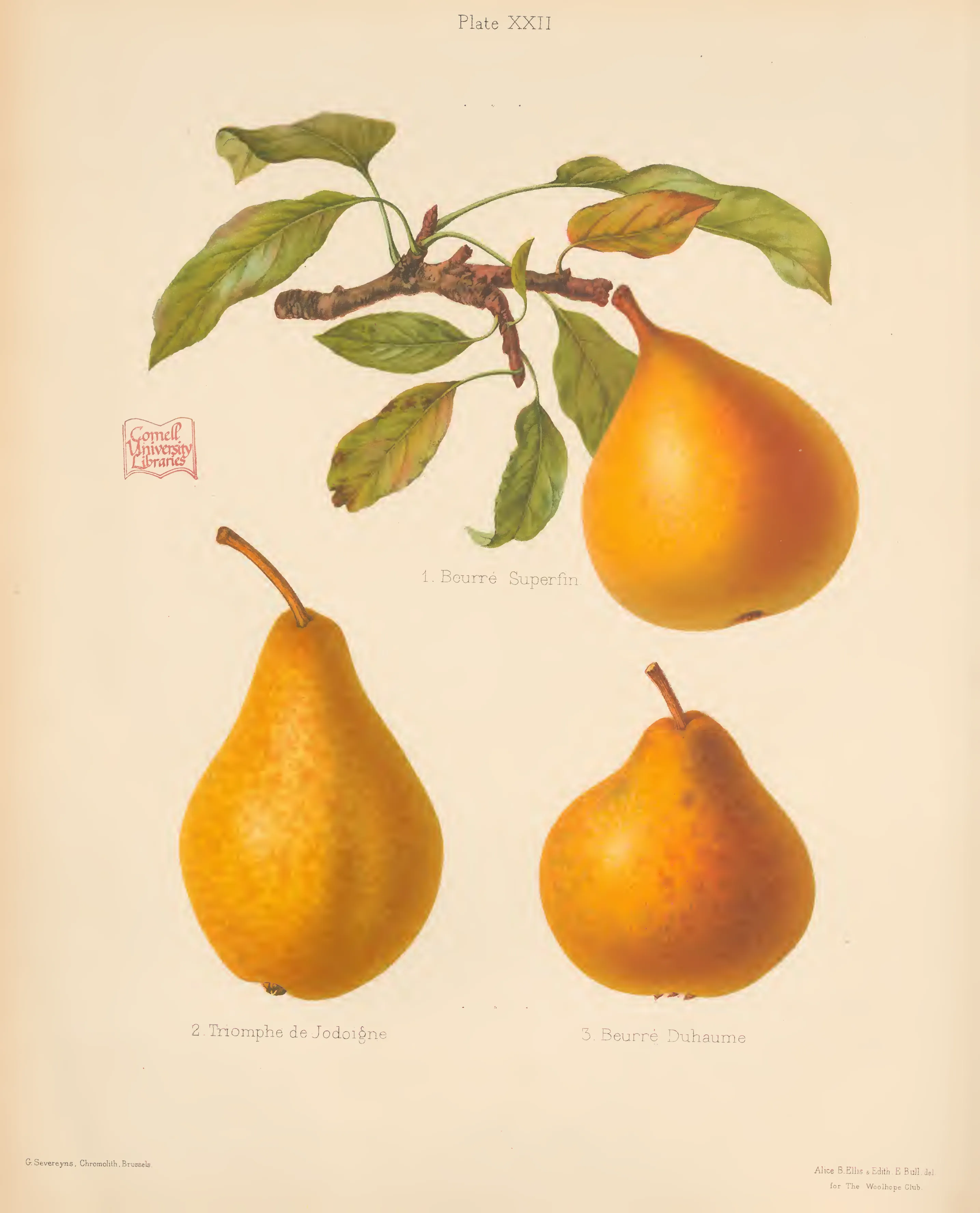
Triomphe de Jodoigne
Origin / History
A Belgian pear, raised by M. Simon Bouvier of Jodoigne, Belgium. Sources agree he raised it as a seedling in 1830 (Downing, Bunyard, Hedrick), and it fruited for the first time in 1843 (Herefordshire Pomona, Bunyard, Hedrick); the Herefordshire Pomona gives the first fruiting as 1843 while noting M. Simon Bouvier as the raiser. Downing states it was "introduced in 1843." Hedrick's earliest reference is Magazine of Horticulture 14:112 (1848), followed by Leroy's Dictionnaire de Pomologie 2:706 (1869) and Bunyard's Handbook of Hardy Fruits (1920).
Tree
Growth vigorous (Elliott: "very strong, vigorous grower"; Desportes: "exceedingly robust"; Downing: "vigorous and productive"; Bunyard: "vigorous, straggling"; Thomas: "vigorous, spreading, irregular"). Sources agree the tree is not an early bearer (Desportes, Elliott), but is ultimately very prolific and productive (Herefordshire Pomona: "very hardy and very prolific"; Downing: "productive"; Bunyard: "fertility good").
Young wood short-jointed, dull grayish brown (Downing). Leaf large, oval, nearly flat, undulating, almost entire (Bunyard).
On stock behavior, sources somewhat disagree: Elliott reports it is "Unsuccessful on Quince." The Herefordshire Pomona is more nuanced — "On the pear stock it grows as freely as the Jargonelle, and makes large extended espaliers. On the Quince stock it will grow well, but makes rather a straggling pyramid."
Fruit
Size
Large to very large. Desportes: "extra, weighing from ten to twelve ounces." Elliott: "large to very large." Herefordshire Pomona: "large." Downing: "large." Thomas: "quite large." Bunyard gives dimensions of 3½ by 4 (inches).
Form
Obovate, obtuse pyriform, tapering markedly toward the stem, irregular and uneven. Desportes: "obovate, slightly pear shaped, terminating obtusely at the stem." Elliott: "obovate, obtuse pyriform." Herefordshire Pomona: "obovate, regular and handsome." Downing: "obovate ovate obtuse pyriform. Surface uneven." Thomas: "obtuse-pyriform, irregular and uneven." Bunyard: "oval pyriform, tapering markedly to stem, uneven." Hedrick: "oval-pyriform, tapering markedly toward stem, uneven." (The Herefordshire Pomona's "regular and handsome" stands in contrast to the more general description of the fruit as irregular/uneven given by Downing, Thomas, Bunyard, and Hedrick.)
Stem / Stalk
Sources vary in description. Herefordshire Pomona: "an inch and a quarter long, curved and inserted without depression." Downing: "rather long, a little inclined, fleshy at its insertion by a ring." Thomas: "stalk large." Bunyard: "long, stout and woody, on level." Hedrick: "rather long, stout, woody, fleshy at insertion."
Cavity
Downing: "small." Herefordshire Pomona: stalk "inserted without depression." Bunyard: stem "on level."
Calyx / Eye
Downing: "Calyx open. Segments short and stiff." Herefordshire Pomona: "Eye: open, set in a slight depression." Thomas: "calyx partly closed in a small basin." Bunyard: "Eye, small, open." Hedrick: "calyx small, open."
Basin
Downing: "small, uneven." Thomas: "small basin." Bunyard: "shallow bossed basin." Hedrick: "small, uneven basin."
Skin
Sources describe somewhat varying colorations:
- Desportes: "green, with occasional traces of russet."
- Elliott: "greenish with traces and faint spots of russet."
- Herefordshire Pomona: "yellow, covered with numerous small russety dots and patches of thin brown russet."
- Downing: "pale greenish yellow, shaded and mottled with crimson in the sun, patches, nettings, and traces of russet, and thickly sprinkled with brown and green dots." (Downing is the only source describing a crimson sun-side cheek.)
- Thomas: "rough, thick, greenish-yellow, with russet dots."
- Bunyard: "Skin, smooth. Colour, clear green changing to lemon yellow, marbled with russet."
- Hedrick: "green becoming lemon-yellow."
Notably Bunyard calls the skin "smooth" while Thomas calls it "rough, thick" — a direct disagreement.
Flesh and Flavor
Whitish to yellowish-white, juicy, half-melting to melting, with a sub-acid to sweet flavor, often with a musky perfume. Sources agree it is variable in quality depending on soil.
- Desportes: "melting, rich sub-acid, good."
- Elliott: "melting, juicy, sub-acid; 'good.'"
- Herefordshire Pomona: "yellowish white, rather coarse, melting, juicy, sugary and brisk, with an agreeable musky perfume."
- Downing: "whitish, coarse, juicy, half melting, sweet. Good to very good."
- Thomas: "coarse, juicy, buttery, musky, of moderate quality."
- Bunyard: "white, half melting, very juicy and sweet, sometimes a little astringent."
- Hedrick: "whitish, coarse, juicy, half-melting, sweet; good to very good."
There is some disagreement on quality and texture. The Herefordshire Pomona notes: "The Triomphe de Jodoigne is a very excellent pear when grown on soil that suits it, but on very heavy or indifferent soils it is apt to be coarse in flavour." Bunyard echoes: "Rather a variable fruit; in some soils it is quite good." Thomas judges it of "moderate quality," while Downing and Hedrick rate it "good to very good."
Core / Seeds
Not described in source.
Season
Sources vary on ripening time, suggesting late-autumn ripening with some keeping ability:
- Desportes: "Ripens in November."
- Elliott: "November."
- Downing: "October."
- Thomas: "Late autumn, keeps into winter."
- Bunyard: "Dessert, December to January."
- Hedrick: "Oct."
Uses
Bunyard classifies it as a dessert pear. Otherwise not specifically described in source.
Subtypes / Variants
Not described in source.
Other
The Veitch & Sons (1911) catalog entry is fragmentary, beginning mid-sentence: "large, also white-fleshed with rich cinnamon colour and fine flavour; requires a warm position." The "rich cinnamon colour" likely refers to russet on the skin, and the note that it "requires a warm position" is a cultural recommendation not mentioned by the other sources.
Multiple sources emphasize that the variety is soil-sensitive — excellent on suitable soil but coarse-flavored on heavy or indifferent soils (Herefordshire Pomona, Bunyard).
Book Sources
Described in 7 period pomological works
Nursery Catalog Sources
Found in 2 catalogs (1900–1911) from England
- Central Experimental Farm , Dominion Department of Agriculture, Agassiz, British Columbia (under test; Bulletin No. 3, Second Series) — 1900
- James Veitch & Sons , Ltd., Royal Exotic Nursery, Chelsea, London (also Coombe Wood, Langley, and Feltham) , England — 1911
View original book sources (8)
— B. Desportes, The Horticulturist (1856)Triomphe de Jodoigne—Size—extra, weighing from ten to twelve ounces. Form—obovate, slightly pear shaped, terminating obtusely at the stem. Color—green, with occasional traces of russet. Flesh—melting, rich sub-acid, good. Ripens in November. The tree of this variety is exceedingly robust, but does not come into bearing so early as many other sorts.
— F.R. Elliott, The Western Fruit Book (1865)Triomphe de Jodoigne.
Foreign. Tree, very strong, vigorous grower, not an early bearer. Fruit, large to very large, obovate, obtuse pyriform, greenish with traces and faint spots of russet ; flesh, melting, juicy, sub-acid; "good." November. Unsuccessful on Quince.
— Woolhope Naturalists Field Club, The Herefordshire Pomona (1885)
- TRIOMPHE DE JODOIGNE.
This fine pear was raised by M. Simon Bouvier, and fruited for the first time in 1843.
Description.—Fruit: large, obovate, regular and handsome. Skin: yellow, covered with numerous small russety dots and patches of thin brown russet. Eye: open, set in a slight depression. Stalk: an inch and a quarter long, curved and inserted without depression. Flesh: yellowish white, rather coarse, melting, juicy, sugary and brisk, with an agreeable musky perfume.
The Triomphe de Jodoigne is a very excellent pear when grown on soil that suits it, but on very heavy or indifferent soils it is apt to be coarse in flavour.
The tree is very hardy and very prolific. On the pear stock it grows as freely as the Jargonelle, and makes large extended espaliers. On the Quince stock it will grow well, but makes rather a straggling pyramid.
— A.J. Downing, The Fruits and Fruit Trees of America (1900)Triomphe de Jodoigne.
A Belgian Pear, seedling of M. Bouvier in 1830, introduced in 1843. Tree vigorous and productive. Young wood short-jointed, dull grayish brown.
Fruit large, obovate ovate obtuse pyriform. Surface uneven. Skin pale greenish yellow, shaded and mottled with crimson in the sun, patches, nettings, and traces of russet, and thickly sprinkled with brown and green dots. Stalk rather long, a little inclined, fleshy at its insertion by a ring. Cavity small. Calyx open. Segments short and stiff. Basin small, uneven. Flesh whitish, coarse, juicy, half melting, sweet. Good to very good. October.
— John J. Thomas, The American Fruit Culturist (1903)Triomphe de Jodoigne. Quite large, obtuse-pyriform, irregular and uneven; skin rough, thick, greenish-yellow, with russet dots; stalk large; calyx partly closed in a small basin; flesh coarse, juicy, buttery, musky, of moderate quality. Late autumn, keeps into winter. Growth vigorous, spreading, irregular.
— E.A. Bunyard, A Handbook of Hardy Fruits (1920)TRIOMPHE DE JODOIGNE. Her. Pom., I., 22. Dessert, December to January, large, 3½ by 4, oval pyriform, tapering markedly to stem, uneven. Skin, smooth. Colour, clear green changing to lemon yellow, marbled with russet. Flesh, white, half melting, very juicy and sweet, sometimes a little astringent. Eye, small, open, in a shallow bossed basin. Stem, long, stout and woody, on level. Growth, vigorous, straggling ; fertility good. Leaf, large, oval, nearly flat, undulating, almost entire. Origin, raised by Simon Bouvier, of Joidoigne, in 1830, first fruited in 1843. Rather a variable fruit ; in some soils it is quite good.
— U.P. Hedrick, The Pears of New York (1921)Triomphe de Jodoigne.
- Mag. Hort. 14:112. 1848. 2. Leroy Dict. Pom. 2:706, fig. 1869. 3. Bunyard Handb. Hardy Fr. 200. 1920.
Raised by Simon Bouvier, Jodoigne, Bel., in 1830. Fruit large, oval-pyriform, tapering markedly toward stem, uneven, green becoming lemon-yellow; calyx small, open, in a small, uneven basin; stem rather long, stout, woody, fleshy at insertion; flesh whitish, coarse, juicy, half-melting, sweet; good to very good; Oct.
— James Veitch & Sons, Veitch's Fruit Trees (1911) (1911)large, also white-fleshed with rich cinnamon colour and fine flavour; requires a warm position.