Van Eseltine
Crab Apple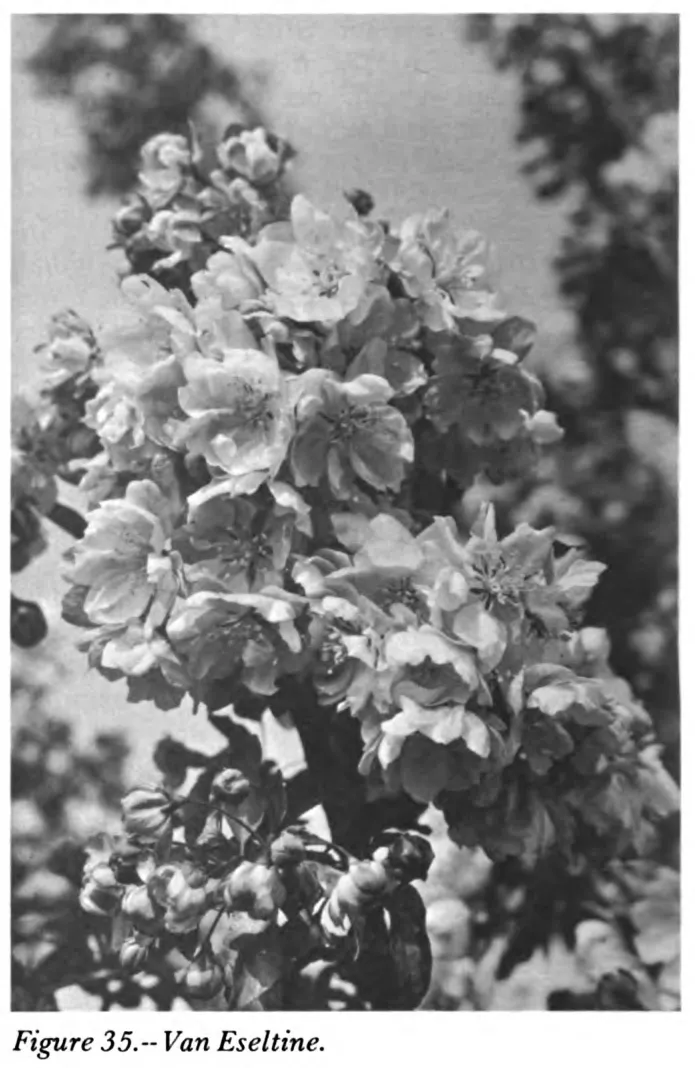
Van Eseltine
Origin / History
Van Eseltine originated from the cross Malus arnoldiana x M. spectabilis, made in 1930. The breeding record number was 30379, and the seedling number was Station 11903. It was selected in 1937 and was introduced without a second test. It was introduced in 1941 under the name Geneva. When it was discovered that the Ottawa Station had used this name for another clone, the New York introduction was renamed Van Eseltine on April 12, 1943. It was named in honor of its originator, Glen P. Van Eseltine. Van Eseltine was briefly described in the Register of New Fruit and Nut Varieties and by Way. Brief descriptions were also printed in the catalogs of the New York State Fruit Testing Association for 1948 to 1968.
Tree
The tree is medium in size and vigor, very upright, medium tall, of medium density, and of closed vase form. The branches do not spread horizontally outward; they are very upright in their growth habit. The trunk is of medium stockiness. The trunk bark is shaggy and gray with a slightly reddish tinge. Main branches are more or less solitary, without frequent side branches, but have numerous fruiting spurs along their sides.
Van Eseltine is a handsome ornamental flowering crab apple. Flowers are abundant and are borne in dense clusters. Flowers are medium in size (2 cm in diameter), double flowered, with 12 to 15 petals per blossom. Flowers are pendulous. Young, unopened flowers are red; as they open, they become pink and change to white when fully open. Two to seven flowers are borne on each flowering spur. The pedicels are 2 cm long, slender, and red or green. The calyx tube of the flower is green and glabrous. The calyx lobes are medium in length, narrow, acuminate, entire, pink, and erect, with the upper surface heavily pubescent and the lower surface glabrous. The petals are 9 mm long, 7 mm wide, oval, and entire. The stamens are numerous and short (7 mm). Stamens are shorter than the petals but slightly longer than the pistils. The anthers are few, abortive, and yellow. The pistil is glabrous. The stigma is small and receptive. The styles are divided at their bases and are 7 mm long. Van Eseltine flowers open late, about a day later than Delicious. Trees bear large quantities of beautiful flowers and flower annually.
Fruit
Size: Fruits are very small crab apples, about 9/16 inch in diameter, borne in clusters.
Form: Roundish to slightly pyriform and symmetrical.
Stem: Long in relation to the size of the fruit, ¾ to 1¼ inch long, and slender.
Cavity: None.
Calyx: Large and closed, deciduous after early summer. The calyx scar is large, 3/8 inch in diameter. There is no calyx tube and no stamens on the fruits.
Basin: No depressed basin. The calyx end of the fruit is almost flat.
Skin: Thin, tender, smooth, and glossy. The color is primarily yellow, with 20 to 40 per cent of the surface pinkish to red blush. The color is not particularly attractive.
Dots: None.
Flesh and flavor: Light yellow, firm, fine grained, and somewhat dry. Flavor sour and very astringent. The flesh is inedible. The fruits are not large enough for jelly making and have no commercial value.
Core and seeds: The core is large in relation to fruit size and is closed. The carpels are round. The seeds are numerous, small, narrow, plump, and acuminate.
Season
The average ripening date at Geneva is October 8, ½ week before Delicious. The average number of days from full bloom to harvest is 142, 3 less than Delicious. Fruits are persistent on the tree through the winter.
Uses
Van Eseltine is not used for eating or jelly. The fruits possibly have some value as wildlife food. Van Eseltine is very useful as an ornamental tree and is highly recommended for this purpose. Trees were sold by the New York State Fruit Testing Association for 21 years, 1948 to 1968. In the 1960 to 1968 period, Van Eseltine trees were sold by seven commercial nurseries. The large number of nurseries offering it for sale is evidence of its commercial usefulness.
Subtypes / Variants
Not described in source.
Other
Van Eseltine is diploid, and the pollen is viable. It is a parent of two ornamental Malus clones. It is the seed parent of Coralburst and the pollen parent of Ellen Gerhart.
Book Sources
Described in 1 period pomological work
View original book sources (1)
— Roger D. Way, Apple Cultivars Introduced by the New York State Agricultural Experiment Station, 1914–1968 (1971)Van Eseltine
Origin. Van Eseltine originated from the cross, Malus arnoldiana x M. spectabilis, made in 1930. The breeding record number was 30379, and the seedling number was Station 11903. It was selected in 1937 and was introduced without a second test. It was introduced in 1941 and was originally named Geneva, but when it was discovered that the Ottawa Station had used this name for another clone, the New York introduction was renamed Van Eseltine on April 12, 1943 (Table 2). It was named in honor of its originator, Glen P. Van Eseltine. Van Eseltine was briefly described in the Register of New Fruit and Nut Varieties (35) and by Way (221). Brief descriptions of it were also printed in the catalogs of the New York State Fruit Testing Association for 1948 to 1968.
Tree. The tree characteristics of Van Eseltine are summarized in Table 5. The tree is medium in size and vigor, very upright, medium tall, of medium density, closed vase form, and produces inedible fruits. The branches do not spread horizontally outward; they are very upright in their growth habit. The trunk is of medium stockiness. The trunk bark is shaggy and gray with a slightly reddish tinge. Main branches are more or less solitary without frequent side branches but have numerous fruiting spurs along their sides. Trees bear large quantities of beautiful flowers and flower annually.
Flowers. Van Eseltine is a handsome ornamental flowering crab apple. The flowers are illustrated in Figure 35. Flowers are abundant and are borne in dense clusters. Flowers are medium in size (2 cm in diameter), double flowered, with 12 to 15 petals per blossom. Flowers are pendulous. Young, unopened flowers are red, but as they open, they become pink and change to white when fully open. Two to seven flowers are borne on each flowering spur. The pedicels are 2 cm long, slender, and red or green. The calyx tube of the flower is green and glabrous. The calyx lobes are medium in length, narrow, acuminate, entire, pink, and erect, with the upper surface heavily pubescent and the lower surface glabrous. The petals are 9 mm long, 7 mm wide, oval, and entire. The stamens are numerous and short (7 mm). Stamens are shorter than the petals but slightly longer than the pistils. The anthers are few, abortive, and yellow. The pistil is glabrous. The stigma is small and receptive. The styles are divided at their bases and are 7 mm long. Van Eseltine flowers open late, about a day later than Delicious (Table 6). It is diploid (Table 4), and the pollen is viable.
Fruit. Van Eseltine fruits are not edible. Fruits are small crab apples. The average ripening date at Geneva is October 8, ½ week before Delicious (Table 7). The average number of days from full bloom to harvest is 142, 3 less than Delicious. Fruits are very small, about 9/16 inch in diameter, and are borne in clusters. They are roundish to slightly pyriform and symmetrical. The stem is long in relation to the size of the fruit, ¾ to 1¼ inch long, and it is slender. The fruit has no cavity. The calyx is large, closed, and is deciduous after early summer. The calyx scar is large, 3/8 inch in diameter. Fruits have no depressed basin. The calyx end of the fruit is almost flat. The skin is thin, tender, smooth, and glossy. The color is primarily yellow, with 20 to 40 per cent of the surface pinkish to red blush. The color is not particularly attractive. There are no dots, no calyx tube, and no stamens on the fruits. The core is large in relation to fruit size and is closed. The carpels are round. The seeds are numerous, small, narrow, plump, and acuminate. The flesh is light yellow, firm, fine grained, somewhat dry, sour, very astringent, and inedible. The fruits are not large enough for jelly making and have no commercial value. Fruits are persistent on the tree through the winter and possibly have some value as wildlife food.
Breeding Behavior. Van Eseltine is a parent of two ornamental Malus clones. It is the seed parent of Coralburst and the pollen parent of Ellen Gerhart (245).
Commercial Usefulness. Trees of Van Eseltine were sold by the New York State Fruit Testing Association for 21 years, 1948-68 (Table 2). In the 1960-68 period, Van Eseltine trees were sold by seven commercial nurseries (Table 3). The large number of nurseries which offer it for sale is evidence of its commercial usefulness. Van Eseltine is very useful as an ornamental tree. It is highly recommended for this purpose.