Wabash Red
Apple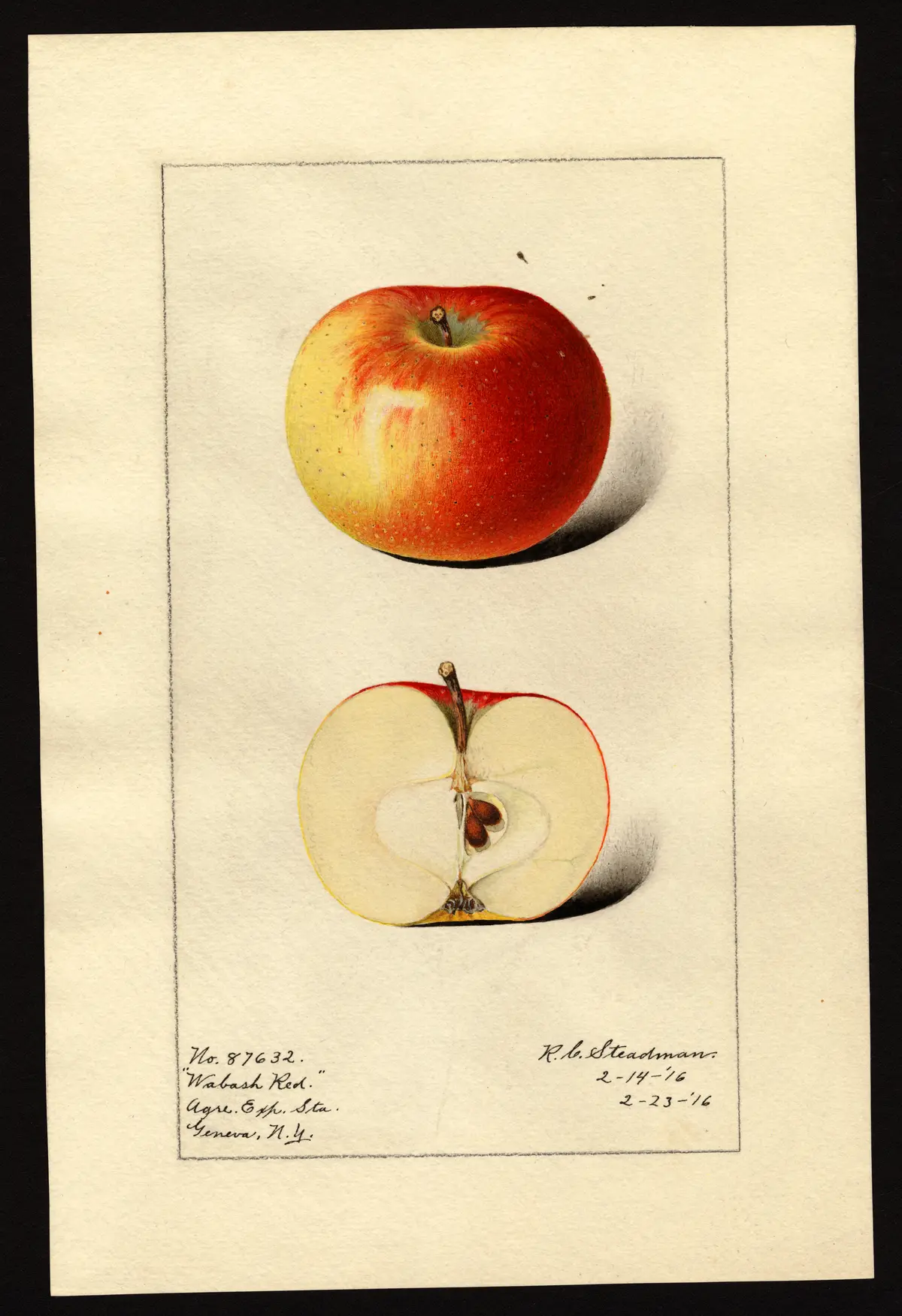
USDA Pomological Watercolor Collection
Wabash Red
Origin and History
Received in 1892 and 1894 from Downing and Morris, Clinton, Indiana, for testing at the New York Agricultural Experiment Station. This variety is distinct from Wabash (also called Wabash Bellflower), with which it may be confused.
Tree
Tree vigorous and upright to roundish in form, with rather dense branching. Twigs short to above medium, straight or somewhat curved, stout, with large terminal buds and medium to short internodes. Bark brownish-red mingled with olive-green, lightly mottled with scarf-skin and slightly pubescent. Lenticels conspicuous and quite numerous, small to medium, roundish or slightly elongated, slightly raised. Buds medium to large, broad, plump, obtuse, free or nearly so, slightly pubescent.
Fruit
Size and Form. Large to medium, quite uniform in size and shape. Form roundish oblate, a little inclined to conic, usually regular, though sides are sometimes unequal.
Stem. Short to above medium, rather thick.
Cavity. Small to medium, acuminate to nearly obtuse, moderately deep to deep, rather narrow to moderately broad, sometimes lipped, usually russeted with outspreading russet.
Calyx. Small to medium, closed or partly open; lobes sometimes separated at the base.
Basin. Medium size, usually shallow and obtuse but varying to moderately deep and somewhat abrupt, wide, somewhat furrowed and wrinkled.
Skin. Moderately thick and tough, nearly smooth. Bright clear yellow, in highly colored specimens largely overspread with bright red or orange-red, obscurely striped with darker red. Prevailing effect red.
Dots. Numerous and rather conspicuous, small to medium, whitish or pale yellow and russet.
Calyx Tube. Cone-shaped to truncate funnel-form. Stamens median.
Core and Seeds. Core rather small, axile or nearly so, with symmetrical cells usually closed and core lines somewhat clasping. Carpels roundish and smooth or nearly so. Seeds compactly filling the cells, medium or above, rather wide, somewhat obtuse, tufted; some often abortive.
Flesh and Flavor. Whitish slightly tinged with yellow, very firm, a little coarse, crisp, not tender, moderately juicy. Flavor mild subacid, pleasant, and sprightly; quality good.
Season
December to May. A late-keeping apple that retains its texture and flavor well throughout the season.
Uses
Suitable as a dessert apple of fairly good quality. Rather too mild in flavor for most culinary uses. Shows a tendency toward small fruit size under some growing conditions.
Other
The tree is a good grower, not slow in coming into bearing, and yields moderate to good crops nearly annually. The fruit shows attractive appearance with bright color and smooth, uniform surface. Based on testing at this Station, the variety was judged sufficiently promising to be worthy of further testing.
Book Sources
Described in 1 period pomological work
Nursery Catalog Sources
Found in 1 catalog (1913) from Illinois
- Benjamin Buckman (personal inventory) , Farmingdale , Illinois — 1913
View original book sources (1)
— S.A. Beach, The Apples of New York, Vol. 1 (1905)WABASH RED.
References. 1. N. Y. Sta. An. Rpt., 11:223. 1892. 2. Ib., 13:170. 1894.
Synonym. Wabash Red Winter (2).
As grown at this Station, Wabash Red is a rather attractive apple of fairly good size, bright color, smooth and uniform appearance and good dessert quality for a late-keeping apple, but rather too mild in flavor for most culinary uses. It has the merit of retaining its texture and flavor well till very late in the season. As tested here the fruit shows a tendency to be deficient in size. The tree is a good grower, is not slow in coming into bearing and yields moderate to good crops nearly annually. It is sufficiently promising to be worthy of further testing.
This is distinct from Wabash or Wabash Bellflower.
Historical. Received in 1892 and 1894 from Downing and Morris, Clinton, Ind., for testing at this Station (1, 2).
TREE.
Tree vigorous. Form upright to roundish, rather dense. Twigs short to above medium, straight or somewhat curved, stout and with large terminal buds; internodes medium to short. Bark brownish-red mingled with olive-green, lightly mottled with scarf-skin; slightly pubescent. Lenticels conspicuous, quite numerous, small to medium, roundish or a little elongated, slightly raised. Buds medium to large, broad, plump, obtuse, free or nearly so, slightly pubescent.
FRUIT.
Fruit large to medium, quite uniform in size and shape. Form roundish oblate, a little inclined to conic, usually regular; sides sometimes unequal. Stem short to above medium, rather thick. Cavity small to medium, acuminate to nearly obtuse, moderately deep to deep, rather narrow to moderately broad, sometimes lipped, usually russeted and with outspreading russet. Calyx small to medium, closed or partly open; lobes sometimes separated at the base. Basin medium size, usually shallow and obtuse but varying to moderately deep and somewhat abrupt, wide, somewhat furrowed and wrinkled.
Skin moderately thick, tough, nearly smooth, bright clear yellow, in highly colored specimens largely overspread with bright red or orange-red obscurely striped with darker red. Dots numerous, rather conspicuous, small to medium, whitish or pale yellow and russet. Prevailing effect red.
Calyx tube cone-shape to truncate funnel-form. Stamens median.
Core rather small, axile or nearly so; cells symmetrical, usually closed; core lines somewhat clasping. Carpels roundish, smooth or nearly so. Seeds compactly filling the cells, medium or above, rather wide, somewhat obtuse, tufted; often some are abortive.
Flesh whitish slightly tinged with yellow, very firm, a little coarse, crisp, not tender, moderately juicy, mild subacid, pleasant, sprightly, good.
Season December to May.