Washington Royal
Apple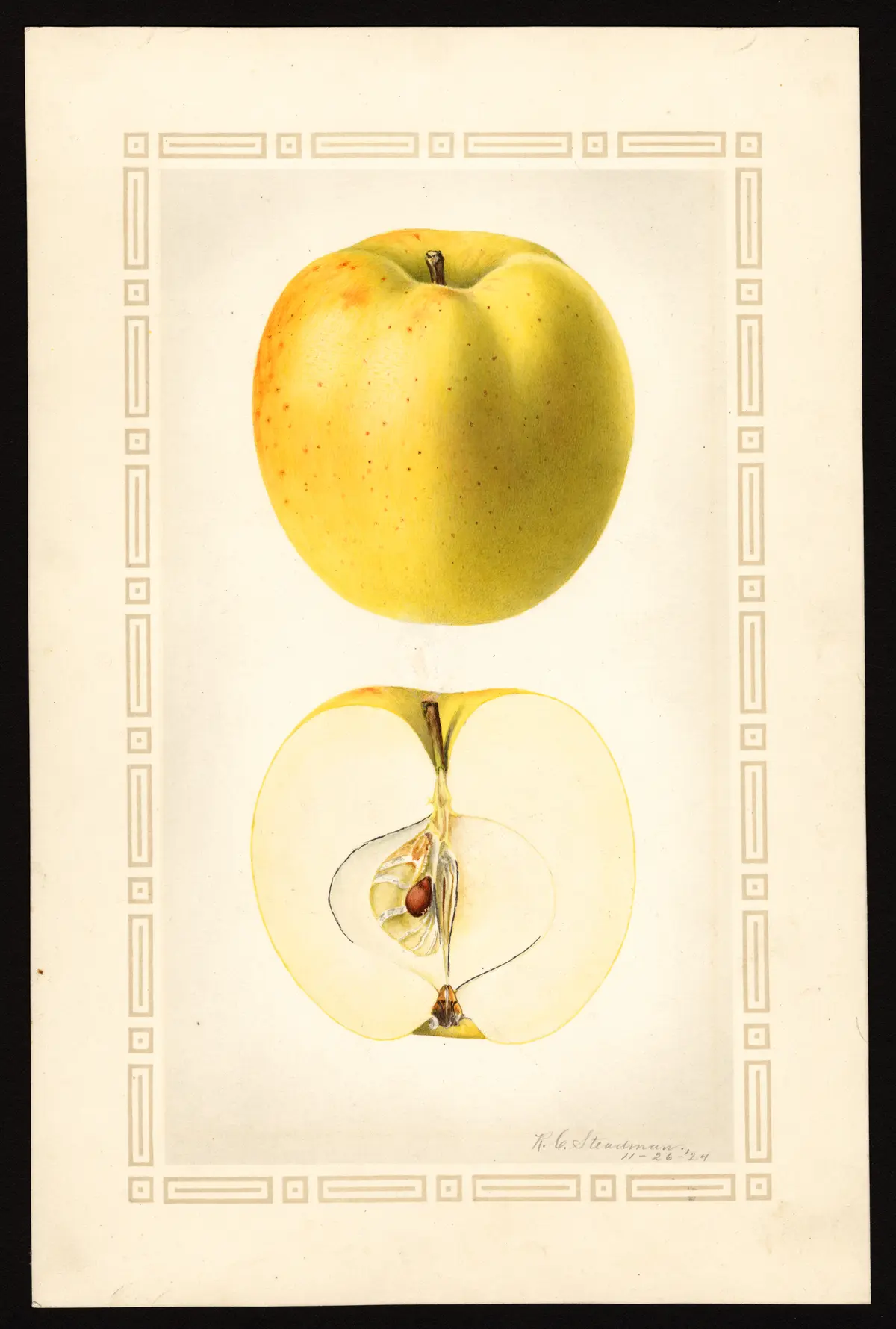
USDA Pomological Watercolor Collection
Origin & History
Originated on the farm of Joseph P. Hayward in Sterling, Massachusetts (Beach, Elliott). It was brought to notice by Ephraim Robbins of Leominster in 1855 (Beach). Downing gives the origin as Leominster, Mass., likely conflating the place of origin with the place of introduction. It has been planted but sparingly in New York state (Beach). It is favorably regarded locally in New England, where it is commonly grown under the name Palmer Greening (Beach).
Tree
Vigorous and productive (Downing). Form upright spreading to roundish. Twigs below medium to rather long, curved, slender to moderately stout; internodes medium to short. Bark dark brown with some green, heavily streaked with scarf-skin, somewhat pubescent. Lenticels scattering, small to medium, roundish, usually not raised. Buds medium to small, broad, rather plump, obtuse, free, pubescent (Beach).
Fruit
Size: Above medium (Downing, Elliott) to medium or above (Beach); quite variable in size (Beach).
Form: Roundish oblate (Downing), flattish round (Elliott), a little oblate, often somewhat ribbed, irregular (Beach).
Stem: Short (Downing) to short to medium (Beach). Elliott describes the stem as slender, half an inch long.
Cavity: Medium to rather large, acuminate to acute, rather narrow to moderately broad, often somewhat furrowed, usually smooth and green (Beach).
Calyx: Downing describes the calyx as closed, in a broad basin. Beach describes the calyx as small to medium, partly open, sometimes closed; lobes erect. Calyx tube conical to somewhat urn-shape or funnel-form. Stamens median (Beach).
Basin: Moderately shallow, rather narrow, abrupt, often somewhat furrowed, wrinkled (Beach). Downing describes it simply as broad.
Skin: Thin, moderately tender, waxy (Beach). Yellowish green with numerous small gray dots and a clear red in the skin (Downing, Elliott). Beach describes the color as yellow or greenish, usually with thin dull orange blush which sometimes deepens to clear red. Dots numerous, whitish or areolar with russet center, characteristic and conspicuous. Prevailing effect rather attractive greenish-yellow (Beach).
Flesh & Flavor: Whitish, firm, moderately fine, crisp, tender, juicy, pleasant subacid becoming nearly sweet, somewhat aromatic, good to very good (Beach). Downing describes the flesh as whitish, crisp, juicy, subacid, slightly aromatic, and rates it good to very good. Elliott describes the flesh as crisp, juicy, and fine flavor. The fruit is mild in flavor and eventually becomes nearly sweet; more suitable for dessert than for culinary use (Beach).
Core & Seeds: Downing describes the core as small. Beach describes the core as medium to large, somewhat abaxile to nearly axile; cells closed or partly open; core lines clasping the funnel cylinder. Carpels rather concave, broadly roundish, emarginate. Seeds dark, medium, rather wide, plump, obtuse, or somewhat acute (Beach).
Season & Storage
A long keeper. Downing and Elliott both report keeping till July. Beach notes that some portion of the fruit may often be kept till May or June in ordinary storage, yet its season is so variable that November may be regarded as the usual safe commercial limit for handling this variety.
Uses
More suitable for dessert than for culinary use (Beach). Beach concludes that, taking all things into consideration, it is hardly equal to standard varieties of its season and is not recommended for commercial planting in New York.
Subtypes & Variants
Not described in source.
Other
Description absent from Encyclopedia of Practical Horticulture (1914); variety present in variety-characteristic table:
Washington Royal............ M rob gy G m W 3* 1*
Book Sources
Described in 4 period pomological works
Nursery Catalog Sources
Found in 1 catalog (1887) from California
- Santa Rosa Nurseries (Luther Burbank) , Santa Rosa , California — 1887
View original book sources (4)
— A.J. Downing, The Fruits and Fruit Trees of America (1900)Washington Royal.
Palmer Greening.
Originated in Leominster, Mass. Tree vigorous and productive.
Fruit above medium size, roundish oblate, yellowish green, with numerous small gray dots, and a clear red in the skin. Calyx closed, in a broad basin. Stalk short. Flesh whitish, crisp, juicy, subacid, slightly aromatic. Core small. Good to very good. Keeping till July.
— S.A. Beach, The Apples of New York, Vol. 1 (1905)WASHINGTON ROYAL.
References. 1. Robbins, N. E. Farmer, 7:231. 1855. 2. Downing, 1857:201. 3. Warder, 1867:735. 4. Downing, 1869:396. 5. Am. Pom. Soc. Cat., 1871. 6. Thomas, 1875:515. 7. Lyon, Mich. Hort. Soc. Rpt., 1890:298. 8. Bailey, An. Hort., 1892:246. 9. Maynard, Putnam and Fletcher, Mass. Sta. Bul., 44:4. 1897. 10. Waugh, Amer. Gard., 20:221. 1899. fig. 11. Van Deman, Rural N. Y., 60:69. 1901. 12. Waugh, Vt. Sta. An. Rpt., 14:312. 1901. 13. Mead, Rural N. Y., 61:67. 1902. 14. Ib., 62:50. 1903. figs. 15. Powell and Fulton, U. S. B. P. I. Bul., 48:60. 1903. 16. Beach and Clark, N. Y. Sta. Bul., 248:149. 1904.
Synonyms. Lock's Favorite (12). Palmer Greening (8, 9, 13, 14). Palmer Greening (4, 10, 11, 12, 15). Washington Royal (14).
Fruit yellow or greenish usually somewhat shaded with red, rather attractive in color, quite variable in size, good in quality but mild in flavor and eventually becoming nearly sweet. More suitable for dessert than for culinary use. As grown at Geneva some portion of the fruit may often be kept till May or June in ordinary storage, yet its season is so variable that November may be regarded as the usual safe commercial limit for handling this variety (16). It is favorably regarded locally in New England, where it is commonly grown under the name Palmer Greening (9, 10, 12). Taking all things into consideration, it is hardly equal to standard varieties of its season and is not recommended for commercial planting in New York.
Historical. Originated in Sterling, Mass. It was brought to notice by Ephraim Robbins of Leominster in 1855 (1). It has been planted but sparingly in New York state.
Tree.
Tree vigorous. Form upright spreading to roundish. Twigs below medium to rather long, curved, slender to moderately stout; internodes medium to short. Bark dark brown with some green, heavily streaked with scarf-skin, somewhat pubescent. Lenticels scattering, small to medium, roundish, usually not raised. Buds medium to small, broad, rather plump, obtuse, free, pubescent.
Fruit.
Fruit medium or above. Form a little oblate, often somewhat ribbed, irregular. Stem short to medium. Cavity medium to rather large, acuminate to acute, rather narrow to moderately broad, often somewhat furrowed, usually smooth and green. Calyx small to medium, partly open, sometimes closed; lobes erect. Basin moderately shallow, rather narrow, abrupt, often somewhat furrowed, wrinkled.
Skin thin, moderately tender, waxy, yellow or greenish, usually with thin dull orange blush which sometimes deepens to clear red. Dots numerous, whitish or areolar with russet center, characteristic and conspicuous. Prevailing effect rather attractive greenish-yellow.
Calyx tube conical to somewhat urn-shape or funnel-form. Stamens median.
Core medium to large, somewhat abaxile to nearly axile; cells closed or partly open; core lines clasping the funnel cylinder. Carpels rather concave, broadly roundish, emarginate. Seeds dark, medium, rather wide, plump, obtuse, or somewhat acute.
Flesh whitish, firm, moderately fine, crisp, tender, juicy, pleasant subacid becoming nearly sweet, somewhat aromatic, good to very good.
— Granville Lowther (ed.), Encyclopedia of Practical Horticulture (1914)Washington Royal............ M rob gy G m W 3* 1*
— F.R. Elliott, The Western Fruit Book (1865)Washington Royal.
Origin, farm of Joseph P. Hayward, Sterling, Mass. Fruit, above medium size, flattish round, yellowish green, with numerous small gray dots, and a clear red in the skin ; calyx, in a broad basin ; stem, slender, half an inch long; flesh, crisp juicy, and fine flavor, keeping till July. (N. E. Farm.)