Water
Apple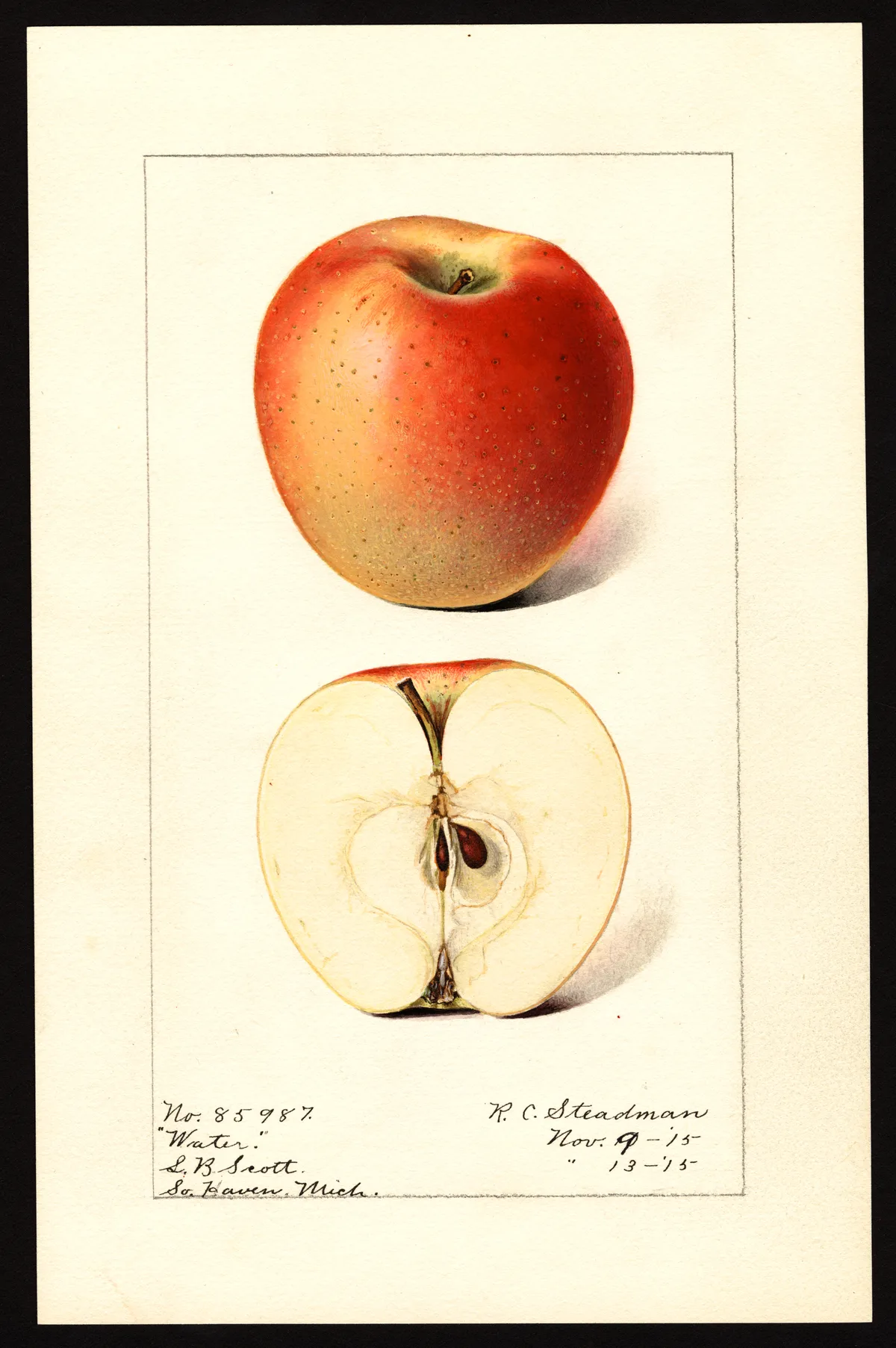
USDA Pomological Watercolor Collection
Water
Origin and History
The Water apple originated in Durham Township, Bucks County, Pennsylvania. It was first described in the horticultural literature by 1864 and was entered in the catalogue of the American Pomological Society in 1877, from which it was dropped in 1897. By the early twentieth century it was but little known in New York State and was not recommended for commercial planting.
Tree
Downing describes the tree as vigorous and erect, forming a round, somewhat close head; Beach characterizes it as a rather moderate grower, moderately vigorous, with short, slender, curved branches and an erect or roundish, rather dense form. Both sources agree it is a biennial bearer; Beach adds that it does not come into bearing young and yields from fair to good crops when it does bear. A distinctive feature noted by Downing is that it blooms nearly two weeks later than other varieties.
Twigs long, curved, moderately stout; internodes short. Bark dark brown, heavily coated with gray scarf skin; pubescent near tips. Young wood very dark, blackish brown (Downing). Lenticels scattering, small, round, not raised. Buds rather prominent, medium to large, plump, obtuse, free, pubescent.
Fruit
Size and Form. Fruit medium in size. Form broadly ovate to roundish conic, varying to oblong conic with flattened ends, nearly regular. Downing describes it as roundish conical, sometimes oblong conic truncated.
Stem. Short to medium in length, slender.
Cavity. Acuminate, rather narrow to moderately broad, moderately shallow to deep, often compressed; sometimes thinly russeted, the russet not extending beyond the cavity.
Calyx. Small to medium; closed or open (Downing describes it as closed). Lobes long, narrow, acute to acuminate. Calyx tube short, wide, broadly conical. Stamens basal to median.
Basin. Varying from shallow to rather deep and abrupt, narrow to medium in width, furrowed and wrinkled. Downing describes it as small, abrupt, and slightly corrugated.
Skin. Pale yellow or greenish (Downing: whitish yellow), with a very attractive, lively pinkish-red blush; in well-colored specimens deepening to dark or purplish-red (Downing: rich purplish crimson in the sun). Not striped. Overspread with a thin bloom. The two sources disagree on the dots: Downing describes few brown dots; Beach describes them as numerous, medium to small, grayish or whitish, often submerged.
Flesh and Flavor. Nearly white (Downing: white), fine, crisp, very tender, juicy, pleasant mild subacid. Rated good to very good. A mild-flavored dessert apple.
Core and Seeds. Core rather small, somewhat abaxile; cells closed or slightly open; core lines slightly clasping. Carpels small, slightly obovate to obcordate, emarginate. Seeds medium in size, few, dark brown, varying from blunt and flat to acute and rather narrow.
Season and Uses
Season October to December or later (Downing: October–November). A mild-flavored dessert apple. Not recommended for commercial planting.
Book Sources
Described in 3 period pomological works
View original book sources (3)
— A.J. Downing, The Fruits and Fruit Trees of America (1900)Water.
Originated in Durham Township, Bucks Co., Pa. Tree vigorous, erect, forming a round somewhat close head, blooms nearly two weeks later than other varieties, and produces abundantly every other year. Young wood very dark, blackish brown.
Fruit medium, roundish conical, sometimes oblong conic truncated, whitish yellow, shaded with rich purplish crimson in the sun, few brown dots. Stalk short, slender. Calyx closed. Basin small, abrupt, slightly corrugated. Flesh white, very tender, juicy, pleasant subacid. Very good. October, November.
— S.A. Beach, The Apples of New York, Vol. 2 (1905)WATER
REFERENCES. 1. Downing, Horticulturist, 19:172. 1864. figs. 2. Warder, 1867:735. 3. Downing, 1869:397. fig. 4. Thomas, 1875:315. 5. Am. Pom. Soc. Cat., 1877:16. 6. Lyon, Mich. Hort. Soc. Rpt., 1890:298. 7. Bailey, An. Hort., 1892:252.
SYNONYMS. None.
A mild flavored dessert apple of medium size, pale yellow or greenish with attractive blush of lively red; in season from October to December. The tree is a rather moderate grower, does not come into bearing young and is a biennial bearer yielding from fair to good crops. Not recommended for commercial planting.
Historical. Origin Durham township, Bucks county, Pa. (1, 3). It was entered in the catalogue of the American Pomological Society in 1877 (5) and dropped from that list in 1897. It is but little known in this state.
TREE.
Tree moderately vigorous with short, slender, curved branches. Form erect or roundish, rather dense. Twigs long, curved, moderately stout; internodes short. Bark dark brown, heavily coated with gray scarf skin; pubescent near tips. Lenticels scattering, small, round, not raised. Buds rather prominent, medium to large, plump, obtuse, free, pubescent.
FRUIT.
Fruit medium size. Form broadly ovate to roundish conic varying to oblong conic with flattened ends, nearly regular. Stem short to medium, slender. Cavity acuminate, rather narrow to moderately broad, moderately shallow to deep, often compressed, sometimes thinly russeted, the russet not extending beyond the cavity. Calyx small to medium, closed or open; lobes long, narrow, acute to acuminate. Basin varying from shallow to rather deep and abrupt, narrow to medium in width, furrowed and wrinkled.
Skin pale yellow or greenish with very attractive, lively pinkish-red blush, in well colored specimens deepening to dark or purplish-red, not striped, overspread with thin bloom. Dots numerous, medium to small, grayish or whitish, often submerged.
Calyx tube short, wide, broadly conical. Stamens basal to median.
Core rather small, somewhat abaxile; cells closed or slightly open; core lines slightly clasping. Carpels small, slightly obovate to obcordate, emarginate. Seeds medium in size, few, dark brown, varying from blunt and flat to acute and rather narrow.
Flesh nearly white, fine, crisp, tender, juicy, pleasant mild subacid, good.
Season October to December or later.
— Granville Lowther (ed.), Encyclopedia of Practical Horticulture (1914)Water.............. M re yt VG f W