Wharton's Early
Pear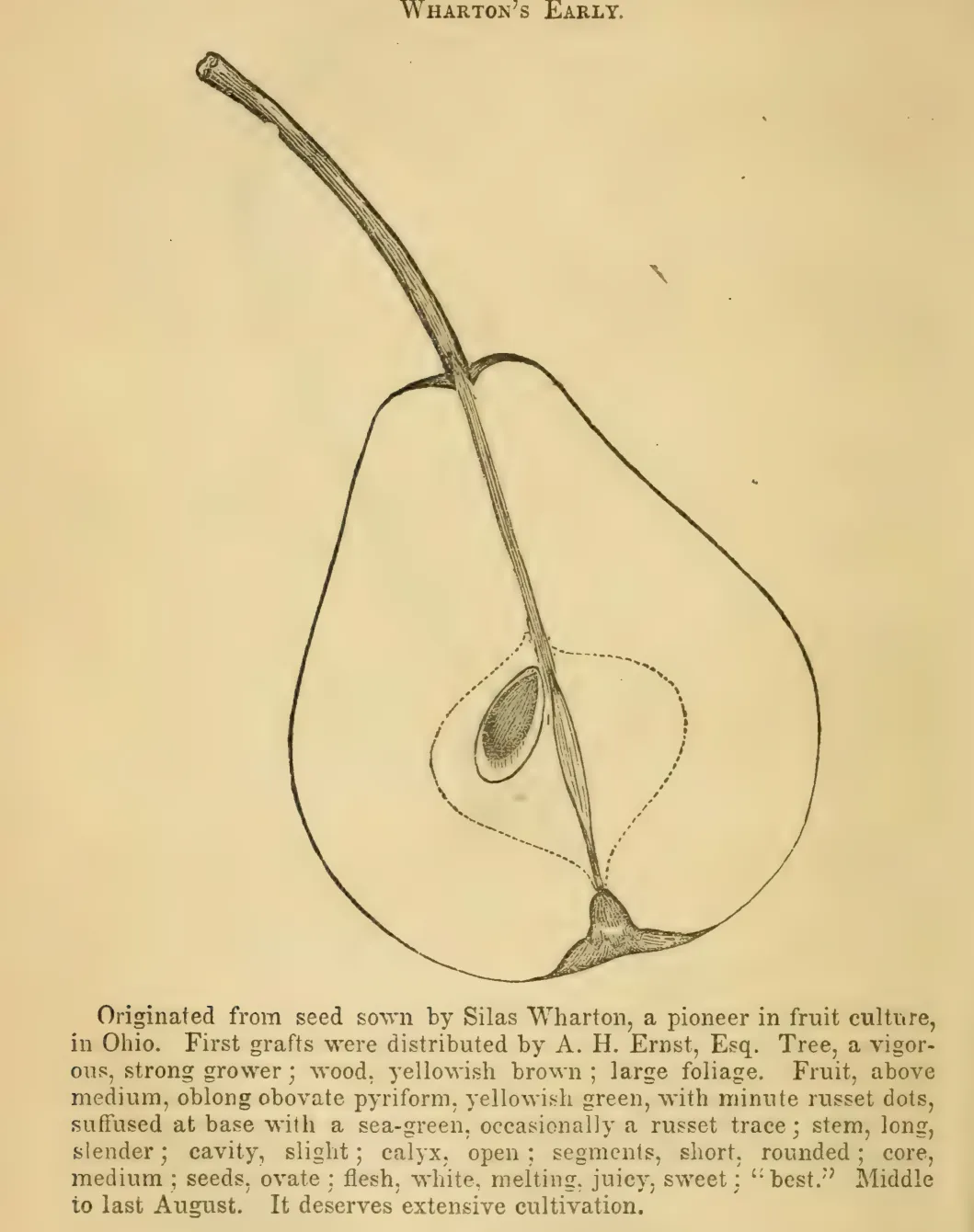
Origin/History
Elliott (1865) states the variety originated from seed sown by Silas Wharton, a pioneer in fruit culture, in Ohio, and that the first grafts were distributed by A. H. Ernst, Esq. Downing (1900) and Hedrick (1921) both record the origin as unknown.
Tree
Tree vigorous. Wood yellowish brown; Downing specifies "olive yellowish brown" on young wood. Elliott describes the tree as a strong grower with large foliage.
Fruit
Size: Downing and Hedrick describe the fruit as medium. Elliott says above medium. Thomas says rather large.
Form: Obovate oblong acute pyriform (Downing), oblong-acute-pyriform (Hedrick), oblong obovate pyriform (Elliott), or obovate pyriform (Thomas). All sources agree on the general pyriform shape.
Skin: Downing and Hedrick describe the skin as pale yellow, with traces of russet, and thickly sprinkled with russet dots. Elliott describes it as yellowish green with minute russet dots, suffused at base with a sea-green, and occasionally a russet trace. Thomas says yellowish-green.
Stem: Long, curved, rather slender, set in a slight cavity, sometimes by a lip (Downing, Hedrick). Elliott agrees on long and slender but does not mention the curve or lip.
Cavity: Slight.
Calyx: Open. Segments short; Downing describes them as erect, while Elliott describes them as rounded.
Basin: Small, uneven (Downing, Hedrick). Not described by Elliott or Thomas.
Core/Seeds: Core medium; seeds ovate (Elliott only). Not described in other sources.
Flesh/Flavor: Whitish (Downing, Hedrick) or white (Elliott), juicy, melting, sweet. Downing and Hedrick add "slightly musky." Quality rated "good or very good" by Downing, "good to very good" by Hedrick, and "best" by Elliott. Elliott adds that "it deserves extensive cultivation."
Season
August. Elliott specifies middle to last of August; Thomas says late August.
Uses
Not described in source.
Subtypes/Variants
Not described in source.
Book Sources
Described in 4 period pomological works
View original book sources (4)
— A.J. Downing, The Fruits and Fruit Trees of America (1900)Wharton's Early.
Origin unknown. Tree vigorous, young wood olive yellowish brown.
Fruit medium size, obovate oblong acute pyriform. Skin pale yellow, traces of russet, and thickly sprinkled with russet dots. Stalk long, curved, rather slender, set in a slight cavity, sometimes by a lip. Calyx open. Segments short, erect. Basin small, uneven. Flesh whitish, juicy, melting, sweet, slightly musky. Good or very good. August.
— U.P. Hedrick, The Pears of New York (1921)Wharton Early. 1. Downing Fr. Trees Am. 560. 1857. Precoce de Wharton. 2. Guide Prat. 113. 1876.
Origin unknown. Fruit medium, oblong-acute-pyriform, pale yellow, with traces of russet, and thickly sprinkled with russet dots; stem long, curved, rather slender, set in a slight cavity, sometimes by a lip; calyx open in a small basin; flesh whitish, juicy, melting, sweet, slightly musky; good to very good; Aug.
— F.R. Elliott, The Western Fruit Book (1865)Wharton's Early.
Originated from seed sown by Silas Wharton, a pioneer in fruit culture, in Ohio. First grafts were distributed by A. H. Ernst, Esq. Tree, a vigorous, strong grower; wood, yellowish brown; large foliage. Fruit, above medium, oblong obovate pyriform, yellowish green, with minute russet dots, suffused at base with a sea-green, occasionally a russet trace; stem, long, slender; cavity, slight; calyx, open; segments, short, rounded; core, medium; seeds, ovate; flesh, white, melting, juicy, sweet: "best." Middle to last August. It deserves extensive cultivation.
— John J. Thomas, The American Fruit Culturist (1903)Wharton's Early. Rather large, obovate pyriform, yellowish-green; melting, juicy, sweet. Late August.