White Longland
Pear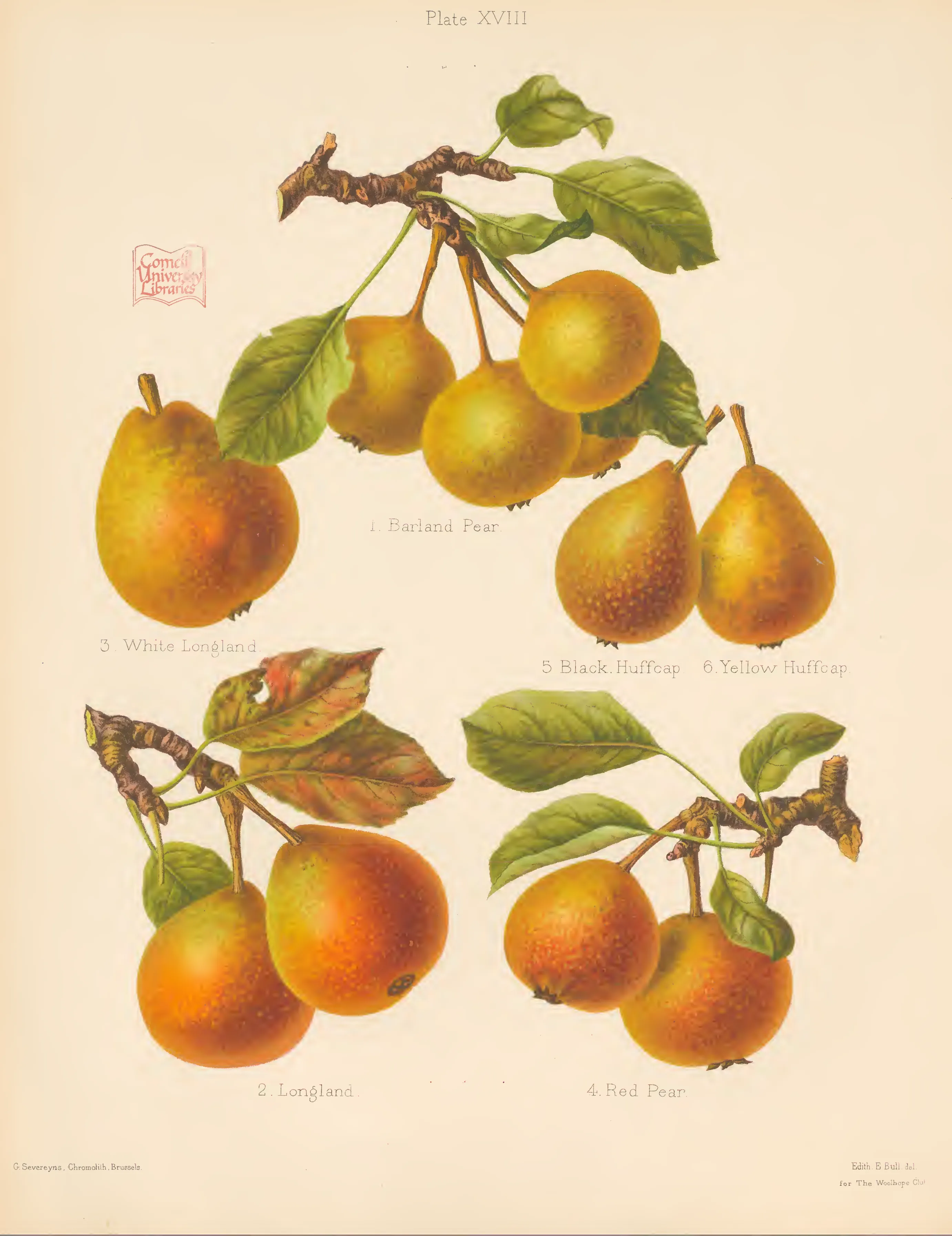
White Longland
Origin/History
The origin of this pear is unknown. It is mentioned by Dr. Beale in his Herefordshire Orchards (1657), making it one of the older documented Herefordshire varieties. It was known in that period under the name White Horse Pear, under which Dr. Beale wrote: "The White Horse Pear yields a juice somewhat near the quality of Cyder."
Tree
Not described in sources.
Fruit
Size: Medium (Hedrick).
Form: The sources give slightly differing shape descriptions: oblong, obovate, even and regular in its outline (Herefordshire Pomona); turbinate, even, regular (Hedrick).
Stem/Stalk: Half an inch long, woody, straight (Hedrick adds "straight"), inserted in a narrow and shallow cavity.
Cavity: Narrow and shallow.
Calyx/Eye: Open, with short, incurved segments.
Basin: Shallow depression (Herefordshire Pomona); shallow basin (Hedrick).
Skin: Yellowish-green on the shaded side; a thin pale red cheek on the exposed side (next the sun). Very thickly sprinkled with large russet dots and tracings (lines) of russet, with a solid patch of russet surrounding the stalk.
Flesh/Flavor: Yellowish, firm, coarse-grained, with a brisk, acid and sweet juice.
Core/Seeds: Not described in sources.
Season
Not described in sources.
Uses
A favourite pear in Herefordshire, valued primarily for its cooking qualities rather than perry. It is an excellent baking (Herefordshire Pomona) and stewing (Hedrick) pear, described as somewhat coarse and rough in flavour but notable for developing a natural deep rich red colour when cooked. It is seldom or never used alone for perry (Herefordshire Pomona), though Hedrick also notes it is used for that purpose.
Subtypes/Variants
Not described in sources.
Other
Chemical analysis of the fresh juice (conducted 1879 by Mr. G. H. With, F.R.A.S.):
- Density of fresh juice: 1.036
- Density after 24 hours' exposure to air: 1.039
- Composition per 100 parts by weight: Sugar 8.580; Tannin, Mucilage, Salts, &c. 3.408; Water 88.012
Book Sources
Described in 2 period pomological works
View original book sources (2)
— Woolhope Naturalists Field Club, The Herefordshire Pomona (1885)
- WHITE LONGLAND.
[Syn : White Horse Pear.]
The origin of this Pear seems to be unknown, but it is mentioned by Dr. Beale in his "Herefordshire Orchards" (1657).
Description.—Fruit : oblong, obovate, even and regular in its outline. Skin : very thickly sprinkled with large russet dots and tracings of russet, and with a solid patch surrounding the stalk ; on the exposed side it has a thin pale red cheek, and on the shaded side, it is yellowish green. Eye : open, with short, incurved segments, set in a shallow depression. Stalk : half an inch long, woody, inserted in a narrow and shallow cavity. Flesh : yellowish, firm, coarse-grained, briskly acid and sweet.
"The White Horse Pear," says Dr. Beale, "yields a juice somewhat near the quality of Cyder."
It is a favourite Pear in Herefordshire, not so much for its Perry—indeed it is seldom or never used alone for this purpose—as for its cooking qualities. It is an excellent baking pear, somewhat coarse and rough in flavour, but with a natural deep rich red colour."
The chemical analysis of the fresh juice from this Pear (1879) made by Mr. G. H. With, F.R.A.S., is as follows :—
Density of the fresh juice 1·036 Ditto after 24 hours exposure to the air 1·039 One hundred parts of the juice by weight contained :— Sugar 8·580 Tannin, Mucilage, Salts, &c. 3·408 Water 88·012 100
— U.P. Hedrick, The Pears of New York (1921)White Longland. 1. Hogg Fruit Man. 664. 1884.
Said to be a good stewing pear, cooking to a splendid red color, but coarse and rough in flavor; also used for perry. Fruit medium, turbinate, even, regular, yellowish-green, pale red next the sun, thickly sprinkled with large russet dots, with lines of russet and a patch round the stalk; calyx open, set in a shallow basin; stem rather short, straight, inserted in a narrow, shallow cavity; flesh yellowish, firm, coarse-grained, with a brisk, sweet juice.