White Sweeting
Apple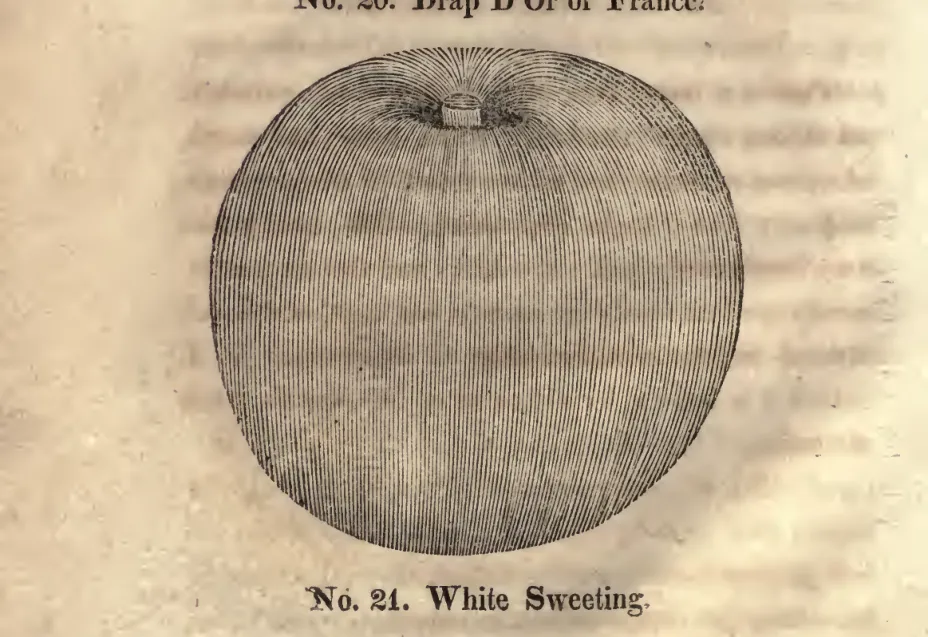
White Sweeting
Origin / History
Supposed to have originated in New Jersey (Downing; Elliott). Coxe notes it was much cultivated in the neighbourhood of Burlington, New Jersey, where it was known by the name of Wetherill's White Sweeting.
Tree
Grows very handsomely and vigorously (Coxe); vigorous and productive (Downing). Productive on light soils (Elliott). Coxe notes it thrives uncommonly well on sandy ground. Thomas calls it a great bearer.
Fruit
Size: Sources disagree. Coxe and Elliott describe the fruit as large; Downing and Thomas describe it as medium.
Form: Sources give related but differing forms. Coxe: rather of an oblong shape. Elliott: roundish oblong. Downing: roundish oblate conic. Thomas: roundish-oblate.
Stem / Stalk: Short (Elliott); slender (Downing).
Cavity: Not described in source.
Calyx: Closed (Downing).
Basin: Not described in source.
Skin: Sources vary in emphasis. Coxe: fair, pale yellow. Elliott: pale yellow. Downing: whitish with a blush of crimson in the sun. Thomas: white with a red cheek.
Flesh / Flavor: White (Coxe, Downing, Elliott). Coxe describes the flesh as sweet and tough, of a pleasant taste. Downing: not very tender, moderately juicy, mild sweet; rated Good. Elliott: sweet. Thomas: very sweet — culinary.
Core / Seeds: Not described in source.
Season
September (Coxe, Elliott); September, October (Downing); Autumn (Thomas).
Uses
Excellent food for hogs and very fine cider in September (Coxe). Valuable for stock, cider, and cooking (Downing). Valued for baking and for stock (Elliott). Culinary (Thomas).
Subtypes / Variants
Not described in source.
Other
Thomas appends the abbreviation "Me." to the entry (likely indicating Maine as a region of cultivation or note).
Book Sources
Described in 4 period pomological works
View original book sources (4)
— William Coxe, A View of the Cultivation of Fruit Trees (1817)NO. 21. WHITE SWEETING.
This is a large, fair, pale yellow apple, rather of an oblong shape ; the flesh is white, sweet, and tough, of a pleasant taste ; and makes excellent food for hogs, and very fine cider in September. The tree grows very handsomely and vigorously, and thrives uncommonly well on sandy ground : it has been much cultivated in the neighbourhood of Burlington N. J. where it is known by the name of Wetherills white Sweeting.
— A.J. Downing, The Fruits and Fruit Trees of America (1900)White Sweet.
Witherill's White Sweet. Honey Sweet of some.
Origin, supposed New Jersey. Tree vigorous, productive.
Fruit medium, roundish oblate conic, whitish with a blush of crimson in the sun. Stalk slender. Calyx closed. Flesh white, not very tender, moderately juicy, mild sweet. Good. September, October. Valuable for stock, cider, and cooking.
— F.R. Elliott, The Western Fruit Book (1865)White Sweeting.
Wetherill's White Sweeting.
From New Jersey. Tree, vigorous; productive on light soils. Fruit, large, roundish oblong, pale yellow; stem, short; flesh, white, sweet; valued for baking and for stock. September.
— John J. Thomas, The American Fruit Culturist (1903)White Sweet. Medium, roundish-oblate, white with a red cheek; very sweet—culinary. Autumn. Great bearer. Me.