Whitney
Crab Apple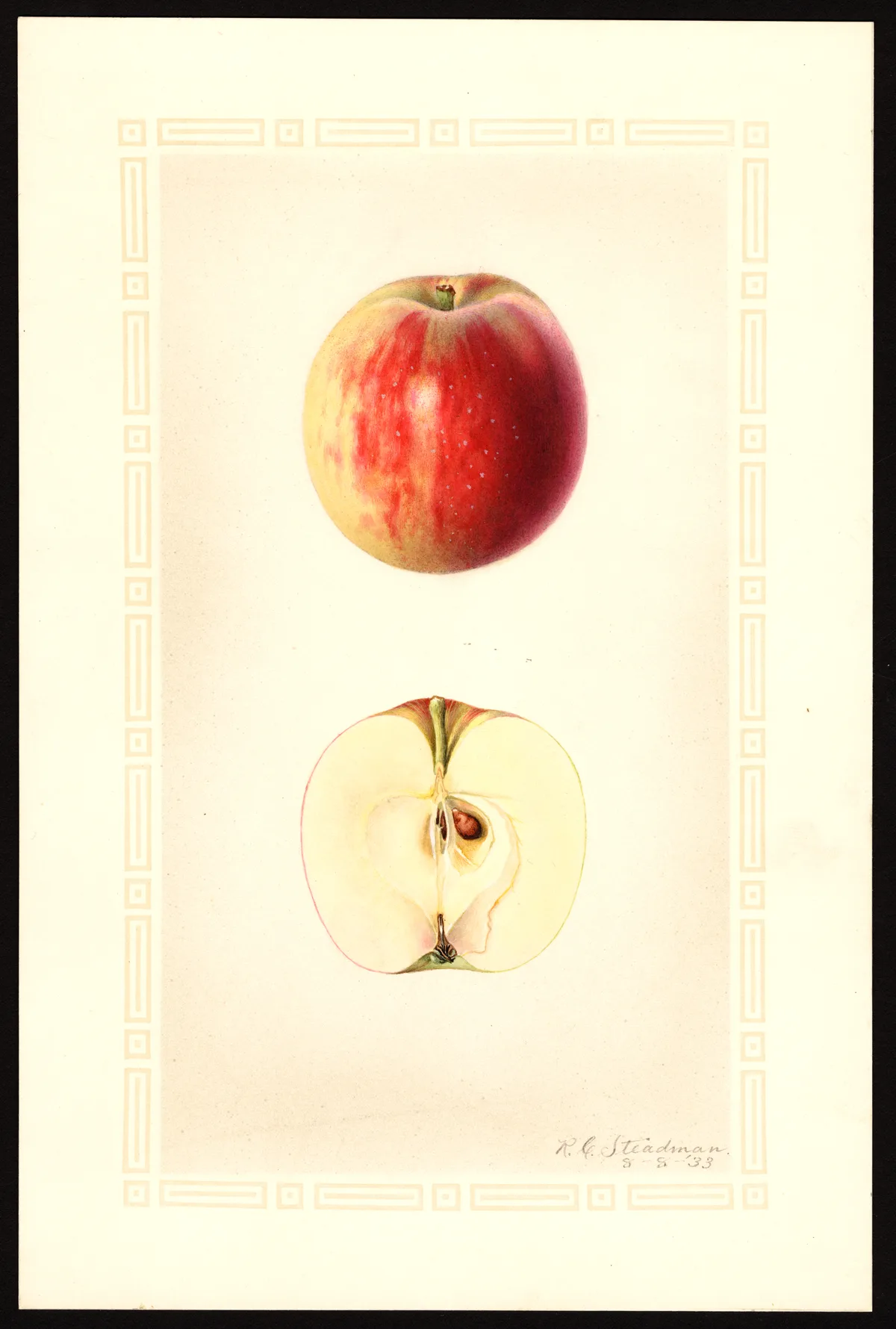
USDA Pomological Watercolor Collection
Whitney
Origin / History
Whitney originated with A. R. Whitney (Hedrick gives the initials as A. E. Whitney) of Franklin Grove, Illinois. It was at first disseminated under the name "Whitney No. 20," under which name it was described by Warder as early as 1869. The variety has been popular and widely planted in the West and North — more popular in the West than in the East — and has not been much planted in New York, though in regions farther north and west its cultivation gradually increased. It is one of the most popular of the large crabapples. At the Central Experimental Farm, Agassiz BC, trees were planted Spring 1891.
Tree
Beach describes the tree as below medium in size, with moderately stout, moderately long, curved branches; form upright, becoming somewhat spreading after fruiting heavily. Hedrick describes the tree as large, rather upright spreading, with stout, curved and drooping branches. The Agassiz catalogue notes it is a moderate grower. The tree is a thrifty, upright grower, comes into bearing young, and is very productive. Very hardy (Thomas).
Twigs short, straight, stout, with large terminal buds; internodes medium size. Bark bright brown tinged with green, lightly streaked with scarf-skin; slightly pubescent near tips. Lenticels numerous, small, oval, not raised. Buds medium to large, broad, obtuse, free, pubescent.
Fruit
Size: Medium large (Thomas) to large; pretty uniform in size and shape.
Form: Roundish, inclined to conic or to ovate (Beach); roundish to roundish oblong, nearly regular, sometimes obscurely angular (Budd-Hansen); round-oblong to oblong, sometimes conic (Hedrick). Handsome.
Stem: Slender (Beach); one inch long (Budd-Hansen); medium to long, stout (Hedrick).
Cavity: Narrow to moderately wide, rather deep, obtuse (Beach); wide, obtuse, regular, with a trace of light russet (Budd-Hansen); narrow, deep, obtuse (Hedrick).
Calyx: Medium to large, closed or partly open (Beach); closed, with segments erect convergent (Budd-Hansen); medium to large, closed or open (Hedrick).
Basin: Broad, shallow, wrinkled (Beach, Hedrick); nearly or quite flat, wrinkled (Budd-Hansen).
Skin: Light yellow, largely shaded and striped with red (Beach, Hedrick); clear waxen yellow, almost wholly covered with lively dark red, delicately shaded, with dark crimson splashes — a handsome fruit (Budd-Hansen); smooth green, splashed with carmine (Agassiz catalogue); attractive, yellow, striped with lively red (Beach summary). Dots few, minute, white, obscure (Budd-Hansen).
Flesh / Flavor: Yellowish to yellow, crisp (Beach, Hedrick) or tender (Budd-Hansen), juicy, mild subacid or nearly sweet with slight crabapple flavor (Beach); subacid (Budd-Hansen, Hedrick). Good to very good. Rich (Thomas).
Core / Seeds: Core closed; tube funnel-shaped; cells ovate, slit (Budd-Hansen).
Season
Late August and early September; ripens in late August. Hedrick notes that the season is the variety's one drawback among the best crab-apples — too early to meet the demand of housewives who postpone caring for this fruit until cooler weather.
Uses
Good for dessert / table and very good (excellent) for culinary uses; also used for cider (Budd-Hansen). For those who want a crab-apple for dessert early in the season, Whitney is about as good as any (Hedrick).
Subtypes / Variants
Not described in source.
Other
Not described in source.
Book Sources
Described in 4 period pomological works
USDA Nomenclature (1905)
From W.H. Ragan, Nomenclature of the Apple, USDA Bulletin No. 56
Possibly identical with: the following, the preceding
Nursery Catalog Sources
Found in 49 catalogs (1889–1947) from Alabama, California, Illinois, Maryland, Massachusetts, Missouri, Nebraska, New Jersey, Oregon, Pennsylvania, Washington
- California Nursery Co. , Niles , California — 1889
- William H. Moon Co. , Morrisville, Bucks County , Pennsylvania — 1890 — listed as Whitney's No. 20
- Missouri Nursery Co. , Louisiana , Missouri — 1891
- Puyallup & Yakima Nurseries , Puyallup, Washington (Lock Box 191) and North Yakima , Washington — 1892
- Milwaukie-Canby Nurseries , Canby, OR (and Milwaukie, OR) — 1893
- Oregon Wholesale Nurseries , Salem , Oregon — 1893
- Sherwood Hall Nursery Co. , Timothy Hopkins (Menlo Park Nurseries), San Francisco / Menlo Park , California — 1893
- Rogers Nursery Co. , Moorestown , New Jersey — 1893 — listed as Whitney's No. 20
- Multnomah Nurseries , Russellville , Oregon — 1894 — listed as Whitney's No. 20
- The Vineland Nurseries (Kelsey & Co. , Proprietors), St. Joseph, Missouri (Office: 13th and Atchison Sts., 2 Blocks East of the Citizens St. Car Line) — 1894 — listed as Whitney's No. 20
- Woodburn Nurseries , Woodburn, Marion Co. , Oregon — 1894 — listed as Whitney's No. 20
- The Lovett Company , Little Silver , New Jersey — 1896 — listed as Whitney's No. 20
- J.V. Cotta (Cotta Nursery) , Carroll County , Illinois — 1898 — listed as Whitney's No. 20
- Reading Nursery , Jacob W. Manning, Proprietor, Reading , Massachusetts — 1898 — listed as Whitney's No. 20
- Brown Brothers Co. , Continental Nurseries, Rochester, NY (also operated from Toronto, Canada) — 1899 — listed as Whitney's No. 20
- Central Experimental Farm , Dominion Department of Agriculture, Agassiz, British Columbia (under test; Bulletin No. 3, Second Series) — 1900
- Alabama Nursery Co. , Huntsville , Alabama — 1900 — listed as Whitney's No. 20
- Benjamin Buckman (personal inventory) , Farmingdale , Illinois — 1901
- The Dalles Nurseries , The Dalles , Oregon — 1901
- Washington Nursery Co. , Toppenish , Washington — 1901
- S.L. Watkins , Grizzly Flats, El Dorado County , California — 1901
- Brown Brothers Co. , Continental Nurseries, Rochester, NY (also operated from Toronto, Canada) — 1901 — listed as Whitney's No. 20
- Mountain Grove Nurseries (Tippin & Moore , Proprietors; Geo. T. Tippin, J. W. Tippin, J. C. Moore), Mountain Grove , Missouri — 1901 — listed as Whitney's No. 20
- Forestville Nurseries , T.J. True, Forestville , California — 1902
- Pacific Nursery Company (W. O. Hudson & A. D. Hudson) , Tangent , Oregon — 1903
- Russellville Nursery Co. , Russellville, OR (three miles east of Portland, one mile from Montavilla car line) — 1903 — listed as Whitney's No. 20
- Phoenix Nursery Company (W. E. Rossney , President; Sidney Tuttle, Vice-President), Bloomington , Illinois — 1904
- Stark Bros. Nurseries & Orchards Co. , Louisiana , Missouri — 1906
- Russellville Nursery Co. , Montavilla Station, Portland, OR (three miles east of Portland, one mile from Montavilla car line) — 1907
- Carlton Nursery Co. , Carlton , Oregon — 1909
- Washington Nursery Company , Toppenish , Washington — 1909
- Milton Nursery Co. (A. Miller & Sons , Proprietors), Milton , Oregon — 1909 — listed as Whitney's No. 20
- Wm. J. Corse (successor to Robert Sinclair / Sinclair Nurseries) , Baltimore , Maryland — 1909 — listed as Whitney's No. 20
- C.F. Lansing , Salem , Oregon — 1910
- Stark Bros. Nurseries & Orchards Co. , Louisiana , Missouri — 1910
- Stark Bros. Nurseries & Orchards Co. , Louisiana , Missouri — 1911
- Galbraith Nursery Co. (DeWitt Hansen , Pres.-Mgr.), Fairbury , Nebraska — 1911
- Stark Bros. Nurseries & Orchards Co. , Louisiana , Missouri — 1912
- Vineland Nurseries Company , Clarkston , Washington — 1912
- Pacific Nursery Company , Portland , Oregon — 1912
- Washington Nursery Company , Toppenish , Washington — 1912
- Benjamin Buckman (personal inventory) , Farmingdale , Illinois — 1913
- Van Holderbeke Nursery Co. , Incorporated, Spokane, Washington (nurseries at Otis Orchards WA, Pasadena WA, Kennewick WA) — 1913 — listed as Whitney's No. 20
- Fancher Creek Nurseries , George C. Roeding, Fresno , California — 1918
- Oregon Nursery Co. , Orenco , Oregon — 1920
- Fresno Nursery Co. , Fresno , California — 1924
- Columbia & Okanogan Nursery Co. , Wenatchee , Washington — 1925
- Milton Nursery Co. , Milton-Freewater , Oregon — 1947
- North-Western Nurseries , Walla Walla , Washington
View original book sources (5)
— John J. Thomas, The American Fruit Culturist (1903)Whitney.* Medium large, roundish, very good, handsome, rich. Very hardy. Illinois.
— S.A. Beach, The Apples of New York, Vol. 2 (1905)WHITNEY.
REFERENCES. 1. Warder, Tilt. Jour. Hort., 5:206. 1869. fig. 2. Minn. Hort. Soc. Rpt., 1876:109. 3. Am. Pom. Soc. Cat., 1881:16. 4. Barry, 1883:360. 5. Gibb, Montreal Hort. Soc. Rpt., 1884:34. fig. 6. Ib., Am. Pom. Soc. Rpt., 1885:29. 7. Thomas, 1885:529. 8. Can. Hort., 11:42. 1888. 9. Wickson, 1889:249. 10. Lyon, Mich. Hort. Soc. Rpt., 1890:300. 11. Bailey, An. Hort., 1892:252. 12. Beach, N. Y. Sta. An. Rpt., 13:584. 1894. 13. Burrill and McCluer, Ill. Sta. Bul., 45:346. 1896. 14. Farrand, Mich. Sta. Bul., 205:48. 1903. 15. Can. Hort., 26:489. 1903. figs. 16. Budd-Hansen, 1903:228.
SYNONYMS. WHITNEY (3, 10, 11, 14, 15, 16). WHITNEY CRAB (4, 7, 9). WHITNEY NO. 20 (1, 2, 5, 6, 8, 11, 12, 13). Whitney No. 20 (15, 16).
One of the most popular of the large crabapples particularly in the West and North. The fruit is attractive, yellow, striped with lively red, subacid, good for dessert and very good for culinary uses. It is in season in August and early September. The tree is a thrifty, upright grower, comes into bearing young and is very productive.
Historical. This variety originated with A. R. Whitney, Franklin Grove, Ill. (1). It was at first disseminated under the name Whitney No. 20, under which name it was described by Warder as early as 1869 (1). It has not been much planted in New York but in regions farther north and west its cultivation is gradually increasing.
TREE. Tree below medium with moderately stout, moderately long, curved branches. Form upright becoming somewhat spreading after fruiting heavily. Twigs short, straight, stout with large terminal buds; internodes medium size. Bark bright brown tinged with green, lightly streaked with scarf-skin; slightly pubescent near tips. Lenticels numerous, small, oval, not raised. Buds medium to large, broad, obtuse, free, pubescent.
FRUIT. Fruit large, pretty uniform in size and shape. Form roundish inclined to conic or to ovate. Stem slender. Cavity narrow to moderately wide, rather deep, obtuse. Calyx medium to large, closed or partly open. Basin broad, shallow, wrinkled. Skin light yellow largely shaded and striped with red. Flesh yellowish, crisp, juicy, mild subacid or nearly sweet with slight crabapple flavor, good to very good. Season late August and early September.
— J.L. Budd & N.E. Hansen, American Horticultural Manual, Part II: Systematic Pomology (1914)Whitney. (Whitney No. 20). — Origin, Illinois. Popular and widely planted at the West. Good for table and excellent for culinary use and cider.
Fruit large, roundish to roundish oblong, nearly regular, sometimes obscurely angular; clear waxen yellow, almost wholly covered with lively dark red, delicately shaded, with dark crimson splashes, a handsome fruit; dots few, minute, white, obscure; cavity wide, obtuse, regular, trace of light russet; stem one inch long; basin nearly or quite flat, wrinkled; calyx closed; segments erect convergent. Core closed; tube funnel-shaped; cells ovate, slit; flesh yellow, tender, juicy, subacid, very good. August, early September.
— U.P. Hedrick, Cyclopedia of Hardy Fruits (1922)WHITNEY. Whitney No. 20. Whitney has in full measure all the good qualities of the best crab-apples in both fruit and tree excepting one — the season. It ripens in late August, too early to meet the demand of housewives who postpone caring for this fruit until cooler weather. For those who want a crab-apple for dessert early in the season, Whitney is about as good as any. The variety was grown from seed by A. E. Whitney, Franklin Grove, Illinois, and was first described in 1869. It is more popular in the West than in the East.
Tree large, rather upright spreading, with stout, curved and drooping branches. Fruit large, uniform in size and shape, round-oblong to oblong, sometimes conic; stem medium to long, stout; cavity narrow, deep, obtuse; calyx medium to large, closed or open; basin broad, shallow, wrinkled; skin light yellow shaded and striped with red; flesh yellow, crisp, juicy, mild subacid; good to very good; late August and early September.
— Central Experimental Farm, Central Experimental Farm, Agassiz BC — Catalogue of Fruit Trees under Test (Bulletin No. 3, 1900) (1900)Planted Spring 1891. Tree a moderate grower. Fruit large. Skin smooth green, splashed with carmine. Season last of August.