William's Favorite
Apple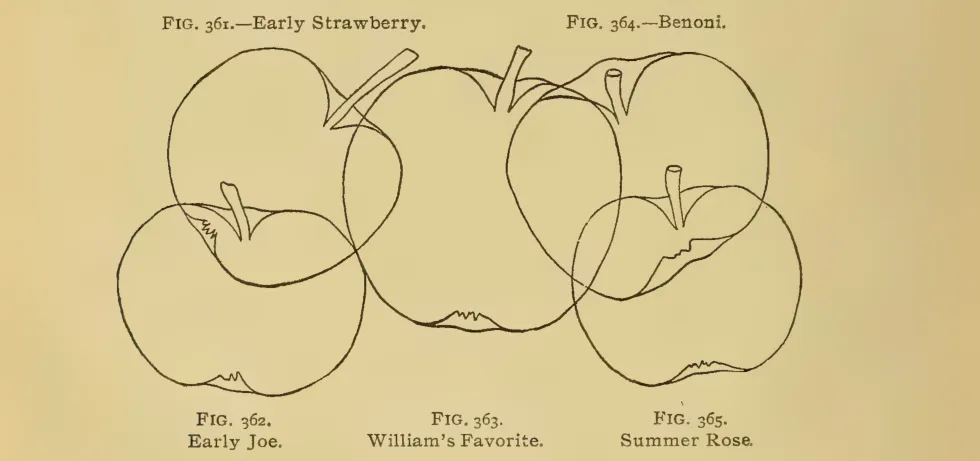
William's Favorite
Origin/History
William's Favorite originated at Roxbury, U.S.A., about 1750, and was probably introduced to England around 1828. Bunyard rates it "one of the best early dessert apples and well worthy of culture."
Tree
Growth and habit: Bunyard describes growth as moderate and rather straggling, spurring well, and fertile. The Central Experimental Farm (Agassiz, BC, planted spring 1894) records the tree as a vigorous grower — a conflict with Bunyard's assessment of moderate growth.
Leaves: Rather large, round, pale, down-hanging, undulating, and serrate (Bunyard).
Fruit
Size
Sources disagree on size. Bunyard calls the fruit medium, measuring 2¼ inches by 2¼ inches. The Central Experimental Farm describes it as above medium size. Stark Bros. (1910) calls it large.
Form
Round to oblong, conical, and irregular (Bunyard). The Central Experimental Farm similarly records oblong and conical.
Stem
Fairly long, much knobbed at each end, set in a shallow cavity (Bunyard).
Cavity
Shallow (Bunyard).
Calyx
Closed; segments reflexed at their tips (Bunyard).
Basin
Moderate in depth; a few round, bead-like knobs are present at its base (Bunyard).
Skin
Bunyard describes the ground color as pale greenish-yellow, nearly covered with a very dark crimson flush and broad stripes. The Central Experimental Farm describes the skin as bright red with streaks and splashes of deep red — consistent with heavy coverage but emphasizing the red rather than noting the underlying greenish-yellow ground.
Flesh and Flavor
Sources conflict on flesh color. Bunyard describes the flesh as soft, greenish, and aromatic. The Central Experimental Farm records the flesh as white, crisp, pleasant sub-acid, and of good quality. Stark Bros. describes the flesh as light yellow (description appears to be cut off in the source).
Core/Seeds
Not described in source.
Season
August. Dessert use.
Uses
Dessert apple. Bunyard considers it one of the best early dessert varieties.
Subtypes/Variants
Not described in source.
Other
Not described in source.
Book Sources
Described in 1 period pomological work
Nursery Catalog Sources
Found in 40 catalogs (1845–1920) from California, England, Maryland, Massachusetts, Missouri, New Jersey, New York, Oregon, Pennsylvania, Washington
- Winship's Nursery (Brighton Nurseries , operated by the Winship family), Brighton (Boston) , Massachusetts — 1845 — listed as Williams' Favorite
- Hovey & Co. , Cambridge , Massachusetts — 1849 — listed as Williams' Favorite
- Azell Bowditch (Nursery / Fruit Catalog) , Boston , Massachusetts — 1850 — listed as Williams' Favorite
- Joseph Breck & Co. , Boston , Massachusetts — 1855 — listed as Williams' Favorite
- St. Helena Nursery , Howell's Prairie, Marion County , Oregon — 1864 — listed as Williams' Favorite
- Felix Gillet , Barren Hill Nursery, Nevada City , California — 1884 — listed as Williams' Favorite
- W.R. Strong & Co. , Capital and Orange Hill Nurseries (Robert Williamson, prop.), Sacramento , California — 1886 — listed as Williams' Favorite
- Felix Gillet , Barren Hill Nursery, Nevada City , California — 1888 — listed as Williams' Favorite
- Felix Gillet , Barren Hill Nursery, Nevada City , California — 1889 — listed as Williams' Favorite
- California Nursery Co. , Niles , California — 1889 — listed as Williams' Favorite
- Felix Gillet , Barren Hill Nursery, Nevada City , California — 1890 — listed as Williams' Favorite
- William H. Moon Co. , Morrisville, Bucks County , Pennsylvania — 1890 — listed as Williams' Favorite
- Felix Gillet , Barren Hill Nursery, Nevada City , California — 1891 — listed as Williams' Favorite
- Puyallup & Yakima Nurseries , Puyallup, Washington (Lock Box 191) and North Yakima , Washington — 1892 — listed as Williams' Favorite
- Sherwood Hall Nursery Co. , Timothy Hopkins (Menlo Park Nurseries), San Francisco / Menlo Park , California — 1893 — listed as Williams' Favorite
- Woodburn Nurseries , Woodburn, Marion Co. , Oregon — 1894 — listed as Williams' Favorite
- Green's Nursery Co. (Charles A. Green) , Rochester , New York — 1894 — listed as Williams' Favorite
- Felix Gillet , Barren Hill Nursery, Nevada City , California — 1895 — listed as Williams' Favorite
- Felix Gillet , Barren Hill Nursery, Nevada City , California — 1897 — listed as Williams' Favorite
- Stark Bros. Nurseries & Orchards Co. , Louisiana , Missouri — 1898 — listed as Williams' Favorite
- Arthur J. Collins & Sons , Moorestown , New Jersey — 1898 — listed as Williams' Favorite
- Reading Nursery , Jacob W. Manning, Proprietor, Reading , Massachusetts — 1898 — listed as Williams' Favorite
- Brown Brothers Co. , Continental Nurseries, Rochester, NY (also operated from Toronto, Canada) — 1899 — listed as Williams' Favorite
- George Bunyard & Co. , Royal Nurseries, Maidstone, Kent , England — 1900 — listed as Williams' Favorite
- Brown Brothers Co. , Continental Nurseries, Rochester, NY (also operated from Toronto, Canada) — 1901 — listed as Williams' Favorite
- Stark Bros. Nurseries & Orchards Co. , Louisiana , Missouri — 1906 — listed as Williams' Favorite
- Wm. J. Corse (successor to Robert Sinclair / Sinclair Nurseries) , Baltimore , Maryland — 1909 — listed as Williams' Favorite
- Stark Bros. Nurseries & Orchards Co. , Louisiana , Missouri — 1910 — listed as Williams' Favorite
- Island Nurseries & Fruit Farm , Vashon (Vashon Island) , Washington — 1910 — listed as Williams' Favorite
- Stark Bros. Nurseries & Orchards Co. , Louisiana , Missouri — 1911 — listed as Williams' Favorite
- Island Nurseries & Fruit Farm , Vashon (Vashon Island) , Washington — 1911 — listed as Williams' Favorite
- Stark Bros. Nurseries & Orchards Co. , Louisiana , Missouri — 1912 — listed as Williams' Favorite
- Pacific Nursery Company , Portland , Oregon — 1912 — listed as Williams' Favorite
- Island Nurseries & Fruit Farm , Vashon (Vashon Island) , Washington — 1914 — listed as Williams' Favorite
- George Bunyard & Co. , Royal Nurseries, Maidstone, Kent , England — 1914 — listed as Williams' Favorite
- Island Nurseries & Fruit Farm , Vashon (Vashon Island) , Washington — 1915 — listed as Williams' Favorite
- Island Nurseries & Fruit Farm , Vashon (Vashon Island) , Washington — 1916 — listed as Williams' Favorite
- Island Nurseries & Fruit Farm , Vashon (Vashon Island) , Washington — 1917 — listed as Williams' Favorite
- George Bunyard & Co. , Royal Nurseries, Maidstone, Kent , England — 1917 — listed as Williams' Favorite
- Oregon Nursery Co. , Orenco , Oregon — 1920 — listed as Williams' Favorite
View original book sources (3)
— E.A. Bunyard, A Handbook of Hardy Fruits (1920)WILLIAM'S FAVOURITE. Dessert, August, medium, 2¼ by 2¼, round to oblong, conical, irregular. Colour, pale greenish-yellow, nearly covered with very dark crimson flush and broad stripes. Flesh, soft, greenish, aromatic. Eye, closed, segments reflexed at tips, in a moderate basin, at the base of which are a few round bead-like knobs. Stem, fairly long, much knobbed each end, in a shallow cavity. Growth, moderate, rather straggling, spurring well; fertile. Leaf, rather large, round, pale, down-hanging, undulating, serrate. Origin, at Roxbury, U.S.A., about 1750. Probably introduced to England, about 1828. One of the best early dessert apples and well worthy of culture.
— Central Experimental Farm, Central Experimental Farm, Agassiz BC — Catalogue of Fruit Trees under Test (Bulletin No. 3, 1900) (1900)Planted Spring 1894. Tree a vigorous grower. Fruit above medium size, oblong, conical. Skin bright red, with streaks and splashes of deep red. Flesh white, crisp, pleasant sub-acid, quality good. Season August.
— Stark Bros. Nurseries & Orchards Co., Stark Bros. Year Book (1910) (1910)A large and handsome dessert apple with superior merit. Flesh is light yellow...