Wilson
Apple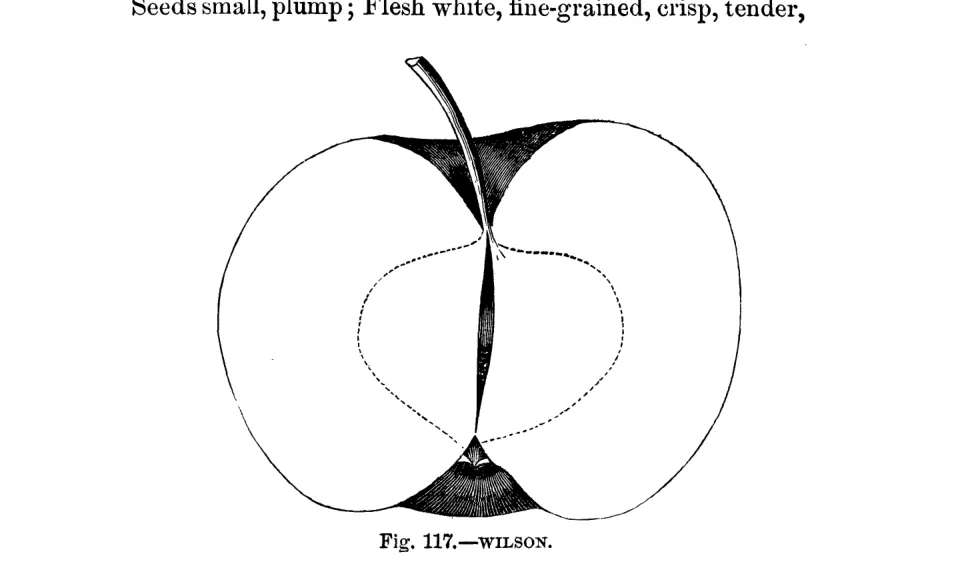
Wilson
Origin / History
Warder received Wilson from Western Virginia, sent under this name by Julius Brace, who found it abundant on Paint Creek. Warder had not been able to identify it and thought it might prove the same as some of the new southern varieties. He gave the outline and description under its local name so that, if it proved identical with the Black Annette of the Clinch river region of Virginia or some other variety, the identity might be more readily traced. Warder calls it "This very nice little apple." Warder distinguishes it from Wilson's of Michigan, which is yellow. Downing (1900) lists the Western Virginia apple as another apple under this name described by Warder, in a condensed form of Warder's description.
Tree
Not described in source.
Fruit
Size: Small.
Form: Nearly regular, oblate or globular-oblate; "roundish oblate or oblate" in Downing's condensed version.
Stem: Long, red.
Cavity: Regular, acute.
Calyx: Eye small, closed.
Basin: Deep, regular, plaited or folded.
Skin: Smooth, nearly covered with very deep red, in which the stripes are almost obscured.
Dots: Numerous, minute, white.
Flesh and flavor: Flesh white, fine-grained, crisp, tender, juicy. Flavor mild sub-acid, agreeable. Quality "best" (Warder).
Core and seeds: Core regular, closed, meeting, not clasping the eye. Seeds small, plump.
Season
January.
Uses
Table (Warder).
Subtypes / Variants
Wilson of Michigan, a different apple from the Western Virginia fruit, is yellow (Warder). Downing, citing Warder, describes it as follows: fruit large, round, slightly conic, regular; surface smooth, golden yellow; dots scattered, dark; flesh yellow, breaking, fine-grained, juicy, subacid, rich; season January, February.
Other
Not described in source.
Book Sources
Described in 2 period pomological works
USDA Nomenclature (1905)
From W.H. Ragan, Nomenclature of the Apple, USDA Bulletin No. 56
May prove to be Black Annette (Warder).
Grown by Mr. Wilson near Richmond
View original book sources (2)
— John A. Warder, American Pomology: Apples (1867)Wilson.
This very nice little apple was sent to me with this name from Western Virginia, by Julius Brace, who found it abundant on Paint Creek. I have not yet been able to identify it, but it may prove to be the same as some of our new southern varieties. An outline and description are here given with its local name, in the hope that if it should prove to be the same as the Black Annette, of the Clinch river region of Virginia, or some other variety, the identity may be the more readily traced.
Fruit small, nearly regular, oblate, or globular-oblate; Surface smooth, nearly covered with very deep red, in which the stripes are almost obscured; Dots numerous, minute, white.
Basin, deep, regular, plaited or folded; Eye small, closed.
Cavity regular, acute; Stem long, red.
Core regular, closed, meeting, not clasping the eye; Seeds small, plump; Flesh white, fine-grained, crisp, tender, juicy; Flavor mild sub-acid, agreeable; Quality best; Use table; Season January.
This is different from Wilson's of Michigan, which is yellow.
— A.J. Downing, The Fruits and Fruit Trees of America (1900)Wilson.
Of Michigan.
Fruit large, round, slightly conic, regular. Surface smooth, golden yellow. Dots scattered, dark. Flesh yellow, breaking, fine-grained, juicy, subacid, rich. January, February. (Warder.)
The same author describes another Apple under this name as from Western Virginia.
Fruit small, roundish oblate or oblate, smooth, nearly covered with very deep red, in which the stripes are almost obscured. Dots minute, white. Flesh white, fine-grained, crisp, tender, juicy, mild subacid. January.