Wormsley Pippin
Apple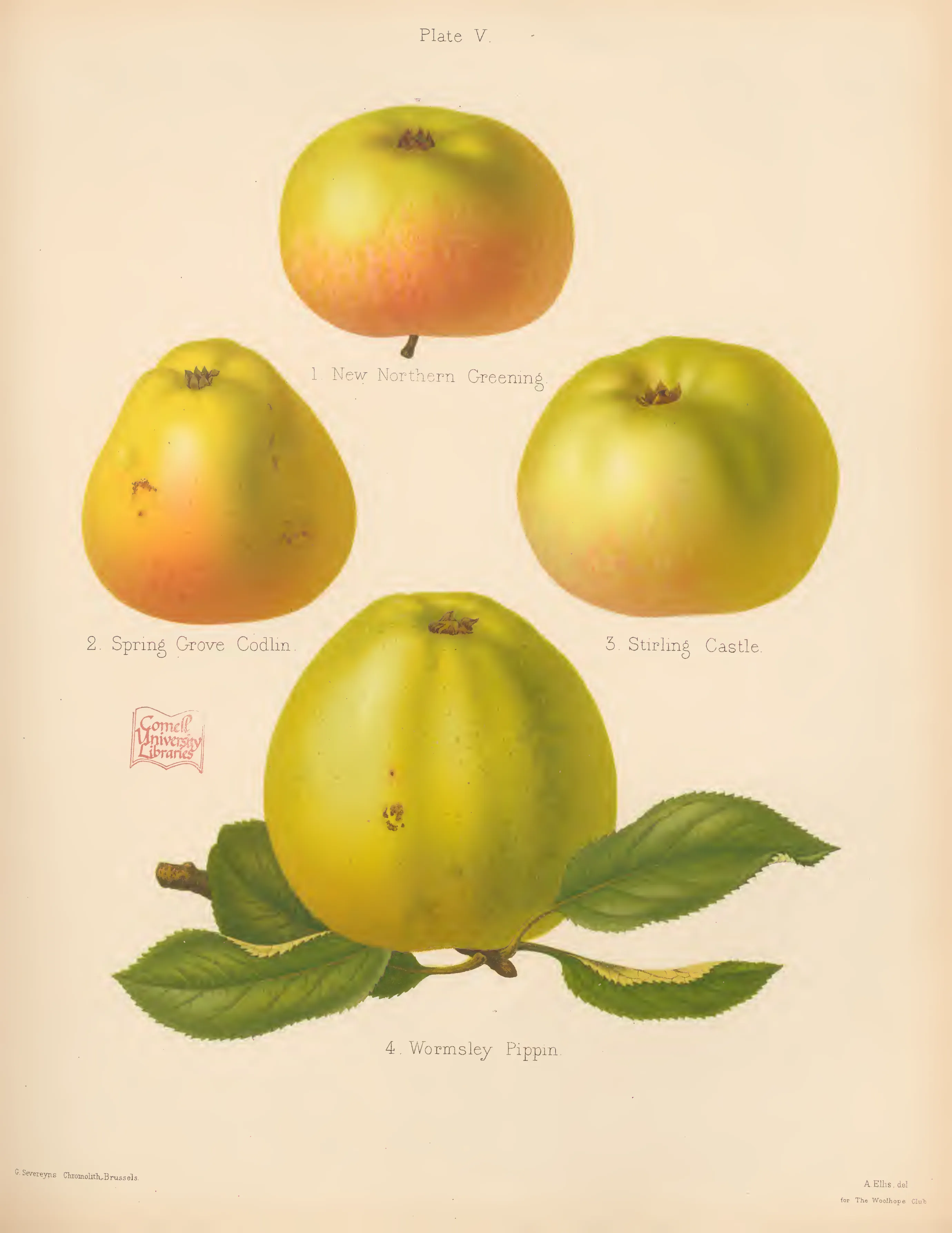
Wormsley Pippin
Origin / History
An English apple, raised by Mr. T. Andrew Knight and first brought into notice / introduced in 1811 (Herefordshire Pomona; Bunyard). It was Knight's favourite seedling apple, and (according to the Herefordshire Pomona) the best he ever produced. Downing classes it simply as "an English fruit." Elliott labels it "Foreign." Bunyard notes that by 1920 it was "seldom grown now," and references Ronalds, P. 3.
Tree
Healthy and hardy; a free grower and a free and abundant bearer (Herefordshire Pomona). Bunyard describes growth as vigorous and fertility as fair. The Herefordshire Pomona reports it has been found to succeed in every latitude of Great Britain, and that the late Sir G. S. McKenzie found it succeed well as an espalier even in Ross-shire; it "ought to be cultivated in every garden however small."
Leaf: Large, oval, bi-serrate (Bunyard).
Fruit
Size: Large — three inches and a half broad in the middle (Herefordshire Pomona, noting the coloured specimen figured is rather above the average size). Bunyard gives 3½ by 2⅞ and calls it "fairly large." Downing calls it middle-sized; Elliott calls it medium.
Form: The Herefordshire Pomona describes the fruit as narrowing both towards the base and the apex, with obtuse angles on the sides which terminate at the crown in several prominent ridges. Downing describes it as roundish, tapering a little towards the eye. Elliott: roundish. Bunyard: flat conical, regular.
Stem / Stalk: Short, inserted in a deep and round cavity which is thickly lined with russet (Herefordshire Pomona). Bunyard agrees: stem short, in a deep russet cavity.
Cavity: Deep and round, thickly lined with russet (Herefordshire Pomona); deep and russeted (Bunyard).
Calyx / Eye: Large and open, with long acuminate segments (Herefordshire Pomona); open (Bunyard).
Basin: Deep-furrowed and angular (Herefordshire Pomona); rather deep and ribbed (Bunyard).
Skin: Smooth, deep clear yellow, with a rich golden or orange tinge on the side next the sun, and covered with numerous small dark spots (Herefordshire Pomona). Downing: pale green or straw color, darker next the sun. Elliott: greenish yellow. Bunyard: yellow with orange flush.
Flesh / Flavor: Yellow, tender, crisp, rich, sugary, brisk and aromatic (Herefordshire Pomona). Downing describes the flesh as white, crisp, firm, with a sharp subacid juice; rated "Good." Elliott calls the fruit acid. Bunyard: flesh crisp, yellowish, sub-acid. The Herefordshire Pomona adds that even in the dessert, when well ripened, Mr. Knight thought it resembled the New Town Pippin in flavour. (Note: sources disagree on flesh color — yellow per Herefordshire Pomona and Bunyard, white per Downing.)
Core / Seeds: Not described in source.
Season
September and October (Herefordshire Pomona; Bunyard). Downing: September. Elliott: October, November.
Uses
A most valuable apple either for dessert or culinary purposes; as a culinary apple it is not to be surpassed, and even in the dessert when well ripened resembles the New Town Pippin in flavour (Herefordshire Pomona). Bunyard classes it as culinary.
Subtypes / Variants
Not described in source.
Other
The Herefordshire Pomona notes that the specimen of fruit coloured (figured) is rather above the average size.
Book Sources
Described in 4 period pomological works
Nursery Catalog Sources
Found in 2 catalogs (1901–1911) from England, Illinois
- Benjamin Buckman (personal inventory) , Farmingdale , Illinois — 1901
- James Veitch & Sons , Ltd., Royal Exotic Nursery, Chelsea, London (also Coombe Wood, Langley, and Feltham) , England — 1911
View original book sources (4)
— Woolhope Naturalists Field Club, The Herefordshire Pomona (1885)
- WORMSLEY PIPPIN.
[Syn. : Knights Codlin.]
This apple was first brought into notice in 1811 by Mr. T. Andrew Knight. It was his favourite seedling apple, and the best he ever produced.
Description.—Fruit; large, three inches and a half broad in the middle, and narrowing both towards the base and the apex, with obtuse angles on the sides, which terminate at the crown in several prominent ridges. Skin; smooth, deep clear yellow, with a rich golden or orange tinge on the side next the sun, and covered with numerous small dark spots. Eye; large and open, with long acuminate segments, placed in a deep-furrowed and angular basin. Stalk; short, inserted in a deep and round cavity, which is thickly lined with russet. Flesh; yellow, tender, crisp, rich, sugary, brisk and aromatic.
A most valuable apple either for dessert or culinary purposes: it is in season during September and October.
As a culinary apple it is not to be surpassed, and even in the dessert when well ripened, Mr. Knight thought it resembled the New Town Pippin in flavour.
The tree is healthy and hardy; a free grower and a free and abundant bearer. It has been found to succeed in every latitude of Great Britain; the late Sir G. S. McKenzie found it succeed well as an espalier even in Rossshire. It ought to be cultivated in every garden however small.
The specimen of fruit coloured is rather above the average size.
— A.J. Downing, The Fruits and Fruit Trees of America (1900)Wormsley Pippin. Knight's Codling. An English fruit, middle-sized, roundish, tapering a little towards the eye, pale green or straw color, darker next the sun. Flesh white, crisp, firm, with a sharp subacid juice. Good. September.
— F.R. Elliott, The Western Fruit Book (1865)Wormsley Pippin. Knight's Codlin. Foreign. Medium, roundish, greenish yellow, acid. October, November.
— E.A. Bunyard, A Handbook of Hardy Fruits (1920)WORMSLEY PIPPIN. Ronalds, P. 3. (Knight's Codlin.) Culinary, September to October, fairly large, 3½ by 2⅞, flat conical, regular. Colour, yellow with orange flush. Flesh, crisp, yellowish, sub-acid. Eye, open, in a rather deep ribbed basin. Stem, short, in a deep russet cavity. Growth, vigorous ; fertility, fair. Leaf, large, oval, bi-serrate. Origin, raised by Mr. T. A. Knight, and introduced in 1811. Seldom grown now.