Yellow Ingestrie
Apple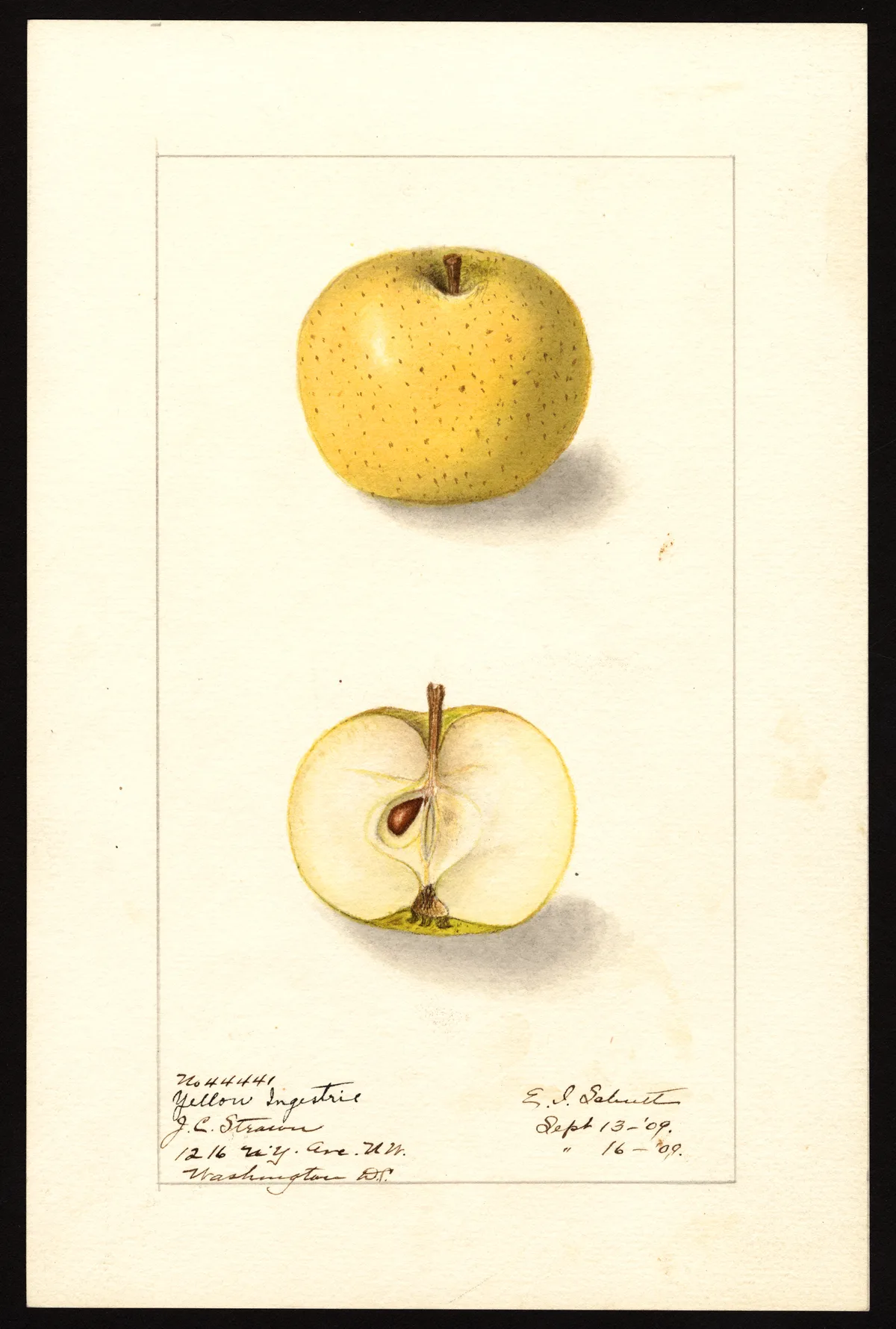
USDA Pomological Watercolor Collection
Yellow Ingestrie
Origin / History
Yellow Ingestrie is an old English variety, raised about 1800 by Thomas Andrew Knight from seed of the Orange Pippin pollinated with Golden Pippin (Hansen; Bunyard). Hansen notes that by the early 20th century it had been propagated pretty extensively in the Northwest, and was still shown at the Iowa State Fair from the central district — "too small for an apple and too large for a crab." At the Central Experimental Farm station at Agassiz, BC, it was planted in the spring of 1894 for trial.
Tree
Growth slender but fertile (Bunyard); a moderate grower and regular bearer (Central Experimental Farm). Hansen and Warder both emphasize its early and abundant productiveness. Veitch describes it as a good bearer. Leaf rather small, roundish, oval, broadly serrate (Bunyard).
Fruit
Size: Small (all sources agree). Bunyard gives dimensions of 2 by 1¼ inches.
Form: Sources describe the form in closely related but slightly varying terms. Warder: globular, truncated, regular. Downing: roundish oblate. Hansen: very regular, oblate, cylindrical, flattened at both ends. Bunyard: square-rounded, regular. Central Experimental Farm: roundish.
Surface / Skin: Smooth (Warder); unctuous (Hansen). Color is a clear bright gold (Downing), lemon yellow (Warder), a clear waxen yellow with a warm, deeper yellow cheek (Hansen), golden-yellow (Bunyard, Veitch), or bright yellow (Central Experimental Farm). Downing specifies "without red." Veitch calls it richly flavoured in addition to golden-yellow in color.
Dots: Minute (Warder); very obscure, numerous, minute, white (Hansen).
Stem: Long (Warder, Hansen); slender (Warder, Bunyard).
Cavity: Acute and brown (Warder); regular, obtuse, with considerable light stellate russet (Hansen); shallow and even (Bunyard). (Warder's "acute" and Hansen's "obtuse" represent a conflict between sources on cavity depth/angle.)
Calyx / Eye: Eye medium and open with segments reflexed (Warder); calyx closed with segments erect convergent (Hansen); eye almost closed (Bunyard). (Warder and Hansen/Bunyard disagree on whether the eye is open with reflexed segments or closed with erect-convergent segments.)
Basin: Wide, shallow, folded (Warder); smooth, wide, abrupt, regular (Hansen); shallow and wide (Bunyard).
Flesh / Flavor: Whitish yellow, breaking, juicy, sub-acid; quality "barely good" (Warder). Tender and delicate, with a plentiful juice when freshly gathered from the tree; "good" (Downing). Yellow, fine grained, firm, crisp, juicy, excellent (Hansen). Firm, yellow, sweet (Bunyard). Yellow, tender, juicy, with a pleasant flavour, quality medium (Central Experimental Farm). Crisp and spicy, "not valued" (Elliott). Richly flavoured (Veitch). (Sources conflict markedly on quality: Elliott dismisses it as "not valued," Warder calls it "barely good" and fit only for cooking, Central Experimental Farm rates it "medium," while Downing calls it "good," Hansen "excellent," and Veitch "richly flavoured.")
Core / Seeds: Core medium, oval, regular, closed, clasping (Warder); core open, clasping, with cells ovate or obovate, entire, axile, tube funnel-shaped, stamens median (Hansen). (Warder and Hansen disagree on whether the core is closed or open.) Seeds few, large, pale (Warder); few, flattened, large, pointed (Hansen).
Season
August and September, ripening in succession (Hansen). End of August to September (Bunyard). September and October (Warder; Veitch). October (Downing; Elliott; Central Experimental Farm). Veitch notes it keeps a considerable time.
Uses
Dessert (Bunyard). Cooking (Warder). Elliott records the variety as "not valued." Warder considers it too small for a profitable market fruit, but desirable on account of its early and abundant productiveness.
Subtypes / Variants
Not described in source. (Bunyard notes that the Summer Golden Pippin, sometimes confused with Yellow Ingestrie, is a distinct variety.)
Other
Not described in source.
Book Sources
Described in 5 period pomological works
Nursery Catalog Sources
Found in 3 catalogs (1900–1911) from England
- George Bunyard & Co. , Royal Nurseries, Maidstone, Kent , England — 1900 — listed as Yellow Ingestre
- Central Experimental Farm , Dominion Department of Agriculture, Agassiz, British Columbia (under test; Bulletin No. 3, Second Series) — 1900 — listed as Yellow Ingestre
- James Veitch & Sons , Ltd., Royal Exotic Nursery, Chelsea, London (also Coombe Wood, Langley, and Feltham) , England — 1911 — listed as Yellow Ingestre
View original book sources (7)
— F.R. Elliott, The Western Fruit Book (1865)Yellow Ingestre. Foreign. Small, clear yellow, crisp, spicy, not valued. October.
— John A. Warder, American Pomology: Apples (1867)Yellow Ingestrie.
This old English variety has been propagated pretty extensively in the Northwest, and though too small for a profitable market fruit, it has been found desirable on account of its early and abundant productiveness.
Fruit small, globular, truncated, regular; Surface smooth, lemon yellow; Dots minute.
Basin wide, shallow, folded; Eye medium, open; Segments reflexed.
Cavity acute, brown; Stem long, slender.
Core medium, oval, regular, closed, clasping; Seeds few, large, pale; Flesh whitish yellow, breaking, juicy; Flavor sub-acid; Quality barely good; Use, cooking; Season, September, October.
— A.J. Downing, The Fruits and Fruit Trees of America (1900)Yellow Ingestrie.
Fruit small, roundish oblate, clear bright gold color, without red. Flesh tender and delicate, with a plentiful juice when freshly gathered from the tree. Good. October.
— N.E. Hansen, A Study of Northwestern Apples (1902)Yellow Ingestrie— Originated in England about 1800 by Thomas Andrew Knight, from seed of the Orange Pippin, pollinated with Golden Pippin—Fruit small, very regular, oblate, cylindrical, flattened at both ends; surface unctuous, a clear waxen yellow with warm, deeper yellow cheek; dots very obscure, numerous, minute, white; cavity regular, obtuse, with considerable light stellate russet; stem long; basin smooth, wide, abrupt, regular; calyx closed; segments erect convergent. Core open, clasping; cells ovate or obovate, entire, axile; tube funnel-shaped; stamens median; seeds few, flattened, large, pointed; flesh yellow, fine grained, firm, crisp, juicy, excellent. August, September. Ripens in succession. An old variety still shown at the Iowa State Fair from the central district. Too small for an apple and too large for a crab.
— E.A. Bunyard, A Handbook of Hardy Fruits (1920)YELLOW INGESTRIE. Her. Pom. P. 2. F., Ingestrie jaune ; G., Gelber Peppin von Ingestrie. (Early Pippin, Summer Golden Pippin (error), White Pippin.) Dessert, end-August to September, small, 2 by 1¼, square-rounded, regular. Colour, golden-yellow. Flesh, firm, yellow, sweet. Eye, almost closed, in a shallow wide basin. Stem, slender, in a shallow, even cavity. Growth, slender ; fertile. Leaf, rather small, roundish, oval, broadly serrate. Origin, raised by Mr. T. A. Knight (Orange Pippin x Golden Pippin), about 1800. Summer Golden Pippin is distinct q.v.
Yellow Transparent : see White Transparent.
— Central Experimental Farm, Central Experimental Farm, Agassiz BC — Catalogue of Fruit Trees under Test (Bulletin No. 3, 1900) (1900)Planted Spring 1894. Tree a moderate grower and regular bearer. Fruit small, roundish. Skin bright yellow. Flesh yellow, tender, juicy, with a pleasant flavour, quality medium. Season October.
— James Veitch & Sons, Veitch's Fruit Trees (1911) (1911)small, golden-yellow and richly flavoured, a good bearer, keeping a considerable time. Sept. & Oct.