Gloria Mundi
| Gloria Mundi | |
|---|---|
| Species | Apple |
| Trees Found | 4 |
| Orchards | McCoin Lower |
| Preserved | Clarno Arboretum(2025) |

A strong rival of Shannon and its superior in several important respects. Mr. Vincenheller, of N.W. Ark., writes us: "Mammoth Pippin is a good commercial apple in Arkansas and some neighboring counties. Mammoth Pippin hangs its fruit very large, larger than Shannon; hangs well, and is a good commercial apple. It will please anyone who wants a large, showy apple." One of our best Pippins; spicy, acid; still everyone in Ark. prefers set five times as many Mammoth Pippins as Shannon. Read the full entry: Gloria Mundi on the Variety Finder for deeper history, every book quote, and all nursery catalog references.
Quick Facts
| Type | Apple |
| Season | Late (Late fall (October to November)) |
| Flavor | tart, subacid, mild |
| Flavor notes | Mildly tart, pleasant; coarse-grained flesh; best used for cooking |
| Uses | cooking, baking, exhibition |
| Keeping quality | Fair |
| Size | Very Large |
| Shape | Round |
| Skin color | yellow, green, blushed, pale, russet |
| Flesh | White crisp |
| Origin | Germany, Germany, c. 1780. Germany; late 1700s, arrived in America by 1804 |
Synonyms
American Gloria Mundi, American Mammoth, Baltimore, Baltimore Pippin, Belle Dubois, Belle Josephine, Belle du Bois, Copp's Mammoth, Glasenwood, Glazenwood Gloria Mundi, Grosse de St. Clement, Imperatrice Josephine, Josephine, Kinderhook Pippin, Mammoth, Mammoth Pippin, Melon, Mississippi, Monstreuse Pippin, Monstrous Pippin, Monstrueuse Pippin, Monstrueux Pippin, Mountain Flora, N. Y. Gloria Mundi, New York Gloria Mundi, New-York Gloria Mundi, Ox Apple, Pound, Spanisch Pippin, Spanish Pippin, Vandyne Apple
Origin and History
The exact place of origin of this apple is uncertain. In 1804 Mease stated that "it originated on the farm of Mr. Crooks, near Red Hook in New York" (cited in Beach). Thirteen years later, Coxe credited it with a Long Island, New York origin. The Herefordshire Pomona reports that the general opinion was that it originated in the garden of a Mr. Smith in the neighbourhood of Baltimore; it was introduced from America into France by Comte Lelieur in 1804, and brought over to England by Captain George Hudson, of the ship Belvidere, of Baltimore, in 1817. The Herefordshire Pomona also notes a competing claim: in the volume of the Allgemeines Teutsches Gartenmagazin for 1805, it is said to have been raised by Herr Kunstgartner Maizman, of Hanover, in which case the apple must have been taken to America by some of the Hanoverian emigrants, which would account for the multiple American localities claiming origin. The Herefordshire Pomona also notes that Dittrich (vol. III, p. 41) confounded the synonyms of the Gloria Mundi with Golden Mundi, which he described under the head of Monstrous Pepping. Downing (1900) gives origin as unknown. Bunyard reports the origin as American, first recorded in America in 1804, and introduced to England from America in 1817. Beach concludes that all that can be stated with certainty is that it is an old variety known in parts of Eastern New York, New Jersey and Pennsylvania in the beginning of the last century. Hedrick states that it was cultivated in the states of the Northeast very generally before 1804, and has since been widely distributed in the United States and Canada. Fisher (1963) records a clone received from Hudson Nur. Co., Tangent, Oregon (Station No. A341286, Reporting Station NyC), with the reported comment "Very large fruit."
Fruit
Size
Fruit of the largest size, among the largest of cultivated apples (Beach, Hedrick). Coxe gives weights of from twenty to twenty-seven ounces. The Herefordshire Pomona reports fruit immensely large, sometimes measuring four inches and a half in diameter. Bunyard gives dimensions of 4 by 3½ inches. Beach describes it as very large or large, and uniform. Elliott says "very large." Thomas says "very large." Downing (1900) says "very large."
Form
Roundish, with truncate ends, slightly conical, ribbed; sides usually unequal (Beach, Hedrick). Downing (1900) describes the form as roundish oblate, ribbed. The Herefordshire Pomona describes it as of a roundish shape, inclining to be angular on the sides, and flattened both at the base and apex. Thomas describes it as roundish, somewhat flattened at the ends, slightly angular or ribbed. Bunyard describes the form as square conical, angular. Elliott says roundish.
Stem
Short and stout (Coxe, Herefordshire Pomona, Thomas). Beach describes it as medium to short, moderately thick. Hedrick says short, thick. Bunyard says short.
Cavity
Deep (Coxe). The Herefordshire Pomona describes the cavity as deep and open, lined with rough russet. Beach describes it as large, acuminate, moderately deep to deep, broad, furrowed and compressed, sometimes slightly russeted. Hedrick gives the same description: large, acuminate, deep, broad, furrowed and compressed, sometimes russeted. Bunyard describes the cavity as very wide and deep, with russet.
Calyx / Eye
Coxe notes the eye is very deep. The Herefordshire Pomona describes the eye as large, open, and deeply set in a wide and slightly furrowed basin. Thomas says the calyx is large. Bunyard describes the eye as open. Beach describes the calyx as medium to large, open or partly closed; lobes separated at base, short, narrow. Hedrick gives the same: calyx large, open or partly closed; lobes separated at base, short, narrow.
Basin
The Herefordshire Pomona describes the basin as wide and slightly furrowed. Thomas says the basin is wide, deep, somewhat ribbed, with an obtuse rim. Bunyard describes the basin as deep, wide, and boldly ribbed. Beach describes it as large, moderately deep to deep, rather wide, somewhat abrupt, sometimes compressed, furrowed and wrinkled. Hedrick describes it as large, deep, wide, abrupt.
Skin
Coxe describes the skin, when ripe, as yellow, smooth, and full of white spots. The Herefordshire Pomona describes the skin as smooth, pale yellowish green, interspersed with white dots and patches of thin delicate russet, and sometimes tinged with a faint blush of red next the sun. Downing (1900) calls it greenish yellow. Thomas describes the skin as smooth, whitish green, becoming whitish yellow. Elliott says greenish yellow. Bunyard describes the colour as grass-green, changing to straw-yellow. Beach describes the skin as greenish-yellow, sometimes with faint bronze blush; dots small to medium, often areolar with russet center, or light colored and submerged; prevailing effect yellow or greenish. Hedrick describes the skin as tough, smooth, greenish-yellow or yellow, sometimes with faint bronze blush; dots small, often areolar with russet center, or light colored and submerged; prevailing effect yellow.
Flesh / Flavor
Coxe describes the flesh as juicy, white, tender, and sprightly, very excellent for cooking, but with not sufficient flavour for a fine table fruit, and not rich enough for cider. The Herefordshire Pomona describes the flesh as white, tender, and juicy, but not highly flavoured. Downing (1900) describes the flesh as coarse, tender, with a pleasant acid flavor, of "Good" quality. Elliott describes the flesh as white, acid. Thomas describes the flesh as white, tender, rather coarse, sub-acid, not rich. Bunyard describes the flesh as tender, white, sub-acid; he adds that it cooks a brown colour, but is very sweet and rich. Beach describes the flesh as slightly tinged with greenish-yellow, coarse, moderately crisp, rather tender, juicy, rather mild subacid, fair or nearly good in quality. Hedrick describes the flesh as yellow, coarse, crisp, tender, juicy, mild subacid, fair or good in quality.
Core / Seeds
Beach: Calyx tube very large, long, wide, broadly conical extending to core, or approaching cylindrical below. Stamens median. Core medium to rather large, usually decidedly abaxile; cells symmetrical, open; core lines usually clasping. Carpels broadly roundish to somewhat elliptical, slightly tufted. Seeds moderately dark brown, medium to rather small, rather narrow, short, plump, obtuse to acute, sometimes tufted. Hedrick: Calyx-tube very large, long, wide, broadly conical extending to core; stamens median; core large, usually abaxile; cells symmetrical, open; core-lines usually clasping; carpels broadly roundish to elliptical, tufted; seeds dark brown, small, narrow, short, plump, obtuse, sometimes tufted.
Season
October to January (Downing 1900, Beach, Hedrick). The Herefordshire Pomona gives the season as October to December. Thomas calls it late autumn and early winter. Elliott gives October, December. Bunyard says it keeps until January.
Uses
Suitable only for culinary purposes (Beach, Hedrick); seldom cultivated except for exhibition (Beach). Coxe says very excellent for cooking but lacking flavour for a fine table fruit, and not rich enough for cider. The Herefordshire Pomona calls it an excellent culinary apple. Thomas calls it a good cooking apple. Bunyard classes it as culinary, noting that it cooks a brown colour but is very sweet and rich.
Illustrations
-
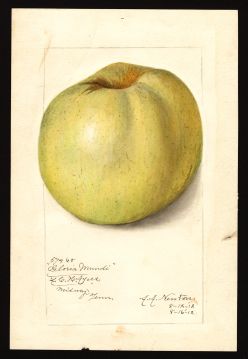 USDA Pomological Watercolor by Newton, Amanda Almira (Midway, Tennessee)
 -
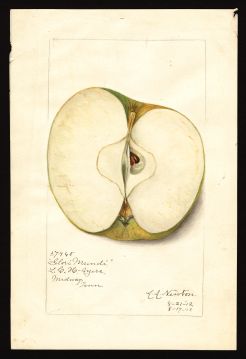 USDA Pomological Watercolor by Newton, Amanda Almira (Midway, Tennessee)
 -
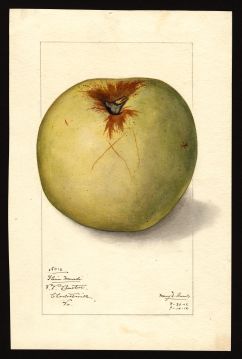 USDA Pomological Watercolor by Arnold, Mary Daisy (Charlottesville, Virginia)
 -
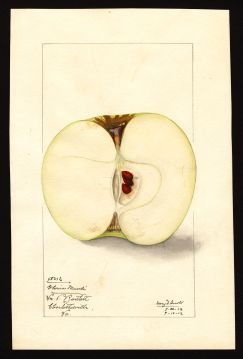 USDA Pomological Watercolor by Arnold, Mary Daisy (Charlottesville, Virginia)


U.S. Department of Agriculture Pomological Watercolor Collection. Rare and Special Collections, National Agricultural Library, Beltsville, MD 20705
Sources
- S.A. Beach, The Apples of New York Vol. 2 (1905). Public domain.
- E.A. Bunyard, A Handbook of Hardy Fruits (1920). Public domain.
- A.J. Downing, Fruits and Fruit Trees of America (1869). Public domain.
- Woolhope Naturalists' Field Club, The Herefordshire Pomona (1876–1885). Public domain.
- H.H. Fisher, A Survey of Apple Clones in the United States (USDA ARS, 1963). Public domain.
- U.P. Hedrick, Cyclopedia of Hardy Fruits (1922). Public domain.
- Coxe, A View of the Cultivation of Fruit Trees (1817). Public domain.
- F.R. Elliott, The Western Fruit Book (1865). Public domain.
- John J. Thomas, The American Fruit Culturist (1903). Public domain.
- USDA Pomological Watercolor Collection, U.S. National Agricultural Library.
- 26 historical nursery catalog references (see Variety Finder for the full list).
- Full entry with all citations: Gloria Mundi on the Variety Finder
Trees of this Variety in Our Collection
| Orchard | Tag | Condition | |
|---|---|---|---|
| McCoin Lower Tree 74 | McCoin Lower | 74 | fair |
| McCoin Lower Tree 76 | McCoin Lower | 76 | good |
| McCoin Lower Tree 77 | McCoin Lower | 77 | good |
| McCoin Lower Tree 78 | McCoin Lower | 78 | good |