Grimes Golden
| Grimes Golden | |
|---|---|
| Species | Apple |
| Trees Found | 1 |
| Orchards | Smith Homestead-Metolius |
| Preserved | Clarno Arboretum({{{clarno_year}}}) |

Undoubtedly one of the most popular of the yellow apples, a favorite commanding highest market prices year after year. A rich, golden, transparent yellow; exceedingly aromatic; large, medium to large; shape somewhat cylindrical; flesh tender, juicy, spicy and very rich. The tree is hardy, a vigorous grower, a late bloomer, and a young bearer. NCS Read the full entry: Grimes Golden on the Variety Finder for deeper history, every book quote, and all nursery catalog references.
Quick Facts
| Type | Apple |
| Season | Late (Mid to late fall (late September)) |
| Flavor | sweet, spicy, nutty, subacid, aromatic |
| Flavor notes | Spicy, sweet with nuances of nutmeg, coriander, and citrus; high sugar content; crisp, tender flesh |
| Uses | fresh eating, sauce, cider, cooking, baking |
| Keeping quality | Excellent |
| Size | Above Medium |
| Shape | Oblate Conic |
| Skin color | yellow, green, russet |
| Flesh | Yellow crisp |
| Origin | Brooke County, West Virginia, USA, c. 1805. Fowlersville (near Wellsburg), Brooke County, West Virginia, USA; discovered around 1805 on Thomas Grimes' farm |
Synonyms
Grimes, Grimes Golden Pippin, Grimes' Golden Pippin
Origin and History
Originated in West Virginia (Brooke County, Virginia at the time of original accounts) on the farm of Thomas Grimes (Warder, Downing, Beach, Hansen, Budd-Hansen, Hedrick, Elliott). It is a chance seedling (Fisher) and is reported to have been known as early as 1804, when fruit from the original tree was sold to New Orleans traders (Beach, Fisher). Warder notes the variety was introduced to the State Pomological Society by S. B. Marshall of Massillon, Ohio, who obtained it from N. Wood of Belmont County. In its native locality it was highly prized for the peculiar hardihood of the tree, which withstood the most severe winters uninjured and never broke in its limbs, as well as for its uniform regular annual productiveness (Downing). It became generally disseminated throughout the Ben Davis regions of the South, West, and Southwest, where it is often planted for home use and highly esteemed as a dessert apple, though not extensively grown in commercial orchards (Beach). Hedrick (1922) notes its culture is confined to the Virginias and adjoining states, plus Indiana, Illinois, and Missouri. In the West, this variety and Jonathan were considered the standard of high quality, nothing better known (Hansen, Budd-Hansen). It has long been known in scattering localities in New York with old trees found in some orchards, but it never became generally planted there; as grown in New York it does not develop in size, color, or quality as well as in more southern latitudes, with a high percentage of loss from drops and culls (Beach). Hedrick characterizes it as a "universal favorite wherever it can be grown" despite its faults. Fisher reports it as susceptible to bitter rot and fire blight, and not reliably hardy under some conditions.
Fruit
Size: Full medium (Warder); medium (Downing, Lowther, Elliott, Central Experimental Farm); above medium (Hansen, Budd-Hansen, Thomas); medium to large (Beach, Hedrick, Fisher).
Form: Cylindrical, regular (Warder); roundish oblate (Lowther); roundish, slightly oblong, regular (Thomas); oblong flattened (Elliott); roundish oblate, slightly conical (Downing); roundish oblong (Central Experimental Farm); regular, cylindrical, sometimes roundish oblate (Hansen, Budd-Hansen); roundish oblong, often flattened at the ends, sometimes inclined to conic, pretty regular, sometimes obscurely ribbed, sometimes oblique, symmetrical, uniform; sides often unequal (Beach, Hedrick); round-oblong, slightly inclined to conical (Fisher).
Stem: Long, curved (Warder); rather short and slender (Downing); slender, in a deep cavity (Thomas); medium (Hansen, Budd-Hansen); short to medium (Beach); short (Hedrick).
Cavity: Wide, regular, green (Warder); rather deep, sometimes slightly russeted (Downing); deep (Thomas); regular, obtuse, slightly russeted (Hansen, Budd-Hansen); broad, deep, acute to acuminate, often russeted (Beach); broad, deep, acute, often russeted (Hedrick).
Calyx / Eye: Eye large, closed (Warder); calyx closed, or partially open (Downing); calyx closed or half open, segments divergent (Hansen, Budd-Hansen); calyx rather large, closed; lobes long, reflexed, often separated at base (Beach); calyx large, closed; lobes long, reflexed, often separated at base (Hedrick). Calyx tube yellow, very broad at the top, conical, deep; stamens basal (Beach, Hedrick, Hansen, Budd-Hansen).
Basin: Abrupt, folded (Warder); abrupt, uneven (Downing); deep, slightly wrinkled (Thomas); deep, abrupt, uneven, somewhat wrinkled (Hansen, Budd-Hansen); abrupt, deep or moderately deep, rather wide, somewhat furrowed (Beach); abrupt, deep, wide, furrowed (Hedrick).
Skin / Color / Dots: Yellow, vein-russeted; dots numerous, minute (Warder). Skin uneven; color rich golden yellow, sprinkled moderately with small gray and bright dots (Downing). Skin yellow, with large russet dots (Thomas). Golden yellow (Elliott). Greenish yellow (Lowther). Rich golden yellow, sprinkled with small gray dots (Central Experimental Farm). Surface rich golden yellow, sometimes with thin open net-veining of russet; dots obscure, many, white, minute, with a few russet dots (Hansen, Budd-Hansen). Skin tough, somewhat rough, clear deep yellow with scattering pale yellow or russet dots (Beach). Skin tough, deep yellow with scattering pale yellow or russet dots (Hedrick). Skin tough, deep yellow with russet dots (Fisher). Hedrick summarizes the outstanding merits as "beautiful rich golden color, well-moulded form."
Flesh / Flavor: Yellow, firm, breaking, very fine-grained, juicy; flavor sub-acid, aromatic, spicy, rich, refreshing (Warder). Yellow, compact, crisp, tender, juicy, rich, sprightly, spicy subacid, peculiar aroma (Downing). Yellowish white, sub-acid (Elliott). Yellowish white, with a mild sub-acid, agreeable, very good flavor (Thomas). Yellow, crisp, firm, juicy, with a rich pleasant flavour (Central Experimental Farm). Yellow, firm, compact, crisp, aromatic, rich, spicy subacid (Hansen, Budd-Hansen). Yellow, very firm, tender, crisp, moderately coarse, moderately juicy, subacid, rich, aromatic, sprightly (Beach). Yellow, very firm, tender, crisp, coarse, juicy, subacid, rich, aromatic, sprightly (Hedrick). Yellow, very firm, crisp, juicy, subacid, rich aromatic (Fisher). Hedrick highlights "firm but crisp and tender flesh, pleasantly acidulous flavor, and most pleasant aroma." Quality very best (Warder, Hansen, Budd-Hansen); very good to best (Beach, Hedrick); very good (Lowther, Central Experimental Farm, Thomas, Fisher); "very good" (Elliott).
Core / Seeds: Core small, pyriform, closed, meeting the eye; seeds numerous, plump, brown (Warder). Core rather small (Downing). Core small, slightly open, pyriform, meeting; cells obovate; tube conical; stamens basal; seeds many, short, plump (Hansen, Budd-Hansen). Core medium to rather small, somewhat abaxile; cells usually pretty symmetrical, closed or somewhat open; core lines meeting or somewhat clasping; carpels roundish, emarginate, concave; seeds numerous, medium or below, somewhat tufted, plump, acute to obtuse (Beach). Core small, abaxile; cells symmetrical, closed or open; core-lines meeting; cells roundish, emarginate, concave; seeds numerous, tufted, plump, acute (Hedrick).
Season
January to March (Warder, Elliott, Central Experimental Farm, Hansen, Budd-Hansen). December to March (Downing). November (Thomas). November to January or February; commercial limit, December or January (Beach). November to January or February (Hedrick). Winter (Lowther). Nov.–Jan., Feb. (Fisher). Beach notes it is in season about with Hubbardston. It is not a good keeper and is apt to scald in storage (Beach, Hedrick).
Uses
Dessert, "too good for aught else"; those who have tried it say it is excellent for cooking (Warder). Excellent for dessert or culinary use (Beach). Family use (Lowther). Unexcelled for home use (Thomas). Highly esteemed as a dessert apple in the South, West, and Southwest (Beach). Fall, yellow dessert apple; dual purpose (Fisher). Hardly a standard market variety, but in some markets it sells well; some few New York fruit growers consider it a fairly profitable variety, but generally it has failed to become a standard apple either in home or commercial orchards of New York (Beach).
Illustrations
-
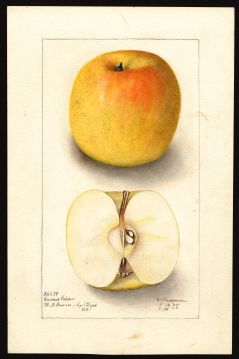 USDA Pomological Watercolor by Passmore, Deborah Griscom
 -
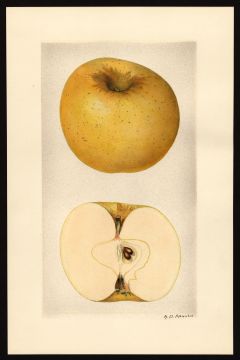 USDA Pomological Watercolor by Arnold, Mary Daisy (Winchester, Virginia)
 -
 USDA Pomological Watercolor by Steadman, Royal Charles (Arlington, Virginia)


U.S. Department of Agriculture Pomological Watercolor Collection. Rare and Special Collections, National Agricultural Library, Beltsville, MD 20705
Sources
- John A. Warder, American Pomology: Apples (1867). Public domain.
- H.H. Fisher, A Survey of Apple Clones in the United States (USDA ARS, 1963). Public domain.
- N.E. Hansen, A Study of Northwestern Apples (South Dakota Ag. Exp. Station Bulletin 76, 1902). Public domain.
- S.A. Beach, The Apples of New York Vol. 1 (1905). Public domain.
- J.L. Budd & N.E. Hansen, American Horticultural Manual, Part II: Systematic Pomology (1914). Public domain.
- Granville Lowther (ed.), Encyclopedia of Practical Horticulture (1914). Public domain.
- U.P. Hedrick, Cyclopedia of Hardy Fruits (1922). Public domain.
- John J. Thomas, The American Fruit Culturist (1903). Public domain.
- A.J. Downing, Fruits and Fruit Trees of America (1869). Public domain.
- F.R. Elliott, The Western Fruit Book (1865). Public domain.
- USDA Pomological Watercolor Collection, U.S. National Agricultural Library.
- 52 historical nursery catalog references (see Variety Finder for the full list).
- Full entry with all citations: Grimes Golden on the Variety Finder
Trees of this Variety in Our Collection
| Orchard | Tag | Condition | |
|---|---|---|---|
| Smith Homestead-Metolius Tree 3 | Smith Homestead-Metolius | 3 | fair |