Mann
| Mann | |
|---|---|
| Species | Apple |
| Trees Found | 0 |
| Orchards | |
| Preserved | Clarno Arboretum({{{clarno_year}}}) |

Downing describes the fruit as follows: "Fruit medium to large, roundish, oblate, nearly regular; skin deep yellow when fully ripe, often with a shade of brownish red where exposed, and thickly sprinkled with light and gray dots, a few being areole; stalk short, rather small; cavity medium or quite large, sometimes slightly corrugated; flesh yellowish, half-fine, half-tender, juicy, mild, pleasant, subacid; good to very good." Tree very hardy, grows straight and symmetrical, and makes a large tree in the orchard; it is an early and annual bearer. Said to be a good keeper. Read the full entry: Mann on the Variety Finder for deeper history, every book quote, and all nursery catalog references.
Quick Facts
| Type | Apple |
| Season | Winter |
| Flavor | subacid, mild |
| Uses | cooking, fresh eating |
| Keeping quality | Good |
| Size | Above Medium |
| Shape | Round |
| Skin color | yellow, green, red, blushed, russet |
| Flesh | Yellow tender |
| Origin | New York, USA, c. 1870 |
Synonyms
Deiltz, Manx
Origin and History
Mann originated as a chance seedling in the orchard of Judge Mooney of Granby, Oswego County, New York (Downing; Beach; Hedrick), about 1870 (Hedrick). It was formerly called the Deiltz. It was introduced into Niagara County by Dr. Mann, and on the suggestion of Elisha Moody of Lockport the Western New York Horticultural Society named the apple Mann. Beach (1905) noted it was not grown extensively in any portion of the state but was still being planted to a limited extent by commercial growers. Hedrick (1922) wrote that "by virtue of several good qualities, Mann gained a high reputation a quarter of a century ago," but with the advent of better orchard care and improved shipping and transportation facilities, the need for a general-purpose apple of this type began to wane, and Mann was doomed to lose the commercial importance it had acquired. It is most commonly grown in New York. Recorded as received from AES, Ithaca, N.Y., in 1956 by the Agricultural Experiment Station, Department of Pomology, Geneva, New York (Fisher, 1963).
In commerce, Mann was used by the trade to some extent as a substitute for Rhode Island Greening late in the season, when it often brought good prices, though decidedly inferior to Rhode Island Greening in quality and not always having a good clear green color, being sometimes streaked more or less with a network of russet (Beach).
Fruit
Size: Medium to large (Downing; Beach; Hedrick; Thomas; Lowther, medium); large (Central Experimental Farm; Thomas). Pretty uniform in size and shape (Beach; Hedrick).
Form: Roundish, somewhat inclined to oblate (Beach); roundish oblate (Downing; Thomas; Lowther; Central Experimental Farm); round-oblate (Hedrick); symmetrical, usually pretty regular, sometimes faintly ribbed (Beach; Hedrick); nearly regular (Downing).
Stem: Short to medium (Beach), short, rather small (Downing), usually not exserted (Beach; Hedrick).
Cavity: Acuminate, rather narrow to moderately wide (Beach; Hedrick, narrow), deep, usually russeted, and often with outspreading broken russet, somewhat furrowed (Beach; Hedrick). Downing describes it as medium or quite large, sometimes slightly russeted.
Calyx: Small to medium (Beach), small (Hedrick), closed or partly open (Beach; Hedrick); generally closed (Downing); lobes medium in length, acute (Beach; Hedrick, lobes acute). Calyx tube moderately wide, cone-shape (Beach); calyx-tube wide, cone-shape (Hedrick).
Basin: Somewhat abrupt (Beach), abrupt (Hedrick), rather narrow to moderately wide (Beach), narrow (Hedrick), usually pretty symmetrical, furrowed and wrinkled (Beach; Hedrick); Downing describes it as rather large, slightly corrugated.
Skin: Moderately thick (Beach), thick (Hedrick), tough; at first deep green (Beach; Hedrick), often partly overspread with a brownish-red blush tinged with shade of olive-green, but late in the season it develops a pronounced yellow color (Beach; Hedrick). Downing: skin deep yellow when fully ripe, often with a shade of brownish red where exposed. Thomas: yellow, with a brownish-red cheek. Central Experimental Farm: greenish yellow, washed with red, cheek in the sun. Lowther lists color simply as red.
Dots: Numerous, large, conspicuous, areolar, whitish/white with russet center (Beach; Hedrick); Downing notes the fruit is thickly sprinkled with light and gray dots, a few being areole; the Central Experimental Farm describes the skin as freely sprinkled with gray dots.
Flesh / Flavor: Flesh yellowish (Beach; Downing), yellow (Hedrick), yellowish white (Central Experimental Farm); moderately coarse (Beach), coarse (Hedrick); half fine, half tender (Downing); firm, crisp (Central Experimental Farm); moderately juicy (Beach), juicy (Downing; Hedrick; Thomas; Central Experimental Farm); at first very hard and firm but later becoming moderately tender and somewhat crisp (Beach), at first hard but becoming tender and crisp (Hedrick); subacid (Beach; Hedrick), mild pleasant subacid (Downing), mildly sub-acid, pleasant (Central Experimental Farm), mild (Thomas). Quality fair to good (Beach; Hedrick), good (Thomas; Central Experimental Farm), good to very good (Downing), very good (Lowther). Beach characterizes the apple as "hard, green, late-keeping" and "decidedly inferior to Rhode Island Greening in quality"; Hedrick describes the apples as "of the Rhode Island Greening type, but mediocre in quality."
Core / Seeds: Core medium (Downing); core below medium to small (Beach), small (Hedrick), usually axile or nearly so; cells pretty symmetrical, usually closed, sometimes open; core lines meeting or slightly clasping (Beach), core-lines meeting (Hedrick). Carpels smooth, broad, narrowing towards the base and apex or approaching truncate at the base, but slightly emarginate if at all (Beach); carpels smooth, broad, narrowing towards the base and apex (Hedrick). Seeds numerous, medium or above (Beach), wide, obtuse to acute (Beach), wide, obtuse (Hedrick), dark. Stamens below median to basal (Beach); stamens median (Hedrick).
Season
A late keeper (Downing; Beach). Downing: January, April. Thomas: keeps till April. Hedrick: March to April. Central Experimental Farm: January and February. Lowther: winter. Beach: commercial limit March or April in ordinary storage and May in cold storage.
Uses
Valuable for market and cooking, and a fair table fruit (Downing). Both kitchen and market (Lowther). Used by the trade as a late-season substitute for Rhode Island Greening, often bringing good prices (Beach). The fruit keeps and ships well (Hedrick); Beach notes the smoothness, uniformity, and superior keeping and shipping qualities of the fruit as great merits.
Illustrations
-
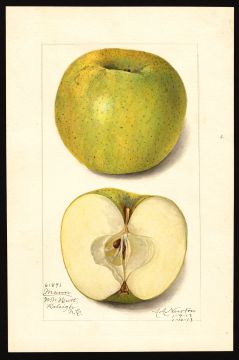 USDA Pomological Watercolor by Newton, Amanda Almira (Raleigh, Wake, North Carolina)
 -
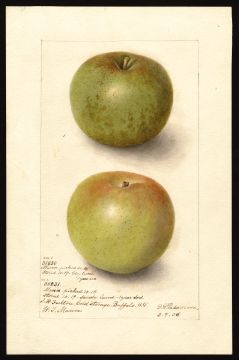 USDA Pomological Watercolor by Passmore, Deborah Griscom (Barker, Niagara, New York)
 -
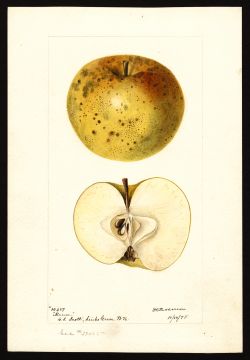 USDA Pomological Watercolor by Passmore, Deborah Griscom (Sinks Grove, Monroe, West Virginia)
 -
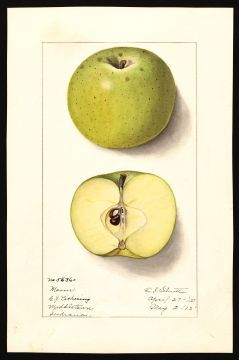 USDA Pomological Watercolor by Schutt, Ellen Isham (Middletown, Allen, Indiana)
 -
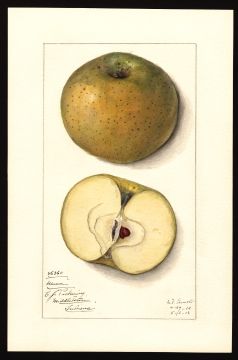 USDA Pomological Watercolor by Arnold, Mary Daisy (Middletown, Allen, Indiana)
 -
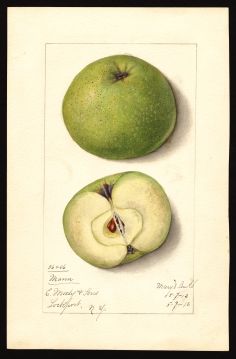 USDA Pomological Watercolor by Arnold, Mary Daisy (Lockport, Niagara, New York)
 -
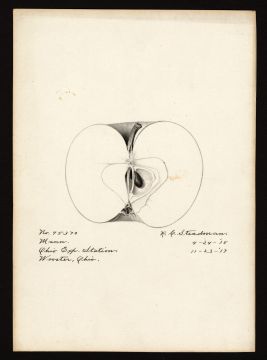 USDA Pomological Watercolor by Steadman, Royal Charles (Wooster, Wayne, Ohio)
 -
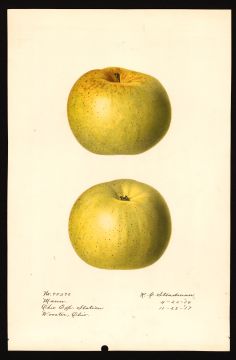 USDA Pomological Watercolor by Steadman, Royal Charles (Wooster, Wayne, Ohio)


U.S. Department of Agriculture Pomological Watercolor Collection. Rare and Special Collections, National Agricultural Library, Beltsville, MD 20705
Sources
- S.A. Beach, The Apples of New York Vol. 1 (1905). Public domain.
- Granville Lowther (ed.), Encyclopedia of Practical Horticulture (1914). Public domain.
- H.H. Fisher, A Survey of Apple Clones in the United States (USDA ARS, 1963). Public domain.
- U.P. Hedrick, Cyclopedia of Hardy Fruits (1922). Public domain.
- John J. Thomas, The American Fruit Culturist (1903). Public domain.
- A.J. Downing, Fruits and Fruit Trees of America (1869). Public domain.
- USDA Pomological Watercolor Collection, U.S. National Agricultural Library.
- 29 historical nursery catalog references (see Variety Finder for the full list).
- Full entry with all citations: Mann on the Variety Finder