Northern Spy
| Northern Spy | |
|---|---|
| Species | Apple |
| Trees Found | 4 |
| Orchards | Cyrus,Haystack,McCoin Lower |
| Preserved | Clarno Arboretum(2025) |

Large, roundish, slightly conical, somewhat ribbed; striped, with the sunny side nearly covered with purplish red; flesh white and tender, with a mild sub-acid, rich and delicious flavor; in perfection in January and keeps till June. The tree is a strong, upright grower, and forms a very compact head; should be kept open by pruning, so as to admit the air and light freely. Originated about 1800, at East Bloomfield, N.Y. Read the full entry: Northern Spy on the Variety Finder for deeper history, every book quote, and all nursery catalog references.
Quick Facts
| Type | Apple |
| Season | Late (Very late fall (late October to early November)) |
| Flavor | sweet tart, aromatic, subacid, spicy |
| Flavor notes | Sweet-tart in perfect balance; aromatic, crisp, juicy; excellent crunch |
| Uses | pies, baking, fresh eating, cider, cooking |
| Keeping quality | Excellent |
| Size | Large |
| Shape | Round |
| Skin color | striped red, red, yellow, green, russet, crimson, striped, blushed, light, orange, pale, pink |
| Flesh | White fine |
| Origin | Ontario County, New York, USA, c. 1800. East Bloomfield, Ontario County, New York, USA; seeds planted around 1800, first fruited around 1825-1830 |
Synonyms
Spy, Späher des Nordens
Origin and History
Originated in a seedling orchard at East Bloomfield, New York (near Rochester), famous also for producing the Early Joe and the Melon. The orchard was planted by Heman Chapin (also spelled Herman Chapin in Lowther 1914) about 1800 with seedling trees grown from seeds brought from Salisbury, Connecticut (Beach 1905; Hovey 1852 gives "nearly fifty years ago" as of 1852, i.e., ca. 1802–1803). The original tree died before bearing. Sprouts/suckers from the original tree were taken up and planted by Roswell Humphrey, and it was by Humphrey that the first fruit of the Northern Spy was raised. In 1847 nine of the trees set out by Humphrey were still living (Beach 1905). Bunyard (1920) gives the origin as "at the orchard of Mr. R. Humphrey, East Bloomfield, New York, soon after 1840," differing from other sources in attribution and date.
The variety was confined to the vicinity of its origin for many years and did not begin to attract the attention of fruit growers in other localities until about 1840 or 1841, when very fine specimens were seen in Rochester as late as May and, on inquiry, proved to be "an entirely new and remarkable seedling variety" (Hovey 1852; Beach 1905). In 1852 the American Pomological Society listed it both as a new variety of promise and as a variety worthy of general cultivation. Since that time it has become extensively planted in New York and throughout the more northern apple-growing regions, its culture spreading westward to the Pacific (Hedrick 1922).
In commercial importance it ranks third among New York apples, surpassed only by Baldwin and Rhode Island Greening (Beach 1905; Lowther 1914). Lowther (1914) states it is "perhaps the very best apple for Michigan, being peculiarly adapted to the soils of that region," and notes that in the Pacific Northwest it does not do so well as in some other sections. Thomas (1903) notes it "succeeds throughout the North and Northwest, but less valuable farther South." Bunyard (1920) notes "this apple only does well in England in very favourable years." Earlier citations appear in Florist and Pomologist 1862 p. 8 and in the German name "Spaeher des Nordens" (Bunyard 1920).
Fruit
Size
Large to very large (Warder 1867; Downing 1900; Beach 1905; Budd-Hansen 1914; Hedrick 1922; Lowther 1914); Elliott (1865) says "medium to large"; Bunyard (1920) says "medium, 2⅜ by 2¼." Hovey (1852) gives "about two and a half inches deep, and three and a half broad," with many specimens measuring twelve inches in circumference. Beach (1905) notes that "except when it is seedless" the fruit is usually large or very large.
Form
Roundish-conical, often flattened at the base, sometimes oblong, nearly symmetrical, often noticeably ribbed/angular; tapering much toward the crown, which is small (Beach 1905; Hovey 1852; Thomas 1903; Elliott 1865; Bunyard 1920 "round conical, almost regular"; Hedrick 1922; Warder 1867 "flattened-conical, angular"; Downing 1900 "roundish oblate conical"; Budd-Hansen 1914 "roundish, oblate, conical, obscurely angular"; Central Experimental Farm 1900 "roundish, conical").
Stem / Stalk
Medium to short (Warder 1867); short, about half an inch in length, rather slender, very deeply inserted (Hovey 1852); three-fourths of an inch long, rather slender (Downing 1900); slender, projecting about even with the surface (Elliott 1865); medium to long, moderately thick (Beach 1905); medium, rather slender (Budd-Hansen 1914); thick (Hedrick 1922); very long, slender (Bunyard 1920). Thomas (1903) says "stalk and calyx deep set."
Cavity
Wide and deep, described as wide, regular or wavy, brown (Warder 1867); very wide, deep cavity, sometimes marked with russet (Downing 1900); large, very wide, open (Hovey 1852); open, wide, deep (Elliott 1865); large, acute, very wide and deep, often broadly furrowed, usually with greenish-russet radiating upwards to the brim (Beach 1905; Hedrick 1922); very wide, deep, sometimes with radiating russet (Budd-Hansen 1914); very wide and deep, faintly russet veined (Bunyard 1920).
Calyx / Eye
Eye/calyx small, closed (Warder 1867; Downing 1900; Beach 1905; Hedrick 1922; Budd-Hansen 1914; Elliott 1865; Bunyard 1920; Hovey 1852 "small, and rather deeply sunk"); sometimes partly open (Beach 1905). Lobes/segments short, broad, obtuse (Beach 1905; Hedrick 1922); segments flat convergent, very small (Budd-Hansen 1914). Calyx-tube sometimes large, long, cone-shape but more often narrow and somewhat funnel-form with very narrow cylinder (Beach 1905; Hedrick 1922 "large, long, narrow funnel-form with very narrow cylinder"); tube funnel-shaped (Budd-Hansen 1914). Stamens basal or nearly so (Beach 1905; Hedrick 1922); stamens median (Budd-Hansen 1914), a conflict between sources.
Basin
Abrupt, regular, or folded (Warder 1867); narrow, abrupt, furrowed (Downing 1900; Budd-Hansen 1914); medium sized, somewhat ribbed, and abruptly depressed (Hovey 1852); open, regular (other than the furrows produced by ribs of the fruit), not deep but rather abrupt (Elliott 1865); small to medium, narrow to medium in width, moderately deep, abrupt, usually somewhat furrowed (Beach 1905); small, narrow, deep, abrupt, furrowed (Hedrick 1922); shallow ribbed basin (Bunyard 1920).
Skin
Thin, tender, and smooth (Downing 1900; Beach 1905; Hedrick 1922; Elliott 1865). In highly colored specimens it is glossy, with the clear pale yellow ground color nearly concealed with bright pinkish-red mottled and splashed with carmine and overspread with a thin delicate bloom (Beach 1905; Hedrick 1922). Warder (1867) describes surface as "smooth, yellow, mixed, and splashed, scarlet, or crimson." Downing (1900): "in the shade greenish or pale yellow, in the sun covered with light and dark stripes of purplish red, marked with a few pale dots, and a thin white bloom." Hovey (1852): "yellow on the shady side, but nearly covered with bright glossy red and distinct stripes of rich purplish crimson, extending nearly to the eye; often having a blotch of russet around the stem, marked with scattered yellow specks, and partially covered with a thin white bloom"; "rich, deep crimson skin, with purplish stripes, and covered with a soft bloom, like the Red Astrachan." Elliott (1865): "light yellow, mostly overspread with light red, striped and slashed with streaks of carmine red, and, when first gathered, covered with a fine bloom." Budd-Hansen (1914): "greenish yellow, thinly covered with light and dark purplish red overlaid with a thin whitish bloom." Bunyard (1920): "greenish-yellow, almost covered with faint red stripes and flush." Central Experimental Farm (1900): "greenish yellow, with splashes of red in two shades." Prevailing effect bright red or striped red; rarely the yellow or green color predominates, and in such cases the quality of the fruit is low (Beach 1905; Hedrick 1922).
Dots
Scattered, small (Warder 1867); a few pale dots (Downing 1900); scattered yellow specks (Hovey 1852); medium to small, not conspicuous, scattering, whitish, gray or russet (Beach 1905); small, scattering, white, gray or russet (Hedrick 1922); obscure, few, yellow, minute (Budd-Hansen 1914).
Flesh / Flavor
Flesh yellowish-white to white to yellow, rather firm, fine to moderately fine-grained, very tender, crisp, very juicy, sprightly, aromatic, subacid (Warder 1867 "yellowish-white, breaking, granular, juicy"; Downing 1900 "white, fine-grained, tender"; Hovey 1852 "yellowish white, fine, crisp, and very tender"; Elliott 1865 "yellowish white, very tender, crisp, juicy, sprightly"; Beach 1905 "yellowish, rather firm, moderately fine-grained, very tender, crisp, very juicy, sprightly, aromatic, subacid"; Budd-Hansen 1914 "white, fine-grained; juicy, tender, delicious, spicy, subacid"; Hedrick 1922 "yellow, firm, fine-grained, tender, crisp, juicy, sprightly, aromatic, subacid"; Central Experimental Farm 1900 "white, fine, tender, juicy, mildly sub-acid, with a good flavour"; Bunyard 1920 "loose, juicy, greenish-yellow, of good flavour").
Juice plentiful and brisk, of a rich sub-acid, possessing a peculiarly delicious aromatic flavor (Hovey 1852). Flavor acid, becoming sub-acid, aromatic, rich, with the spiciness of a Spitzenberg (Warder 1867). "Slightly subacid, with a peculiarly fresh and delicious flavor" (Downing 1900). "Rich, aromatic, mild sub-acid, fine" (Thomas 1903). Quality "very good to best" (Beach 1905; Hedrick 1922; Budd-Hansen 1914); "very good" (Central Experimental Farm 1900); "considered best, but rather coarse in texture" (Warder 1867); "very good to best" and "peculiarly fresh and delicious" (Downing 1900). Hovey (1852) considers it "surpassed by no other fruit." Hedrick (1922) emphasizes "delectable quality." Northern Spy is one of the most delicious, fragrant, and sprightly of all late dessert apples (Downing 1900).
Core / Seeds
Core large, irregular, open (Warder 1867); large and open (Downing 1900; Hovey 1852 "medium size, and rather open"; Elliott 1865 "large, capsules open"; Budd-Hansen 1914 "large, open; cells ovate, entire"); usually large, sometimes medium, abaxile (Beach 1905; Hedrick 1922 "large, abaxile"). Cells pretty symmetrical, open or nearly closed, often not uniformly developed (Beach 1905; Hedrick 1922). Core-lines clasping the funnel cylinder (Beach 1905; Hedrick 1922). Carpels much concave, broadly roundish, emarginate, slightly tufted (Beach 1905; Hedrick 1922 "carpels concave, broadly round, emarginate, tufted").
Seeds numerous, small, pointed, pale (Warder 1867); abundant, many of them triangular ovate pointed (Elliott 1865); numerous, short, plump (Budd-Hansen 1914); small to medium, wide, often abortive and few but sometimes numerous, plump, obtuse, dark, somewhat tufted (Beach 1905); small, wide, plump, obtuse, dark, tufted (Hedrick 1922). Many small apples are seedless or nearly so due to improper fertilization (Beach 1905; Lowther 1914).
Season
Ripens in November–December and keeps remarkably well, retaining crispness and high flavor. Specific ranges given:
- "December until May, and in the North longer" (Warder 1867)
- "Ripens in January, keeps till June" (Downing 1900; Hovey 1852 "Ripe in January, and keeps perfectly sound till June")
- "November and December" for readiness; in ordinary cellar storage the season sometimes closes in February, but more often extends to March or April; with carefully regulated temperature may sometimes be held till May (Beach 1905)
- "November to April" (Hedrick 1922)
- "December to June" (Budd-Hansen 1914)
- "January to April; South, it will probably become an early Winter variety" (Elliott 1865)
- "Keeps through winter and late into spring; preserves its flavor remarkably fresh" (Thomas 1903)
- "December and January" (Central Experimental Farm 1900)
- "Dessert, till March" (Bunyard 1920)
In some localities it appears to require from two to three weeks longer than Rhode Island Greening to ripen properly (Beach 1905). Keeping quality varies considerably between seasons and locations. It stands heat fairly well, but should go into storage as soon as possible after picking. Poorly colored fruit is not good in flavor and does not keep as well as well-ripened and highly colored fruit (Beach 1905). The fruits stand usage in shipping, storing, and marketing very well (Hedrick 1922).
Uses
Table, kitchen, and market (Warder 1867). Dessert, culinary, and market, well adapted for either local, general, or fancy trade (Beach 1905). A first-class dessert apple and excellent for culinary purposes (Downing 1900; Lowther 1914). Not a good variety for evaporating because it is too juicy and tender (Beach 1905). Profitable for market under proper cultivation and with care in picking, assorting, and packing (Thomas 1903; Elliott 1865). The fruit has a well-established reputation in market and, because of size, beauty, fine flavor, and high quality, often sells at more than average prices / for the highest prices (Beach 1905; Lowther 1914; Hedrick 1922; Downing 1900 "always commands the highest market price"). Thin skin and juicy, tender flesh render careful handling absolutely necessary, otherwise there is much shrinkage in storage; the fruit is easily bruised in handling (Beach 1905; Lowther 1914; Hedrick 1922).
Illustrations
-
 USDA Pomological Watercolor by Newton, Amanda Almira
 -
 USDA Pomological Watercolor by Newton, Amanda Almira (Missoula, Missoula, Montana)
 -
 USDA Pomological Watercolor by Newton, Amanda Almira (Michigan)
 -
 USDA Pomological Watercolor by Newton, Amanda Almira (Cedaredge, Delta, Colorado)
 -
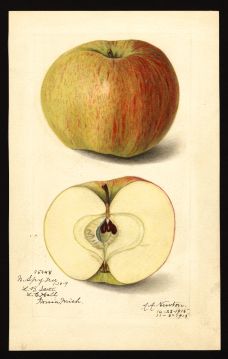 USDA Pomological Watercolor by Newton, Amanda Almira (Michigan)
 -
 USDA Pomological Watercolor by Newton, Amanda Almira (Michigan)
 -
 USDA Pomological Watercolor by Newton, Amanda Almira (Hamlin, Monroe, New York)
 -
 USDA Pomological Watercolor by Passmore, Deborah Griscom (Jersey City, Hudson, New Jersey)
 -
 USDA Pomological Watercolor by Schutt, Ellen Isham (Syracuse, Onondaga, New York)
 -
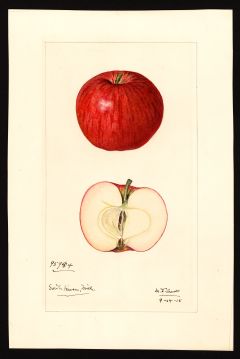 USDA Pomological Watercolor by Arnold, Mary Daisy (South Haven, Van Buren, Michigan)
 -
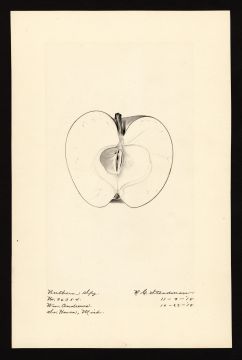 USDA Pomological Watercolor by Steadman, Royal Charles (South Haven, Van Buren, Michigan)
 -
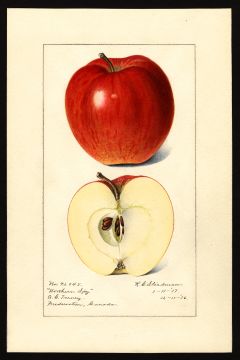 USDA Pomological Watercolor by Steadman, Royal Charles (Fredericton, Canada)
 -
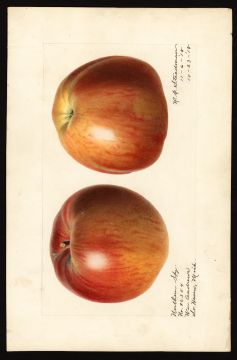 USDA Pomological Watercolor by Steadman, Royal Charles (South Haven, Van Buren, Michigan)
 -
 USDA Pomological Watercolor by Lower, Elsie E. (Onondaga, Onondaga, New York)
 -
 USDA Pomological Watercolor by Steadman, Royal Charles (Arlington, Virginia)
 -
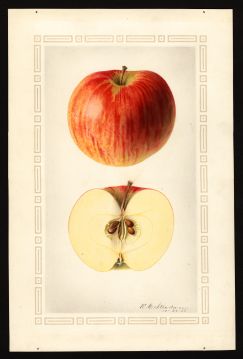 USDA Pomological Watercolor by Steadman, Royal Charles (East Lansing, Ingham, Michigan)
 -
 USDA Pomological Watercolor by Steadman, Royal Charles (East Lansing, Ingham, Michigan)


U.S. Department of Agriculture Pomological Watercolor Collection. Rare and Special Collections, National Agricultural Library, Beltsville, MD 20705
Sources
- S.A. Beach, The Apples of New York Vol. 1 (1905). Public domain.
- John A. Warder, American Pomology: Apples (1867). Public domain.
- J.L. Budd & N.E. Hansen, American Horticultural Manual, Part II: Systematic Pomology (1914). Public domain.
- E.A. Bunyard, A Handbook of Hardy Fruits (1920). Public domain.
- A.J. Downing, Fruits and Fruit Trees of America (1869). Public domain.
- U.P. Hedrick, Cyclopedia of Hardy Fruits (1922). Public domain.
- F.R. Elliott, The Western Fruit Book (1865). Public domain.
- Granville Lowther (ed.), Encyclopedia of Practical Horticulture (1914). Public domain.
- John J. Thomas, The American Fruit Culturist (1903). Public domain.
- C.M. Hovey, The Fruits of America (1852). Public domain.
- USDA Pomological Watercolor Collection, U.S. National Agricultural Library.
- 87 historical nursery catalog references (see Variety Finder for the full list).
- Full entry with all citations: Northern Spy on the Variety Finder
Trees of this Variety in Our Collection
| Orchard | Tag | Condition | |
|---|---|---|---|
| Cyrus Tree 17 | Cyrus | 17 | fair |
| Haystack Tree 109 | Haystack | 109 | poor |
| McCoin Lower Tree 68 | McCoin Lower | 68 | good |
| McCoin Lower Tree 80 | McCoin Lower | 80 | good |