Wealthy
| Wealthy | |
|---|---|
| Species | Apple |
| Trees Found | 7 |
| Orchards | McCoin Lower |
| Preserved | Clarno Arboretum(2025) |

An apple of fine appearance and quality, an early and too profuse bearer. A good market apple of its season. Tree nearly as hardy as Duchess. Its chief fault is killing itself by its early and excessive bearing. Its keeping quality, if gathered early and carefully handled, is pretty good in the North, but farther south it is only a fine fall apple, ripening with us in September. In size and beauty it equals Baldwin, and a better dessert apple. Read the full entry: Wealthy on the Variety Finder for deeper history, every book quote, and all nursery catalog references.
Quick Facts
| Type | Apple |
| Season | Early (Early fall (late August to September)) |
| Flavor | sweet, subacid, berry, aromatic, vinous |
| Flavor notes | Mild subacid flavor with notes of pear and lemon; sweet when fully ripe with strawberry hints; juicy and crisp |
| Uses | fresh eating, cider, cooking |
| Keeping quality | Good |
| Size | Above Medium |
| Shape | Oblate |
| Skin color | yellow, green, red, crimson, blushed, striped, pale, dark, orange, pink |
| Flesh | Pink tender |
| Origin | Minnesota, USA, c. 1861. Excelsior, Minnesota, USA; developed by Peter Gideon, first fruited around 1861 |
Fruit
Size: Medium (Downing, Thomas); above medium to large when well grown but often small on old trees, more or less uneven in size (Beach); above medium to large, inclining to be small and to ripen irregularly on old trees (Lowther); above medium to large (Hansen, Budd-Hansen); fairly large, 3 by 2¼ (Bunyard); medium to large (Hedrick). Pretty uniform in shape and quality; the apples run small and uneven on old trees (Hedrick).
Form: Oblate or roundish oblate (Downing); roundish oblate, very regular (Hansen, Budd-Hansen); roundish, oblate (Thomas); roundish conic, slightly flattened at base, regular, symmetrical (Beach, Lowther, Hedrick); round, a little flattened each end (Bunyard).
Stem/Stalk: Short to medium, slender (Downing); usually short to medium, but rather long on small fruit and rather slender (Beach); short to medium (Lowther); medium (Hansen, Budd-Hansen); short, long on small fruit, slender (Hedrick); very slender, rather long (Bunyard).
Cavity: Green, russet (Downing); decidedly acuminate, rather deep, moderately narrow to rather broad, russeted (Beach); decidedly acuminate, rather deep (Lowther); deep, acute, regular, with slight stellate russet (Hansen, Budd-Hansen); acuminate, deep, narrow, russeted (Hedrick); remarkably narrow and deep, with the crimson flush and broad stripes extending right into the cavity (Bunyard).
Calyx: Partially closed (Downing); medium size, closed or partly open; lobes broad, obtuse to acute (Beach); medium sized, closed or partly open (Lowther); partially closed, segments erect convergent (Hansen, Budd-Hansen); closed or partly open; lobes broad, obtuse (Hedrick); eye very small, closed (Bunyard).
Basin: Deep, abrupt, uneven (Downing); medium in depth to rather shallow, rather narrow, abrupt, smooth, symmetrical (Beach); deep, smooth, regular, abrupt, sometimes finely wrinkled (Hansen, Budd-Hansen); narrow, abrupt, smooth, symmetrical (Hedrick); deep and rather narrow, slightly ribbed (Bunyard).
Skin: Whitish yellow ground, shaded with deep rich crimson in the sun, obscure broken stripes and mottlings in the shade, sometimes entirely covered with crimson, many light dots (Downing). Thin, tough, pale yellow or greenish, blushed and marked with narrow stripes and splashes of red, deepening in highly colored specimens to brilliant red, very attractive; dots numerous, small, inconspicuous, pale or russet; prevailing effect bright red (Beach, Lowther, Hedrick). Surface smooth, light yellow, almost wholly covered with bright crimson splashes and stripes, marbled, mottled and mixed on sunny side, a beautiful fruit; dots many, distinct, minute, white (Hansen, Budd-Hansen). Yellowish shade with dark red, oily (Thomas). Pale golden-yellow almost covered with brilliant crimson flush and broad stripes (Bunyard). Lowther adds that in almost all parts of the arid sections where it is grown it takes on a rich color. Hedrick notes the fruits are handsome in appearance, color, size, and shape, in all of which they are uniform.
Flesh/Flavor: White (Downing, Thomas, Hansen, Budd-Hansen, Bunyard), whitish (Beach, Lowther, Hedrick), sometimes/often stained with red. Fine-grained (Downing), moderately fine (Beach, Lowther), fine (Hedrick), loose grained (Bunyard); crisp (Beach, Lowther, Hedrick), tender (Downing, Beach, Lowther, Thomas, Hansen, Budd-Hansen, Hedrick), very juicy (Beach, Lowther, Hansen, Budd-Hansen, Hedrick; "juicy", Downing, Thomas, Bunyard). Flavor described as lively, vinous, subacid, very good (Downing); agreeable subacid, sprightly, somewhat aromatic, good to very good (Beach, Lowther); agreeable subacid, sprightly, aromatic, good to very good (Hedrick); sprightly subacid, very good (Hansen, Budd-Hansen); sub-acid, very good (Thomas); very sweet, with a pleasant strawberry flavour (Bunyard). Hedrick notes the quality, while not of the best, is good, the flesh being especially crisp, juicy, and refreshing.
Core/Seeds: Core small (Downing, Hansen, Budd-Hansen, Hedrick); medium to very small, axile or sometimes slightly abaxile; cells symmetrical, slightly open; core lines clasping (Beach); barely clasping, closed; cells round, entire (Hansen, Budd-Hansen); axile or sometimes abaxile; cells symmetrical, open; core-lines clasping (Hedrick). Calyx tube conical approaching funnel-form (Beach); funnel-shaped (Hansen, Budd-Hansen); calyx-tube conical (Hedrick). Stamens median (Beach, Hedrick); median or basal (Hansen, Budd-Hansen). Carpels medium to rather small, roundish, narrowing toward base and apex, smooth, flat (Beach); small, round, narrowing toward base and apex, smooth, flat (Hedrick). Seeds moderately dark brown, above medium, rather acute (Beach); plump (Hansen, Budd-Hansen); dark brown, acute (Hedrick).
Season
October to January (Beach, Lowther, Hedrick); October to February (Hansen, Budd-Hansen); December, February (Downing); October to November (Bunyard). In season from October to early winter or mid-winter; in ordinary storage its commercial limit is October, but in cold storage it may be kept till January or later; it does not stand heat very well before going into storage, and goes down rather quickly (Beach). The fruits stand handling and storage (Hedrick).
Uses
Bright red and good in quality for either dessert or culinary uses; the fruit sells well, and the variety is being planted for commercial purposes in many parts of the state, in some sections more than any other apple of its season (Beach). A standard commercial variety in the plains region, and valued as an excellent culinary and market sort elsewhere (Thomas). Dessert; "almost worth growing for its appearance alone, and to those who like a tender fleshed variety it will be acceptable; it is rather too soft for market use" (Bunyard). An ideal apple for planting as a filler among permanent trees (Hedrick).
Illustrations
-
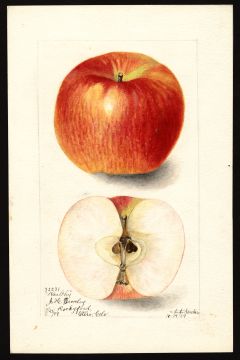 USDA Pomological Watercolor by Newton, Amanda Almira (Rockyford, Otero, Colorado)
 -
 USDA Pomological Watercolor by Newton, Amanda Almira (Douglas, Allegan, Michigan)
 -
 USDA Pomological Watercolor by Passmore, Deborah Griscom (Rockford, Floyd, Iowa)
 -
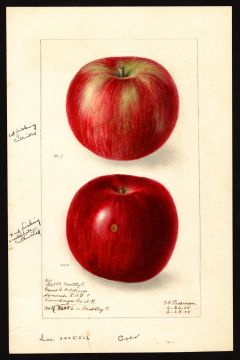 USDA Pomological Watercolor by Passmore, Deborah Griscom (Syracuse, Onondaga, New York)
 -
 USDA Pomological Watercolor by Schutt, Ellen Isham (Douglas, Allegan, Michigan)
 -
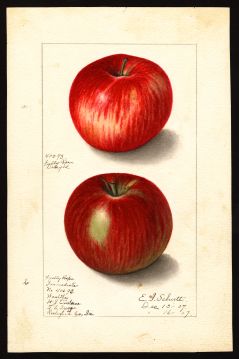 USDA Pomological Watercolor by Schutt, Ellen Isham (Rockford, Floyd, Iowa)
 -
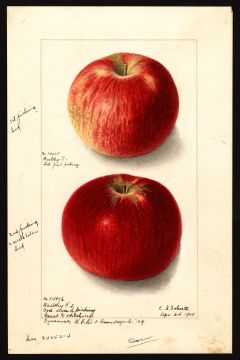 USDA Pomological Watercolor by Schutt, Ellen Isham (Syracuse, Onondaga, New York)
 -
 USDA Pomological Watercolor by Schutt, Ellen Isham (Minneapolis, Hennepin, Minnesota)
 -
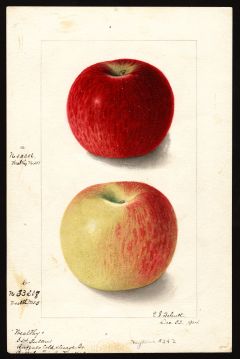 USDA Pomological Watercolor by Schutt, Ellen Isham (Buffalo, Erie, New York)
 -
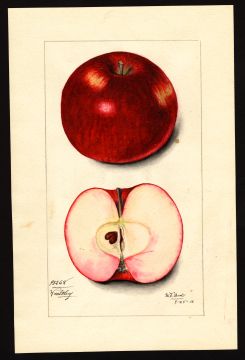 USDA Pomological Watercolor by Arnold, Mary Daisy
 -
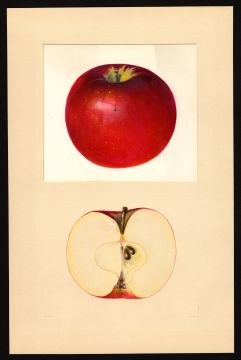 USDA Pomological Watercolor by Arnold, Mary Daisy (Dorset, Bennington, Virginia)
 -
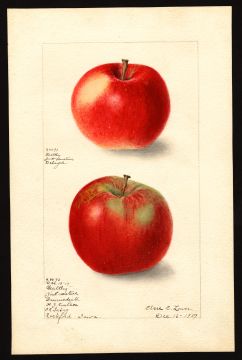 USDA Pomological Watercolor by Lower, Elsie E. (Rockford, Floyd, Iowa)


U.S. Department of Agriculture Pomological Watercolor Collection. Rare and Special Collections, National Agricultural Library, Beltsville, MD 20705
USDA Bulletin 56 Notes
USDA name: Wealthy
USDA citations: AHortA'69
Sources
- S.A. Beach, The Apples of New York Vol. 2 (1905). Public domain.
- J.L. Budd & N.E. Hansen, American Horticultural Manual, Part II: Systematic Pomology (1914). Public domain.
- Granville Lowther (ed.), Encyclopedia of Practical Horticulture (1914). Public domain.
- N.E. Hansen, A Study of Northwestern Apples (South Dakota Ag. Exp. Station Bulletin 76, 1902). Public domain.
- E.A. Bunyard, A Handbook of Hardy Fruits (1920). Public domain.
- A.J. Downing, Fruits and Fruit Trees of America (1869). Public domain.
- U.P. Hedrick, Cyclopedia of Hardy Fruits (1922). Public domain.
- John J. Thomas, The American Fruit Culturist (1903). Public domain.
- USDA Pomological Watercolor Collection, U.S. National Agricultural Library.
- 72 historical nursery catalog references (see Variety Finder for the full list).
- Full entry with all citations: Wealthy on the Variety Finder