Winter Banana
| Winter Banana | |
|---|---|
| Species | Apple |
| Trees Found | 0 |
| Orchards | |
| Preserved | Clarno Arboretum({{{clarno_year}}}) |

This valuable new variety was originated on the farm of D. N. Flory, Cass County, Indiana. Fruit large, fine grained, a beautiful golden yellow, shaded with bright red, unusually handsome. Flesh of golden yellow, very large and highly perfumed and considered the most flavored apple grown; an excellent table variety. Tree hardy. An early and prolific bearer. November to May. We have watched this apple since its introduction and from our personal observation, believe it is a profitable variety to grow, especially for the fancy trade, and those who wish to secure this class of business will make no mistake in planting it. Read the full entry: Winter Banana on the Variety Finder for deeper history, every book quote, and all nursery catalog references.
Quick Facts
| Type | Apple |
| Season | Winter |
| Flavor | subacid, aromatic, mild |
| Uses | fresh eating |
| Keeping quality | Good |
| Size | Large |
| Shape | Oblate Conic |
| Skin color | yellow, blushed, pink, red, russet, dark, light, orange |
| Flesh | Yellow tender |
| Origin | Indiana, USA, c. 1876 |
Synonyms
Banana, Banana Apple
Fruit
Size. Nearly large to very large, not very uniform in size or shape. Bunyard gives dimensions as "very large, 3 by 2½."
Form. Roundish conic to oblong conic, or sometimes oblate and noticeably flat at the base, often irregularly elliptical and somewhat ribbed; axis sometimes oblique; sides often unequal (Beach; Hedrick concurs). Bunyard: "round, rather flattened, tapering to eye."
Stem. Short to moderately long, medium in thickness to rather slender (Beach); Hedrick: "short to long"; Bunyard: "rather slender, fairly long."
Cavity. Usually rather large, acute to acuminate, moderately shallow to deep, broad, gently furrowed, sometimes lipped, smooth or sometimes partly russeted (Beach). Hedrick: "large, acute, shallow, broad, gently furrowed, sometimes lipped, smooth or partly russeted." Bunyard: "wide deep cavity, which is sometimes rather russet."
Calyx. Small to medium, partly open or sometimes closed; lobes convergent or connivent, short to medium length, obtuse to acute (Beach). Hedrick: "small, partly open or sometimes closed; lobes convergent or connivent, short, obtuse." Bunyard: "Eye, slightly open."
Basin. Small to medium, often decidedly oblique, rather shallow to moderately deep, usually rather narrow but sometimes moderately wide, obtuse to rather abrupt, furrowed and wrinkled (Beach). Hedrick: "small, often oblique, shallow, narrow or sometimes wide, obtuse, furrowed and wrinkled." Bunyard: "broad, slightly ribbed basin."
Skin. Smooth, moderately thick (Hedrick: "thick"), tough, waxy, bright pale yellow, often with a blush which in well-colored specimens deepens to dark pinkish-red (Hedrick: "deepens to dark red"). Often a suture line extends from the basin nearly or quite to the cavity. Dots numerous, whitish and submerged or with fine russet point. Prevailing effect yellow with a pretty contrasting blush. Bunyard: "Colour, pale golden-yellow with slight red flush. Skin, very smooth." Hedrick: "clear pale waxen yellow with a delicate blush which sometimes deepens into a bright red." The color shows bruises more readily than do red apples like Baldwin or Tompkins King (Beach); Lowther emphasizes "it is so easily bruised and shows its bruises so clearly that in picking, packing and marketing it must be handled with very great care"; Hedrick: "the fruits are so easily bruised that they seldom reach the market in good condition."
Flesh and flavor. Flesh whitish tinged with pale yellow (Beach) / pale yellow (Bunyard, Hedrick), moderately firm (Beach) / firm (Hedrick), a little coarse / coarse, somewhat crisp, tender, juicy, mild subacid, distinctly aromatic, good to very good (Beach; Hedrick concurs). Bunyard: "pale yellow, a little coarse grained, juicy, aromatic." Beach: "characteristically aromatic, of good dessert quality, but too mild in flavor to excel for culinary uses." Hedrick: "The flavor is that rich admixture of sweet and sour which characterizes most of our best fruits, while the aroma has a suggestion of musk exclusively the property of this apple."
Core and seeds. Calyx tube wide above, rather short (Hedrick: "short"), cone-shape or funnel-form (Hedrick: "cone-shape"). Stamens median to marginal (Hedrick: "median"). Core rather small to above medium (Hedrick: "small"), abaxile; cells not uniformly developed, usually symmetrical and open, sometimes closed; core lines somewhat clasping (Hedrick: "clasping"). Carpels elongated ovate, narrow, emarginate, tufted. Seeds often abortive; the plump ones vary from small to rather large and are more or less irregular, usually obtuse to acute (Hedrick: "obtuse"), dull dark brown, sometimes tufted.
Season
In ordinary storage the fruit is in season from mid-November to the first of April (Beach), or December to the first of April (Lowther). Hedrick: "October to March"; also says "The season is that of Rhode Island Greening." Bunyard: "Dessert, till March." Beach notes its safe commercial limit in the New York climate probably would not extend much beyond December. In cold storage it ranks as a keeper about with Rhode Island Greening, but is not equal to Baldwin (Beach).
Uses
Dessert apple of good quality; too mild in flavor to excel for culinary uses (Beach; Lowther). Not highly regarded as a market variety on account of the tender flesh and color which shows bruises very readily (Lowther; Hedrick concurs, "the variety is thus condemned for commercial plantings"). Beach suggests "it could perhaps be used to advantage commercially to follow the Maiden Blush and extend the season for fruit having the general appearance of that variety. As compared with Maiden Blush this is larger, neither as uniform nor as symmetrical, better for dessert use but less desirable for culinary purposes." Hedrick recommends it especially for the amateur planter.
Illustrations
-
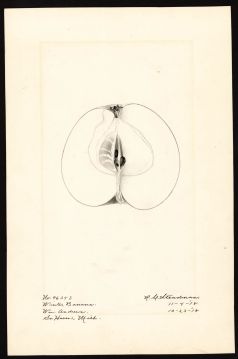 USDA Pomological Watercolor of Winter Banana
 -
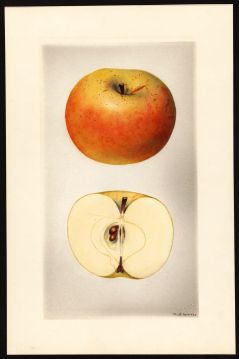 USDA Pomological Watercolor of Winter Banana
 -
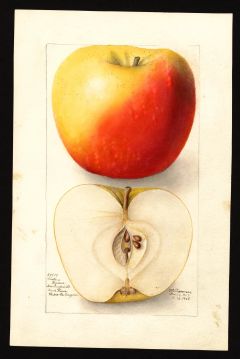 USDA Pomological Watercolor of Winter Banana
 -
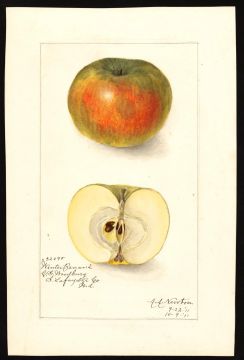 USDA Pomological Watercolor of Winter Banana
 -
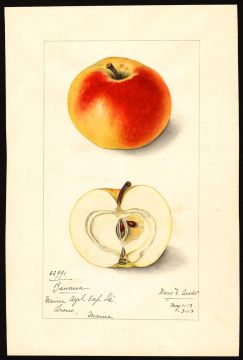 USDA Pomological Watercolor of Winter Banana
 -
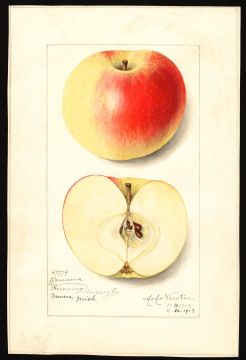 USDA Pomological Watercolor of Winter Banana
 -
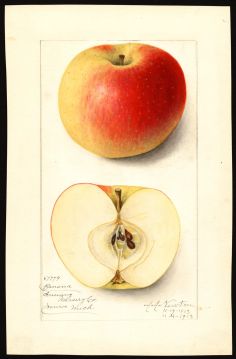 USDA Pomological Watercolor of Winter Banana
 -
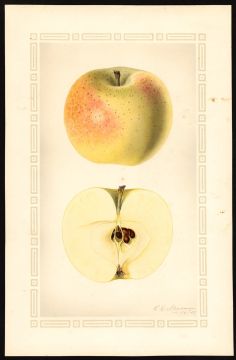 USDA Pomological Watercolor of Winter Banana
 -
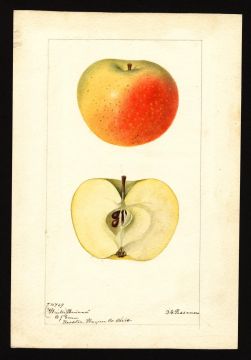 USDA Pomological Watercolor of Winter Banana
 -
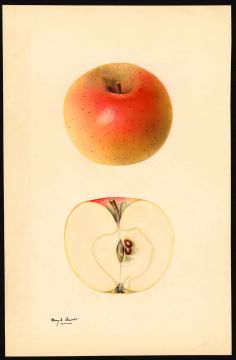 USDA Pomological Watercolor of Winter Banana
 -
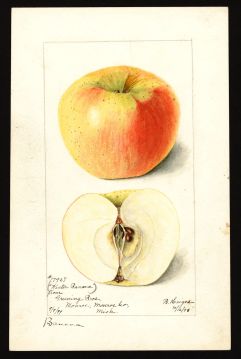 USDA Pomological Watercolor of Winter Banana
 -
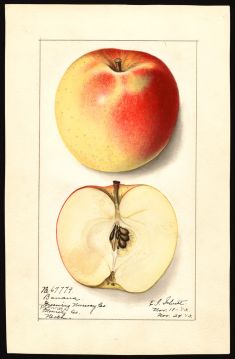 USDA Pomological Watercolor of Winter Banana
 -
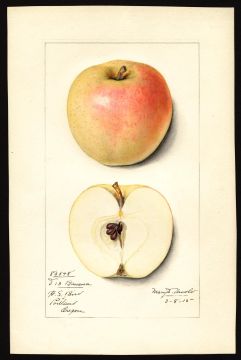 USDA Pomological Watercolor of Winter Banana
 -
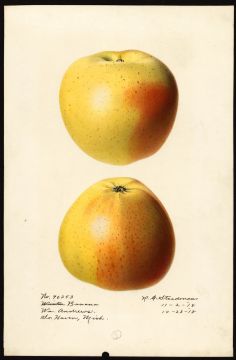 USDA Pomological Watercolor of Winter Banana
 -
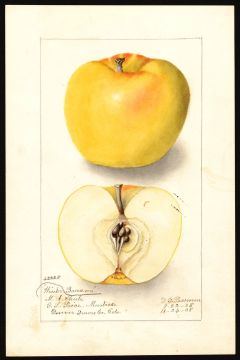 USDA Pomological Watercolor of Winter Banana
 -
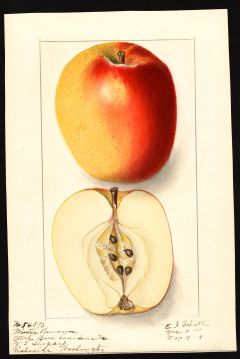 USDA Pomological Watercolor of Winter Banana
 -
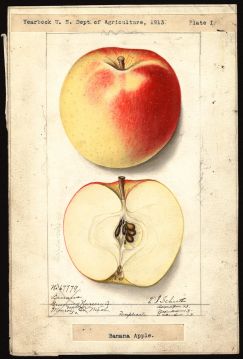 USDA Pomological Watercolor of Winter Banana
 -
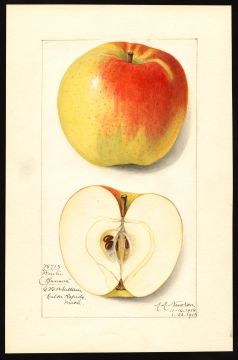 USDA Pomological Watercolor of Winter Banana


U.S. Department of Agriculture Pomological Watercolor Collection. Rare and Special Collections, National Agricultural Library, Beltsville, MD 20705
Sources
- S.A. Beach, The Apples of New York Vol. 1 (1905). Public domain.
- E.A. Bunyard, A Handbook of Hardy Fruits (1920). Public domain.
- Granville Lowther (ed.), Encyclopedia of Practical Horticulture (1914). Public domain.
- U.P. Hedrick, Cyclopedia of Hardy Fruits (1922). Public domain.
- USDA Pomological Watercolor Collection, U.S. National Agricultural Library.
- 55 historical nursery catalog references (see Variety Finder for the full list).
- Full entry with all citations: Winter Banana on the Variety Finder