Yellow Bellflower
| Yellow Bellflower | |
|---|---|
| Species | Apple |
| Trees Found | 3 |
| Orchards | 5 Tree,McCoin Lower |
| Preserved | Clarno Arboretum(2025) |

Planted Spring 1890. Tree a strong grower, and regular bearer. Fruit above medium size, oblong, tapering to eye. Skin smooth, pale yellow, sometimes with a faint blush. Flesh yellowish, coarse, tender, juicy, pleasantly acid, quality good. Season December and January. Read the full entry: Yellow Bellflower on the Variety Finder for deeper history, every book quote, and all nursery catalog references.
Quick Facts
| Type | Apple |
| Season | Late (Late fall (October to November)) |
| Flavor | sweet, tart, aromatic, subacid, brisk |
| Flavor notes | Sweet-sharp; aromatic; yellowish flesh, fine-grained, firm; distinctly tart if not fully ripe, mellows in storage |
| Uses | fresh eating, cooking, baking, pies |
| Keeping quality | Good |
| Size | Very Large |
| Shape | Oblong |
| Skin color | red, yellow, pale, green, blushed, light, pink, russet |
| Flesh | Yellow tender |
| Origin | Burlington County, New Jersey, USA, c. 1742. Crosswicks, Burlington County, New Jersey, USA; mid-1700s (possibly 1742) |
Synonyms
Bell Flower, Bell-Flower, Belle Flavoise, Belle Fleur, Belle-Fleur, Belle-Fleur Jaune, Belle-Flower, Bellefleur Jaune, Bellefleur Yellow, Bellflower, Bishop's Pippin of Nova Scotia, Gelber Belle Fleur, Gelber Bellefleur, Gelber Englischer Schonbluhender, Gelber Englischer Schönblühender A, Gul. Bellefleur, Lady Washington, Lincoln Pippin, Lineous Pippin, Linnaeus Pippin, Linneous Pippin, Metzger Apfel, Metzger Cahill, Metzger's Cahill, Metzger's Calvill, Metzgerapfel, Monstrous Bellflower, Reinette Muse, Reinette Musque, Reinette Musquee, Warren Pippin, Weisser Metzger A, Weisser Metzger Apfel, Weisser Metzgerapfel, Yellow Belle Fleur, Yellow Belle-fleur, Yellow Bellefleur, Yellow Belleflower
Fruit
Size: Large to very large, but variable, small to large or very large (Beach). Often a large percentage of apples, especially when grown where rainfall is scarce during the growing season, do not reach marketable size. Central Experimental Farm reports above medium size.
Form: Oblong, often oblong-ovate or oblong-conic, with apex quite narrow and conical (Thomas); roundish oblong narrowing toward the basin varying to oblong conic, frequently somewhat ovate, irregularly elliptical and more or less ribbed, often with prominent ridges at the apex; sides usually unequal (Beach, Hedrick). A little irregular, tapering to the eye (Downing, Elliott). Angular and ribbed, tapering to the calyx (Budd-Hansen). Coxe describes the related Monstrous Bellflower as oblong, resembling Yellow Bellflower but more regular in form.
Stem: Long, slender, curved (Downing, Elliott, Warder long curved); medium to rather long, rather slender to moderately stout (Beach); slender (Thomas); medium to long, very stout (Budd-Hansen, note: conflicts with the more common "slender" reports); long, slender (Hedrick).
Cavity: Deep (Downing, Elliott); deep, acute or wide, wavy (Warder); medium to large, acute to acuminate, deep to very deep, moderately narrow to wide, furrowed, sometimes compressed, sometimes lipped, usually with outspreading broken rays of brownish russet (Beach); regular, deep, obtuse, with a faint trace of russet (Budd-Hansen); large, acute, deep, wide, furrowed, sometimes compressed, sometimes lipped, usually with outspreading broken rays of brownish-red russet (Hedrick).
Calyx: Closed (Downing, Elliott); small, closed (Warder); below medium to above, closed or partly so; lobes narrow, acuminate, pubescent (Beach, Hedrick).
Basin: Plaited, deep (Elliott); rather narrow, plaited (Downing); shallow or moderately deep, plaited or folded (Warder); ribbed (Thomas); small, oblique, abrupt, narrow, shallow to rather deep, distinctly ridged and wrinkled (Beach, Hedrick); narrow, shallow (Budd-Hansen, text cuts off).
Skin: Smooth, pale lemon yellow, often with a blush next the sun (Downing); smooth, rich yellow, sometimes blushed (Warder); pale yellow with a blush next the sun (Elliott); smooth, pale lemon yellow, often with bronze red blush (Budd-Hansen); pale lemon-yellow varying to whitish in the shade and often with a shade of brownish-red in the sun which in highly colored specimens deepens to a pinkish-red blush; prevailing effect bright pale yellow (Beach); smooth, delicate, pale, lemon-yellow, waxen skin usually beautifully blushed on the cheek to the sun (Hedrick). At the time of picking it is generally a greenish yellow, but as it ripens it comes to be a light golden yellow (Lowther). Color improves in storage, becoming more clearly yellow as the fruit matures (Beach). Tender skin is easily injured/bruised, must be handled very carefully because it very easily shows bruises. Central Experimental Farm: smooth, pale yellow, sometimes with a faint blush.
Dots: Scattered, gray (Warder); whitish or russet, numerous and small toward the basin, larger, irregular and scattering toward the cavity (Beach, Hedrick); obscure, numerous, minute, whitish and russet (Budd-Hansen).
Flesh/Flavor: Tender, juicy, crisp, with a sprightly subacid flavor; before fully ripe it is considerably acid; very good (Downing). Yellow, breaking, fine-grained, juicy; flavor acid to sub-acid, aromatic, very rich and satisfying; quality best (Warder). Tender, juicy, crisp, sprightly, sub-acid (Elliott). Very tender when ripe, fine grained, crisp, juicy, acid, becoming sub-acid, excellent (Thomas). Whitish tinged with pale yellow, firm, crisp, moderately fine-grained, rather tender, juicy, aromatic, very good for culinary use, rather too acid for dessert early in the season but later its acidity becomes somewhat subdued (Beach). Yellow, firm, crisp, fine-grained, tender, juicy, aromatic; very good (Hedrick). Yellowish, coarse, tender, juicy, pleasantly acid, quality good (Central Experimental Farm, note: "coarse" conflicts with the consistent "fine-grained" reports of other sources). Rather acid until well ripened when it is pleasant and luscious (Lowther). Coxe (on Monstrous Bellflower): rich, juicy and tender. Hedrick (1922) judged the fruits "not suitable for dessert, the flavor being a little too austere, but unsurpassed for culinary purposes." Beach noted it is "rather too briskly subacid to suit the tastes of some, particularly during the early part of its season" and "does not reach its best condition for dessert use till January or later, when its acidity becomes somewhat subdued."
Core/Seeds: Core large, oval, open, clasping (Warder); seeds in a large hollow capsule or core (Downing); core large; capsules long, hollow; seeds large, ovate pyriform, angular at broad end (Elliott); seeds dark, large, angular, imperfect (Warder); seeds long (Thomas); core large, long, remarkably abaxile; cells sometimes unsymmetrical, wide open or partly closed; core lines clasping the funnel cylinder; carpels long, narrow, roundish obovate, much concave, much tufted; seeds large, long, obtuse to acute (Beach); core large, long, remarkably abaxile; cells unsymmetrical, wide open or partly closed; core-lines clasping; carpels long, narrow, round-obovate, concave, much tufted; seeds large, long, obtuse (Hedrick). Calyx tube yellowish, elongated funnel-shape, sometimes extending to the core; stamens median to basal (Beach); stamens median (Hedrick).
Season
December (Warder); December to February (Downing); December to March (Elliott, "October to February, South"); December and January (Central Experimental Farm); winter, keeps through winter (Thomas); season at Geneva, NY from December to April with January or February as the commercial limit; in cold storage it keeps about with Tompkins King, but not as well as Rhode Island Greening (Beach); October to March (Hedrick). Storage behavior is contested: tender and easily bruised, yet when grown in some sections, if carefully handled, it keeps well, while in others it deteriorates rapidly (Lowther). Some do not regard it as a good keeper, while others find that it keeps pretty well (Beach). It does not stand heat well before going into storage and when it begins to deteriorate goes down quickly. To get best results in storage, the fruit must be thoroughly protected from scab in the orchard, picked and handled with extra care, and kept from heat from the time it is picked till it is stored as well as while in storage. Hedrick (1922): "The apples do not stand storage well, and deteriorate quickly when brought from low temperatures." Quite susceptible to injury by the apple-scab fungus (fruit and foliage).
Uses
Use: table, kitchen, market (Warder). Generally highly esteemed for culinary uses and also for its excellent dessert qualities, although it is rather too briskly subacid to suit the tastes of some, particularly during the early part of its season (Beach). One of the finest culinary apples in the catalogue (Warder). A favorite for dessert wherever known (Budd-Hansen). Hedrick: not suitable for dessert (austere flavor), but unsurpassed for culinary purposes. Coxe (on Monstrous Bellflower): a pleasant fruit, although inferior to many excellent apples of the season. In California it is one of the best apples when grown upon the highlands or mountain sides (Lowther).
Illustrations
-
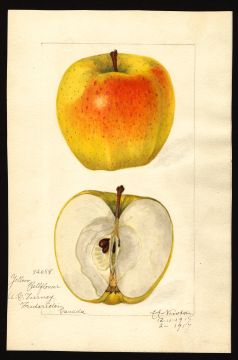 USDA Pomological Watercolor by Newton, Amanda Almira (Fredericton, Canada)
 -
 USDA Pomological Watercolor by Schutt, Ellen Isham (Watsonville, Santa Cruz, California)
 -
 USDA Pomological Watercolor by Schutt, Ellen Isham (Watsonville, Santa Cruz, California)
 -
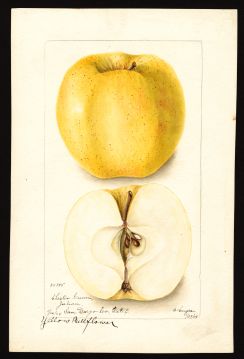 USDA Pomological Watercolor by Heiges, Bertha (San Diego, San Diego, California)
 -
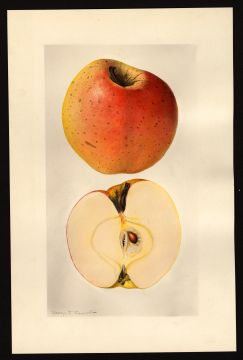 USDA Pomological Watercolor by Arnold, Mary Daisy (Arlington, Virginia)
 -
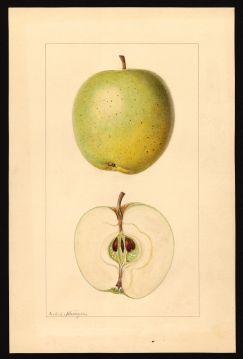 USDA Pomological Watercolor by Krieger, L.C.C. (Louis Charles Christopher) (Douglas Flat, Calaveras, California)
 -
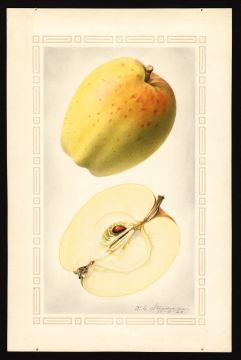 USDA Pomological Watercolor by Steadman, Royal Charles (Sacramento, Sacramento, California)
 -
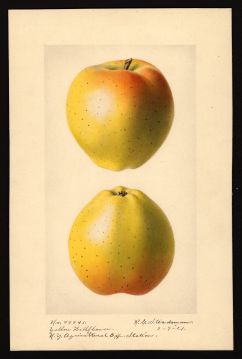 USDA Pomological Watercolor by Steadman, Royal Charles (New York)
 -
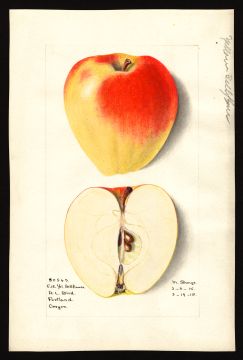 USDA Pomological Watercolor by Strange, M. (Portland, Multnomah, Oregon)


U.S. Department of Agriculture Pomological Watercolor Collection. Rare and Special Collections, National Agricultural Library, Beltsville, MD 20705
Sources
- S.A. Beach, The Apples of New York Vol. 1 (1905). Public domain.
- John A. Warder, American Pomology: Apples (1867). Public domain.
- A.J. Downing, Fruits and Fruit Trees of America (1869). Public domain.
- U.P. Hedrick, Cyclopedia of Hardy Fruits (1922). Public domain.
- John J. Thomas, The American Fruit Culturist (1903). Public domain.
- Coxe, A View of the Cultivation of Fruit Trees (1817). Public domain.
- J.L. Budd & N.E. Hansen, American Horticultural Manual, Part II: Systematic Pomology (1914). Public domain.
- Granville Lowther (ed.), Encyclopedia of Practical Horticulture (1914). Public domain.
- F.R. Elliott, The Western Fruit Book (1865). Public domain.
- USDA Pomological Watercolor Collection, U.S. National Agricultural Library.
- 67 historical nursery catalog references (see Variety Finder for the full list).
- Full entry with all citations: Yellow Bellflower on the Variety Finder
Trees of this Variety in Our Collection
| Orchard | Tag | Condition | |
|---|---|---|---|
| 5 Tree Tree 101 | 5 Tree | 101 | poor |
| McCoin Lower Tree 83 | McCoin Lower | 83 | fair |
| McCoin Lower Tree 84 | McCoin Lower | 84 | fair |