Yellow Transparent: Difference between revisions
No edit summary |
Bot: remove 1 issue-marked watercolor(s) (injury/disease illustrations) |
||
| (4 intermediate revisions by 2 users not shown) | |||
| Line 2: | Line 2: | ||
|name=Yellow Transparent | |name=Yellow Transparent | ||
|species=Apple | |species=Apple | ||
}} | }} | ||
[[File:USDA_Pomological_Yellow_Transparent_POM00000996.jpg|thumb|right|320px|USDA Pomological Watercolor by Newton, Amanda Almira (Bayfield, Bayfield, Wisconsin). <small>Public domain. USDA National Agricultural Library.</small>]] | |||
''' | A Russian variety. Tree hardy and a strong grower and an unusually early bearer. Fruit pale yellow, good size and good quality; skin clear white at first, turning to a pale yellow when fully ripe. Parties who have fruited it extensively, both north and south, say that it ripens earlier than any other variety, being ten days or two weeks ahead of Early Harvest. This makes it exceedingly valuable as an early market variety, and we are convinced that it has come to stay. Our experience with this variety is very satisfactory. We have found it earliest of all apples. Of a mild, pleasant, yet sprightly flavor. It bears abundantly and at an extremely early age. Two year trees in the nursery rows frequently produce fine fruit. It should be in every home garden on the American continent. Aug. | ||
'''Read the full entry:''' [https://heritageapplecorps.org/varieties/yellow-transparent-apple/ Yellow Transparent on the Variety Finder] for deeper history, every book quote, and all nursery catalog references. | |||
== | == Quick Facts == | ||
{| class="wikitable" | {| class="wikitable" | ||
|- | |- | ||
| '''Type''' || Apple | |||
|- | |||
| '''Season''' || Very Early (Very early (July to early August)) | |||
|- | |||
| '''Flavor''' || sweet tart, subacid, pleasant | |||
|- | |||
| '''Flavor notes''' || Mild, pleasant, sweet-tart; tender, juicy flesh | |||
|- | |- | ||
| ''' | | '''Uses''' || fresh eating, sauce, cooking, baking | ||
|- | |- | ||
| ''' | | '''Keeping quality''' || Poor | ||
|- | |- | ||
| ''' | | '''Size''' || Above Medium | ||
|- | |- | ||
| ''' | | '''Shape''' || Round | ||
|- | |||
| '''Skin color''' || yellow, green, white, pale, russet | |||
|- | |||
| '''Flesh''' || White tender | |||
|- | |||
| '''Origin''' || Riga, Latvia, c. 1850. Riga, Latvia (then Russian Empire); originated around 1850 as a chance seedling | |||
|} | |} | ||
=== | == Synonyms == | ||
Charlottenthaler, De Revel, Enthaler, Erdbeer Streifling, Grand-Sultan, Nitchner's Erdbeer, Red Duck, Reval (P. de), Revelstone, Revelstone Pippin, Skwosnoi Schotoi, Thaler, Transparente Blanche, Transparente Jaune, Transparente de Saint-Leger, Transparente de St. Leger, Weisser Transparent, White Transparent | |||
== Fruit == | |||
'''Size.''' Medium or above medium, sometimes large (Beach, Lowther, Hedrick, Budd-Hansen); medium (Downing, Thomas, Hansen); above medium size (Central Experimental Farm). Pretty uniform in shape and size on young or vigorous-growing trees, where fruit may grow rather large; on mature slow-growing trees, especially when overloaded, the fruit is apt to be below medium size unless thinned (Beach). Hedrick notes the fruits on old trees run small and uneven in size and shape. Hansen's Transparent group description gives size as "5 to 6." | |||
'''Form.''' Roundish ovate to roundish conic or oblate conic, slightly ribbed (Beach, Lowther); roundish oblate, slightly conical, slightly angular (Downing); roundish conical, sometimes roundish oblate and slightly conical, obscurely angular (Hansen); roundish conical, sometimes oblate conical, obscurely angular (Budd-Hansen); round conic (Thomas); roundish inclining to conical (Central Experimental Farm); round-oval, round-conic or oblate-conic, ribbed (Hedrick). Hansen's Transparent group gives form as "round, conical." Sides unequal. | |||
'''Stem.''' Medium to long, rather thick (Beach, Lowther, Hedrick); short to medium, rather slender (Downing); medium to long (Hansen); long (Budd-Hansen); in Hansen's Transparent group description, "long, rather stout." | |||
'''Cavity.''' Acute or approaching obtuse, medium to deep, rather narrow, sometimes slightly lipped, sometimes russeted (Beach, Hedrick); rather large, sometimes a little greenish (Downing); regular, obtuse, usually russeted (Hansen); regular, acute, usually russeted (Budd-Hansen); acute (Thomas). Hansen's Transparent group gives cavity as "very broad, medium deep." Lowther describes the cavity as "acute or approaching obtuse, medium to deep, rather narrow, somewhat abrupt, furrowed and slightly wrinkled", conflating the cavity with descriptors other sources assign to the basin. | |||
'''Calyx.''' Closed (Downing, Beach, Hansen, Budd-Hansen, Hedrick); lobes medium in length, broad (Beach, Hedrick). Hansen's Transparent group description gives calyx as "open." Calyx tube conical (Beach, Lowther, Hedrick); funnel-shaped (Hansen); conical (Budd-Hansen). Stamens marginal. | |||
'''Basin.''' Moderately shallow, rather narrow, somewhat abrupt, furrowed and slightly wrinkled (Beach); shallow, narrow, abrupt, furrowed and wrinkled (Hedrick); medium, slightly corrugated, sometimes with small protuberances (Downing); narrow, shallow, corrugated (Hansen, Budd-Hansen); shallow, regular (Thomas); medium, wrinkled (Hansen, Transparent group). | |||
'''Skin.''' Thin, tender, smooth, waxy, pale greenish-yellow changing to an attractive yellowish-white (Beach, Lowther); pale yellow changing to yellowish-white (Hedrick); clear white at first, becoming pale yellow when fully mature (Downing); smooth, transparent; surface clear white, becoming pale yellow at maturity (Hansen); smooth, light yellow (Budd-Hansen); yellow, almost transparent (Thomas); pale yellow with a sprinkling of grayish dots (Central Experimental Farm); pale straw-yellow (Hansen, Transparent group). Beach notes that on account of its delicate color and tender skin it shows bruises readily and must be handled with extra care; Lowther echoes that it is not a good shipper for the same reason; Hedrick lists bruising and poor shipping/keeping as chief faults. Beach emphasizes it takes on a good clear yellow color before becoming overripe, which makes it desirable for local market. | |||
'''Dots.''' Moderately numerous, greenish and light colored, often submerged (Beach, Lowther); moderately sprinkled with light and greenish dots, somewhat obscure (Downing); white, large, suffused, obscure (Hansen); large, white, suffused, many (Budd-Hansen); numerous, light colored, often submerged (Hedrick); grayish (Central Experimental Farm); slightly raised irregular gray dots (Hansen, Transparent group). | |||
'''Flesh/Flavor.''' White, moderately firm (Beach, Lowther; "firm" per Hedrick), fine-grained, crisp, tender, juicy, sprightly subacid with a pleasant but not high flavor; quality good or sometimes very good (Beach, Hedrick, Lowther). Downing: white, half fine, tender, juicy, sprightly subacid; quality good to very good; flesh more tender and delicate than [https://heritageapplecorps.org/varieties/tetofsky-apple/ Tetofsky]. Hansen: white, tender, fine grained, juicy, pleasant, sprightly subacid, very good. Budd-Hansen: white, fine-grained, juicy, pleasant, sprightly subacid, good to very good. Thomas: crisp, sub-acid, good. Central Experimental Farm: whitish, coarse, tender, juicy, pleasantly sub-acid, quality very good. Hansen's Transparent group: fine grained, nearly white; flavor pleasant acid. Hedrick notes that if not over-ripe, the apples are very good culinary fruits, and at the proper stage of maturity are acceptable for dessert. | |||
'''Core/Seeds.''' Core medium (Downing); medium to small (Beach, Lowther); medium in size (Hedrick); slightly open, clasping (Hansen); half open, clasping (Budd-Hansen); cells partly open to wide open; core lines clasping (Beach, Hedrick); nearly closed (Hansen, Transparent group). Carpels broadly ovate (Beach, Hedrick). Seeds medium size, rather wide, rather flat, obtuse to slightly acute (Beach); wide, flat, obtuse (Hedrick). | |||
== | == Season == | ||
<gallery mode="packed" heights=" | Early. Beach gives late July and August; the crop ripens continuously through a period of three or four weeks, beginning in July and continuing in season in some cases till early September; two or more pickings are required to secure the fruit in prime condition. Downing: early August, a week or two before [https://heritageapplecorps.org/varieties/tetofsky-apple/ Tetofsky]. Lowther: July and August, depending on latitude. Hedrick: July and August. Hansen: early August. Budd-Hansen: late July and early August. Central Experimental Farm: August and September. Hansen's Transparent group description: August 1st to 10th. It does not continue long in use (Downing); the fruits can never be kept long nor shipped far (Hedrick). | ||
File: | |||
== Uses == | |||
File:USDA_Pomological_Yellow_Transparent_POM00000993.jpg| | One of the best of the extra early apples, excellent for culinary use and acceptable for dessert (Beach). Not equal in quality to [https://heritageapplecorps.org/varieties/early-harvest-apple/ Early Harvest], but it begins to ripen somewhat earlier and is a more reliable cropper (Beach). Generally grown in New York state for home use only, but in some places cultivated to a limited extent for market, particularly for local market; desirable for this purpose because it takes on a good clear yellow color before becoming overripe (Beach). Thomas: "Largely grown all over the country as an excellent early market apple. Especially valuable for the kitchen." Budd-Hansen: a commercial variety for first early. Hedrick: very good culinary fruits if not over-ripe, acceptable for dessert at proper maturity. A. G. Tuttle (quoted via Hansen): "I find this variety profitable for the earliest fancy market, shipped in small boxes." | ||
File:USDA_Pomological_Yellow_Transparent_POM00000995.jpg| | |||
File: | == Illustrations == | ||
File:USDA_Pomological_Yellow_Transparent_POM00000997.jpg| | <gallery mode="packed" heights="240"> | ||
File: | File:USDA_Pomological_Yellow_Transparent_POM00000996.jpg|USDA Pomological Watercolor by Newton, Amanda Almira (Bayfield, Bayfield, Wisconsin) | ||
File: | File:USDA_Pomological_Yellow_Transparent_POM00000993.jpg|USDA Pomological Watercolor by Passmore, Deborah Griscom (Magnolia, Kent, Delaware) | ||
File: | File:USDA_Pomological_Yellow_Transparent_POM00000995.jpg|USDA Pomological Watercolor by Schutt, Ellen Isham (Hancock, Washington, Maryland) | ||
File:USDA_Pomological_Yellow_Transparent_POM00000998.jpg|USDA Pomological Watercolor by Schutt, Ellen Isham (College Park, Prince Georges, Maryland) | |||
File:USDA_Pomological_Yellow_Transparent_POM00000997.jpg|USDA Pomological Watercolor by Arnold, Mary Daisy (Arlington, Virginia) | |||
File:USDA_Pomological_Yellow_Transparent_POM00000999.jpg|USDA Pomological Watercolor by Arnold, Mary Daisy (College Park, Prince Georges, Maryland) | |||
File:USDA_Pomological_Yellow_Transparent_POM00000013.jpg|USDA Pomological Watercolor by Steadman, Royal Charles (South Haven, Van Buren, Michigan) | |||
File:USDA_Pomological_Yellow_Transparent_POM00000992.jpg|USDA Pomological Watercolor by Steadman, Royal Charles (South Haven, Van Buren, Michigan) | |||
</gallery> | </gallery> | ||
<small>U.S. Department of Agriculture Pomological Watercolor Collection. Rare and Special Collections, National Agricultural Library, Beltsville, MD 20705</small> | <small>U.S. Department of Agriculture Pomological Watercolor Collection. Rare and Special Collections, National Agricultural Library, Beltsville, MD 20705</small> | ||
== USDA Bulletin 56 Notes == | |||
'''USDA name:''' Grand Sultan | |||
'''USDA citations:''' NYExR'92 | |||
== Sources == | |||
* S.A. Beach, The Apples of New York Vol. 2 (1905). Public domain. | |||
* A.J. Downing, Fruits and Fruit Trees of America (1869). Public domain. | |||
* Granville Lowther (ed.), Encyclopedia of Practical Horticulture (1914). Public domain. | |||
* N.E. Hansen, A Study of Northwestern Apples (South Dakota Ag. Exp. Station Bulletin 76, 1902). Public domain. | |||
* J.L. Budd & N.E. Hansen, American Horticultural Manual, Part II: Systematic Pomology (1914). Public domain. | |||
* U.P. Hedrick, Cyclopedia of Hardy Fruits (1922). Public domain. | |||
* John J. Thomas, The American Fruit Culturist (1903). Public domain. | |||
* USDA Pomological Watercolor Collection, U.S. National Agricultural Library. | |||
* 68 historical nursery catalog references (see [https://heritageapplecorps.org/varieties/yellow-transparent-apple/ Variety Finder] for the full list). | |||
* '''Full entry with all citations:''' [https://heritageapplecorps.org/varieties/yellow-transparent-apple/ Yellow Transparent on the Variety Finder] | |||
== Trees of this Variety in Our Collection == | |||
{{#ask: [[Has variety::Yellow Transparent]] | |||
|?Has orchard=Orchard | |||
|?Has field tag=Tag | |||
|?Has condition=Condition | |||
|format=table | |||
|sort=Has orchard, Has field tag | |||
}} | |||
[[Category:Varieties]] | [[Category:Varieties]] | ||
[[Category:Apple Trees]] | [[Category:Apple Trees]] | ||
Latest revision as of 01:26, 18 July 2026
| Yellow Transparent | |
|---|---|
| Species | Apple |
| Trees Found | 11 |
| Orchards | Clarno Arboretum,Cyrus,El Rancho |
| Preserved | Clarno Arboretum({{{clarno_year}}}) |

A Russian variety. Tree hardy and a strong grower and an unusually early bearer. Fruit pale yellow, good size and good quality; skin clear white at first, turning to a pale yellow when fully ripe. Parties who have fruited it extensively, both north and south, say that it ripens earlier than any other variety, being ten days or two weeks ahead of Early Harvest. This makes it exceedingly valuable as an early market variety, and we are convinced that it has come to stay. Our experience with this variety is very satisfactory. We have found it earliest of all apples. Of a mild, pleasant, yet sprightly flavor. It bears abundantly and at an extremely early age. Two year trees in the nursery rows frequently produce fine fruit. It should be in every home garden on the American continent. Aug. Read the full entry: Yellow Transparent on the Variety Finder for deeper history, every book quote, and all nursery catalog references.
Quick Facts
| Type | Apple |
| Season | Very Early (Very early (July to early August)) |
| Flavor | sweet tart, subacid, pleasant |
| Flavor notes | Mild, pleasant, sweet-tart; tender, juicy flesh |
| Uses | fresh eating, sauce, cooking, baking |
| Keeping quality | Poor |
| Size | Above Medium |
| Shape | Round |
| Skin color | yellow, green, white, pale, russet |
| Flesh | White tender |
| Origin | Riga, Latvia, c. 1850. Riga, Latvia (then Russian Empire); originated around 1850 as a chance seedling |
Synonyms
Charlottenthaler, De Revel, Enthaler, Erdbeer Streifling, Grand-Sultan, Nitchner's Erdbeer, Red Duck, Reval (P. de), Revelstone, Revelstone Pippin, Skwosnoi Schotoi, Thaler, Transparente Blanche, Transparente Jaune, Transparente de Saint-Leger, Transparente de St. Leger, Weisser Transparent, White Transparent
Fruit
Size. Medium or above medium, sometimes large (Beach, Lowther, Hedrick, Budd-Hansen); medium (Downing, Thomas, Hansen); above medium size (Central Experimental Farm). Pretty uniform in shape and size on young or vigorous-growing trees, where fruit may grow rather large; on mature slow-growing trees, especially when overloaded, the fruit is apt to be below medium size unless thinned (Beach). Hedrick notes the fruits on old trees run small and uneven in size and shape. Hansen's Transparent group description gives size as "5 to 6."
Form. Roundish ovate to roundish conic or oblate conic, slightly ribbed (Beach, Lowther); roundish oblate, slightly conical, slightly angular (Downing); roundish conical, sometimes roundish oblate and slightly conical, obscurely angular (Hansen); roundish conical, sometimes oblate conical, obscurely angular (Budd-Hansen); round conic (Thomas); roundish inclining to conical (Central Experimental Farm); round-oval, round-conic or oblate-conic, ribbed (Hedrick). Hansen's Transparent group gives form as "round, conical." Sides unequal.
Stem. Medium to long, rather thick (Beach, Lowther, Hedrick); short to medium, rather slender (Downing); medium to long (Hansen); long (Budd-Hansen); in Hansen's Transparent group description, "long, rather stout."
Cavity. Acute or approaching obtuse, medium to deep, rather narrow, sometimes slightly lipped, sometimes russeted (Beach, Hedrick); rather large, sometimes a little greenish (Downing); regular, obtuse, usually russeted (Hansen); regular, acute, usually russeted (Budd-Hansen); acute (Thomas). Hansen's Transparent group gives cavity as "very broad, medium deep." Lowther describes the cavity as "acute or approaching obtuse, medium to deep, rather narrow, somewhat abrupt, furrowed and slightly wrinkled", conflating the cavity with descriptors other sources assign to the basin.
Calyx. Closed (Downing, Beach, Hansen, Budd-Hansen, Hedrick); lobes medium in length, broad (Beach, Hedrick). Hansen's Transparent group description gives calyx as "open." Calyx tube conical (Beach, Lowther, Hedrick); funnel-shaped (Hansen); conical (Budd-Hansen). Stamens marginal.
Basin. Moderately shallow, rather narrow, somewhat abrupt, furrowed and slightly wrinkled (Beach); shallow, narrow, abrupt, furrowed and wrinkled (Hedrick); medium, slightly corrugated, sometimes with small protuberances (Downing); narrow, shallow, corrugated (Hansen, Budd-Hansen); shallow, regular (Thomas); medium, wrinkled (Hansen, Transparent group).
Skin. Thin, tender, smooth, waxy, pale greenish-yellow changing to an attractive yellowish-white (Beach, Lowther); pale yellow changing to yellowish-white (Hedrick); clear white at first, becoming pale yellow when fully mature (Downing); smooth, transparent; surface clear white, becoming pale yellow at maturity (Hansen); smooth, light yellow (Budd-Hansen); yellow, almost transparent (Thomas); pale yellow with a sprinkling of grayish dots (Central Experimental Farm); pale straw-yellow (Hansen, Transparent group). Beach notes that on account of its delicate color and tender skin it shows bruises readily and must be handled with extra care; Lowther echoes that it is not a good shipper for the same reason; Hedrick lists bruising and poor shipping/keeping as chief faults. Beach emphasizes it takes on a good clear yellow color before becoming overripe, which makes it desirable for local market.
Dots. Moderately numerous, greenish and light colored, often submerged (Beach, Lowther); moderately sprinkled with light and greenish dots, somewhat obscure (Downing); white, large, suffused, obscure (Hansen); large, white, suffused, many (Budd-Hansen); numerous, light colored, often submerged (Hedrick); grayish (Central Experimental Farm); slightly raised irregular gray dots (Hansen, Transparent group).
Flesh/Flavor. White, moderately firm (Beach, Lowther; "firm" per Hedrick), fine-grained, crisp, tender, juicy, sprightly subacid with a pleasant but not high flavor; quality good or sometimes very good (Beach, Hedrick, Lowther). Downing: white, half fine, tender, juicy, sprightly subacid; quality good to very good; flesh more tender and delicate than Tetofsky. Hansen: white, tender, fine grained, juicy, pleasant, sprightly subacid, very good. Budd-Hansen: white, fine-grained, juicy, pleasant, sprightly subacid, good to very good. Thomas: crisp, sub-acid, good. Central Experimental Farm: whitish, coarse, tender, juicy, pleasantly sub-acid, quality very good. Hansen's Transparent group: fine grained, nearly white; flavor pleasant acid. Hedrick notes that if not over-ripe, the apples are very good culinary fruits, and at the proper stage of maturity are acceptable for dessert.
Core/Seeds. Core medium (Downing); medium to small (Beach, Lowther); medium in size (Hedrick); slightly open, clasping (Hansen); half open, clasping (Budd-Hansen); cells partly open to wide open; core lines clasping (Beach, Hedrick); nearly closed (Hansen, Transparent group). Carpels broadly ovate (Beach, Hedrick). Seeds medium size, rather wide, rather flat, obtuse to slightly acute (Beach); wide, flat, obtuse (Hedrick).
Season
Early. Beach gives late July and August; the crop ripens continuously through a period of three or four weeks, beginning in July and continuing in season in some cases till early September; two or more pickings are required to secure the fruit in prime condition. Downing: early August, a week or two before Tetofsky. Lowther: July and August, depending on latitude. Hedrick: July and August. Hansen: early August. Budd-Hansen: late July and early August. Central Experimental Farm: August and September. Hansen's Transparent group description: August 1st to 10th. It does not continue long in use (Downing); the fruits can never be kept long nor shipped far (Hedrick).
Uses
One of the best of the extra early apples, excellent for culinary use and acceptable for dessert (Beach). Not equal in quality to Early Harvest, but it begins to ripen somewhat earlier and is a more reliable cropper (Beach). Generally grown in New York state for home use only, but in some places cultivated to a limited extent for market, particularly for local market; desirable for this purpose because it takes on a good clear yellow color before becoming overripe (Beach). Thomas: "Largely grown all over the country as an excellent early market apple. Especially valuable for the kitchen." Budd-Hansen: a commercial variety for first early. Hedrick: very good culinary fruits if not over-ripe, acceptable for dessert at proper maturity. A. G. Tuttle (quoted via Hansen): "I find this variety profitable for the earliest fancy market, shipped in small boxes."
Illustrations
-
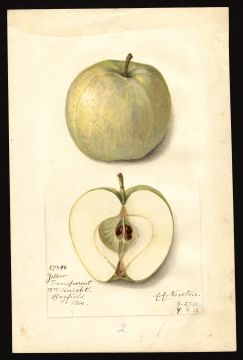 USDA Pomological Watercolor by Newton, Amanda Almira (Bayfield, Bayfield, Wisconsin)
 -
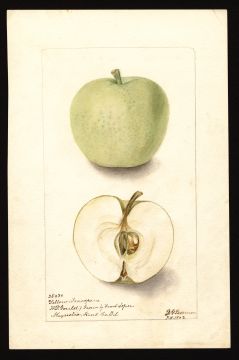 USDA Pomological Watercolor by Passmore, Deborah Griscom (Magnolia, Kent, Delaware)
 -
 USDA Pomological Watercolor by Schutt, Ellen Isham (Hancock, Washington, Maryland)
 -
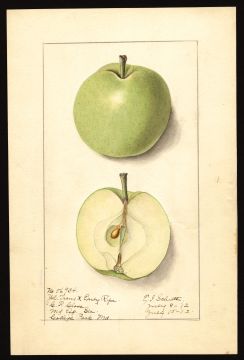 USDA Pomological Watercolor by Schutt, Ellen Isham (College Park, Prince Georges, Maryland)
 -
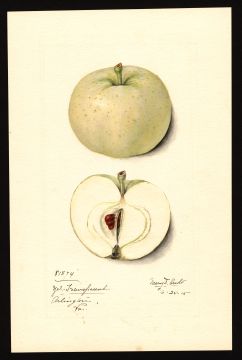 USDA Pomological Watercolor by Arnold, Mary Daisy (Arlington, Virginia)
 -
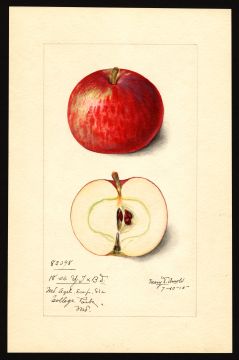 USDA Pomological Watercolor by Arnold, Mary Daisy (College Park, Prince Georges, Maryland)
 -
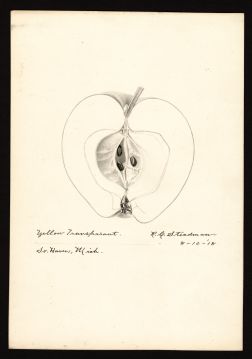 USDA Pomological Watercolor by Steadman, Royal Charles (South Haven, Van Buren, Michigan)
 -
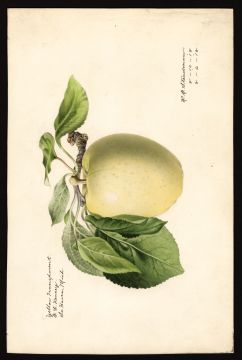 USDA Pomological Watercolor by Steadman, Royal Charles (South Haven, Van Buren, Michigan)


U.S. Department of Agriculture Pomological Watercolor Collection. Rare and Special Collections, National Agricultural Library, Beltsville, MD 20705
USDA Bulletin 56 Notes
USDA name: Grand Sultan
USDA citations: NYExR'92
Sources
- S.A. Beach, The Apples of New York Vol. 2 (1905). Public domain.
- A.J. Downing, Fruits and Fruit Trees of America (1869). Public domain.
- Granville Lowther (ed.), Encyclopedia of Practical Horticulture (1914). Public domain.
- N.E. Hansen, A Study of Northwestern Apples (South Dakota Ag. Exp. Station Bulletin 76, 1902). Public domain.
- J.L. Budd & N.E. Hansen, American Horticultural Manual, Part II: Systematic Pomology (1914). Public domain.
- U.P. Hedrick, Cyclopedia of Hardy Fruits (1922). Public domain.
- John J. Thomas, The American Fruit Culturist (1903). Public domain.
- USDA Pomological Watercolor Collection, U.S. National Agricultural Library.
- 68 historical nursery catalog references (see Variety Finder for the full list).
- Full entry with all citations: Yellow Transparent on the Variety Finder