Early Harvest
Apple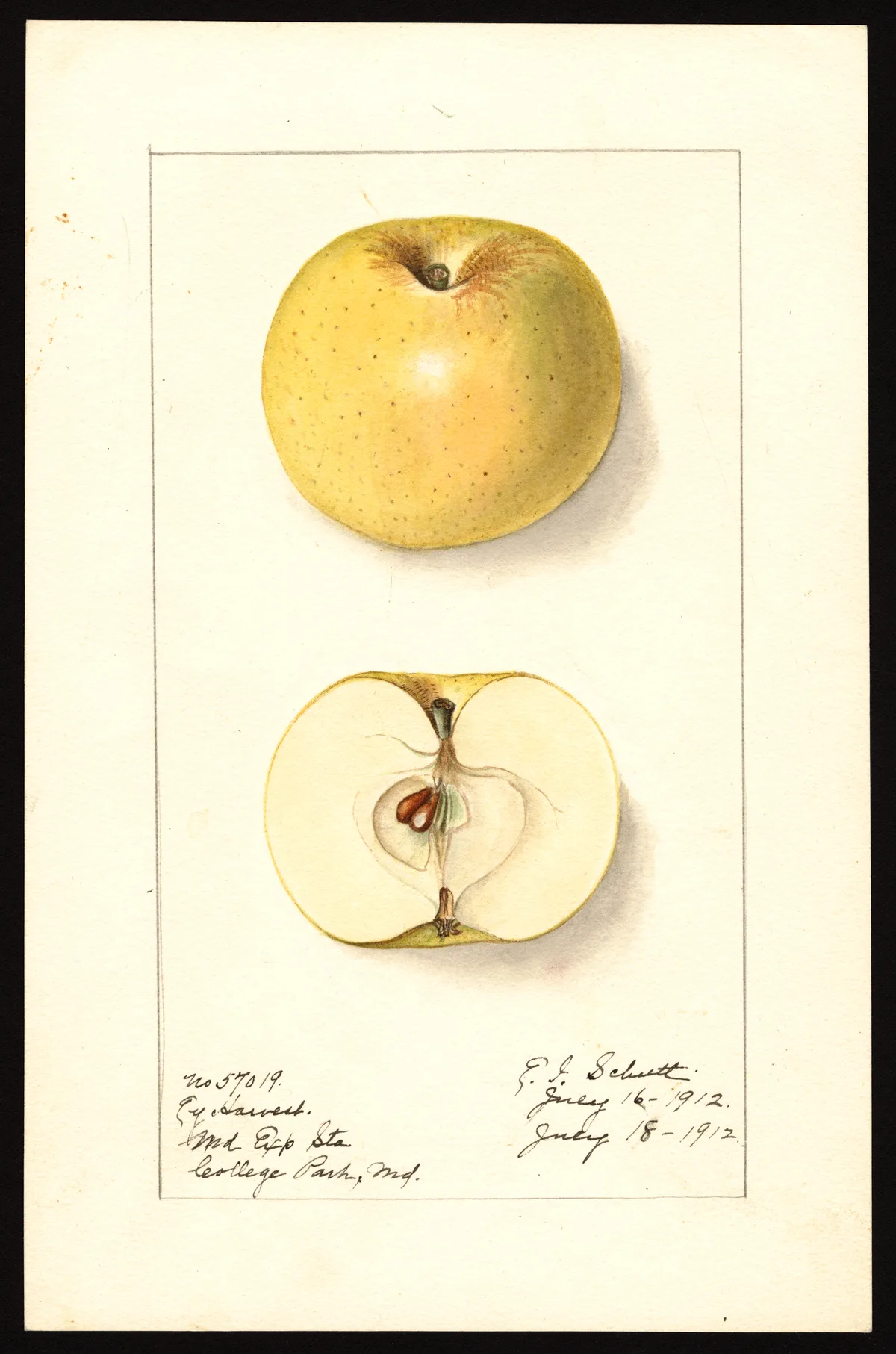
USDA Pomological Watercolor Collection
Early Harvest
Origin/History
Early Harvest is of American origin, though its precise origin is unknown (Beach, Lowther, Hedrick, Budd-Hansen). It was described as long ago as 1806 (Hedrick) and has been known in cultivation for more than one hundred years (Beach, Lowther). William Coxe (1817) was the first author to notice the variety, describing it under the names "Prince's Harvest, or Early French Reinette," but did not state its origin or from whence he received it; because it has not been identified among the many foreign kinds introduced to American collections, there is no doubt of its native origin (Hovey). Hovey (1852) wrote that although upwards of thirty years had passed since Coxe brought it to notice, it was yet very little cultivated in comparison with other sorts more recently introduced and of inferior quality; the supply of fruit for markets was exceedingly limited, and what there was, when large and fine, commanded a very high price. At one time it was quite extensively cultivated for local market in some localities but by Beach's time (1905) was seldom or never planted except for home use. For the commercial orchard it fell into disfavor with market men because of its uncertainty and its proneness to be defective on some soils (Warder).
Tree
Tree of medium size, moderately vigorous (Beach, Hedrick, Lowther, Budd-Hansen, Hovey), though Warder describes it as healthy and vigorous, and the Central Experimental Farm catalogue (1900) calls the tree "a vigorous and spreading grower." Coxe (1817) describes the tree as of middling size with growth not very vigorous, the head round, the limbs spreading without much symmetry or regularity. Form upright, spreading or roundish, open (Beach, Lowther, Hedrick, Budd-Hansen, Downing); Warder describes it as spreading. Hovey notes it branches low but forms, when full grown, a fine round head. Young trees grow upright and may readily be distinguished among others from the forked appearance of the lateral shoots, several of which spring from the extremity of the previous year's wood (Hovey); shoots erect, slightly diverging, straight, often forked (Thomas). The limbs are very strongly attached to the trunk by a woody enlargement at their base, and the pale olive twigs are remarkable for their peculiar mode of production in twos and threes from a common origin (Warder). Comes early into bearing and produces abundant crops (Hovey); moderately long-lived, a biennial or almost annual cropper and moderately productive (Beach); productive (Thomas, Budd-Hansen); above the average in vigor, productiveness, hardiness, and healthfulness (Hedrick). Needs rich cultivation to be fine (Thomas, Budd-Hansen). Good throughout the northern States and Southwest, tender Northwest (Thomas).
Wood/Twigs. Twigs moderately long, curved, rather stout; internodes short (Beach, Lowther). Bark dark brown with some olive-green, lightly streaked with scarfskin; slightly pubescent (Beach, Lowther). Young shoots reddish brown (Downing). Hovey describes the wood as reddish chestnut, sprinkled with small whitish specks, moderately stout, short-jointed; annual shoots somewhat downy at the ends; old wood brownish chestnut.
Lenticels. Scattering, round, not raised (Beach).
Buds. Medium size, plump, obtuse, free, slightly pubescent (Beach). Hovey describes buds as small, short, and flattened, with small shoulders; flower-buds medium size, frequently formed at the ends of the shoots.
Leaves. Medium size, roundish obovate, rather light green, tapering to the point, wavy at the edges, and irregularly and rather obtusely serrated; petioles rather short, about half an inch long, stout (Hovey).
Flowers. Medium size; petals obovate, cupped (Hovey).
Fruit
Size. Medium (Downing, Thomas, Hovey, Beach, Hedrick, Budd-Hansen, Central Experimental Farm); Coxe (1817) says "rather above the middling"; sometimes rather large (Beach, Hedrick); often medium or below (Beach, Budd-Hansen); uniform in size and shape (Beach, Hedrick); a comparatively large percentage runs undersized or otherwise unmarketable (Beach, Lowther, Hedrick). Hovey gives the specific measurement: about three inches broad and two and a half deep. Stark Bros. (1910) calls it "small in size but large in quality."
Form. Flat (Coxe); roundish (Downing, Hovey, Budd-Hansen, Central Experimental Farm); often roundish oblate (Downing, Budd-Hansen); oblate to nearly round, regular or slightly angular (Beach, Hedrick); usually more or less oblate (Thomas); oblate at the West (Budd-Hansen); usually oblate in the West (Warder), where the oblate form prevails; medium, regular, oblate, sometimes almost round (Warder); sometimes little flattened at the base, rounding off to the crown, which is full (Hovey); sides slightly unequal (Beach) or unequal (Hedrick).
Stem/Stalk. Medium in length (Beach, Hedrick, Downing, Thomas, Budd-Hansen); short (Warder); rather short and slender (Thomas); rather slender (Downing, Hovey); moderately thick (Beach) or thick (Hedrick); about three quarters of an inch long (Hovey); half to three-fourths of an inch long (Downing); long and planted in a deep hollow, as is also the crown (Coxe).
Cavity. Wide, regular (Warder, Budd-Hansen); obtuse (Budd-Hansen); nearly acuminate, shallow, rather narrow to moderately broad (Beach), or acuminate, shallow, narrow to broad (Hedrick); moderately deep and somewhat narrow (Hovey); of moderate depth (Downing); russeted and with outspreading, broken russet rays (Beach, Hedrick); with russet patch (Budd-Hansen).
Calyx/Eye. Small (Warder, Beach) to medium (Beach); Hovey gives medium size, closed; closed (Warder, Beach, Hedrick, Downing, Hovey); lobes long, narrow (Beach, Hedrick); segments of the calyx narrow, twisted (Hovey); moderately sunk (Thomas); calyx-tube short, funnel-shape (Beach, Hedrick); tube conical or funnel-shaped (Budd-Hansen); stamens median (Hedrick) or medium (Beach); stamens marginal or median (Budd-Hansen).
Basin. Regular, narrow, abrupt (Warder); shallow, moderately wide, obtuse, slightly wrinkled (Beach); shallow, wide, obtuse, wrinkled (Hedrick); wide, shallow, smooth (Budd-Hansen); shallow, nearly smooth (Hovey); Downing simply says calyx set in a shallow basin.
Skin. Very smooth (Beach, Hedrick, Downing, Budd-Hansen, Warder); smooth (Coxe, Thomas, Central Experimental Farm); fair, smooth (Hovey); thin, tender (Beach, Hedrick); clear pale waxen yellow (Beach, Budd-Hansen), or with deeper yellow on exposed cheek (Hedrick), or occasionally with deeper yellow on exposed cheek (Beach); clear, waxy yellow (Warder); bright straw color when ripe (Thomas, Coxe, Hovey, Downing); a beautiful bright straw colour when fully ripe (Coxe); pale yellow when fully ripe (Hovey); pale clear yellow, with a few white dots (Central Experimental Farm); pale yellow, sometimes with a faint blush (Beach, Lowther); very rarely blushed (Warder, Budd-Hansen); sometimes slightly blushed (Beach, Hedrick); very slightly tinged with blush on the sunny side, with a few traces of russet round the stem, and some scattered spots of the same color, intermixed with white specks, over the surface (Hovey).
Dots. Numerous, large and small, submerged or russet (Beach, Hedrick); numerous, minute, green (Warder); obscure, few, minute, white and green (Budd-Hansen); a few faint white dots (Downing); a few white dots (Central Experimental Farm).
Flesh. White (Coxe, Hovey, Warder, Beach, Hedrick, Budd-Hansen, Central Experimental Farm); very white (Downing, Budd-Hansen); pale yellow (Elliott — note that Elliott's entry is titled "Sinclair's Yellow," a listed synonym); nearly white (Thomas); rather fine (Beach) or fine (Hedrick); crisp (Hovey, Beach, Hedrick, Budd-Hansen, Central Experimental Farm); tender (Coxe, Hovey, Warder, Beach, Hedrick, Budd-Hansen, Downing, Central Experimental Farm); breaking (Warder); not firm (Beach); juicy (Hovey, Warder, Beach, Hedrick, Budd-Hansen, Downing, Central Experimental Farm); juice abundant (Hovey).
Flavor. Pleasantly acid, sprightly, and well flavored (Hovey); sprightly (Coxe, Central Experimental Farm, Budd-Hansen); rich sprightly subacid (Downing); acid to sub-acid, agreeable (Warder); rather acid, fine (Thomas); briskly subacid at first but eventually becoming milder, and more agreeable for dessert (Beach); briskly subacid but becoming mild (Hedrick); pleasant rich subacid (Budd-Hansen); sprightly subacid, and very good in quality (Beach, Lowther); rich, sub-acid (Elliott, under "Sinclair's Yellow"). Hovey praises it as combining, in its flavor, "that pleasant admixture of sweet and acid which gives a freshness peculiar among early apples." Stark Bros. (1910) describes it as of "fruity flavor which proves a most grateful and pleasant variety." Rated good to very good (Hedrick, Budd-Hansen), very good to best (Budd-Hansen), or very good (Beach); of first quality for table or kitchen during the month of July (Warder). Downing rates it "very good to best."
Core/Seeds. Core rather close (Hovey); small, closed (Downing, Budd-Hansen); round, closed, not meeting the eye (Warder); medium size, somewhat abaxile; cells closed or slightly open; core lines clasping (Beach); medium, abaxile; cells closed or slightly open; core-lines clasping (Hedrick). Carpels slightly obovate (Beach) or obovate (Hedrick); cells obovate (Budd-Hansen). Seeds small (Hovey); small to rather large, narrow, long, plump, acute (Beach); small to large, narrow, long, plump, acute (Hedrick); few, large, pointed (Budd-Hansen); large, pointed (Warder).
Season
Ripens about the first of July and continues in use all that month (Downing). Ripe from the middle of July to the end of August (Hovey). In season during the whole month of July (Coxe). The first three weeks of July (Budd-Hansen). Ripens at wheat harvest, and for three weeks afterward (Thomas). Of first quality for table or kitchen during the month of July (Warder). Late July and August (Beach, Hedrick). Season generally ripe in July and August, depending on the latitude and the elevation (Lowther). Season August at Agassiz BC (Central Experimental Farm). Elliott gives June and July for "Sinclair's Yellow." It is one of the earliest of the summer apples (Beach) — the earliest summer apple (Hedrick). Fruit keeps but a short time (Beach, Lowther, Hedrick).
Uses
Excellent for either dessert or culinary uses (Beach, Hedrick, Lowther, Hovey, Downing, Warder, Elliott under "Sinclair's Yellow"). A very fine apple for stewing when green, and when ripe is a very pleasant eating apple (Coxe). Of first quality for table or kitchen during the month of July (Warder). Desirable for the home orchard/home collection (Beach, Hedrick, Lowther); the smallest collection of apples should comprise this and the Red Astrachan (Downing). Not a desirable commercial variety because there is a comparatively large percentage of undersized or otherwise unmarketable fruit, the color is such that it shows bruises very readily, and it keeps but a short time (Beach, Lowther, Hedrick); suitable only for nearby markets (Hedrick). For the commercial orchard, it has fallen into disfavor with the market men because of its uncertainty and its proneness to be defective on some soils (Warder).
Subtypes/Variants
Hovey notes a "Large Early Harvest" (from Thatcher's American Orchardist) among the names Coxe and others applied to this variety, but describes no distinct sub-strain.
Other
Coxe (1817) notes that the apple "is a great bearer, and is in season during the whole month of July." Hovey characterizes Early Harvest as "without doubt, the finest early apple we yet possess," of good size and beautiful appearance, with crisp and tender flesh combining a pleasant admixture of sweet and acid that gives it a freshness peculiar among early apples. Downing similarly calls it, taking into account its beauty, its excellent qualities for the dessert and for cooking, and its productiveness, "the finest early apple yet known."
Book Sources
Described in 10 period pomological works
- Beach, The Apples of New York Vol. 2 (1905)
- Warder, American Pomology: Apples (1867)
- Downing, Fruits and Fruit Trees of America (1900)
- Hedrick, Cyclopedia of Hardy Fruits (1922)
- Budd & Hansen, Systematic Pomology (1914)
- Elliott, The Western Fruit Book (1865)
- Lowther (ed.), Encyclopedia of Practical Horticulture (1914)
- Thomas, The American Fruit Culturist (1903)
- Coxe, A View of the Cultivation of Fruit Trees (1817) — listed as Princes Harvest, Or Early French Reinette
- Hovey, The Fruits of America (1852) — listed as THE EARLY HARVEST APPLE.
Nursery Catalog Sources
Found in 80 catalogs (1845–1932) from Alabama, Arkansas, California, England, Florida, Illinois, Kansas, Maryland, Massachusetts, Missouri, Nebraska, New Jersey, New York, Oregon, Pennsylvania, Virginia, Washington
- Winship's Nursery (Brighton Nurseries , operated by the Winship family), Brighton (Boston) , Massachusetts — 1845
- Hovey & Co. , Cambridge , Massachusetts — 1849
- Azell Bowditch (Nursery / Fruit Catalog) , Boston , Massachusetts — 1850
- Joseph Breck & Co. , Boston , Massachusetts — 1855
- St. Helena Nursery , Howell's Prairie, Marion County , Oregon — 1864
- Hutchison Nursery , James Hutchison, Oakland , California — 1881
- Felix Gillet , Barren Hill Nursery, Nevada City , California — 1884
- Fancher Creek Nursery , Fresno , California — 1886
- Huntsville Wholesale Nurseries (Jessie S. Moss , Proprietor; W.F. Heikes, Manager), Huntsville , Alabama — 1886
- W.R. Strong & Co. , Capital and Orange Hill Nurseries (Robert Williamson, prop.), Sacramento , California — 1886
- Felix Gillet , Barren Hill Nursery, Nevada City , California — 1888
- California Nursery Co. , Niles , California — 1889
- Felix Gillet , Barren Hill Nursery, Nevada City , California — 1889
- Felix Gillet , Barren Hill Nursery, Nevada City , California — 1890
- William H. Moon Co. , Morrisville, Bucks County , Pennsylvania — 1890
- Felix Gillet , Barren Hill Nursery, Nevada City , California — 1891
- Puyallup & Yakima Nurseries , Puyallup, Washington (Lock Box 191) and North Yakima , Washington — 1892
- Glen St. Mary Nurseries (G.L. Taber , Proprietor), Glen St. Mary , Florida — 1893
- Milwaukie-Canby Nurseries , Canby, OR (and Milwaukie, OR) — 1893
- Oregon Wholesale Nurseries , Salem , Oregon — 1893
- Rogers Nursery Co. , Moorestown , New Jersey — 1893
- Sherwood Hall Nursery Co. , Timothy Hopkins (Menlo Park Nurseries), San Francisco / Menlo Park , California — 1893
- Green's Nursery Co. (Charles A. Green) , Rochester , New York — 1894
- Multnomah Nurseries , Russellville , Oregon — 1894
- The Vineland Nurseries (Kelsey & Co. , Proprietors), St. Joseph, Missouri (Office: 13th and Atchison Sts., 2 Blocks East of the Citizens St. Car Line) — 1894
- Woodburn Nurseries , Woodburn, Marion Co. , Oregon — 1894
- Felix Gillet , Barren Hill Nursery, Nevada City , California — 1895
- Stark Bros. Nurseries & Orchards Co. , Louisiana , Missouri — 1896
- The Lovett Company , Little Silver , New Jersey — 1896
- Felix Gillet , Barren Hill Nursery, Nevada City , California — 1897
- Kelway & Son , Langport, Somerset , England — 1897
- The Salem Nursery (John A. Francis , Proprietor), Salem , Virginia — 1897
- Arthur J. Collins & Sons , Moorestown , New Jersey — 1898
- Reading Nursery , Jacob W. Manning, Proprietor, Reading , Massachusetts — 1898
- Stark Bros. Nurseries & Orchards Co. , Louisiana , Missouri — 1898
- Brown Brothers Co. , Continental Nurseries, Rochester, NY (also operated from Toronto, Canada) — 1899
- Alabama Nursery Co. , Huntsville , Alabama — 1900
- Central Experimental Farm , Dominion Department of Agriculture, Agassiz, British Columbia (under test; Bulletin No. 3, Second Series) — 1900
- George Bunyard & Co. , Royal Nurseries, Maidstone, Kent , England — 1900 — listed as July Pippin
- The Dalles Nurseries , The Dalles , Oregon — 1901
- Washington Nursery Co. , Toppenish , Washington — 1901
- Brown Brothers Co. , Continental Nurseries, Rochester, NY (also operated from Toronto, Canada) — 1901
- S.L. Watkins , Grizzly Flats, El Dorado County , California — 1901
- Yarbrough Bros. , Stephens , Arkansas — 1901
- Mountain Grove Nurseries (Tippin & Moore , Proprietors; Geo. T. Tippin, J. W. Tippin, J. C. Moore), Mountain Grove , Missouri — 1901
- Benjamin Buckman (personal inventory) , Farmingdale , Illinois — 1901
- Forestville Nurseries , T.J. True, Forestville , California — 1902
- Pacific Nursery Company (W. O. Hudson & A. D. Hudson) , Tangent , Oregon — 1903
- Russellville Nursery Co. , Russellville, OR (three miles east of Portland, one mile from Montavilla car line) — 1903
- Henderson Luelling / Traveling Nursery (historical recall) , Oregon — 1904
- Phoenix Nursery Company (W. E. Rossney , President; Sidney Tuttle, Vice-President), Bloomington , Illinois — 1904
- Stark Bros. Nurseries & Orchards Co. , Louisiana , Missouri — 1906
- J.B. Pilkington , Portland , Oregon — 1907
- Russellville Nursery Co. , Montavilla Station, Portland, OR (three miles east of Portland, one mile from Montavilla car line) — 1907
- Carlton Nursery Co. , Carlton , Oregon — 1909
- Milton Nursery Co. (A. Miller & Sons , Proprietors), Milton , Oregon — 1909
- Wm. J. Corse (successor to Robert Sinclair / Sinclair Nurseries) , Baltimore , Maryland — 1909
- Washington Nursery Company , Toppenish , Washington — 1909
- C.F. Lansing , Salem , Oregon — 1910
- Stark Bros. Nurseries & Orchards Co. , Louisiana , Missouri — 1910
- Galbraith Nursery Co. (DeWitt Hansen , Pres.-Mgr.), Fairbury , Nebraska — 1911
- Stark Bros. Nurseries & Orchards Co. , Louisiana , Missouri — 1911
- James Veitch & Sons , Ltd., Royal Exotic Nursery, Chelsea, London (also Coombe Wood, Langley, and Feltham) , England — 1911
- Vineland Nurseries Company , Clarkston , Washington — 1912
- Pacific Nursery Company , Portland , Oregon — 1912
- Washington Nursery Company , Toppenish , Washington — 1912
- Samuel Fraser , Geneseo , New York — 1913
- Van Holderbeke Nursery Co. , Incorporated, Spokane, Washington (nurseries at Otis Orchards WA, Pasadena WA, Kennewick WA) — 1913
- Benjamin Buckman (personal inventory) , Farmingdale , Illinois — 1913
- Union Nurseries , J.B. Weaver & Sons, Union , Oregon — 1915
- Holsinger Bros. Nurseries (Holsinger Brothers Nursery) , Rosedale , Kansas — 1916
- Manalapan Nurseries , Englishtown , New Jersey — 1916
- Fancher Creek Nurseries , George C. Roeding, Fresno , California — 1918
- Stark Bros. Nurseries & Orchards Co. , Louisiana , Missouri — 1918
- Oregon Nursery Co. , Orenco , Oregon — 1920
- Benedict Nursery Co. , Portland , Oregon — 1921
- Fresno Nursery Co. , Fresno , California — 1924
- Columbia & Okanogan Nursery Co. , Wenatchee , Washington — 1925
- Stark Bro's Nurseries , Louisiana , Missouri — 1932
- North-Western Nurseries , Walla Walla , Washington
View original book sources (12)
— William Coxe, A View of the Cultivation of Fruit Trees (1817)NO. 2. PRINCES HARVEST, OR EARLY FRENCH REINETTE.
This is a very fine apple for stewing when green, and when ripe is a very pleasant eating apple—the form is flat, the size rather above the middling; the skin when fully ripe, of a beautiful bright straw colour; the flesh white, tender, sprightly, and juicy. The character of this apple stands very high; it is a great bearer, and is in season during the whole month of July: the tree is of a middling size, the growth not very vigorous; the head round, the limbs spreading, without much symmetry or regularity—the stalk is long and planted in a deep hollow, as is also the crown.
— C.M. Hovey, The Fruits of America (1852)THE EARLY HARVEST APPLE.
Early Harvest. Kenrick's American Orchardist, 1st Ed. 1833. Large Early Harvest, Thatcher's Am. Orchardist. Prince's Harvest, or } Early French Reinette, } Coxe's View of the Orchard, &c. July Pippin, Floy, in Guide to the Orchard, Am. Ed. July Early Pippin, } Large Early, } Hort. Soc. Catalogue, 3d. Ed. 1842. Harvest, } Yellow Harvest, } Large White Juneating, } of some American collections. Tart Bough, }
The Early Harvest is, without doubt, the finest early apple we yet possess. Of good size, and beautiful appearance, it has a crisp and tender flesh, and combines, in its flavor, that pleasant admixture of sweet and acid which gives a freshness peculiar among early apples.
Mr. Coxe, in his excellent work on fruit trees, describes the Early Harvest under the names above quoted from his work, and he is the first author who notices this variety. He does not, however, state its origin, or from whence he received it; but as it has not been identified among the great number of foreign kinds which have been introduced to American collections, there can be no doubt of its native origin.
Though now upwards of thirty years since it was first brought to notice by Mr. Coxe, it is yet very little cultivated, in comparison with other sorts more recently introduced, and of inferior quality. The supply of fruit for our markets is exceedingly limited, and what there is, when large and fine, commands a very high price. That a variety so excellent should not have been much more extensively disseminated is somewhat remarkable, and we hope our description and figure of it may aid in making it better known to all cultivators.
The Early Harvest is a moderately vigorous and healthy growing tree, branching low, but forming, when full grown, a fine round head ; it comes early into bearing, and produces abundant crops. The young trees grow upright, and may readily be distinguished among others from the forked appearance of the lateral shoots, several of which spring from the extremity of the previous year's wood.
Tree. — Moderately vigorous, upright, the branches making very acute angles.
Wood. — Reddish chestnut, sprinkled with small whitish specks, moderately stout, short-jointed ; annual shoots somewhat downy at the ends ; old wood, brownish chestnut ; buds, small, short, and flattened, with small shoulders : Flower-buds, medium size, frequently formed at the ends of the shoots.
Leaves. — Medium size, roundish obovate, rather light green, tapering to the point, wavy at the edges, and irregularly and rather obtusely serrated ; petioles rather short, about half an inch long, stout.
Flowers. — Medium size ; petals obovate, cupped.
Fruit. — Medium size, about three inches broad, and two and a half deep : Form, roundish, sometimes little flattened at the base, rounding off to the crown, which is full : Skin, fair, smooth, pale yellow or straw color when mature, very slightly tinged with blush on the sunny side, with a few traces of russet round the stem, and some scattered spots of the same color, intermixed with white specks, over the surface : Stem, medium length, about three quarters of an inch long, rather slender, and inserted in a moderately deep and somewhat narrow cavity : Eye, medium size, closed, and slightly sunk in a shallow, nearly smooth, basin ; segments of the calyx narrow, twisted : Flesh, white, rather fine, crisp, and tender : Juice, abundant, pleasantly acid, sprightly and well flavored : Core, rather close : Seeds, small.
Ripe from the middle of July to the end of August.
— F.R. Elliott, The Western Fruit Book (1865)Sinclair's Yellow. Fruit, small to medium, flat or roundish ; skin, smooth, of a fine orange color, darkened in the sun ; flesh, pale yellow, with a rich, sub-acid flavor ; a good bearer, and excellent for both the table and kitchen. June and July,
— John A. Warder, American Pomology: Apples (1867)Early Harvest.
This American apple has long been a prime favorite in the orchard, especially when planted for family use, since it is of excellent quality for table as well as in the kitchen. For the commercial orchard, however, it is falling into disfavor with the market men, because of its uncertainty, and its proneness to be defective on some soils.
Tree spreading, healthy and vigorous ; the limbs are very strongly attached to the trunk by a woody enlargement at their base, and the pale olive twigs are remarkable for their peculiar mode of production in twos and threes from a common origin.
Fruit medium, regular, oblate, sometimes almost round, as described by Downing, but this is rare in the West, where the oblate form prevails. Surface smooth, clear, waxy yellow, very rarely blushed ; Dots numerous, minute, green. Basin regular, narrow, abrupt ; Eye small, closed. Cavity wide, regular ; Stem short. Core round, closed, not meeting the eye ; Seeds large, pointed ; Flesh tender, breaking, juicy, acid to sub-acid, agreeable ; Of first quality for table or kitchen during the month of July.
— A.J. Downing, The Fruits and Fruit Trees of America (1900)Early Harvest.
Prince's Harvest, or Early French Reinette, of Coxe. July Pippin. Tart Bough. Yellow Harvest. Early French Reinette. Large White Juneating. Sinclair's Yellow.
An American Apple; and taking into account its beauty, its excellent qualities for the dessert and for cooking, and its productiveness, we think it the finest early apple yet known. It begins to ripen about the first of July, and continues in use all that month. The smallest collection of apples should comprise this and the Red Astrachan. Tree moderately vigorous, upright, spreading. Young shoots reddish brown.
Fruit medium size. Form roundish, often roundish oblate, medium size. Skin very smooth, with a few faint white dots, bright straw-color when fully ripe. Stalk half to three-fourths of an inch long, rather slender, inserted in a hollow of moderate depth. Calyx set in a shallow basin. Flesh very white, tender, and juicy, crisp, with a rich sprightly subacid flavor. Very good to best. Core small.
— John J. Thomas, The American Fruit Culturist (1903)Early Harvest.* (Yellow Harvest, Prince's Harvest, Early French Reinette, July Pippin.) Size medium, roundish, usually more or less oblate, smooth; bright straw color when ripe; stalk rather short and slender; calyx moderately sunk; flesh nearly white, flavor rather acid, fine. Ripens at wheat harvest, and for three weeks afterward. Shoots erect, slightly diverging, straight, often forked. Productive. Needs rich cultivation to be fine. Good throughout the northern States and Southwest, tender Northwest. Fig. 354.
— S.A. Beach, The Apples of New York, Vol. 2 (1905)EARLY HARVEST.
REFERENCES. 1. Amer. Gard. Cat., 1806:584. 2. Coxe, 1817:101. fig. 3. Thacher, 1822:129. 4. Buel, N. Y. Bd. Agr. Mem., 1826:476. 5. Wilson, 1828:136. 6. Fessenden, 1828:131. 7. London Hort. Soc. Cat., 1831:No. 355. 8. Kenrick, 1832:26. 9. Floy-Lindley, 1833:410. 10. Mag. Hort., 1:362. 1835. 11. Manning, 1838:45. 12. Ib., Mag. Hort., 7:51. 1841. 13. Downing, 1845:72. fig. 14. French, Horticulturist, 1:256. 1846. 15. Hovey, Mag. Hort., 14:115. 1848. fig. 16. Cole, 1849:97. fig. 17. Walker, Mag. Hort., 15:165. 1849. 18. Thomas, 1849:142. 19. Emmons, Nat. Hist. N. Y., 3:16. 1851. 20. Barry, 1851:280. 21. Hovey, 1:75. 1851. col. pl. and fig. 22. Am. Pom. Soc. Cat., 1852. 23. Elliott, 1854:84. fig. 24. Hooper, 1857:31, 107, 111. 25. Gregg, 1857:36. fig. 26. Warder, 1867:403. fig. 27. Fitz, 1872:143, 160, 172. 28. Downing, 1872:10 index, app. 29. Ib., 1881:11 index, app. 30. Hogg, 1884:67. 31. Wickson, 1889:243. 32. Lyon, Mich. Hort. Soc. Rpt., 1890:290. 33. Bailey, An. Hort., 1892:238. 34. Stinson, Ark. Sta. An. Rpt., 7:44. 1894. 35. Burrill and McCluer, Ill. Sta. Bul., 45:320. 1896. 36. Woolverton, Ont. Fr. Stas. An. Rpt., 3:7. 1896. figs. 37. Can. Hort., 20:328. 1897. figs. 38. Alwood, Va. Sta. Bul., 130:121. 1901. 39. Waugh, Vt. Sta. An. Rpt., 14:292. 1901. 40. Budd-Hansen, 1903:73. fig.
SYNONYMS. Early French Reinette (2, 8, 13, 15, 18, 19, 21, 23, 30, 34). EARLY HARVEST (1, 7, 8, 10, 11, 12, 14, 15, 16, 17, 18, 19, 20, 21, 22, 24, 25, 26, 27, 28, 29, 30, 31, 32, 33, 34, 35, 36, 37, 38, 39, 40). Early Harvest (9, 23). Early July Pippin (24). Early June (23). HARVEST (23). Harvest (21). Early Pippin (15, 21, 30). JULY PIPPIN (9). July Pippin (13, 15, 18, 19, 21, 23, 30, 34). Large Early (15, 21, 30). Large Early Harvest (15, 21). LARGE EARLY HARVEST (3). Large White Juneating (13, 15, 19, 21, 23, 30). Maralandica (29). Oats incorrectly (29). Pomme d'Ete of Canada (30). Prince's Early Harvest (8, 30). PRINCE'S HARVEST (2, 4, 5, 6). Prince's Harvest (8, 13, 15, 18, 19, 21, 23, 24, 30, 34). Prince's Yellow Harvest (30). Tart Bough (13, 15, 19, 21, 30). Yellow Harvest (13, 15, 16, 18, 19, 21, 23, 24, 30, 34). Yellow Juneating (23).
Fruit medium, pale yellow, sometimes with a faint blush, tender, sprightly subacid, and very good in quality. It is a desirable variety for the home orchard because it is one of the earliest of the summer apples, and is excellent for either dessert or culinary uses. It is not a desirable commercial variety because there is a comparatively large percentage of undersized or otherwise unmarketable fruit, the color is such that it shows bruises very readily and it keeps but a short time. The tree is a fairly good grower, moderately long-lived, comes into bearing rather early, is a biennial or almost annual cropper and moderately productive.
Historical. Early Harvest has been known in cultivation for more than a hundred years. Its origin is unknown but it is supposed to have originated in America. At one time it was quite extensively cultivated for local market in some localities but it is now seldom or never planted except for home use.
TREE. Tree medium size, moderately vigorous. Form upright spreading or roundish, open. Twigs moderately long, curved, rather stout; internodes short. Bark dark brown with some olive-green, lightly streaked with scarfskin; slightly pubescent. Lenticels scattering, round, not raised. Buds medium size, plump, obtuse, free, slightly pubescent.
FRUIT. Fruit usually medium or below but sometimes rather large, uniform in size and shape. Form oblate to nearly round, regular or slightly angular; sides slightly unequal. Stem medium in length, moderately thick. Cavity nearly acuminate, shallow, rather narrow to moderately broad, russeted and with outspreading, broken russet rays. Calyx small to medium, closed; lobes long, narrow. Basin shallow, moderately wide, obtuse, slightly wrinkled. Skin thin, tender, very smooth, clear pale waxen yellow, occasionally with deeper yellow on exposed cheek, sometimes slightly blushed. Dots numerous, large and small, submerged or russet. Calyx tube short, funnel-shape. Stamens medium. Core medium size, somewhat abaxile; cells closed or slightly open; core lines clasping. Carpels slightly obovate. Seeds small to rather large, narrow, long, plump, acute. Flesh white, not firm, rather fine, crisp, tender, juicy, at first briskly subacid but eventually becoming milder, and more agreeable for dessert. Good to very good.
Season late July and August.
— J.L. Budd & N.E. Hansen, American Horticultural Manual, Part II: Systematic Pomology (1914)Early Harvest. — Of American origin; tree moderately vigorous, upright, spreading, productive, needs rich cultivation.
Early Harvest.
Fruit medium or below, roundish, often roundish oblate, usually oblate at the West; surface very smooth, clear, pale waxen yellow, very rarely blushed; dots obscure, few, minute, white and green; cavity wide, regular, obtuse, with russet patch; stem medium; basin wide, shallow, smooth. Core small, closed; cells obovate; tube conical or funnel-shaped; stamens marginal or median; seeds few, large, pointed; flesh very white, tender, juicy, crisp, sprightly, pleasant rich subacid, very good to best. The first three weeks of July.
— Granville Lowther (ed.), Encyclopedia of Practical Horticulture (1914)Early Harvest
The Early Harvest is in color pale yellow, sometimes with a faint blush, tender, sprightly subacid, and very good in quality. It is desirable as an early variety for home use and is excellent either for cooking or dessert. It is not desirable as a market variety, because it easily bruises; fruit keeps but a short time and produces a considerable percentage of small, undersized and unmarketable fruit.
Historical. The origin of the variety is unknown, but it is supposed to have originated in America, and is known to have been in cultivation for more than one hundred years.
The tree is a medium size, moderately vigorous. Form upright, spreading, roundish, open. Twigs moderately long, curved, rather stout; internodes short. Bark dark brown, with some olive green, lightly streaked with scarf skin; slightly pubescent, or hairy.
Season depending on the latitude and the elevation, but generally ripe in July and August.
— U.P. Hedrick, Cyclopedia of Hardy Fruits (1922)EARLY HARVEST. Fig. 17. July Pippin. Tart Bough. Yellow Harvest. Yellow Juneating.
As the earliest summer apple, and because the fruit is excellent for either dessert or cooking, Early Harvest should hold a welcome place in every home collection. Much of the fruit is too small to be marketable, and the apples bruise badly in handling, so that the variety is suitable only for nearby markets. The trees are above the average in vigor, productiveness, hardiness, and healthfulness. Early Harvest was described as long ago as 1806, and is probably of American origin.
Tree medium size, moderately vigorous, upright-spreading or roundish, open. Fruit medium, sometimes large, uniform in size and shape, oblate to nearly round, regular or slightly angular; sides unequal; stem medium in length, thick; cavity acuminate, shallow, narrow to broad, russeted, with outspreading, broken russet rays; calyx small, closed; lobes long, narrow; basin shallow, wide, obtuse, wrinkled; skin thin, tender, smooth, clear pale waxen yellow, with deeper yellow on exposed cheek, sometimes slightly blushed; dots numerous, large and small, submerged or russet; calyx-tube short, funnel-shape; stamens median; core medium, abaxile; cells closed or slightly open; core-lines clasping; carpels obovate; seeds small to large, narrow, long, plump, acute; flesh white, fine, crisp, tender, juicy, at first briskly subacid but becoming mild; good to very good; late July and August.
— Central Experimental Farm, Central Experimental Farm, Agassiz BC — Catalogue of Fruit Trees under Test (Bulletin No. 3, 1900) (1900)Planted Spring 1890. Tree a vigorous and spreading grower. Fruit of medium size, roundish. Skin pale clear yellow, with a few white dots. Flesh white, tender, crisp, juicy, sprightly, quality good. Season August.
— Stark Bros. Nurseries & Orchards Co., Stark Bros. Year Book (1910) (1910)This is small in size but large in quality, being fairly early. Fruity flavor which proves a most grateful and pleasant variety...