Champlain
Apple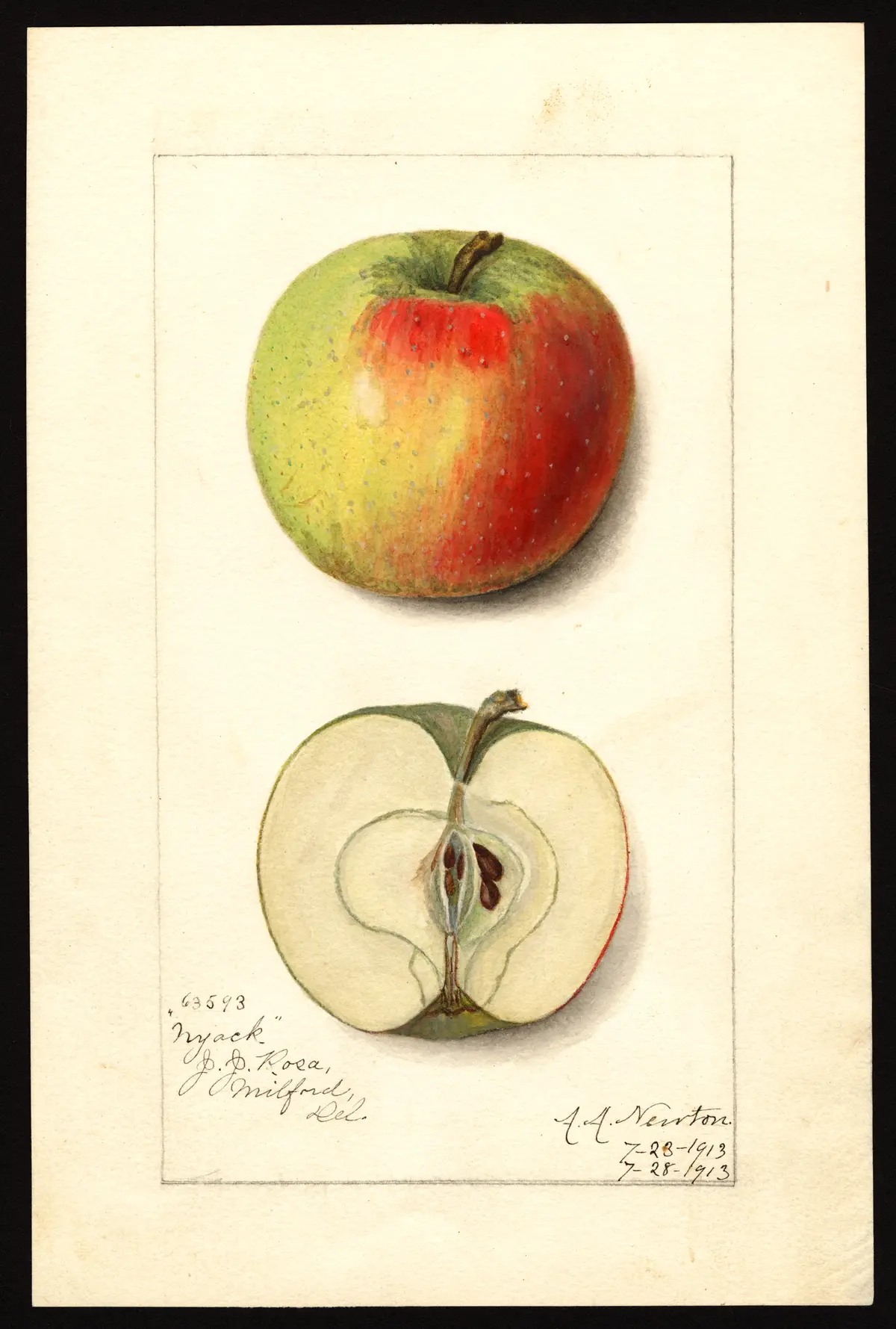
USDA Pomological Watercolor Collection
Champlain
Origin / History
Origin unknown (Downing 1900; Beach 1905; Hedrick 1922). Budd-Hansen (1914) gives the origin as Westchester County, New York. An old fruit, much cultivated in Rockland and Westchester Counties, New York, and a valuable market fruit there (Downing 1900). Warder (1867) recounts that A. L. Benedict, of Morrow County, exhibited it before the Ohio Pomological Society as the Paper apple; Benedict had obtained the cions from the celebrated apple region of Grand Isle, Vermont, "where it is sometimes called Champlain, and where it had been introduced from Rhode Island, without a name, by his friend Macomber." Benedict further informed Warder that "the growth of the tree is strong and stocky, and that the fruit never scabs nor rots on the tree. It is increasing in esteem as it becomes better known, and is preferred to the Red Astrachan, ripening with it. When sent to J. J. Thomas, he thought it synonymous with the Primate, but Jos. Newcomber, having both varieties growing side by side, assured me they were quite unlike, and that the Paper was much the better apple of the two." The variety has been on record since 1853, when an account of it was published in the New England Farmer (Hedrick 1922; Beach 1905). In 1871 it was included in the American Pomological Society's Catalogue under the name Summer Pippin; since 1897 it has been listed under the name Champlain (Beach 1905). Old trees are frequently found in the home orchards throughout New York state, though it is now seldom planted (Beach 1905). Its culture is almost wholly confined to New England and the Middle Atlantic states (Hedrick 1922). Nurserymen sometimes list this variety as Nyack, and sometimes as Summer Pippin, but seldom or never as Champlain (Beach 1905); it is more often known as Nyack or as Summer Pippin than as Champlain (Hedrick 1922).
Tree
Tree medium to large, vigorous, hardy, healthy, and moderately long-lived (Beach 1905; Hedrick 1922). Warder (1867) describes it as medium size, vigorous, stocky. Downing (1900) and Thomas (1903) describe the tree as vigorous, forming a beautiful round head, a regular and good bearer. Budd-Hansen (1914) call it vigorous, round-topped, productive, and a regular bearer. Form upright-spreading to roundish, open, with long and moderately stout branches (Beach 1905); upright-spreading, open, with long stout branches (Hedrick 1922). Comes into bearing rather young and is a reliable cropper, yielding good crops biennially or almost annually (Beach 1905); productive (Elliott 1865). Young shoots dull reddish grayish brown, slightly downy (Downing 1900). Twigs long to medium, straight, moderately stout; internodes long (Beach 1905). Bark dull brown tinged with olive-green, lightly streaked with scarf-skin, heavily pubescent (Beach 1905). Lenticels scattering, medium size, oblong, slightly raised (Beach 1905). Buds medium size, plump, obtuse, appressed, pubescent (Beach 1905).
Fruit
Size
Large (Elliott 1865); full medium (Warder 1867); medium to large, not very uniform in size or shape (Beach 1905; Budd-Hansen 1914; Hedrick 1922); medium (Lowther 1914); rather large (Thomas 1903).
Form
Roundish conic (Elliott 1865); globular, rather conical, angular (Warder 1867); medium to large, variable in form, generally roundish oblong, inclining to conic (Downing 1900); oblong, oval, irregular (Thomas 1903); roundish, rather conical to ovate or somewhat oblong, irregularly ribbed; sides somewhat unequal (Beach 1905); roundish conical to oblong oval, angular, irregular (Budd-Hansen 1914); round-conic to ovate or oblong, irregularly ribbed, sides unequal (Hedrick 1922); roundish oblate (Lowther 1914).
Stem
Long (Elliott 1865); long, slender (Warder 1867); varies in length and thickness (Downing 1900; Warder 1867 additional; Beach 1905 gives medium to long, medium to rather thick); variable, deep set (Thomas 1903); variable, generally long, slender (Budd-Hansen 1914); medium to long (Hedrick 1922).
Cavity
Deep (Elliott 1865); acute, wavy, green (Warder 1867); deep, abrupt (Downing 1900); acuminate to acute, moderately shallow to deep, rather narrow to medium in width, sometimes furrowed and usually lightly russeted (Beach 1905); acute, deep, green, wavy (Budd-Hansen 1914); acuminate, shallow, narrow, sometimes furrowed and usually russeted (Hedrick 1922).
Calyx
Closed (Elliott 1865; Downing 1900; Budd-Hansen 1914); small, long, closed (Warder 1867 — "Eye small, long, closed"); small, closed (Budd-Hansen 1914); small to medium, closed or slightly open (Beach 1905); small, closed or open (Hedrick 1922). Calyx tube conical to funnel-form, usually rather short but sometimes elongated (Beach 1905); calyx-tube conical, usually short but sometimes elongated (Hedrick 1922). Stamens median to marginal (Beach 1905); stamens median (Hedrick 1922).
Basin
Narrow (Elliott 1865); small, abrupt, folded (Warder 1867); deep, abrupt, corrugated (Downing 1900); abrupt, furrowed (Thomas 1903); shallow to medium in depth, narrow, a little abrupt, nearly smooth (Beach 1905); abrupt, corrugated, deep (Budd-Hansen 1914); shallow, narrow, abrupt, smooth (Hedrick 1922).
Skin
Greenish, with a fine blush (Elliott 1865); surface smooth, yellowish green, slightly blushed (Warder 1867); pale waxen yellow, shaded with a delicate crimson blush, and sprinkled with green and grayish dots (Downing 1900); pale yellow, with greenish dots and a crimson blush (Thomas 1903); tender, greenish-yellow or pale yellow, often with a light crimson blush (Beach 1905); surface smooth, pale waxen yellow with slight crimson blush (Budd-Hansen 1914); tender, pale yellow, often with a light crimson blush (Hedrick 1922); yellow-red (Lowther 1914). Fruit of good size, smooth and attractive for a greenish-yellow apple (Beach 1905).
Dots
Warder (1867): minute, indented. Downing (1900): green and grayish. Thomas (1903): greenish dots. Beach (1905): numerous, small, russet or submerged. Budd-Hansen (1914): minute, green and grayish. Hedrick (1922): numerous, small, russet or submerged.
Flesh / Flavor
White, tender, juicy, pleasant, sub-acid (Elliott 1865). White, tender, fine-grained, juicy; flavor sub-acid, aromatic, delicate; quality best (Warder 1867). White, tender, moderately juicy, pleasant, refreshing, subacid (Downing 1900). White, tender, with a pleasant sub-acid flavor (Thomas 1903). White or with slight tinge of yellow, rather fine, very tender, juicy, sprightly, subacid, good to very good (Beach 1905). White, tender, fine-grained, juicy, aromatic, pleasant subacid, very good to best (Budd-Hansen 1914). Yellow, fine, very tender, juicy, sprightly, subacid; good to very good (Hedrick 1922). Quality good (Lowther 1914). Note conflict on flesh color: Beach (1905) records white or with slight tinge of yellow; Hedrick (1922) records yellow.
Core / Seeds
Core medium, round, slightly open, clasping (Warder 1867); core round, slightly open, clasping (Budd-Hansen 1914); core large, axile to somewhat abaxile; cells open; core lines clasp the funnel cylinder; carpels smooth, elongated ovate, not emarginate (Beach 1905); core large, axile to abaxile; cells open; corelines clasping; carpels smooth, elongated-ovate (Hedrick 1922). Seeds numerous, angular, dark (Warder 1867); many, angular (Budd-Hansen 1914); rather dark brown, medium size, rather narrow and short, plump, sharp pointed, almost acuminate (Beach 1905); dark brown, narrow, short, plump, sharp-pointed, acuminate (Hedrick 1922).
Season
September (Elliott 1865); August, September (Warder 1867; Budd-Hansen 1914); ripens the middle of August, and continues a month or more (Downing 1900); end of summer (Thomas 1903); ripens in succession from late August till October, so more than two pickings are required to secure the crop in good condition, neither too green nor too ripe (Beach 1905); late August till October (Beach 1905; Hedrick 1922). No season data reported (Lowther 1914).
Uses
Good for dessert and excellent for culinary use (Beach 1905); use, the dessert especially (Warder 1867); valuable for culinary uses, and profitable for market (Downing 1900); use, both kitchen and market (Lowther 1914). Some find Champlain a profitable commercial variety, but usually it is grown for home use rather than for market (Beach 1905). Has many qualities that commend it for the home orchard (Hedrick 1922).
Subtypes / Variants
Downing (1900) notes: "There is another Summer Pippin which we have received from Iowa. Tree very vigorous, productive. The fruit is medium, oblate, inclining to conic, yellowish, shaded, splashed, and striped with crimson in the sun, large light dots. Stalk rather long. Calyx closed. Flesh white, pleasant subacid. August, September." This is presented by Downing as a distinct fruit received under the same name, not as an accepted strain of the primary variety.
Other
Warder (1867), quoting Benedict, reports the specific horticultural virtue that "the fruit never scabs nor rots on the tree." Benedict also reported that when specimens were sent to J. J. Thomas, Thomas thought it synonymous with the Primate, but Jos. Newcomber, having both varieties growing side by side, "assured me they were quite unlike, and that the Paper was much the better apple of the two." Lowther (1914) reports the variety from 6 stations in the Northern Division, 6 stations in the Central Division, and 2 stations in the Southern Division (figures given under the Summer Pippin heading in that source).
Book Sources
Described in 8 period pomological works
- Beach, The Apples of New York Vol. 2 (1905)
- Warder, American Pomology: Apples (1867)
- Downing, Fruits and Fruit Trees of America (1900) — listed as Summer Pippin
- Budd & Hansen, Systematic Pomology (1914)
- Elliott, The Western Fruit Book (1865)
- Lowther (ed.), Encyclopedia of Practical Horticulture (1914) — listed as Champlain (Nyack)
- Hedrick, Cyclopedia of Hardy Fruits (1922)
- Thomas, The American Fruit Culturist (1903)
Nursery Catalog Sources
Found in 4 catalogs (1900–1913) from Illinois
- Central Experimental Farm , Dominion Department of Agriculture, Agassiz, British Columbia (under test; Bulletin No. 3, Second Series) — 1900 — listed as Nyack Pippin
- Benjamin Buckman (personal inventory) , Farmingdale , Illinois — 1901 — listed as Large Golden Pippin
- Benjamin Buckman (personal inventory) , Farmingdale , Illinois — 1913 — listed as Large Golden Pippin
- Benjamin Buckman (personal inventory) , Farmingdale , Illinois — 1913 — listed as Nyack Pippin
View original book sources (8)
— F.R. Elliott, The Western Fruit Book (1865)Champlain. Tree, moderately vigorous, productive. Fruit, large, roundish conic; skin, greenish, with a fine blush; stem, long; cavity, deep; calyx, closed; basin, narrow; flesh, white, tender, juicy, pleasant, sub-acid. September. (Downing.)
[Additional entry in this volume: "Summer Pippin", pp. 177–177]
Summer Pippin. Sour Bough. American. Tree, vigorous, profitable market sort ; valuable for cooking. Fruit, medium to large, oblong oval, irregular, waxy yellow ; shaded with crimson blush, green and grayish dots ; stem, varying ; cavity, deep, abrupt ; calyx, closed ; basin, deep, furrowed ; flesh, white, tender, pleasant, sub-acid ; core, large. August. September.
[Additional entry in this volume: "Walworth", pp. 183–183]
Walworth.
Vermont, | Large Golden Pippin.
From New Jersey. Fruit, large, roundish conical, clear yellow, bright red in sun, dotted with greenish russet specks; stem, short, slender; calyx, small, closed; basin, furrowed; core, large, open; seeds, plump; flesh, yellowish white, tender, juicy, sub-acid. October. (Hov. Mag.) We suspect this is an old variety under a new name.
— John A. Warder, American Pomology: Apples (1867)Champlain. — [Downing.] PAPER — PAPER-SKIN. This very delicate fruit was exhibited before the Ohio Pomological Society by A. L. Benedict, of Morrow County, as the Paper apple. He obtained the cions from the celebrated apple region, Grand Isle, Vermont, where it is sometimes called Champlain, and where it had been introduced from Rhode Island, without a name, by his friend Macomber. My friend Benedict informs me that "the growth of the tree is strong and stocky, and that the fruit never scabs nor rots on the tree. It is increasing in esteem as it becomes better known, and is preferred to the Red Astrachan, ripening with it. When sent to J. J. Thomas, he thought it synonymous with the Primate, but Jos. Newcomber, having both varieties growing side by side, assured me they were quite unlike, and that the Paper was much the better apple of the two." Tree medium size, vigorous, stocky. Fruit full medium, globular, rather conical, angular; Surface smooth, yellowish green, slightly blushed; Dots minute, indented. Basin small, abrupt, folded; Eye small, long, closed. Cavity acute, wavy, green; Stem long, slender. Core medium, round, slightly open, clasping; Seeds numerous, angular, dark; Flesh white, tender, fine-grained, juicy; Flavor sub-acid, aromatic, delicate; Quality best; Use, the dessert especially; Season, August, September.
[Additional entry in this volume: "Nyack Pippin", pp. 447–447]
Nyack. NYACK PIPPIN.
Origin New York; specimen obtained from Mr. E. H. Warren, of Chelmsford, Massachusetts. Fruit medium, flat, uneven; Surface smooth, greenish-yellow, mixed, striped, splashed bright red; Dots numerous, distinct, yellow, indented. Basin shallow, folded; Eye small, closed; Axis short. Cavity wide, deep, wavy, brown; Stem short, thick, knobby. Core rather wide, closed, rather clasping; Seeds large; Flesh white, firm, juicy; Flavor acid, rich; Quality pretty good; Use table, market; Season December.
[Additional entry in this volume: "Summer Pippin", pp. 647–647]
Summer Pippin.
A favorite apple about New York — not known extensively. Tree vigorous, forming a beautiful head, a regular and good bearer.
Fruit medium to large, variable in form, sometimes oblong-oval, or inclining to conic, angular and irregular; Skin pale waxen yellow, shaded with a delicate crimson blush, and sprinkled with green and grayish dots; Stalk varies in length and thickness, inserted in a deep, abrupt cavity; Calyx closed, set in a deep, abrupt, corrugated basin; Flesh white, tender, moderately juicy, with a pleasant, refreshing sub-acid flavor; Valuable for culinary uses; Ripens in August and continues a month or more. — [Downing.]
— A.J. Downing, The Fruits and Fruit Trees of America (1900)Sour Bough. Summer Pippin. Walworth. Calkin's Pippin. Haverstraw Pippin. Tart Bough. Paper Apple. Champlain. Large Golden Pippin. Underdunk. Nyack Pippin. Geneva Pearmain.
Origin unknown. An old fruit, much cultivated in Rockland and Westchester Counties, N. Y. ; a valuable market fruit. Tree vigorous, forming a beautiful round head, a regular and good bearer. Young shoots dull reddish grayish brown, slightly downy.
Summer Pippin. Fruit medium to large, variable in form, generally roundish oblong, inclining to conic, pale waxen yellow, shaded with a delicate crimson blush, and sprinkled with green and grayish dots. Stalk varies in length and thickness, inserted in a deep, abrupt cavity. Calyx closed, set in a deep, abrupt, corrugated basin. Flesh white, tender, moderately juicy, pleasant, refreshing, subacid, valuable for culinary uses, and profitable for market. Ripens the middle of August, and continues a month or more.
There is another Summer Pippin which we have received from Iowa. Tree very vigorous, productive.
The fruit is medium, oblate, inclining to conic, yellowish, shaded, splashed, and striped with crimson in the sun, large light dots. Stalk rather long. Calyx closed. Flesh white, pleasant subacid. August, September.
— John J. Thomas, The American Fruit Culturist (1903)Champlain. See Summer Pippin.
[Additional entry in this volume: "Summer Pippin", pp. 330–330]
Summer Pippin. (Sour Bough.) Rather large, oblong, oval, irregular; skin pale yellow, with greenish dots and a crimson blush; stalk variable, deep set; basin abrupt, furrowed; flesh white, tender, with a pleasant sub-acid flavor. End of summer. A regular, handsome grower and good bearer. Westchester County, N. Y.
[Additional entry in this volume: "Walworth", pp. 746–746]
Walworth does not appear as a headed entry on page 746. The page contains only a cross-reference to it within the V-section of the alphabetical short-entry list: "Vermont. See Walworth." The page ends with "Waddei's Hall. See Shockley." — the actual Walworth entry must begin on page 747.
[Additional entry in this volume: "Sour Bough", pp. 742–742]
Sour Bough. See Summer Pippin.
— S.A. Beach, The Apples of New York, Vol. 2 (1905)CHAMPLAIN.
REFERENCES. 1. N. E. Farmer, 1853 (cited by 14). 2. Downing, 1857:128. 3. Warder, 1867:637. 4. Downing, 1869:368. fig. 5. Am. Pom. Soc. Cat., 1871:10. 6. Leroy, 1873:828. fig. 7. Thomas, 1875:197, 496. 8. Barry, 1883:334. 9. Bailey, An. Hort., 1892:245. 10. Ib., 1892:250. 11. Am. Pom. Soc. Cat., 1897:12. 12. Waugh, Vt. Sta. An. Rpt., 14:290. 1901. 13. Budd-Hansen, 1903:61. 14. Ragan, U. S. B. P. I. Bul. 56:300. 1905.
SYNONYMS. Calkin's Pippin (4, 14). CHAMPLAIN (1, 2, 3, 5, 11, 12, 13, 14). Champlain (4, 6, 7, 8, 14). Geneva Pearmain (4, 6, 14). Haverstraw Pippin (4, 14). Large Golden Pippin (4, 6, 14). Nyack (9, 13). NYACK PIPPIN (9). Nyack Pippin (4, 14). Paper (3, 4, 6, 14). Paper-Skin (3, 14). Sourbough (13). Sour Bough (4, 6, 7, 14). SUMMER PIPPIN (4, 6, 7, 8, 10, 14). Summer Pippin (13, 14). Tart Bough (4, 6, 14). Underdunk (4, 6, 14). Vermont (14). Walworth (4, 6, 14).
Nurserymen sometimes list this variety as Nyack, and sometimes as Summer Pippin, but seldom or never as Champlain (9, 10). Fruit of good size, smooth and attractive for a greenish-yellow apple. It is good for dessert and excellent for culinary use. Since it ripens in succession from late August till October, more than two pickings are required to secure the crop in good condition, neither too green nor too ripe. The tree is a good grower, hardy, healthy, and moderately long-lived. It comes into bearing rather young and is a reliable cropper, yielding good crops biennially or almost annually. Some find Champlain a profitable commercial variety, but usually it is grown for home use rather than for market.
Historical. Origin unknown. In 1871 (5) it was included in the list of the American Pomological Society's Catalogue under the name Summer Pippin, but since 1897 it has been listed as Champlain (11). Old trees of it are frequently found in the home orchards throughout the state. It is now seldom planted.
TREE. Tree medium to large, vigorous with long and moderately stout branches. Form upright spreading to roundish, open. Twigs long to medium, straight, moderately stout; internodes long. Bark dull brown tinged with olive-green, lightly streaked with scarf-skin, heavily pubescent. Lenticels scattering, medium size, oblong, slightly raised. Buds medium size, plump, obtuse, appressed, pubescent.
FRUIT. Fruit medium to large, not very uniform in size or shape. Form roundish, rather conical to ovate or somewhat oblong, irregularly ribbed; sides somewhat unequal. Stem medium to long, medium to rather thick. Cavity acuminate to acute, moderately shallow to deep, rather narrow to medium in width, sometimes furrowed and usually lightly russeted. Calyx small to medium, closed or slightly open. Basin shallow to medium in depth, narrow, a little abrupt, nearly smooth. Skin tender, greenish-yellow or pale yellow, often with a light crimson blush. Dots numerous, small, russet or submerged. Calyx tube conical to funnel-form, usually rather short but sometimes elongated. Stamens median to marginal. Core large, axile to somewhat abaxile; cells open; core lines clasp the funnel cylinder. Carpels smooth, elongated ovate, not emarginate. Seeds rather dark brown, medium size, rather narrow and short, plump, sharp pointed, almost acuminate. Flesh white or with slight tinge of yellow, rather fine, very tender, juicy, sprightly, subacid, good to very good. Season late August till October.
— J.L. Budd & N.E. Hansen, American Horticultural Manual, Part II: Systematic Pomology (1914)Champlain (Nyack; Sourbough, Summer Pippin).—Origin, Westchester Co., New York: tree vigorous; round-topped, productive, a regular bearer.
Fruit medium to large, roundish conical to oblong oval, angular, irregular; surface smooth, pale waxen yellow with slight crimson blush; dots minute, green and grayish; cavity acute, deep, green, wavy; stem variable, generally long, slender; basin abrupt, corrugated, deep; calyx small, closed. Core round, slightly open, clasping; seed many, angular; flesh white, tender, fine-grained, juicy, aromatic, pleasant subacid, very good to best. August, September.
— Granville Lowther (ed.), Encyclopedia of Practical Horticulture (1914)Champlain (Nyack). Size: medium. Form: roundish oblate. Color: yellow-red. Quality: good. Use: both kitchen and market. No season or division data reported.
[Additional entry in this volume: "Summer Pippin", pp. 453–453]
Summer Pippin (25) is a medium-sized fruit of oblate-conical form with yellow-red skin. Quality is good; primary use is both kitchen and market; season is summer. Reported by 6 stations in the Northern Division (also reported in more than one division), 6 stations in the Central Division (also reported in more than one division), and 2 stations in the Southern Division (also reported in more than one division).
— U.P. Hedrick, Cyclopedia of Hardy Fruits (1922)CHAMPLAIN. Haverstraw Pippin. Large Golden Pippin. Nyack. Sour Bough. Summer Pippin. Tart Bough.
Champlain has many qualities that commend it for the home orchard. The apples are attractive in color, good in quality, and ripen throughout a long period. The trees are vigorous, hardy, healthy, long-lived, and productive. The origin of the variety is unknown but it has been on record since 1853, when an account of it was published in the New England Farmer. Its culture is almost wholly confined to New England and the Middle Atlantic states. It is more often known as Nyack or as Summer Pippin than as Champlain.
Tree medium to large, vigorous, upright-spreading, open, with long stout branches. Fruit medium to large, un-uniform in size or shape, round-conic to ovate or oblong, irregularly ribbed, sides unequal; stem medium to long; cavity acuminate, shallow, narrow, sometimes furrowed and usually russeted; calyx small, closed or open; basin shallow, narrow, abrupt, smooth; skin tender, pale yellow, often with a light crimson blush; dots numerous, small, russet or submerged; calyx-tube conical, usually short but sometimes elongated; stamens median; core large, axile to abaxile; cells open; corelines clasping; carpels smooth, elongated-ovate; seeds dark brown, narrow, short, plump, sharp-pointed, acuminate; flesh yellow, fine, very tender, juicy, sprightly, subacid; good to very good; late August to October.