White Spanish Reinette
Apple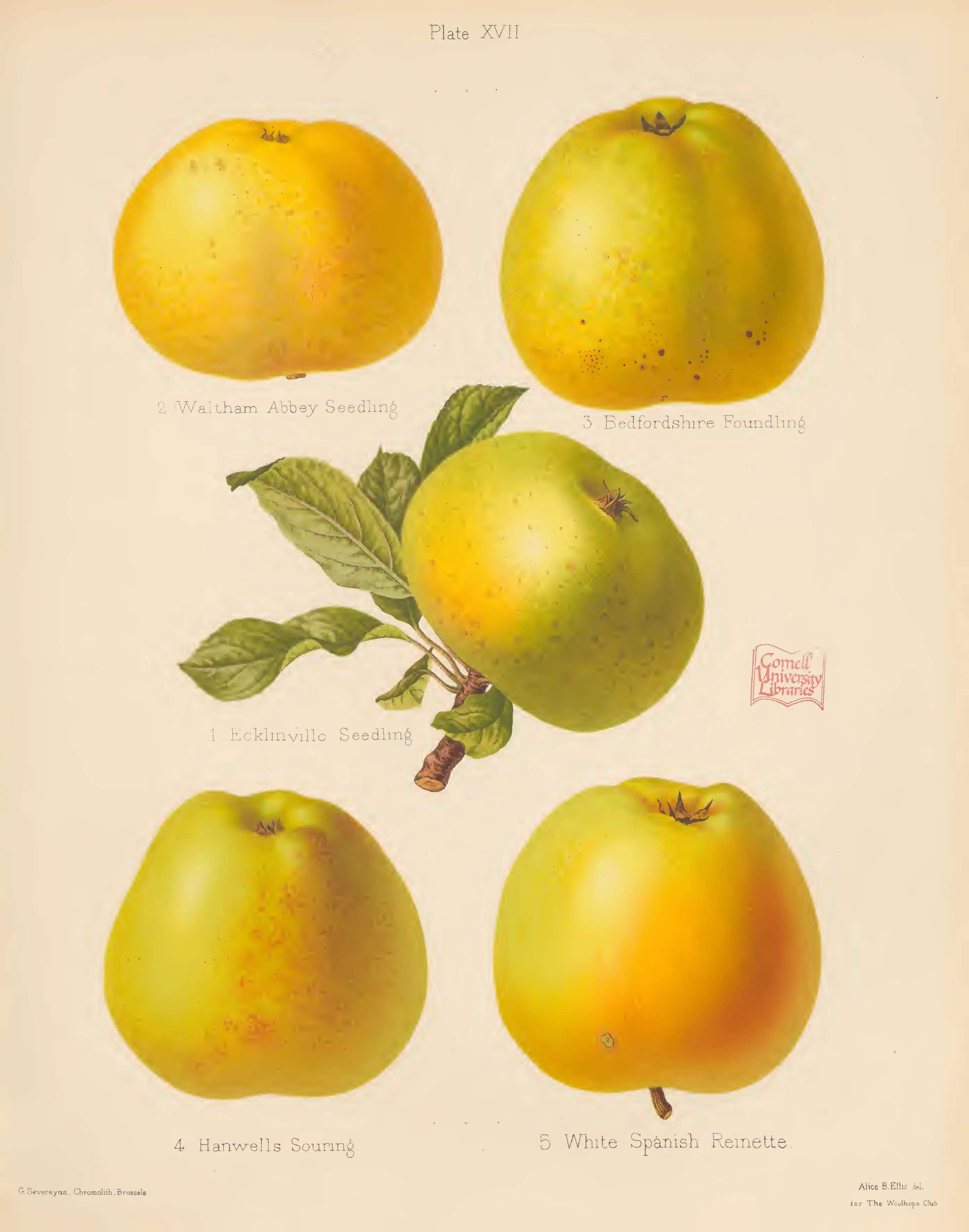
White Spanish Reinette
Origin/History
The history of this valuable old variety is largely lost. It is an old European variety which has long been cultivated in Spain, France, and England, and is said to be the national apple of Spain, where it has been known from great antiquity under the name "Camuesar." The date of its introduction to England is not known, but it was exhibited at the Horticultural Society by Mr. John Darby in 1829, from some very ancient trees then growing in Sussex. It is figured by Lindley, Pl. no. 110 (Pomological Magazine, 1830).
It was early imported into America and is, according to Downing, perhaps the parent of the American Fall Pippin and Holland Pippin — Elliott likewise calls it "probably the parent of Fall Pippin." Downing and Beach both stress that it is quite distinct from Fall Pippin, though it resembles that variety in the growth of the tree and in the color and character of the fruit, being less regular in shape and keeping later. According to Lyon, it is seldom seen under its own name. Beach notes that by the early 20th century it appeared to be but little cultivated in New York, having been superseded by other varieties. The general appreciation of this apple is shown by the wide extent of its growth and the great variety of its synonyms.
Tree
The tree is healthy and vigorous in growth and an excellent bearer. It has the same wood, foliage, and vigorous habit as the Fall Pippin. It does best in a dry, warm, and loamy soil — a characteristic which its name at once suggests. It is better adapted for dwarf or espalier growth, owing to the size and weight of the fruit.
Fruit
Size: Very large — three inches and a half wide, and three inches and three quarters high (Herefordshire Pomona). Dr. Lindley remarked that "its principal defect is its gigantic size."
Form: Oblato-oblong (Herefordshire Pomona); roundish oblate (Downing); roundish oblate or inclined to oblong (Beach); roundish oblong, sometimes ribbed (Elliott); roundish, oblong, slightly conical, somewhat angular, ribbed (Thomas). Angular on the sides, with broad ribs, and uneven at the crown, where it is nearly as broad as at the base.
Stem/Stalk: Short — half an inch long.
Cavity: Inserted in a narrow, rather small, even, regular cavity (Beach, Downing, Herefordshire Pomona, Elliott, Thomas).
Calyx/Eye: Large and open. Calyx tube conical. Stamens marginal.
Basin: Deep, broadly angular, irregular, oblique.
Skin: Smooth, waxy, and unctuous to the touch; yellowish green in the shade, orange-tinged with brownish red (rich brownish red, per Thomas) next the sun, and strewed/sprinkled with dark or grayish dots.
Flesh/Flavor: Yellowish white, crisp, tender, juicy, sugary, rich subacid (Downing, Beach, Thomas); "sharp sub-acid" (Elliott). Of first-rate quality.
Core/Seeds: Cells open, obovate (Beach).
Season
In season from December to March, or even April (Herefordshire Pomona; Hogg gives the English season as December to April). In America, Beach gives the season as October to January or February; Lyon gives the season in Michigan as October to January; Elliott gives November to February. The fruit keeps about a month longer than Fall Pippin.
Uses
An apple of first-rate quality, suitable for dessert but more especially valued for culinary purposes. Very good for either dessert or culinary use (Beach); valued for cooking (Elliott).
Subtypes/Variants
Not described in source.
Other
Belongs in the group with Fall Pippin and Holland Pippin (Beach).
Book Sources
Described in 5 period pomological works
Nursery Catalog Sources
Found in 1 catalog (1900)
- Central Experimental Farm , Dominion Department of Agriculture, Agassiz, British Columbia (under test; Bulletin No. 3, Second Series) — 1900 — listed as Saint Germain
View original book sources (5)
— Woolhope Naturalists Field Club, The Herefordshire Pomona (1885)
- WHITE SPANISH REINETTE.
[Syn: Camussar; Reinette blanche d'Espagne; Reinette d'Espagne; Reinette tendre; Josephine; Belle Josephine; De Rattecm; Concombre ancien.]
The history of this valuable old variety is quite lost. It is said to be the national apple of Spain with the name "Camussar," and has been known there from great antiquity. The date of its introduction to England is not known, but it was exhibited at the Horticultural Society by Mr. John Darby in 1829, from some very ancient trees then growing in Sussex. It is figured by Lindley, Pl. no. 110.
Description.—Fruit: very large, three inches and a half wide, and three inches and three quarters high; oblato-oblong, angular on the sides and uneven at the crown, where it is nearly as broad as at the base. Skin: smooth and unctuous to the touch; yellowish green in the shade, but orange tinted with brownish red next the sun, and strewed with dark dots. Eye: large and open, set in a deep, angular and irregular basin. Stalk: half an inch long, inserted in a narrow and even cavity. Flesh: yellowish white, tender, juicy and sugary.
An apple of first rate quality suitable for dessert, but more especially for culinary purposes. It is in season from December to March or even April. The tree is healthy and vigorous in growth and an excellent bearer. It does best in a dry, warm and loamy soil, a characteristic which its name at once suggests. It is better adapted for dwarf, or espalier growth from the size and weight of the fruit. The general appreciation of this apple is shown by the wide extent of its growth and the great variety of its synonyms. "Its principal defect" says Dr. Lindley is its gigantic size.
— A.J. Downing, The Fruits and Fruit Trees of America (1900)White Spanish Reinette. D'Espagne. Reinette Blanche d'Espagne. Fall Pippin, erroneously. Reinette d'Espagne. Large Fall Pippin. Camnesar. Cobbett's Fall Pippin. Elgin Pippin ?
A very celebrated old Spanish variety.
Fruit very large, roundish oblate, with broad ribs on its sides, terminating in an uneven crown, where it is nearly as broad as at the base. Calyx large, open, very deeply sunk in a broad-angled, oblique, irregular basin. Stalk half an inch long, set in a rather small, even cavity. Skin smooth, yellowish green on the shaded side, orange, tinged with brownish red next the sun, and sprinkled with grayish dots. Flesh yellowish white, crisp, tender, rich subacid. Very good. The tree has the same wood, foliage, and vigorous habit as our Fall Pippin, and the fruit keeps a month longer. This is quite distinct from Fall Pippin.
— S.A. Beach, The Apples of New York, Vol. 2 (1905)WHITE SPANISH REINETTE.
REFERENCES. 1. Pom. Mag., 5:No. 110. 1830. col. pl. 2. Floy-Lindley, 1833:61. 3. Downing, 1845:130. 4. Emmons, Nat. Hist. N. Y., 3:88. 1851. 5. Elliott, 1854:162. 6. Downing, 1869:404. 7. Leroy, 1873:669. fig. 8. Thomas, 1875:231. 9. Hogg, 1884:190. 10. Lyon, Mich. Hort. Soc. Rpt., 1890:300.
SYNONYMS. American Fall Pippin (9). Belle Josephine (9). Blanche (7). Blanche d'Espagne (7). Camuesar (1, 6, 9). Camoisas du roi d'Espagne (7). Campise Blanche (7). Camoisce Blanche (7). Camuezas (7). Camusar (7). Cobbett's Fall (1) err. Cobbett's Fall Pippin (2, 3, 6, 7) err. Concombre Ancien (1, 2, 5, 7, 9). De Ratteau (1, 2, 5, 7, 9). D'Espagne (1, 2, 3, 5, 6, 7). Elgin Pippin? (6). Episcopate (7). Fall Pippin (1, 2, 3, 7, err. 6) err. Josephine (9). Large Fall (1). Large Fall Pippin (2, 3, 6, 7). Philadelphia Pippin (7). Reinette A Gobelet (7). Reinette Blanche (7). REINETTE BLANCHE D'ESPAGNE (3, 9). Reinette Blanche d'Espagne (1, 2, 5, 6, 7, 8). REINETTE D'ESPAGNE (7). Reinette d'Espagne (1, 6, 9). Reinette Tendre (7). Saint-Germain (7). WHITE SPANISH REINETTE (1, 2, 4, 5, 6, 8, 10). White Spanish Reinette (3, 7, 9). York Pippin (7).
This variety belongs in the group with Fall Pippin and Holland Pippin. It resembles Fall Pippin in the growth of the tree as well as in the color and character of the fruit, but is less regular in shape and keeps later (3, 6). Season here October to January or February; Hogg gives its season in England as December to April (9). Lyon gives its season in Michigan as October to January (10).
Historical. This is an old European variety which has long been cultivated in Spain, France and England (1, 2, 3, 6, 7, 9). It was early imported into this country and is perhaps the parent of our Fall Pippin and Holland Pippin (6). According to Lyon (10) it is seldom seen under its own name. It appears to be but little cultivated in New York having been superseded by other varieties.
FRUIT. Fruit very large. Form roundish oblate or inclined to oblong, angular, uneven at the crown where it is nearly as broad as at the base (3, 6, 9). Stem short. Cavity narrow, rather small, regular. Calyx large, open. Basin deep, broadly angular, irregular, oblique. Skin smooth, waxy, yellowish-green, with orange tinge and brownish-red blush on the exposed cheek. Calyx tube conical. Stamens marginal. Cells open, obovate. Flesh yellowish-white, crisp, tender, juicy, subacid, very good for either dessert or culinary purposes. Season October to January or February.
— F.R. Elliott, The Western Fruit Book (1865)White Spanish Reinette.
Reinette Blanche d'Espagne, | D'Espagne, De Ratteau, | Concombre Ancien.
Foreign. Probably the parent of Fall Pippin, Fruit, large, roundish oblong, sometimes ribbed ; calyx, large, open ; basin, deep, irregular ; stem, half inch long; cavity, even: color, yellowish green; flesh, yellowish white, crisp, sharp sub-acid ; valued for cooking. November to February.
— John J. Thomas, The American Fruit Culturist (1903)White Spanish Reinette. (Reinette Blanche d'Espagne.) Very large, roundish, oblong, slightly conical, somewhat angular, ribbed; yellowish green in the shade, rich brownish red next the sun; stalk short, cavity small and even; calyx large, open; basin deep, angular; flesh yellowish white, crisp, flavor rich sub-acid. Growth of tree and fruit resemble that of Fall Pippin, but it keeps longer.