Melon
Apple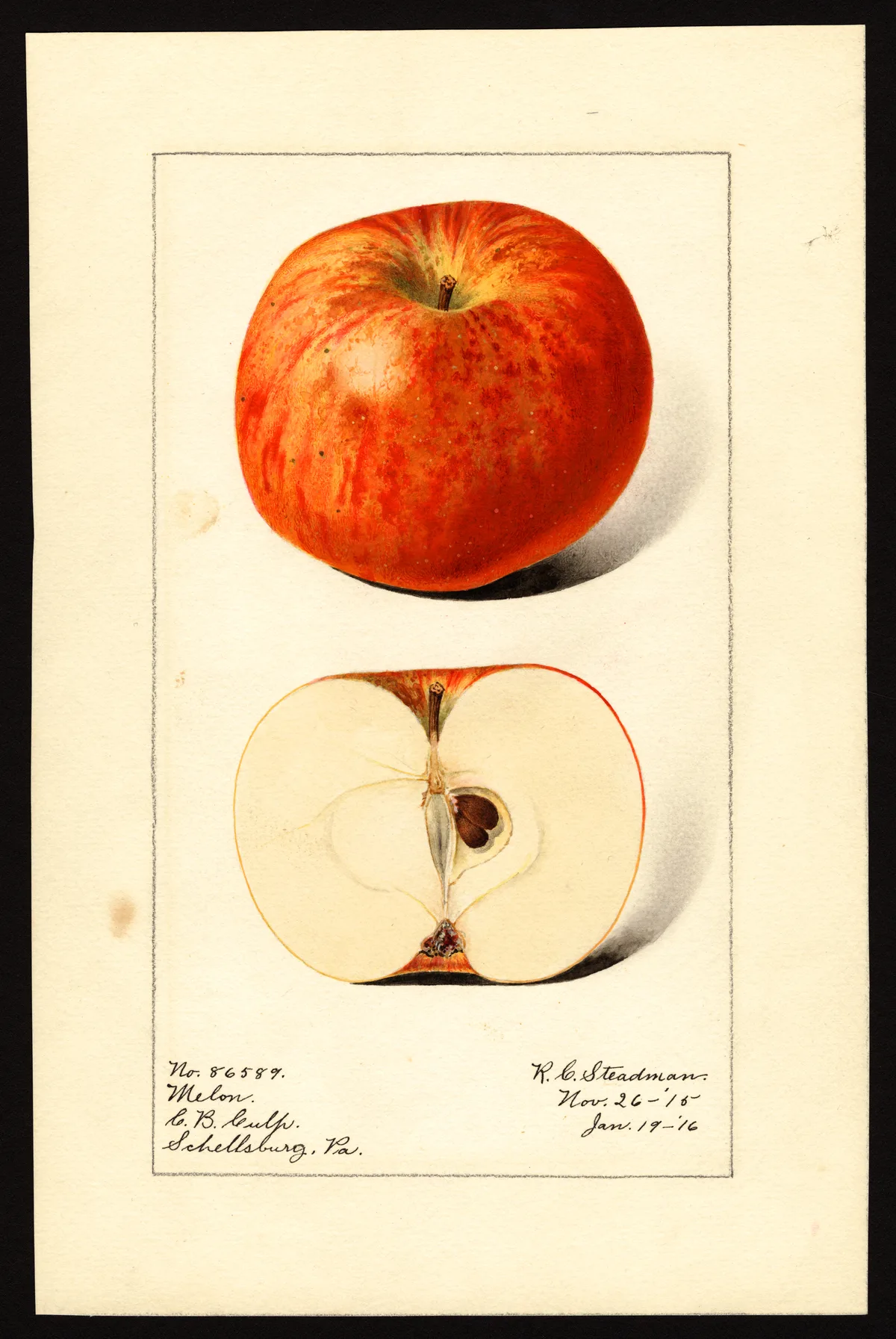
USDA Pomological Watercolor Collection
Melon
Origin / History
Melon originated in East Bloomfield, Ontario County, New York, in the old seedling orchard of Heman Chapin. The orchard was planted about 1800 with seedling trees grown from seed brought to East Bloomfield from Connecticut. Elliott (1865) noted the origin was questioned — "whether New York or Connecticut" — but later sources consistently fix the origin in East Bloomfield, New York. Melon was introduced to the trade by Ellwanger and Barry about 1845 (Beach; Bunyard). Bunyard adds that it was introduced into England about 1850. By Beach's time (1905) it had been "pretty widely disseminated but in no portion of the state is it grown extensively," was seldom offered by nurserymen, and seldom planted. Bunyard (1920) described it as "a good useful late fruit now seldom met with." Hedrick (1922) reports it "most popular in New York and New England."
Tree
Tree medium in size, moderately vigorous (Beach); vigorous in locations suited to it (Hedrick); growth rather slow when young (Thomas, Downing, Budd & Hansen) but a good bearer; Elliott calls the tree "vigorous, spreading" and notes it requires deep, strong soil; Warder calls it "sufficiently vigorous, spreading, round-headed"; Budd & Hansen say "spreading, round-topped, productive"; Veitch calls it "a good bearer." Form upright, somewhat spreading or roundish (Beach); upright-spreading (Hedrick).
Twigs medium to long, erect or spreading, slender to moderately stout. Young shoots dull grayish reddish brown (Downing); shoots reddish brown (Elliott). Bark reddish-brown, lightly mottled with scarf-skin, pubescent. Lenticels numerous, usually small, round. Buds medium, plump, acute, somewhat pubescent. Leaves rather large, often rather broad (Beach; Hedrick); Bunyard describes the leaf as light green, flat, undulating, coarsely curved serrate.
Bearing habits: Thomas calls it "a moderate bearer"; Beach reports the tree "fully as hardy and productive as Tompkins King or perhaps more so, and after it attains mature bearing age it is often reliably productive, yielding good crops biennially or in some cases annually." Beach further notes it is "an unsatisfactory grower in the nursery and makes but a moderately vigorous growth in the orchard, particularly when grown on its own body. On this account it is advisable to top-work Melon upon some stock that is healthier and more vigorous, such as Golden Russet, Roxbury, Northern Spy, Baldwin or Rhode Island Greening. The tree naturally develops a rather dense top and particular care is required in pruning to keep it sufficiently open."
Susceptibility: In portions of Eastern New York the variety is reported as being especially susceptible to the attacks of the apple maggot or railroad worm, Rhagoletis pomonella Walsh. In some localities the foliage and fruit are both quite subject to the attacks of the apple-scab fungus (Beach; Hedrick), and the tree is apt to be injured by canker on the limbs and on the body (Beach).
Fruit
Size
Medium to large; somewhat variable in size, usually above medium to large (Beach). Bunyard gives dimensions of 3 by 2¼ inches. Hedrick notes "variable in size, medium to large" and that "the product is too often undersized, poorly colored, and unattractive" when not grown on choice apple soils.
Form
Roundish, often slightly conical and frequently a little irregular (Thomas); roundish oblate, slightly conic, with obscure ribs towards the apex (Downing); roundish oblate, slightly conical, obscurely ribbed toward the basin (Budd & Hansen); roundish flattened, regular (Elliott); large, oblate, somewhat conical, angular (Warder); roundish oblate (Lowther); round conical (Bunyard); roundish conic, sometimes inclined to oblate conic, often more or less elliptical and obscurely ribbed, usually symmetrical (Beach; Hedrick). Hedrick describes the apples as "rotund, red-cheeked, smooth-skinned ... very uniform, and, all in all, most attractive when well grown."
Stem / Stalk
Stem medium, slender (Elliott, Warder, Budd & Hansen); stalk medium, slender (Downing); stalk an inch long, slender (Thomas); stem short to medium, slender (Beach); stem short, slender (Hedrick); stem long and slender (Bunyard).
Cavity
Wide, round, open, marked with greenish russet (Elliott); deep, acute, wavy, green and brown (Warder); large, deep, regular, often considerably russeted (Downing); large, deep, acute, wavy, often with much russet (Budd & Hansen); acuminate (Thomas); deep and narrow (Bunyard); acute to acuminate, deep, narrow to moderately wide, often russeted and sometimes with outspreading russet rays (Beach); acute, deep, narrow to wide, often russeted and sometimes with outspreading russet rays (Hedrick).
Calyx / Eye
Calyx closed (Elliott); eye medium, open (Warder); calyx partially closed, segments medium, erect, sometimes a little recurved (Downing); calyx half open (Budd & Hansen); eye open or closed, in a small basin (Bunyard); calyx small to above medium, closed or partly open, segments narrow, acuminate (Beach); calyx small, closed or partly open, lobes narrow, acuminate (Hedrick).
Basin
Deep, finely plaited at bottom (Elliott); wide, medium depth (Warder); deep (Thomas); rather abrupt, slightly corrugated (Downing); wide, medium, slightly corrugated (Budd & Hansen); small (Bunyard); rather small, shallow to moderately deep, narrow to medium in width, rather abrupt, often somewhat furrowed and wrinkled (Beach); small, shallow to deep, narrow, abrupt, often furrowed and wrinkled (Hedrick).
Skin / Color
Surface glossy, uneven; color pale yellowish white, much overspread with broken streaks and stripes of reddish purple, becoming rich and dark in the sun (Elliott). Surface smooth, waxen yellow, nearly covered with marbled and mixed scarlet, striped distinctly with darker shade; dots minute (Warder). Pale yellow, nearly covered with bright crimson, splashed, striped, and mottled with carmine, some traces of russet, and moderately sprinkled with light and brown dots (Downing). Stripes and dots of bright red on yellow ground, or clear red on pale yellow (Thomas). Surface smooth, pale waxen yellow, nearly covered with marbled and mixed bright red, distinctly splashed and striped with darker crimson, with net-veining and patches of very thin smooth pale brown russet; dots minute, few, light and brown (Budd & Hansen). Pale yellow with carmine flush and stripes (Bunyard). Bright yellow with red chequering and russet spotting (Veitch). Skin pretty smooth, pale yellow or greenish-yellow and when well colored nearly overspread with rather light, bright red striped and splashed with carmine; dots small, pale yellow or russet, not conspicuous; prevailing effect red mingled with yellow (Beach). Skin smooth, pale yellow overspread with bright red, striped and splashed with carmine; dots small, pale yellow or russet (Hedrick).
Flesh / Flavor
Flesh white, fine-grained, crisp, tender, juicy, sprightly (Elliott). Flesh yellow, tender, fine grained, juicy; flavor acid, sub-acid, aromatic, rich; quality almost best (Warder). Flesh white, very tender, juicy, refreshing, lively vinous subacid; best (Downing). Flesh white, tender, very juicy, fresh, and pleasant, spicy, sub-acid or slightly sub-acid, fine flavored (Thomas). Flesh yellowish white, very tender, crisp, juicy, aromatic, sprightly subacid, best (Budd & Hansen). Flesh pale yellow, tender, juicy, somewhat aromatic (Bunyard). Flesh tender and juicy, with good flavour (Veitch). Flesh white slightly tinged with yellow, moderately firm, rather fine-grained, crisp, very tender, juicy, sprightly, somewhat aromatic, pleasantly subacid, very good (Beach). Flesh yellow, firm, fine-grained, crisp, very tender, juicy, sprightly, aromatic, pleasant subacid; very good (Hedrick). Hedrick summarizes: "tender, crisp, fine-grained, very juicy, and has a sprightly but rich and aromatic flavor." Quality is rated "best" by Downing, Budd & Hansen, and Lowther; "almost best" by Warder; "very good" by Beach and Hedrick.
Core / Seeds
Core rather small (Elliott); core small (Downing, Hedrick); core medium to small, axile; cells symmetrical, closed; core lines clasping (Beach); core small, axile; cells symmetrical, closed; core-lines clasping (Hedrick). Warder describes the core as regular, heart-shaped, wide, partially open, clasping. Budd & Hansen: core partially open, clasping; cells round, axile, slit; tube conical; stamens marginal, median, or basal. Calyx tube rather small, cone-shape varying to short funnel-form with fleshy pistil point projecting into the base; stamens median to marginal (Beach); calyx-tube small, cone-shaped, with fleshy pistil point projecting into the base; stamens median (Hedrick).
Carpels broadly roundish or elliptical, sometimes slightly tufted, but slightly emarginate if at all (Beach); carpels elliptical, sometimes tufted (Hedrick). Seeds broad, nearly black (Elliott); seeds numerous, medium, angular (Warder, Budd & Hansen); seeds below medium to rather large, plump, moderately wide, often irregular or angular, very dark brown, sometimes tufted (Beach); seeds large, plump, wide, often angular, very dark brown, sometimes tufted (Hedrick).
Season
October to December (Elliott); November to January (Warder, Bunyard); late autumn and early winter, but often keeps longer (Thomas); November to March (Downing, Budd & Hansen); winter (Lowther); September to January (Veitch); October to midwinter — Beach notes that "if kept later than January in ordinary storage it soon loses in flavor and quality"; October to March (Hedrick).
Uses
Table, market, and kitchen (Warder); both kitchen and market (Lowther); "An excellent table apple" (Thomas); "One of the best and most valuable sorts for the dessert; a little too tender for shipping long distances" (Downing); "fruit too tender for distant shipment" (Budd & Hansen). Dessert (Bunyard). Beach notes commercial performance is mixed: "Some fruit growers find it profitable but more often it has proved an unsatisfactory variety in the commercial orchard. Under favorable conditions the fruit develops good size and good color and is smooth and decidedly attractive, but in many cases there is a rather high percentage of loss from undersized, poorly colored or otherwise imperfect fruit." Hedrick: "Unfortunately, the variety thrives only on choice apple soils, and the product is too often undersized, poorly colored, and unattractive."
Subtypes / Variants
Not described in source.
Other
Not described in source.
Book Sources
Described in 9 period pomological works
- Beach, The Apples of New York Vol. 1 (1905)
- Warder, American Pomology: Apples (1867)
- Downing, Fruits and Fruit Trees of America (1900)
- Budd & Hansen, Systematic Pomology (1914) — listed as Melon, Norton
- Bunyard, A Handbook of Hardy Fruits (1920)
- Elliott, The Western Fruit Book (1865)
- Lowther (ed.), Encyclopedia of Practical Horticulture (1914)
- Hedrick, Cyclopedia of Hardy Fruits (1922)
- Thomas, The American Fruit Culturist (1903)
Nursery Catalog Sources
Found in 6 catalogs (1850–1913) from England, Illinois, Massachusetts, Oregon
- Azell Bowditch (Nursery / Fruit Catalog) , Boston , Massachusetts — 1850
- Woodburn Nurseries , Woodburn, Marion Co. , Oregon — 1894
- Central Experimental Farm , Dominion Department of Agriculture, Agassiz, British Columbia (under test; Bulletin No. 3, Second Series) — 1900
- Benjamin Buckman (personal inventory) , Farmingdale , Illinois — 1901
- James Veitch & Sons , Ltd., Royal Exotic Nursery, Chelsea, London (also Coombe Wood, Langley, and Feltham) , England — 1911
- Benjamin Buckman (personal inventory) , Farmingdale , Illinois — 1913
View original book sources (10)
— F.R. Elliott, The Western Fruit Book (1865)Melon. Norton's Melon. | Watermelon.
American. Origin questioned—whether New York or Connecticut. It proves fine so far, wherever it has been tested. Tree, vigorous, spreading; shoots, reddish brown; requires deep, strong soil.
Fruit, medium to large; form, roundish flattened, regular; surface, glossy, uneven; color, pale yellowish white, much overspread with broken streaks and stripes of reddish purple, becoming rich and dark in the sun; stem, medium, slender; cavity, wide, round, open, marked with greenish russet; calyx, closed; basin, deep, finely plaited at bottom; flesh, white, fine-grained, crisp, tender, juicy, sprightly; core, rather small; seeds broad, nearly black. October to December.
— John A. Warder, American Pomology: Apples (1867)Melon.
Origin East Bloomfield, New York. Tree sufficiently vigorous, spreading, round-headed.
Fruit large, oblate, somewhat conical, angular; Surface smooth, waxen yellow, nearly covered with marbled and mixed scarlet, striped distinctly with darker shade; Dots minute.
Basin, wide, medium depth; Eye medium, open.
Cavity deep, acute, wavy, green and brown; Stem medium.
Core regular, heart-shaped, wide, partially open, clasping; Seeds numerous, medium, angular; Flesh yellow, tender, fine grained, juicy; Flavor acid, sub-acid, aromatic, rich; Quality almost best; Use, table, market and kitchen; Season, November to January.
— A.J. Downing, The Fruits and Fruit Trees of America (1900)Melon.
Norton's Melon. Watermelon.
Origin, East Bloomfield, N. Y. Tree of rather slow growth while young, a good bearer. Young shoots dull grayish reddish brown. One of the best and most valuable sorts for the dessert; a little too tender for shipping long distances.
Fruit medium or above. Form roundish oblate, slightly conic, obscure ribs towards apex. Color pale yellow, nearly covered with bright crimson, splashed, striped, and mottled with carmine, some traces of russet, and moderately sprinkled with light and brown dots. Stalk medium, slender. Cavity large, deep, regular, often considerably russeted. Calyx partially closed. Segments medium, erect, sometimes a little recurved. Basin rather abrupt, slightly corrugated. Flesh white, very tender, juicy, refreshing, lively vinous subacid. Core small. Best. November to March.
— John J. Thomas, The American Fruit Culturist (1903)Melon.* (Watermelon, Norton's Melon.) Medium or large, roundish, often slightly conical, frequently a little irregular; color, with stripes and dots of bright red on yellow ground, or clear red on pale yellow; stalk an inch long, slender; cavity acuminate; basin deep; flesh white, tender, very juicy, fresh, and pleasant, spicy, sub-acid or slightly sub-acid, fine flavored. Growth rather slow. Late autumn and early winter, but often keeps longer. Fig. 389. An excellent table apple, but a moderate bearer. Origin, East Bloomfield, N. Y.
— S.A. Beach, The Apples of New York, Vol. 1 (1905)MELON
[Note: The opening text including REFERENCES, SYNONYMS, and introductory paragraphs appear on page 341, which precedes the color plate and was not provided. The following text is from pages 344–345.]
October to midwinter. If kept later than January in ordinary storage it soon loses in flavor and quality (24). Some fruit growers find it profitable but more often it has proved an unsatisfactory variety in the commercial orchard. Under favorable conditions the fruit develops good size and good color and is smooth and decidedly attractive, but in many cases there is a rather high percentage of loss from undersized, poorly colored or otherwise imperfect fruit. In portions of Eastern New York it is reported as being especially susceptible to the attacks of the apple maggot or railroad worm, Rhagoletis pomonella Walsh. In some localities the foliage and fruit are both quite subject to the attacks of the apple-scab fungus and the tree is apt to be injured by canker on the limbs and on the body. The tree appears to be fully as hardy and productive as Tompkins King or perhaps more so, and after it attains mature bearing age it is often reliably productive, yielding good crops biennially or in some cases annually. It is an unsatisfactory grower in the nursery and makes but a moderately vigorous growth in the orchard, particularly when grown on its own body. On this account it is advisable to top-work Melon upon some stock that is healthier and more vigorous, such as Golden Russet, Roxbury, Northern Spy, Baldwin or Rhode Island Greening. The tree naturally develops a rather dense top and particular care is required in pruning to keep it sufficiently open.
Historical. Melon originated in East Bloomfield, Ontario county, in the old seedling orchard of Heman Chapin. This orchard was planted about 1800¹ with seedling trees grown from seed brought to East Bloomfield from Connecticut (3, 4, 6, 13). Melon was introduced to the trade by Ellwanger and Barry about 1845 (1, 2, 4, 5, 6, 13). It has been pretty widely disseminated but in no portion of the state is it grown extensively. It is now seldom offered by nurserymen (20) and seldom planted.
TREE.
Tree medium in size, moderately vigorous. Form upright, somewhat spreading or roundish. Twigs medium to long, erect or spreading, slender to moderately stout. Bark reddish-brown, lightly mottled with scarf-skin, pubescent. Lenticels numerous, usually small, round. Buds medium, plump, acute, somewhat pubescent. Leaves rather large, often rather broad.
¹ Letters, H. G. Chapin and Charles Chapin, 1905.
FRUIT.
Fruit somewhat variable in size, usually above medium to large. Form roundish conic, sometimes inclined to oblate conic, often more or less elliptical and obscurely ribbed, usually symmetrical. Stem short to medium, slender. Cavity acute to acuminate, deep, narrow to moderately wide, often russeted and sometimes with outspreading russet rays. Calyx small to above medium, closed or partly open; segments narrow, acuminate. Basin rather small, shallow to moderately deep, narrow to medium in width, rather abrupt, often somewhat furrowed and wrinkled.
Skin pretty smooth, pale yellow or greenish-yellow and when well colored nearly overspread with rather light, bright red striped and splashed with carmine. Dots small, pale yellow or russet, not conspicuous. Prevailing effect red mingled with yellow.
Calyx tube rather small, cone-shape varying to short funnel-form with fleshy pistil point projecting into the base. Stamens median to marginal.
Core medium to small, axile; cells symmetrical, closed; core lines clasping. Carpels broadly roundish or elliptical, sometimes slightly tufted, but slightly emarginate if at all. Seeds below medium to rather large, plump, moderately wide, often irregular or angular, very dark brown, sometimes tufted.
Flesh white slightly tinged with yellow, moderately firm, rather fine-grained, crisp, very tender, juicy, sprightly, somewhat aromatic, pleasantly subacid, very good.
— J.L. Budd & N.E. Hansen, American Horticultural Manual, Part II: Systematic Pomology (1914)Melon, Norton. — Origin, East Bloomfield, New York; tree a rather slow grower while young, spreading, round-topped, productive; fruit too tender for distant shipment.
Fruit medium to large; form roundish oblate, slightly conical, obscurely ribbed toward the basin; surface smooth, pale waxen yellow, nearly covered with marbled and mixed bright red, distinctly splashed and striped with darker crimson, with net-veining and patches of very thin smooth pale brown russet; dots minute, few, light and brown; cavity large, deep, acute, wavy, often with much russet; stem medium, slender; basin wide, medium, slightly corrugated; calyx half open. Core partially open, clasping; cells round, axile, slit; tube conical; stamens marginal, median, or basal; seeds numerous, medium, angular; flesh yellowish white, very tender, crisp, juicy, aromatic, sprightly subacid, best. November to March.
Melon.
— Granville Lowther (ed.), Encyclopedia of Practical Horticulture (1914)Melon. Size: medium. Form: roundish oblate. Quality: best. Use: both kitchen and market. Season: winter.
— E.A. Bunyard, A Handbook of Hardy Fruits (1920)MELON. New York, I., 204. Dessert, December to January, medium to large, 3 by 2¼, round conical. Colour, pale yellow with carmine flush and stripes. Flesh, pale yellow, tender, juicy, somewhat aromatic. Eye, open or closed, in a small basin. Stem, long and slender, in a deep and narrow cavity. Growth, moderate; fertile. Leaf, light green, flat, undulating, coarsely curved serrate. Origin, raised in East Bloomfield, Ontario, in the orchard of Heman Chapin, and introduced by Messrs. Ellwanger & Barry, in 1845; it was introduced into England about 1850. A good useful late fruit now seldom met with.
— U.P. Hedrick, Cyclopedia of Hardy Fruits (1922)MELON. Norton's Melon. Watermelon. The apples are rotund, red-cheeked, smooth-skinned, of medium size, very uniform, and, all in all, most attractive when well grown. The flesh is tender, crisp, fine-grained, very juicy, and has a sprightly but rich and aromatic flavor. Unfortunately, the variety thrives only on choice apple soils, and the product is too often undersized, poorly colored, and unattractive. The tree, in locations suited to it, is vigorous, hardy, and productive, though susceptible to apple-scab. Melon originated in East Bloomfield, New York, in a seedling orchard planted by Heman Chapin about 1800. The variety is most popular in New York and New England. Tree medium in size, vigorous, upright-spreading. Leaves large, broad. Fruit variable in size, medium to large, round-conic, sometimes oblate-conic, often more or less elliptical and obscurely ribbed, symmetrical; stem short, slender; cavity acute, deep, narrow to wide, often russeted and sometimes with outspreading russet rays; calyx small, closed or partly open; lobes narrow, acuminate; basin small, shallow to deep, narrow, abrupt, often furrowed and wrinkled; skin smooth, pale yellow overspread with bright red, striped and splashed with carmine; dots small, pale yellow or russet; calyx-tube small, cone-shaped, with fleshy pistil point projecting into the base; stamens median; core small, axile; cells symmetrical, closed; core-lines clasping; carpels elliptical, sometimes tufted; seeds large, plump, wide, often angular, very dark brown, sometimes tufted; flesh yellow, firm, fine-grained, crisp, very tender, juicy, sprightly, aromatic, pleasant subacid; very good; October to March.
— James Veitch & Sons, Veitch's Fruit Trees (1911) (1911)medium size, bright yellow with red chequering and russet spotting, flesh tender and juicy, with good flavour, a good bearer and keeps till winter. Sept. to Jan.