Fallawater
Apple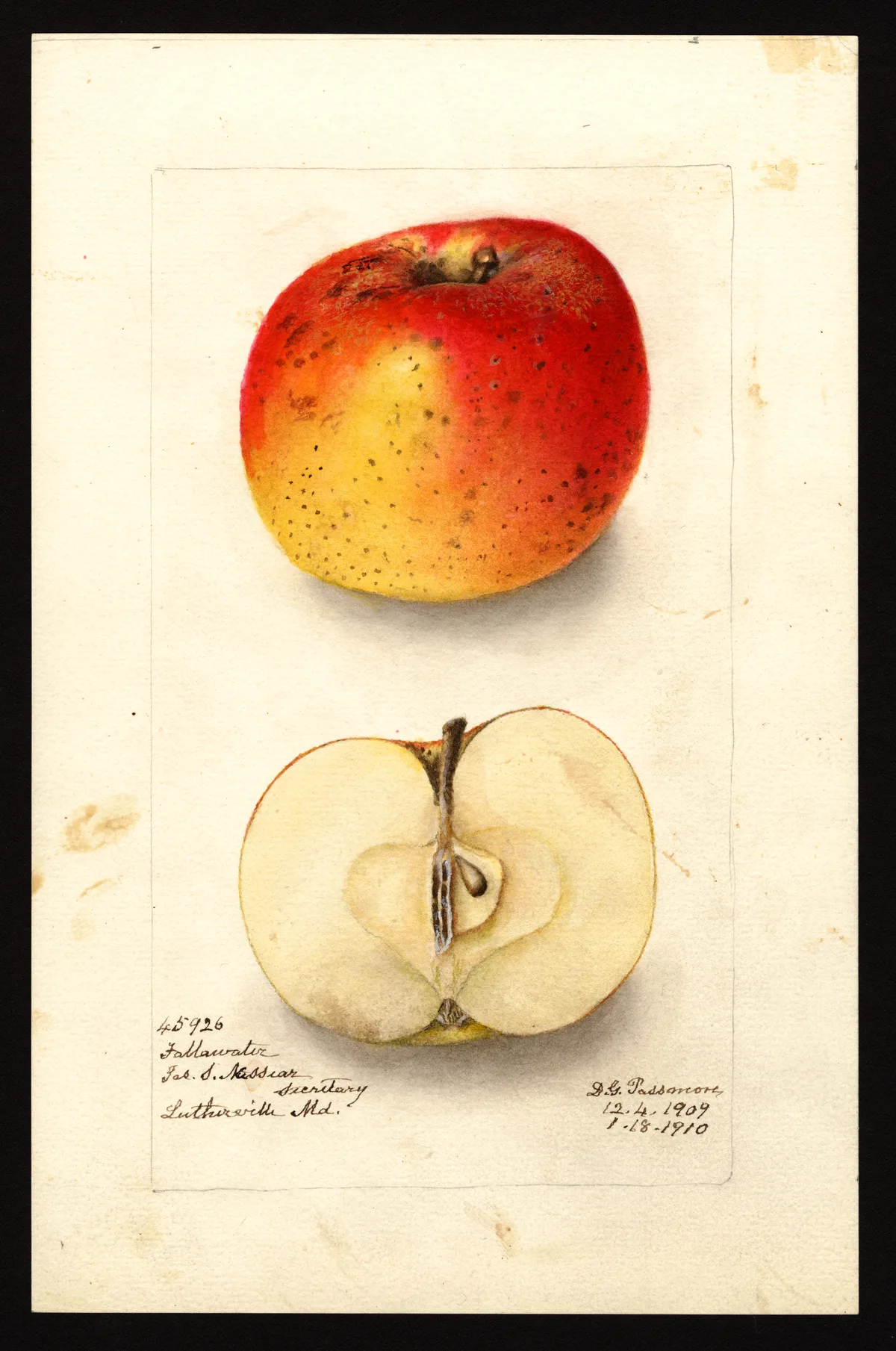
USDA Pomological Watercolor Collection
Fallawater
Origin / History
Fallawater is a native of Pennsylvania, originating in Bucks County. Beach notes it is at least a century old (writing in 1905), and Hedrick (1922) likewise records it as at least a century old, having originated in Bucks County, Pennsylvania. Hovey referred to it in 1856 as having been known and cultivated for many years under the name Fallawater. Warder in 1867 remarked that it was then a great favorite in Pennsylvania and "extensively cultivated through the West." Budd & Hansen note it was very popular in Pennsylvania and Ohio. Thomas notes that although the fruit is of quite moderate quality, its large size and fair appearance render it very popular in Pennsylvania, Ohio, and portions of the West. It was taken by pioneers from its native state to the Middle West, where it is still widely cultivated (Hedrick). Although it had long been disseminated throughout New York by the early 1900s, Beach notes it had not generally been regarded with favor by New York orchardists, except possibly in some parts of Long Island.
Tree
Tree very vigorous, strong-growing, spreading, productive, but not long-lived (Warder). Downing describes it as a strong grower and very productive. Budd & Hansen describe the tree as of strong growth and very productive. Hedrick describes it as large, vigorous, upright.
Beach gives the most detailed tree description: makes a moderately light root growth in the nursery; in the orchard it becomes large and vigorous. Form upright to roundish. Twigs medium in length to short, moderately stout, thick at the tips, erect; internodes medium. Bark smooth, bright brownish-red mingled with olive-green, finely mottled with scarf-skin; slightly pubescent. Lenticels moderately conspicuous, rather abundant, medium in size, usually roundish. Buds medium or above, roundish, obtuse, sparingly pubescent, free.
Shoots very stout, dark (Warder). Leaves large (Warder).
Bearing habit: usually a good, regular bearer, producing biennially or in some localities almost annually (Beach). Sometimes the larger branches break under their load of fruit (Beach; Hedrick notes productiveness is sometimes a fault, causing branches to break). The fruit being large, there is apt to be considerable loss from dropping, but considering its size it generally hangs to the tree pretty well (Beach).
Fruit
Size
Large to very large. Warder: "large." Downing: "very large." Beach: "large to very large." Thomas: "rather large." Budd & Hansen: "large to very large." Hedrick: "large to very large." Attractive in size and form (Beach).
Form
Globular; sometimes oblate; round or oblate-conic (Warder); globular, inclining to conic (Downing); round, slightly conical, very regular (Budd & Hansen); roundish, and slightly ovate-conical, very regular (Thomas); globular, sometimes a little oblate, usually symmetrical, sometimes slightly irregular and faintly ribbed, but pretty uniform in size and shape (Beach); globular, sometimes oblate, symmetrical, sometimes slightly irregular and faintly ribbed, uniform in size and shape (Hedrick). Lowther records form as "re." (round).
Stem
Very short (Beach, Hedrick, Downing). Warder describes it as "short, stout." Thomas describes it as "slender." Budd & Hansen: "stem short."
Cavity
Deep, regular, brown (Warder). Deep (Downing). Distinctly acuminate, deep, rather narrow to broad, usually somewhat furrowed (Beach). Acuminate, deep, narrow, somewhat furrowed (Hedrick). Narrow, acuminate (Thomas). Regular, narrow, acuminate, slightly russeted (Budd & Hansen).
Calyx
Eye large, open (Warder). Calyx small and closed (Downing). Calyx medium to large, closed or partly open; lobes variable (Beach). Calyx large, closed or open; lobes variable (Hedrick). Calyx large, open; segments divergent (Budd & Hansen). Calyx tube wide, rather short, cone-shape or approaching funnel-form; stamens basal to median (Beach). Calyx-tube wide, short, cone-shape; stamens basal (Hedrick). Tube conical, short; stamens marginal (Budd & Hansen).
Basin
Rather deep, regular (Warder). Slightly plaited (Downing). Shallow to moderately deep, moderately abrupt to abrupt, often nearly symmetrical, sometimes distinctly furrowed, wrinkled (Beach). Shallow to deep, abrupt, sometimes furrowed, wrinkled (Hedrick). Small (Thomas). Slightly wrinkled, narrow, nearly flat (Budd & Hansen).
Skin
Sometimes smooth, greenish-yellow, often blushed crimson—large specimens covered with whitish veined marks (Warder). Yellowish green, shaded with dull red, and sprinkled with large gray dots (Downing). Greenish yellow (Lowther). A smooth shade of dull red on light greenish yellow, with a few large whitish dots (Thomas). Surface smooth, yellowish green, shaded with dull red blush on sunny side, often overlaid with whitish net-veinings; dots many, distinct, large, gray with russet centres (Budd & Hansen).
Beach gives the fullest skin description: skin tough, smooth, a little waxy, often dull grass-green with dull blush, but highly colored specimens eventually become distinctly yellow and largely blushed with bright deep pinkish-red, often considerably streaked with thin grayish scarf-skin. Dots conspicuous, whitish, often large areolar with russet point. Hedrick: skin tough, smooth, waxy, often dull grass-green with dull blush; highly-colored specimens yellow and blushed with bright deep red, often streaked with thin grayish scarf-skin; dots conspicuous, white, areolar with russet point.
Warder records dots as numerous, gray, large, and having whitish bases. Beach notes that as grown in Western New York the color is often rather dull, while in favorable localities on Long Island it colors well and develops better quality than it commonly does north of Orange county. Hedrick characterizes well-colored specimens as showing an "unbroken pinkish-red color on a yellow background." Beach notes the accompanying colored plate (in The Apples of New York) was made from a highly colored specimen grown in the Hudson valley.
Flesh and Flavor
Whitish, often greenish-white, light, tender, juicy (Warder). Greenish white, juicy, crisp, rather tender (Downing). Greenish white, fine-grained (Thomas). Greenish white, light, crisp, tender, juicy (Budd & Hansen). Flesh tinged with yellow or green, firm, coarse, crisp, moderately tender, juicy (Beach). Flesh yellow, firm, coarse, crisp, tender, juicy (Hedrick). Beach also notes the flesh is coarse and at best but second rate in quality; Hedrick: "flesh is coarse, without distinctive flavor."
Flavor very mild sub-acid, or sweet, with little character (Warder). Pleasant, subacid flavor (Downing). Mild, slightly sub-acid, moderate flavor (Thomas). Pleasant, mild subacid (Budd & Hansen). Subacid to mildly sweet, without distinct or high flavor (Beach). Subacid to mildly sweet (Hedrick).
Quality scarcely good (Warder). Good (Downing, Lowther). Quality good or nearly so (Beach). Good only (Budd & Hansen). Fair to good (Hedrick).
Core and Seeds
Core medium, closed, meeting the eye; seeds numerous, angular (Warder). Core open, meeting; cells elliptical, slit (Budd & Hansen). Core decidedly abaxile to nearly axile, medium to large, cells unsymmetrical, open or closed; core lines meeting or somewhat clasping. Carpels distinctly tufted, long, narrowly ovate, mucronate, but slightly emarginate if at all. Seeds often very few, long, narrow, acute to acuminate, tufted (Beach). Core abaxile to axile, large; cells unsymmetrical, open or closed; core-lines meeting or clasping; carpels tufted, long, narrowly ovate, mucronate; seeds few, long, narrow, acuminate, tufted (Hedrick). Budd & Hansen: seeds short, plump.
(Note: Warder describes seeds as "numerous, angular," while Beach and Hedrick describe them as "few, long, narrow, acute to acuminate," and Budd & Hansen as "short, plump"; sources disagree.)
Season
November, December, and may be kept longer if desired (Warder). November to February (Downing). Early winter (Thomas; Budd & Hansen). Winter (Lowther). November to March or April (Beach, Hedrick). Variable in season — Beach ranks it as a keeper sometimes with Hubbardston and sometimes with Rhode Island Greening; on Long Island it is commonly in season in October and out of season in January. Hedrick: the season is more or less variable.
Uses
Essentially a market apple, having little to recommend it but its size, appearance and productiveness (Warder). Use, market and stock (Warder). Desirable only for cooking and market (Beach). Primary use market (Lowther). Well known in market, and often handled at satisfactory prices in domestic and also in export trade (Beach).
Subtypes / Variants
Not described in source.
Other
Lowther (Encyclopedia of Practical Horticulture, 1914) reports geographic distribution: 3 stations in the Northern Division, 15 stations in the Central Division, and 1 station in the Southern Division (each also grown in more than one division).
[NOTE: Source text may be incorrect — The Central Experimental Farm, Agassiz BC, Bulletin No. 3 (1900) entry describes "Fallawater" as "Fruit very large, pyriform. Skin green, sometimes with a brownish cheek. Flesh solid, a cooking pear," which describes a pear rather than the Fallawater apple. Salvageable detail: planted Spring 1896 at the Central Experimental Farm; tree a strong grower. The fruit description in that entry does not match the apple Fallawater and appears to be either a misidentification or a different variety bearing the same name.]
Hedrick summarizes: "The fruits of Fallawater are unique, easily recognized by their large size, globular form, and, in well-colored specimens, the unbroken pinkish-red color on a yellow background."
Book Sources
Described in 7 period pomological works
- Beach, The Apples of New York Vol. 1 (1905)
- Warder, American Pomology: Apples (1867)
- Budd & Hansen, Systematic Pomology (1914) — listed as Fallawater (Tulpehocken)
- Thomas, The American Fruit Culturist (1903)
- Downing, Fruits and Fruit Trees of America (1900)
- Lowther (ed.), Encyclopedia of Practical Horticulture (1914)
- Hedrick, Cyclopedia of Hardy Fruits (1922)
USDA Nomenclature (1905)
From W.H. Ragan, Nomenclature of the Apple, USDA Bulletin No. 56
From Gardener's Monthly. Description bad.
Nursery Catalog Sources
Found in 23 catalogs (1896–1921) from Alabama, England, Illinois, Missouri, Oregon, Virginia, Washington
- Stark Bros. Nurseries & Orchards Co. , Louisiana , Missouri — 1896
- Kelway & Son , Langport, Somerset , England — 1897
- The Salem Nursery (John A. Francis , Proprietor), Salem , Virginia — 1897
- Alabama Nursery Co. , Huntsville , Alabama — 1900
- George Bunyard & Co. , Royal Nurseries, Maidstone, Kent , England — 1900
- Central Experimental Farm , Dominion Department of Agriculture, Agassiz, British Columbia (under test; Bulletin No. 3, Second Series) — 1900
- Washington Nursery Co. , Toppenish , Washington — 1901
- Mountain Grove Nurseries (Tippin & Moore , Proprietors; Geo. T. Tippin, J. W. Tippin, J. C. Moore), Mountain Grove , Missouri — 1901
- Benjamin Buckman (personal inventory) , Farmingdale , Illinois — 1901
- Pacific Nursery Company (W. O. Hudson & A. D. Hudson) , Tangent , Oregon — 1903
- OSU Bulletin 81 (as "Tulpahocken") — 1904
- Phoenix Nursery Company (W. E. Rossney , President; Sidney Tuttle, Vice-President), Bloomington , Illinois — 1904
- Washington Nursery Company , Toppenish , Washington — 1909
- Island Nurseries & Fruit Farm , Vashon (Vashon Island) , Washington — 1910
- Island Nurseries & Fruit Farm , Vashon (Vashon Island) , Washington — 1911
- Pacific Nursery Company , Portland , Oregon — 1912
- Washington Nursery Company , Toppenish , Washington — 1912
- Vineland Nurseries Company , Clarkston , Washington — 1912
- Benjamin Buckman (personal inventory) , Farmingdale , Illinois — 1913
- George Bunyard & Co. , Royal Nurseries, Maidstone, Kent , England — 1914
- Union Nurseries , J.B. Weaver & Sons, Union , Oregon — 1915
- George Bunyard & Co. , Royal Nurseries, Maidstone, Kent , England — 1917
- Benedict Nursery Co. , Portland , Oregon — 1921
View original book sources (8)
— John A. Warder, American Pomology: Apples (1867)Fallawater. TULPEHOCKEN, ETC.
A native of Pennsylvania, where it is a great favorite; extensively cultivated through the West.
Fig. 138.—FALLAWATER.
This is essentially a market apple, having little to recommend it but its size, appearance and productiveness.
Tree very vigorous, spreading, productive, not long-lived; Shoots very stout, dark; Leaves large.
Fruit large, round or oblate-conic, regular; Surface sometimes smooth, greenish-yellow, often blushed crimson—large specimens covered with whitish veined marks; Dots numerous, gray, large, and having whitish bases.
Basin rather deep, regular; Eye large, open.
Cavity deep, regular, brown; Stem short, stout.
Core medium, closed, meeting the eye; Seeds numerous, angular; Flesh whitish, often greenish-white, light, tender, juicy; Flavor very mild sub-acid, or sweet, with little character; Quality scarcely good; Use, market and stock; Season, November, December, and may be kept longer if desired.
— A.J. Downing, The Fruits and Fruit Trees of America (1900)Fallawater.
Falwalder. Pirn's Beauty of the West. Winter Blush Fornwalder. Pound. Green Mountain Pippin. Tulpehocken. Mountain Pippin. Molly Whopper. Pfarrer Walter. Fall de Walldes. Falder. Baltimore, erroneously. Brubacker. Fallawalder. Fallawalder.
A favorite Apple of Pennsylvania, of which State it is a native. Tree a strong grower and very productive.
Fruit very large, globular, inclining to conic. Skin yellowish green, shaded with dull red, and sprinkled with large gray dots. Stalk very short, inserted in a deep cavity. Calyx small and closed, set in a slightly plaited basin. Flesh greenish white, juicy, crisp, rather tender, pleasant, subacid flavor. Good. November, February.
— S.A. Beach, The Apples of New York, Vol. 1 (1905)FALLAWATER
References. 1. Downing, 1845:109. 2. Horticulturist, 2:482, 570. 1848. 3. Thomas, 1849:180. 4. Emmons, Nat. Hist. N. Y., 3:44. 1851. col. pl. 5. James, Horticulturist, 8:247. 1853. 6. Hovey, Mag. Hort., 22:556. 1856. fig. 7. Am. Pom. Soc. Cat., 1856. 8. Elliott, 1858:79. fig. 9. Norris, Horticulturist, 15:183. 1860. 10. Warder, 1867:495. fig. 11. Downing, 1872:167. 12. Barry, 1883:345. 13. Lyon, Mich. Hort. Soc. Rpt., 1890:290. 14. Wickson, 1891:248. 15. Bailey, An. Hort., 1892:238, 251. 16. Dempsey, Ont. Fr. Stas. An. Rpt., 1:24. 1894. 17. N. C. Bd. of Agr. Bul., 1900:10. col. pl. 18. Waugh, Vt. Sta. An. Rpt., 14:293. 1901. 19. Budd-Hansen, 1903:78. fig. 20. Beach and Clark, N. Y. Sta. Bul., 248:119. 1904.
Synonyms. Faldwalder (6). Fallawater (2, 5, 8). Fall de Waides (9). Fallenwalder (5, 8). Fallenwalder (6). Fornwalder (5). Green Mountain Pippin (6, 8, 11). Mountain Pippin (8, 11). Pim's Beauty of the West (8). Pine's Beauty of the West (6). Pound (2, 11). Tulpahocken (6, 8). Tulpehocken (2). Tulpehocken (10, 11, 12, 14, 18, 19, 20). Winter Blush (11).
Fruit large or very large, globular, attractive in size and form, but as grown in Western New York it is often rather dull in color. The accompanying colored plate was made from a highly colored specimen grown in the Hudson valley. In favorable localities on Long Island it colors well and develops better quality than it commonly does north of Orange county. The flesh is coarse and at best but second rate in quality. It is well known in market, and is often handled at satisfactory prices in domestic and also in export trade.
The tree is usually a good, regular bearer, producing biennially or in some localities almost annually. Sometimes the larger branches break under their load of fruit. The fruit being large, there is apt to be a considerable loss from dropping, but considering its size it generally hangs to the tree pretty well. It is variable in season, ranking as a keeper sometimes with Hubbardston and sometimes with Rhode Island Greening. Although it has long been disseminated throughout New York, it has not generally been regarded with favor by New York orchardists, except possibly in some parts of Long Island.
Historical. Origin Bucks county, Pennsylvania. Hovey referred to it in 1856 as having been known and cultivated for many years under the name Fallawater (6). Warder in 1867 remarked that it was then a great favorite in Pennsylvania and "extensively cultivated through the West."
Tree.
Tree makes a moderately light root growth in the nursery. In the orchard it becomes large and vigorous. Form upright to roundish. Twigs medium in length to short, moderately stout, thick at the tips, erect; internodes medium. Bark smooth, bright brownish-red mingled with olive-green, finely mottled with scarf-skin; slightly pubescent. Lenticels moderately conspicuous, rather abundant, medium in size, usually roundish. Buds medium or above, roundish, obtuse, sparingly pubescent, free.
Fruit.
Fruit large to very large. Form globular, sometimes a little oblate, usually symmetrical, sometimes slightly irregular, and faintly ribbed, but it is pretty uniform in size and shape. Stem very short. Cavity distinctly acuminate, deep, rather narrow to broad, usually somewhat furrowed. Calyx medium to large, closed or partly open; lobes variable. Basin shallow to moderately deep, moderately abrupt to abrupt, often nearly symmetrical, sometimes distinctly furrowed, wrinkled.
Skin tough, smooth, a little waxy, often dull grass-green with dull blush, but highly colored specimens eventually become distinctly yellow and largely blushed with bright deep pinkish-red, often considerably streaked with thin grayish scarf-skin. Dots conspicuous, whitish, often large areolar with russet point.
Calyx tube wide, rather short, cone-shape or approaching funnel-form. Stamens basal to median.
Core decidedly abaxile to nearly axile, medium to large, cells unsymmetrical, open or closed; core lines meeting or somewhat clasping. Carpels distinctly tufted, long, narrowly ovate, mucronate, but slightly emarginate if at all. Seeds often are very few, long, narrow, acute to acuminate, tufted.
Flesh tinged with yellow or green, firm, coarse, crisp, moderately tender, juicy, subacid to mildly sweet, without distinct or high flavor, quality good or nearly so.
Season November to March or April, being quite variable in different localities and in different seasons. On Long Island it is commonly in season in October and out of season in January.
Use. Desirable only for cooking and market.
— Granville Lowther (ed.), Encyclopedia of Practical Horticulture (1914)Fallawater is large in size. Form: re. Skin color is greenish yellow. Quality is good. Primary use is market. Season is winter. Reported by 3 stations in the Northern Division (also grown in more than one division), 15 stations in the Central Division (also grown in more than one division), and 1 station in the Southern Division (also grown in more than one division).
— Central Experimental Farm, Central Experimental Farm, Agassiz BC — Catalogue of Fruit Trees under Test (Bulletin No. 3, 1900) (1900)Planted Spring 1896. Tree a strong grower. Fruit very large, pyriform. Skin green, sometimes with a brownish cheek. Flesh solid, a cooking pear.
— John J. Thomas, The American Fruit Culturist (1903)Fallawater.* (Tulpahocken, Fornwalder.) Rather large, roundish, and slightly ovate-conical, very regular, smooth; color a smooth shade of dull red on light greenish yellow, with a few large whitish dots; stalk slender; cavity narrow, acuminate; basin small; flesh greenish white, fine-grained, with a mild, slightly sub-acid, moderate flavor. Early winter. A native of Pennsylvania. Although this fruit is of quite moderate quality, its large size and fair appearance render it very popular in Pennsylvania, Ohio, and portions of the West. Fig. 464.
— J.L. Budd & N.E. Hansen, American Horticultural Manual, Part II: Systematic Pomology (1914)Fallawater (Tulpehocken). — Origin, Pennsylvania; tree of strong growth and very productive. Very popular in Pennsylvania and Ohio.
Fruit large to very large, round, slightly conical, very regular; surface smooth, yellowish green, shaded with dull red blush on sunny side, often overlaid with whitish net-veinings; dots many, distinct, large, gray with russet centres; cavity regular, narrow, acuminate, slightly russeted; stem short; basin slightly wrinkled, narrow, nearly flat; calyx large, open; segments divergent. Core open, meeting; cells elliptical, slit; tube conical, short; stamens marginal; seeds short, plump; flesh greenish white, light, crisp, tender, juicy, pleasant, mild subacid, good only. Early winter.
— U.P. Hedrick, Cyclopedia of Hardy Fruits (1922)FALLAWATER.
Tulpahocken.
The fruits of Fallawater are unique, easily recognized by their large size, globular form, and, in well-colored specimens, the unbroken pinkish-red color on a yellow background. The flesh is coarse, without distinctive flavor. The season is more or less variable. The tree characters are usually very satisfactory, though productiveness is sometimes a fault, causing branches to break. Fallawater is at least a century old, having originated in Bucks County, Pennsylvania; it was taken by pioneers from its native state to the Middle West, where it is still widely cultivated.
Tree large, vigorous, upright. Fruit large to very large, globular, sometimes oblate, symmetrical, sometimes slightly irregular and faintly ribbed, uniform in size and shape; stem very short; cavity acuminate, deep, narrow, somewhat furrowed; calyx large, closed or open; lobes variable; basin shallow to deep, abrupt, sometimes furrowed, wrinkled; skin tough, smooth, waxy, often dull grass-green with dull blush, highly-colored specimens yellow and blushed with bright deep red, often streaked with thin grayish scarf-skin; dots conspicuous, white, areolar with russet point; calyx-tube wide, short, cone-shape; stamens basal; core abaxile to axile, large; cells unsymmetrical, open or closed; core-lines meeting or clasping; carpels tufted, long, narrowly ovate, mucronate; seeds few, long, narrow, acuminate, tufted; flesh yellow, firm, coarse, crisp, tender, juicy, subacid to mildly sweet; fair to good; November to March or April.