McAFEE
Apple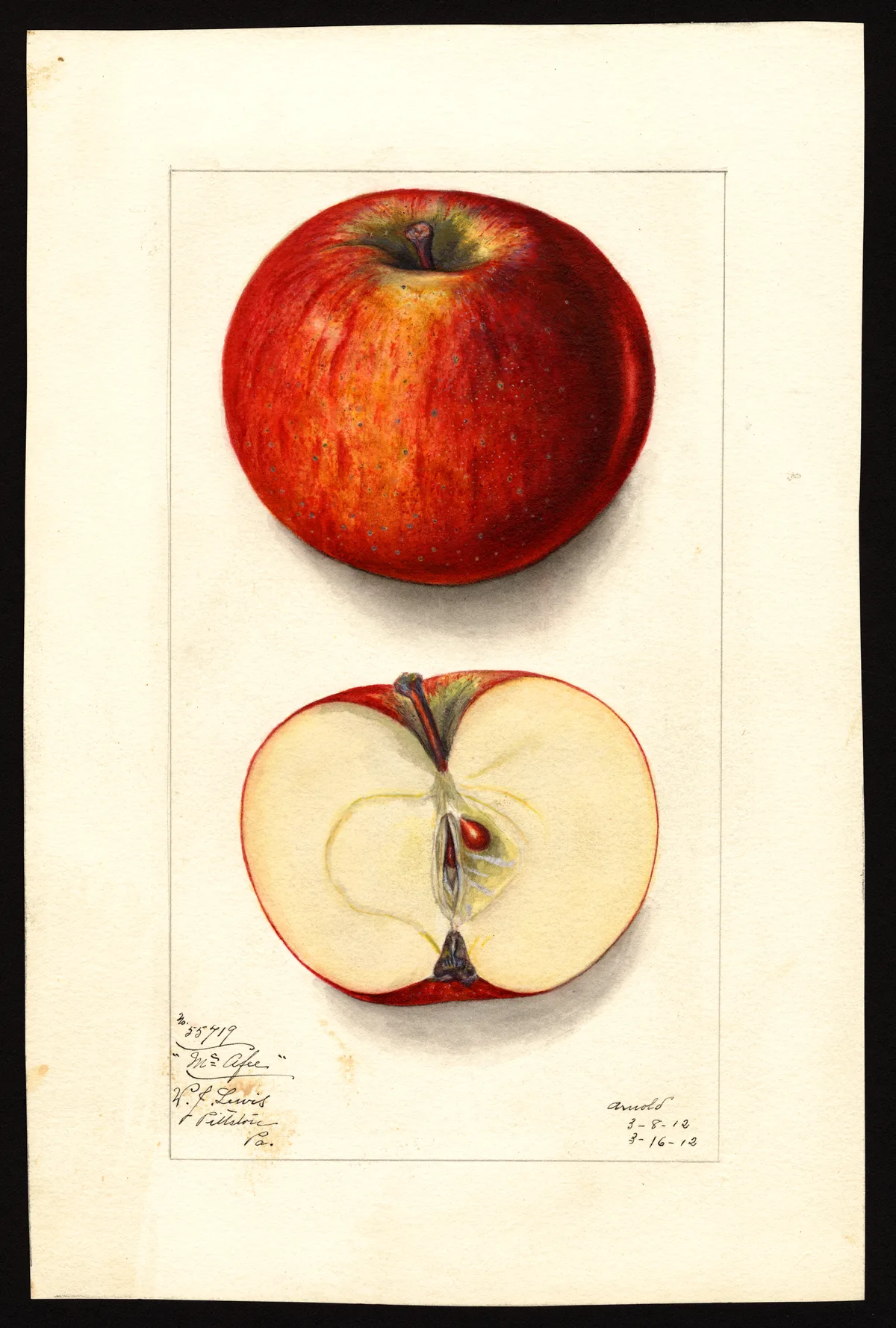
USDA Pomological Watercolor Collection
McAFEE
Origin / History
An old variety which originated near Harrodsburg, Kentucky — specifically at McAfee's old Fort in Kentucky (Downing; Budd-Hansen). Beach notes it was at first called Nonesuch but afterwards became widely known under the name McAfee's Nonsuch; Dr. Howsley gives an extended account of its origin and of its dissemination under various synonyms. Elliott called attention to it in 1854 (Hedrick). Warder supposed it to have originated in Kentucky — possibly further South — and reported that in his time it was found in Eastern Ohio, Southern Indiana and Illinois, and in Missouri, and was much grown in Kentucky, doing well in all places and giving entire satisfaction, excepting that the bark bursts near the ground even in bearing trees that are root-grafted. Downing (1900) says it is considerably grown all through the West, and largely under the name of Striped Sweet Pippin. Beach reports it was well known in portions of the South and of the Middle West; as grown in Western New York it was a reliable bearer giving moderately heavy crops, the fruit hung well to the tree, developed good color and was a late keeper, but its quality was not very satisfactory, and it was not recommended for planting in that state. Hedrick (1922) notes it was once very popular in the South and parts of the Middle West, but by his time was little planted — the apples are well flavored and attractive but rather too mild and characterless in flavor, and there are no remarkable tree-characters.
Tree
Medium in size, moderately vigorous to vigorous (Beach; Hedrick); a good grower and very productive (Downing; Budd-Hansen); hardy, vigorous, spreading, productive (Downing 1900); thrifty, spreading, productive (Warder). Form roundish, somewhat spreading (Beach). Bark bursts near the ground even in bearing trees, root-grafted (Warder).
Shoots/Twigs: Twigs medium in length, rather slender with dark bark; slightly pubescent towards the tips; young twigs smooth, dark, reddish-brown (Beach). Warder describes shoots as rather slender, dark. Downing (1900) describes young shoots as clear reddish brown with a slight bloom on ends in the main entry, and as smooth reddish brown in the McAfee's Nonsuch entry.
Foliage: Dark green, abundant on young trees (Warder).
Fruit
Size: Medium to large (Elliott; Beach; Hedrick); large (Warder; Downing 1900 second entry; Budd-Hansen); medium (Elliott's McAfee's Nonsuch entry).
Form: Roundish oblate, regular (Beach); round-oblate, regular (Hedrick); globular, slightly flattened (Elliott); roundish flattened, oblique angular (Elliott's McAfee's Nonsuch entry); roundish, inclining to oblate (Downing 1900); globular, inclining to oblate (Downing 1900 second entry); roundish, slightly oblate (Budd-Hansen); large, round, flattened, regular, fair, handsome (Warder). Warder adds that in the West it is more flattened than in Ohio, becoming in large specimens almost a flat or oblate apple.
Stem/Stalk: Short to long (Beach; Hedrick); short, slender (Elliott, both entries); short, fleshy (Budd-Hansen); short, medium, or rather long (Warder); medium or short, and small (Downing 1900); short (Downing 1900 second entry).
Cavity: Large, wide, acute, rather deep, gently furrowed, often with thin outspreading russet (Beach); large, wide, acute, deep, gently furrowed, often with thin outspreading russet (Hedrick); open, little russeted, broad, deep (Elliott's McAfee's Nonsuch entry); wide, wavy, rather deep, brown (Warder); large, surrounded by russet (Downing 1900); large (Downing 1900 second entry); regular, green, obtuse (Budd-Hansen).
Calyx / Eye: Small, closed (Elliott; Beach; Hedrick; Warder; Downing 1900; Budd-Hansen); closed, with segments connivent (Budd-Hansen). Elliott's McAfee's Nonsuch entry: calyx medium; segments short, stiff, half open, erect, reflexed.
Basin: Shallow (Elliott; Beach; Hedrick); shallow, usually rather narrow, sometimes broad, sometimes compressed, wrinkled and gently furrowed (Beach); shallow, narrow, sometimes broad, wrinkled and gently furrowed (Hedrick); deep (Elliott's McAfee's Nonsuch entry); broad, uneven (Downing 1900); small (Downing 1900 second entry); medium, regular, sometimes cracked (Warder); smooth, very narrow, shallow (Budd-Hansen).
Skin / Surface: Rather thin, smooth, yellow faintly washed with red and splashed and striped with carmine, often marked over the base with thin, grayish, mottled or streaked scarf-skin and sometimes with fine, irregularly broken russet lines; prevailing effect striped red (Beach; Hedrick gives essentially the same with "yellow faintly washed with red and splashed and striped with carmine, often marked at the base with thin, gray, mottled scarfskin"). Elliott: yellow, striped and blended with two shades of red. Elliott's McAfee's Nonsuch entry: yellowish, mostly overspread with two shades red, bluish tinge, and grayish dots apparently raised on surface. Warder: surface smooth, mixed, splashed and striped, pale purplish red on yellow, which shows through the shading. Downing (1900): yellow, striped, splashed, and shaded with shades of red. Downing (1900) second entry: yellowish green, shaded and striped with crimson and covered with a thin bloom. Budd-Hansen: surface polished, greenish yellow, almost wholly, but thinly, covered with fine solid crimson, obscurely striped and covered with a thin bloom.
Dots: Minute, indented, gray or whitish mingled with some that are larger, areolar (Beach); minute, indented, gray or white with some large and areolar (Hedrick); numerous gray dots, giving it somewhat appearance of bloom (Downing 1900); minute, indented, gray, so that the fruit has a general gray appearance (Warder); grayish dots apparently raised on surface (Elliott's McAfee's Nonsuch entry); distinct, numerous, minute, white (Budd-Hansen).
Flesh / Flavor: Yellowish, somewhat coarse, somewhat breaking, tender, juicy, mild subacid approaching sweet, good to very good (Beach); yellow, coarse, breaking, tender, juicy, mild subacid; good to very good (Hedrick); yellow, tender, juicy, sub-acid (Elliott); yellowish, firm, crisp, juicy, sub-acid, aromatic; "very good" (Elliott's McAfee's Nonsuch entry); yellow, breaking, somewhat coarse-grained, juicy; flavor sub-acid; quality quite good (Warder); yellow, juicy, crisp, tender, very mild, rich, pleasant, scarcely subacid; very good (Downing 1900); whitish, solid, crisp, subacid; good to very good (Downing 1900 second entry); juicy, white, fine-grained, lively subacid, very good (Budd-Hansen). Hedrick (1922) characterizes the flavor as "rather too mild and characterless."
Core / Seeds: Core medium in size, decidedly abaxile, roundish; cells pretty symmetrical, open; core lines clasp the funnel cylinder; carpels rather concave, tufted, very broadly obovate or approaching obcordate, narrowing towards the stem; seeds numerous, large, long, rather wide, obtuse, dark (Beach). Hedrick gives essentially the same: core abaxile, round; cells symmetrical, open; core-lines clasping the funnel cylinder; carpels concave, tufted, broadly obovate; seeds numerous, large, long, wide, obtuse, dark. Elliott: core open; seeds large. Elliott's McAfee's Nonsuch entry: core medium, compact; seeds short, ovate. Warder: core roundish, medium, regular, open; seeds numerous, large, angular, some imperfect. Budd-Hansen: core open; cells ovate, entire, abaxile; tube conical; stamens median; seeds small, plump. Beach also describes the calyx tube as funnel-form, sometimes elongated and constricted at the base of the limb, enlarging somewhat below and extending to the core; stamens median to basal. Hedrick gives calyx-tube funnel-form; stamens median to basal.
Season
December to February (Elliott, both entries; Warder; Beach gives October to February). October to January (Downing 1900). December to March (Downing 1900 second entry). November to March (Budd-Hansen). October to February (Hedrick). A late keeper (Beach).
Uses
Market, kitchen, table (Warder). Highly recommended for commercial orchards, whether for shipping North or South — particularly the latter (Warder).
Subtypes / Variants
Not described in source.
Other
Thomas (1903) lists "Striped Pearmain, or Striped Winter Pearmain" as a cross-reference to McAfee's Nonsuch, with no further description. Beach's reference list cites Elliott 1854, Downing 1857, Downing in Horticulturist 16:42 (1861), Warder 1867, Howsley in Am. Pom. Soc. Rpt. 1871, Am. Pom. Soc. Cat. 1871, Downing 1872, Fitz 1872, Barry 1883, Thomas 1885, Lyon in Mich. Hort. Soc. Rpt. 1890, Bailey's An. Hort. 1892, Beach in W. N. Y. Hort. Soc. An. Rpt. 41:76 (1901), Budd-Hansen 1903, and Bruner in N. C. Sta. Bul. 182 (1903).
Book Sources
Described in 7 period pomological works
- Beach, The Apples of New York Vol. 1 (1905)
- Warder, American Pomology: Apples (1867) — listed as Large Striped Pearmain
- Downing, Fruits and Fruit Trees of America (1900) — listed as Striped Winter Pearmain
- Budd & Hansen, Systematic Pomology (1914) — listed as McAfee (McAfee Red)
- Elliott, The Western Fruit Book (1865)
- Hedrick, Cyclopedia of Hardy Fruits (1922)
- Thomas, The American Fruit Culturist (1903) — listed as McAfee's Nonsuch
Nursery Catalog Sources
Found in 7 catalogs (1894–1913) from Illinois, Missouri, Oregon, Washington
- Woodburn Nurseries , Woodburn, Marion Co. , Oregon — 1894
- Stark Bros. Nurseries & Orchards Co. , Louisiana , Missouri — 1896
- Central Experimental Farm , Dominion Department of Agriculture, Agassiz, British Columbia (under test; Bulletin No. 3, Second Series) — 1900
- Benjamin Buckman (personal inventory) , Farmingdale , Illinois — 1901
- Phoenix Nursery Company (W. E. Rossney , President; Sidney Tuttle, Vice-President), Bloomington , Illinois — 1904 — listed as Missouri Superior
- Vineland Nurseries Company , Clarkston , Washington — 1912 — listed as McAfee's Nonsuch
- Benjamin Buckman (personal inventory) , Farmingdale , Illinois — 1913
View original book sources (7)
— F.R. Elliott, The Western Fruit Book (1865)Striped Pearmain.
Large Striped Pearmain. | Snorter.
Grown in Ky., from whence we have received fruit. We copy description from Mr. Ernst's manuscript. Fruit, medium to large, globular, slightly flattened, yellow, striped and blended with two shades of red; calyx, small closed; basin, shallow; stem, short, slender; core, open; seeds, large; flesh, yellow, tender, juicy, sub-acid. December to February.
[Additional entry in this volume: "McAfee's Nonsuch", pp. 163–163]
McAfee's Nonsuch. From Kentucky ; somewhat grown Southwest. Fruit medium, roundish flattened, oblique angular; yellowish, mostly overspread with two shades red, bluish tinge, and grayish dots apparently raised on surface ; stem, short, slender; cavity, open, little russeted, broad, deep; calyx, medium; segments, short, stiff, half open, erect, reflexed ; basin, deep ; flesh, yellowish, firm, crisp, juicy, sub-acid, aromatic ; core, medium, compact ; seeds, short, ovate; "very good." December to February.
— John A. Warder, American Pomology: Apples (1867)Large Striped Pearmain.
This choice Western apple is supposed to have originated in Kentucky — possibly further South. It is now to be found in Eastern Ohio, Southern Indiana and Illinois, and in Missouri. Much grown in Kentucky. In all places it seems to be doing well, and giving entire satisfaction, excepting that the bark bursts near the ground even in bearing trees, root-grafted.
Tree vigorous, thrifty, spreading, productive; Shoots rather slender, dark; Foliage dark green, abundant on young trees.
Fruit large, round, flattened, regular, fair, handsome, though not so beautifully colored as some others; Surface smooth, mixed, splashed and striped, pale purplish red on yellow, which shows through the shading; Dots minute, indented, gray, so that the fruit has a general gray appearance.
Basin medium, regular, sometimes cracked; Eye small, closed.
Cavity wide, wavy, rather deep, brown; Stem short, medium, or rather long.
Core roundish, medium, regular, open; Seeds numerous, large, angular, some imperfect; Flesh yellow, breaking, somewhat coarse-grained, juicy; Flavor sub-acid; Quality quite good; Use, market, kitchen, table; Season, December to February.
In the West it is more flattened than in Ohio, becoming in large specimens almost a flat or oblate apple. Highly recommended for commercial orchards, whether for shipping North or South — particularly the latter.
— A.J. Downing, The Fruits and Fruit Trees of America (1900)Striped Winter Pearmain.
Striped Sweet Pippin. Large Striped Winter Pearmain. Snorter. Striped Pearmain. Winter Pearmain of some. Missouri Keeper? Missourian?
An old variety, which can only be traced to Kentucky. It is considerably grown now all through the West, and largely under the name of Striped Sweet Pippin. Tree hardy, vigorous, spreading, productive. Young shoots clear reddish brown, slight bloom on ends.
Fruit medium to large, roundish, inclining to oblate, yellow, striped, splashed, and shaded with shades of red, numerous gray dots, giving it somewhat appearance of bloom. Stalk medium or short, and small, inserted in a large cavity surrounded by russet. Calyx small, closed, set in a broad, uneven basin. Flesh yellow, juicy, crisp, tender, very mild, rich, pleasant, scarcely subacid. Very good. October to January.
[Additional entry in this volume: "McAfee's Nonsuch", pp. 285–285]
McAfee's Nonsuch.
McAfee's Red.
Originated at McAfee's old Fort in Kentucky. Good grower, very productive. Young shoots smooth reddish brown.
Fruit large, globular, inclining to oblate. Skin yellowish green, shaded and striped with crimson and covered with a thin bloom. Stalk short, inserted in a large cavity. Calyx closed, set in a small basin. Flesh whitish, solid, crisp, subacid. Good to very good. December to March.
— John J. Thomas, The American Fruit Culturist (1903)Striped Pearmain, or Striped Winter Pearmain. See McAfee's Nonsuch.
— S.A. Beach, The Apples of New York, Vol. 1 (1905)McAFEE.
REFERENCES. 1. Elliott, 1854:158. 2. Downing, 1857:170. 3. Downing, Horticulturist, 16:42. 1861. 4. Warder, 1867:601, 725. 5. Howsley, Am. Pom. Soc. Rpt., 1871:76. 6. Am. Pom. Soc. Cat., 1871. 7. Downing, 1872:260, 363, app. fig. 8. Fitz, 1872:143. 9. Barry, 1883:349. 10. Thomas, 1885:517. 11. Lyon, Mich. Hort. Soc. Rpt., 1890:294. 12. Bailey, An. Hort., 1892:244. 13. Beach, W. N. Y. Hort. Soc. An. Rpt., 41:76. 1901. 14. Budd-Hansen, 1903:119. 15. Bruner, N. C. Sta. Bul., 182:27. 1903.
SYNONYMS. Gray Apple (7). Gray's Keeper (5). Indian Wyandotte (7). LARGE STRIPED PEARMAIN (4). Large Striped Pearmain (1, 5, 6, 7). LARGE STRIPED WINTER PEARMAIN (3). Large Striped Winter Pearmain (7, 9). McAfee (7). McAfee Red (14). MCAFEE'S NONESUCH (8). McAfee's Nonesuch (5). MCAFEE'S NONSUCH (2, 7, 9, 10). McAfees Red (5, 7). MCAFFEE (4). MCAFFEE'S NONESUCH (6). Missouri Superior (5, 7, 13). New Missouri (5). Nonsuch (7). Park (5). Parks Keeper (5, 7, 13). Snorter (1, 7). Stevenson Pippin (13). Slime (15). Storr's Wine (5). STRIPED PEARMAIN (1). Striped Sweet Pippin (7). STRIPED WINTER PEARMAIN (7). Valandingham (5). White Crow (5). Winter Pearmain (5). Winter Pippin of some (7). Zeeke (5).
This is an old variety well known in portions of the South and of the Middle West. As grown in Western New York it is a reliable bearer giving moderately heavy crops, the fruit hangs well to the tree, develops good color and is a late keeper but its quality is not very satisfactory. It is not recommended for planting in this state.
Historical. An old variety which originated near Harrodsburg, Kentucky. At first it was called Nonesuch but afterwards became widely known under the name McAfee's Nonsuch. Dr. Howsley gives an extended account of its origin and of its dissemination under various synonyms (5).
TREE.
Tree medium in size, moderately vigorous to vigorous. Form roundish, somewhat spreading. Twigs medium in length, rather slender with dark bark; slightly pubescent towards the tips; young twigs smooth, dark, reddish-brown.
FRUIT.
Fruit medium to large. Form roundish oblate, regular. Stem short to long. Cavity large, wide, acute, rather deep, gently furrowed, often with thin outspreading russet. Calyx small, closed. Basin shallow, usually rather narrow, sometimes broad, sometimes compressed, wrinkled and gently furrowed. Skin rather thin, smooth, yellow faintly washed with red and splashed and striped with carmine, often marked over the base with thin, grayish, mottled or streaked scarf-skin and sometimes with fine, irregularly broken russet lines. Dots minute, indented, gray or whitish mingled with some that are larger, areolar. Prevailing effect striped red. Calyx tube funnel-form, sometimes elongated and constricted at the base of the limb, enlarging somewhat below and extending to the core. Stamens median to basal. Core medium in size, decidedly abaxile, roundish; cells pretty symmetrical, open; core lines clasp the funnel cylinder. Carpels rather concave, tufted, very broadly obovate or approaching obcordate, narrowing towards the stem. Seeds numerous, large, long, rather wide, obtuse, dark. Flesh yellowish, somewhat coarse, somewhat breaking, tender, juicy, mild subacid approaching sweet, good to very good. Season October to February.
— J.L. Budd & N.E. Hansen, American Horticultural Manual, Part II: Systematic Pomology (1914)McAfee (McAfee Red).—Originated at McAfee's old fort, Kentucky; tree a good grower and very productive.
Fruit large, roundish, slightly oblate; surface polished, greenish yellow, almost wholly, but thinly, covered with fine solid crimson, obscurely striped and covered with a thin bloom; dots distinct, numerous, minute, white; cavity regular, green, obtuse; stem short, fleshy; basin smooth, very narrow, shallow; calyx closed; segments connivent. Core open; cells ovate, entire, abaxile; tube conical; stamens median; seeds small, plump; flesh juicy, white, fine-grained, lively subacid, very good. November to March.
— U.P. Hedrick, Cyclopedia of Hardy Fruits (1922)McAFEE. McAfee Red. McAfee's Nonesuch. Striped Sweet Pippin. Winter Pippin. This is an old sort, once very popular in the South and parts of the Middle West, now but little planted. The apples are well flavored and attractive but rather too mild and characterless in flavor. There are no remarkable tree-characters. McAfee originated near Harrodsburg, Kentucky. Elliott called attention to it in 1854. Tree medium in size, vigorous, spreading. Fruit medium to large, round-oblate, regular; stem short to long; cavity large, wide, acute, deep, gently furrowed, often with thin outspreading russet; calyx small, closed; basin shallow, narrow, sometimes broad, wrinkled and gently furrowed; skin thin, smooth, yellow faintly washed with red and splashed and striped with carmine, often marked at the base with thin, gray, mottled scarfskin and sometimes with fine, irregularly broken russet lines; dots minute, indented, gray or white with some large and areolar; prevailing effect striped-red; calyx-tube funnel-form; stamens median to basal; core abaxile, round; cells symmetrical, open; core-lines clasping the funnel cylinder; carpels concave, tufted, broadly obovate; seeds numerous, large, long, wide, obtuse, dark; flesh yellow, coarse, breaking, tender, juicy, mild subacid; good to very good; October to February.