Ribston Pippin
Apple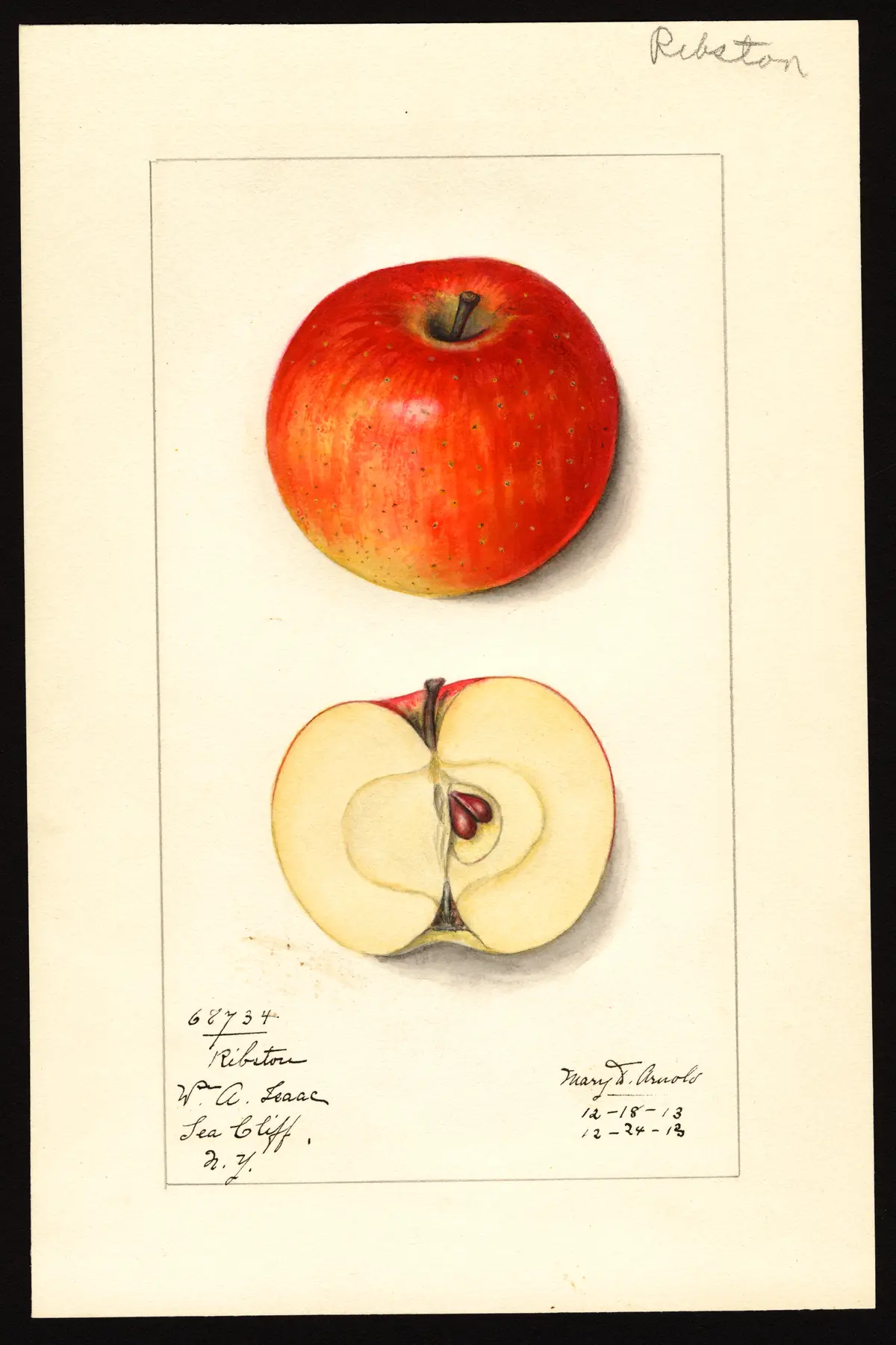
USDA Pomological Watercolor Collection
Ribston Pippin
Origin / History
Ribston Pippin originated at Ribston Hall, near Knaresborough, Yorkshire, England, on the banks of the river Nidd, more than two hundred years ago — Budd & Hansen give the date as probably about 1688, while Bunyard and other accounts give about 1709. According to tradition recorded in the Herefordshire Pomona, the pip from which it grew came from Normandy. An account supposed to have been written by Sir John Goodricke (d. 1789) states: "Three pippins (pips?) were sent to Sir Henry Goodricke from Normandy, about the year 1709, only one of them succeeded, and from that tree all the Ribston Pippins have descended." Another account states that Sir Henry Goodricke, father of the last Sir John Goodricke, while at Rouen in Normandy preserved the pips of some fine-flavoured apples and sent them to Ribston, where they were sown and the young trees planted in the Park (now George Garth). Of seven trees planted, five proved failures and died; the other two proved good apples, and one of them was the celebrated original Ribston Pippin tree — never grafted. In an undated letter from Miss Clough it is stated: "The Ribston Pippin came from Normandy about the beginning of the last century. My great grandfather, Sir Henry, had a friend abroad who sent him over three pippins (pips) in a letter, which being sown, two came to nothing. The present old tree at Ribston is the produce of the third, and has been distributed into all parts."
The original tree stood until 1810, when it was blown down by a violent gale of wind. It was afterwards supported by stakes in a horizontal position and continued to produce fruit until it lingered and died in 1840. On clearing away the old wood, a healthy young sucker was found growing from the root about four inches below the surface of the ground; this young shoot was carefully tended but did not grow well, and the tree was smaller than in earlier years. The branches died off considerably after the frost of 1860. In 1875 the tree bore two pecks of very fine fruit; in 1876 and 1877 it bore less freely; and in the bad seasons of 1878–80 it did not ripen any fruit. It continued to throw up suckers freely. The owner of Ribston Hall at the time of the Herefordshire Pomona's writing was John Dent Dent, Esq. A tradition existed there that the gardener who raised the original tree was a certain Robert Clemesha; a second account holds that he was the father of Lowe, who during the last century was the fruit tree nurseryman at Hampton Wick.
Notwithstanding its great merits, the variety did not become generally known until the end of the eighteenth century. It is not mentioned in any edition of Miller's Dictionary, nor by any other author of that period; it was not grown in the Brompton Park nursery grounds in 1770. In 1775 it appears in that collection to the extent of a quarter of a row (about twenty-five plants), and this supply sufficed for three years' demand. In 1788 cultivation extended to one row (about one hundred plants), three years later to two rows, and from 1791 it increased one row annually until 1794, when it reached five rows. At the time of the Herefordshire Pomona it was cultivated in the same nursery to the extent of about twenty-five rows, or 2,500 plants annually; in the West of England nursery of Messrs. Richard Smith and Co. at St. John's, Worcester, 3,000 plants were annually propagated by budding for trained plants, pyramids, and standards.
In Great Britain it stands "as high as the Bank of England," and to say that an apple has a "Ribston flavor" is there the highest praise (Downing). Nicol called it "a universal apple for three kingdoms: it will thrive at John O'Groat's, while it deserves a place at Exeter or Cork." In America it has not gained the standing it holds in England — Coxe obtained it from Mr. Priestly late of Northumberland, Pennsylvania. It is not much esteemed in southern or central regions but is valued in northern sections, succeeding particularly well in Maine, parts of Northern New England, and Canada, where it is of some commercial importance. Hedrick calls it "one of the few exotic apples worth growing in America." Beach notes it belongs in the same group as Hubbardston but is hardly satisfactory as a cropper, with Hubbardston preferred for commercial planting in New York.
Tree
Tree medium to large in size, moderately vigorous to vigorous, hardy, healthy, and long-lived, with rather stout, stocky branches. Form rather upright and spreading, or roundish, not very regular (Beach); upright-spreading (Hedrick); spreading top (Downing); spreading (Budd & Hansen); diverging or spreading shoots (Thomas). Twigs medium to rather long, rather slender to moderately stout; internodes medium to long. Bark bright dark reddish-brown and olive-green, somewhat mottled with grayish scarf-skin. Lenticels conspicuous, scattering, small to medium, elongated or roundish. Buds medium to large, broad, plump, obtuse, nearly free, very pubescent; buds and young shoots rather hoary (Thomas). Leaves broad; foliage rather dense. Bunyard describes the leaf as very dark, densely woolly below, upcupped, with edges twisted and shallow serrate. Flowers large and pink (George Bunyard catalog).
The tree is hardy and vigorous in growth, an early bearer, and bears well when grown in a light, rich, and dry soil — it is otherwise apt to canker. In all the southern and middle counties of England it succeeds well as an open standard, but in the North and in Scotland it requires the protection of a wall. It comes into bearing rather young and usually bears some fruit every year; occasionally the crops are heavy, but more often they vary from moderate to rather light. Productive overall, though not sufficiently productive nor does it hold the crop well enough to make a market variety (Hedrick). Bunyard describes growth as moderate and fertility as medium.
Fruit
Size and Form
Medium, or medium to large, occasionally above; often averaging below medium (Beach). Pretty uniform in shape and size. Form roundish, rather broad and flattened at the base, narrowing somewhat toward the basin, occasionally a little inclined to roundish oblong, often broadly and obscurely ribbed. Coxe describes the form as "rather flat." Thomas and Budd & Hansen describe it as roundish conical or roundish, slightly conical. Warder describes it as round, truncated, regular. Bunyard gives dimensions of 3 by 2¼ inches, round conical, irregular. Herefordshire Pomona describes the outline as roundish and irregular, caused by several obtuse and unequal angles on its sides.
Stem and Cavity
Stem pubescent, medium to short, occasionally moderately slender, more often rather thick, sometimes irregularly swollen or inserted under a lip (Beach, Hedrick); stalk short, slender (Downing); stalk slender, often short (Thomas); stem long, slender (Warder); stem slender (Elliott); stalk half an inch long, slender (Herefordshire Pomona); stem rather long (Bunyard); stem short (Budd & Hansen).
Cavity rather large to large, acute, moderately shallow to deep, wide to moderately narrow, sometimes furrowed or compressed, occasionally smooth and green but often faintly russeted and with some outspreading russet rays (Beach, Hedrick); rather wide cavity (Downing, Thomas); acute, wide, regular, brown (Warder); somewhat acuminate, often with large stellate russet patch (Budd & Hansen); narrow, russet cavity (Bunyard); round cavity surrounded with russet, with the stalk generally inserted its whole length (Herefordshire Pomona).
Calyx and Basin
Calyx variable, small to rather large, closed or partly open; lobes sometimes separated at the base, erect or converging, tips usually somewhat reflexed (Beach, Hedrick). Other sources describe it more simply as small, closed (Elliott, Downing, Warder, Budd & Hansen); small and closed in an irregular basin (Herefordshire Pomona); a little open in a deep uneven basin (Bunyard).
Basin small to medium, shallow to moderately deep, moderately narrow, more or less abrupt or occasionally obtuse, often slightly furrowed and wrinkled (Beach, Hedrick); abrupt, plaited or regular, russeted (Warder); narrow, angular (Thomas); abrupt, medium, angular and ribbed, russeted (Budd & Hansen); open (Elliott); angular (Downing); irregular, generally netted with russet (Herefordshire Pomona).
Skin
Skin smooth or slightly roughened with russet. Ground color deep yellow or greenish-yellow, more or less overspread with rather dull red, which in highly colored specimens deepens to a distinct red with some obscure carmine stripes and splashes (Beach, Hedrick). Coxe describes the skin as "streaked with red and yellow, with a small portion of russet." Elliott: greenish yellow, russet near the stem, dull red in sun. Warder: surface rough, splashed and mixed dull red on yellow. Herefordshire Pomona: greenish yellow, changing as it ripens to dull yellow, marked with broken streaks of pale red on the shaded side, but dull red changing to clear faint crimson, marked with streaks of deeper crimson, on the side next the sun, and generally russety over the base. Downing: greenish yellow, mixed with a little russet near the stalk, and clouded with dull red on the sunny side. Thomas: clouded and striped with yellowish red on a yellow and slightly russeted ground. Budd & Hansen: surface rough, greenish, shaded and striped with dull red on sunny side, with open network of russet. Bunyard: yellow with dull brownish-red flush and few stripes and russet. Central Experimental Farm catalog: greenish yellow, with a little russet, and a dull red blush. George Bunyard catalog (fragmentary): "round, dull with rusly and olive." Prevailing effect sometimes rather attractive but more often the colors are rather dull; the fruit is not attractive in appearance (Hedrick), is ordinary in appearance (Beach).
Dots scattering, conspicuous toward the base, more numerous and smaller toward the basin, pale, sometimes whitish, often areolar with russet center (Beach, Hedrick); numerous, minute, prominent, russet (Warder); obscure, gray or russet, few (Budd & Hansen).
Flesh and Flavor
Flesh tinged with yellow, deep yellow, or yellow with yellow veinings (Budd & Hansen); golden yellow (Central Experimental Farm); firm, very crisp, medium in texture, juicy, pleasantly aromatic, rich, sprightly subacid, very good (Beach, Hedrick). Elliott: yellow, firm, crisp, aromatic, sub-acid. Warder: yellow, crisp, firm, juicy; flavor acid, rich, aromatic. Downing: deep yellow, firm, crisp, with a sharp, rich, aromatic flavor; very good. Thomas: yellow, crisp, granular, juicy, with a very rich and rather sharp or acid flavor. Herefordshire Pomona: yellow, firm, crisp, rich and sugary, and charged with a powerful aromatic flavour. Budd & Hansen: deep yellow with yellow veinings, firm, crisp, juicy, rich, aromatic subacid, very good. Bunyard: firm, yellow, highly aromatic — "one of the richest flavoured apples when well ripened." Central Experimental Farm: golden yellow, firm, crisp, moderately juicy, with a rich aromatic flavour, quality very good. Rivers catalog: rich, aromatic, and excellent. George Bunyard catalog (fragmentary): "very fine flavour of cinnamon and nutmeg. Very good indeed." Lowther: quality very good. Hedrick: fine rich flavor, pleasant aroma, firm, fine, crisp flesh that fits it admirably for dessert.
Core and Seeds
Core below medium to small, axile or with a narrow hollow cylinder at the axis; cells pretty regular, closed; core lines clasping to nearly meeting (Beach, Hedrick); core regular, closed (Warder); core small (Elliott); core small, distant, barely clasping, closed; cells obovate, axile, slit (Budd & Hansen). Calyx tube rather wide, cone-shape or sometimes funnel-form; stamens basal (Beach, Hedrick); tube funnel-shaped or broadly conical; stamens median or basal (Budd & Hansen).
Carpels roundish to nearly elliptical, emarginate, slightly tufted (Beach); elliptical, emarginate, tufted (Hedrick).
Seeds variable, some abortive, usually but few are plump, light and dark brown, rather large, moderately narrow to wide, medium to long, obtuse or sometimes approaching acute, sometimes slightly tufted (Beach, Hedrick); numerous, angular, imperfect (Warder); flattened ovate (Elliott); pointed, few, often imperfect (Budd & Hansen).
Season
Late September to December or later (Beach); September to December (Hedrick); October until April (Coxe); November to February (Elliott); October and later, but apt to wilt (Warder); November to April (Downing, Budd & Hansen); late autumn and early winter (Thomas); in greatest perfection during November and December, but with good management will keep until March (Herefordshire Pomona); dessert till January (Bunyard); November to January (Central Experimental Farm); October to May (Veitch); September to January (Rivers); winter (Lowther).
In southern New York the season extends from late September to November or December; in northern and more elevated regions from late fall to early or mid-winter, with a portion of the fruit sometimes keeping till spring in ordinary storage. Heat ripens it quickly and it is not considered a very good keeper; in cold storage, if properly handled before storing, it is possibly equal to Tompkins King or Hubbardston as a keeper (Beach). Its quality is usually suffered to deteriorate needlessly by remaining too long on the tree (Thomas). Warder notes it is "apt to wilt." Veitch notes it "ripens in the autumn but improves when stored in good condition."
Uses
Excellent table and baking apple (Coxe). Desirable either for dessert or culinary uses (Beach); fits admirably for dessert (Hedrick); kitchen — scarcely for table (Warder); first-rate as far north as Maine, often second-rate farther south (Thomas); both kitchen and market (Lowther); dessert (Bunyard). In England long considered the standard of excellence among dessert apples.
Subtypes / Variants
Not described in source.
Other
Coxe references "NO. 41" in his numbered series. Lowther's source consists of tabular data: size medium, form round, color yellow-red, quality very good, use both kitchen and market, season winter, with reports from 2 reporting stations in the Central Division (reported in more than one division). Beach references an enormous bibliography of forty-six prior pomological notices spanning 1803 to 1904. The Herefordshire Pomona notes that the last remnant of the original Ribston Pippin tree at Ribston Hall, Knaresborough, was depicted in a woodcut vignette lent by the Editor of the Gardener's Chronicle, and that a portion of the old wood is still carefully preserved near the gardener's house.
Book Sources
Described in 11 period pomological works
- The Herefordshire Pomona (1876–1885)
- Downing, Fruits and Fruit Trees of America (1900)
- Beach, The Apples of New York Vol. 2 (1905) — listed as Ribston
- Budd & Hansen, Systematic Pomology (1914) — listed as Ribston (Ribston Pippin)
- Coxe, A View of the Cultivation of Fruit Trees (1817) — listed as Ribstone Pippin
- Warder, American Pomology: Apples (1867)
- Bunyard, A Handbook of Hardy Fruits (1920)
- Elliott, The Western Fruit Book (1865)
- Lowther (ed.), Encyclopedia of Practical Horticulture (1914)
- Thomas, The American Fruit Culturist (1903)
- Hedrick, Cyclopedia of Hardy Fruits (1922) — listed as RIBSTON
Nursery Catalog Sources
Found in 17 catalogs (1884–1917) from California, England, Illinois, Oregon, Washington
- Felix Gillet , Barren Hill Nursery, Nevada City , California — 1884
- Felix Gillet , Barren Hill Nursery, Nevada City , California — 1888
- Felix Gillet , Barren Hill Nursery, Nevada City , California — 1889
- Felix Gillet , Barren Hill Nursery, Nevada City , California — 1890
- Felix Gillet , Barren Hill Nursery, Nevada City , California — 1891
- Felix Gillet , Barren Hill Nursery, Nevada City , California — 1895
- Felix Gillet , Barren Hill Nursery, Nevada City , California — 1897
- Kelway & Son , Langport, Somerset , England — 1897
- George Bunyard & Co. , Royal Nurseries, Maidstone, Kent , England — 1900
- Central Experimental Farm , Dominion Department of Agriculture, Agassiz, British Columbia (under test; Bulletin No. 3, Second Series) — 1900
- Benjamin Buckman (personal inventory) , Farmingdale , Illinois — 1901
- James Veitch & Sons , Ltd., Royal Exotic Nursery, Chelsea, London (also Coombe Wood, Langley, and Feltham) , England — 1911
- Ballygreen Nurseries , Hanford , Washington — 1912
- Pacific Nursery Company , Portland , Oregon — 1912
- Thomas Rivers & Son , Sawbridgeworth, Hertfordshire , England — 1913
- George Bunyard & Co. , Royal Nurseries, Maidstone, Kent , England — 1914
- George Bunyard & Co. , Royal Nurseries, Maidstone, Kent , England — 1917
View original book sources (15)
— William Coxe, A View of the Cultivation of Fruit Trees (1817)NO. 41. RIBSTONE PIPPIN.
This is an admired English apple, which I obtained from Mr. Priestly late of Northumberland, Pennsylvania—the size is large, the form rather flat, the skin streaked with red and yellow, with a small portion of russet: it is an excellent table and baking apple; in season, from October till April.
— F.R. Elliott, The Western Fruit Book (1865)Ribston Pippin.
Glory of York, | Travers, | Formosa Pippin.
Foreign. Valued in Northern sections ; not esteemed South or Central. Fruit, medium, roundish, greenish yellow, russet near the stem, dull red in sun ; stem, slender ; calyx, small closed ; basin, open ; core, small ; seeds, flattened ovate ; flesh, yellow, firm, crisp, aromatic, sub-acid. November to February.
— John A. Warder, American Pomology: Apples (1867)Ribston Pippin.
This famous English apple does not seem to have many admirers among our orchardists, but on some accounts it merits a place in the amateur's collection.
Tree productive, early bearer.
Fruit medium to large, round, truncated, regular; Surface rough, splashed and mixed dull red on yellow; Dots numerous, minute, prominent, russet.
Basin abrupt, plaited or regular, russeted; Eye small, closed.
Cavity acute, wide, regular, brown; Stem long, slender.
Core regular, closed; Seeds numerous, angular, imperfect; Flesh yellow, crisp, firm, juicy; Flavor acid, rich, aromatic; Use, kitchen — scarcely for table; Season, October and later, but apt to wilt.
— Woolhope Naturalists Field Club, The Herefordshire Pomona (1885)
- RIBSTON PIPPIN.
[Syn: Glory of York; Travers Pippin.]
The original tree of this celebrated Apple grows in the park at Ribston Hall, near Knaresborough, Yorkshire, on the banks of the river Nidd; and if tradition is to be believed, the pip from which it grew came from Normandy. The following account of its origin is supposed to have been written by Sir John Goodricke, who died in 1789:—"Three pippins (pips?) were sent to Sir Henry Goodricke from Normandy, about the year 1709, only one of them succeeded, and from that tree all the Ribston Pippins have descended." Another account states that "Sir Henry Goodricke, father of the last Sir John Goodricke (owner of Ribston) being at Rouen in Normandy, preserved the pips of some fine-flavoured apples and sent them to Ribston. They were sown, and the young trees in due time planted in the Park (now George Garth). Out of seven trees planted, five proved decided" . . . (illegible—probably "failures and are all") . . . "dead. The other two proved good apples. They are" . . . (illegible—probably "bearing") . . . "yet. They never were grafted, and one of them is the celebrated original Ribston Pippin tree." And, lastly, in an undated letter from Miss Clough it is stated, "The Ribston Pippin came from Normandy about the beginning of the last century. My great grandfather, Sir Henry, had a friend abroad who sent him over three pippins (pips) in a letter, which being sown, two came to nothing. The present old tree at Ribston is the produce of the third, and has been distributed into all parts."
The original tree stood until the year 1810, when it was blown down by a violent gale of wind. It was afterwards supported by stakes in a horizontal position, as is shown by the woodcut vignette which has been kindly lent to the Club by the Editor of the Gardener's Chronicle to appear here. It continued to produce fruit until it lingered and died in the year 1840. On clearing away the old wood, a portion of which is still carefully preserved near the gardener's house, a healthy young sucker was found to be growing from the root about four inches below the surface of the ground. This young shoot has been well cared for but it does not grow well, and the tree is not so large as it was some years since. The branches died off very much after the frost of 1860. In the year 1875 the tree bore two pecks of very fine fruit. In 1876 and 1877 it did not bear so freely, and in the bad seasons of 1878—9 and 80 it did not ripen any fruit. The tree is still so far flourishing that it continues to bear fruit. It throws up suckers freely, so that when the present tree dies altogether, one of these with care would soon make a nice tree and still perpetuate the original.
The owner of Ribston Hall at this time is John Dent Dent, Esq., and much of the above information has been kindly supplied by Mrs. Dent. A tradition exists there that the gardener who raised the original tree, was a certain Robert Clemesha; but a second account states he was the father of Lowe, who, during the last century, was the fruit tree nurseryman at Hampton Wick.
Notwithstanding the great merits of the Ribston Pippin apple, now so universally admitted, it did not become generally known until the end of the last century; and it is not mentioned in any of the editions of Miller's Dictionary, or by any other author of that period; neither was it grown in the Brompton Park nursery grounds in 1770. In 1775 it appears in that collection, when it was grown to the extent of a quarter of a row, or about twenty-five plants; and as this supply seems to have sufficed for three years' demand, its merits must have been but little known. In 1788 its cultivation extended to one row, or about one hundred plants, and three years later to two rows. From 1791 it increased one row annually till 1794, when it reached five rows. From these facts we may pretty well learn the rise and progress of its popularity. It is now in the same nursery cultivated to the extent of about twenty-five rows, or 2,500 plants annually.
The extent to which the Ribston Pippin is now generally cultivated may be judged of from the fact, that in one single Nursery in the West of England, that of Messrs. Richard Smith and Co., at St. John's, Worcester, 3,000 plants are annually propagated by budding for trained plants, pyramids and standards.
Description.—Fruit: medium sized, roundish and irregular in its outline, caused by several obtuse and unequal angles on its sides. Skin: greenish yellow, changing as it ripens to dull yellow, and marked with broken streaks of pale red on the shaded side, but dull red changing to clear faint crimson, marked with streaks of deeper crimson, on the side next the sun, and generally russety over the base. Eye: small and closed, set in an irregular basin, which is generally netted with russet. Stalk: half an inch long, slender, and generally inserted its whole length in a round cavity, which is surrounded with russet. Flesh: yellow, firm, crisp, rich and sugary, and charged with a powerful aromatic flavour.
This delicious Apple needs no encomium. It is as highly appreciated as it is generally known. It is in greatest perfection during the months of November and December, but with good management it will keep until March.
The tree is hardy and vigorous in growth, and bears well when grown in a light, rich and dry soil. It is otherwise apt to canker. In all the Southern and middle counties of England it succeeds well as an open standard; but in the North and in Scotland it requires the protection of a wall to bring it to perfection. Nicol calls it "a universal apple for three kingdoms: it will thrive at John O'Groat's, while it deserves a place at Exeter or Cork." It may be added, too, that it carries everywhere its delicious flavour.
The last remnant of the original Ribston Pippin Tree, Ribston Hall, Knaresborough.
— A.J. Downing, The Fruits and Fruit Trees of America (1900)Ribston Pippin.
Glory of York. Travers'. Formosa Pippin. Rockhill's Russet.
The Ribston Pippin, a Yorkshire Apple, stands as high in Great Britain as the Bank of England, and to say that an Apple has a Ribston flavor is there the highest praise that can be bestowed. But it is scarcely so much esteemed here, and must be content to give place with us to the Newtown Pippin, the Swaar, the Spitzenburgh, or the Baldwin. In Maine, and parts of Canada, it is very fine and productive.
Ribston Pippin.
Fruit of medium size, roundish, greenish yellow, mixed with a little russet near the stalk, and clouded with dull red on the sunny side. Stalk short, slender, planted in a rather wide cavity. Calyx small, closed, and set in an angular basin. Flesh deep yellow, firm, crisp, with a sharp, rich, aromatic flavor. Very good. The tree forms a spreading top. November to April.
— John J. Thomas, The American Fruit Culturist (1903)Ribston Pippin. Medium or rather large, roundish conical; clouded and striped with yellowish red, on a yellow and slightly russeted ground; stalk slender, often short; cavity rather wide; basin narrow, angular; flesh yellow, crisp, granular, juicy, with a very rich and rather sharp or acid flavor. First-rate as far north as Maine, often second-rate farther south; but its quality is usually suffered to deteriorate needlessly by remaining too long on the tree. Late autumn and early winter. Shoots diverging or spreading; buds and young shoots rather hoary. English.
— S.A. Beach, The Apples of New York, Vol. 2 (1905)RIBSTON.
REFERENCES. 1. Forsyth, 1803:52. 2. Diel, 11:93. 1813. 3. Coxe, 1817:125. fig. 4. Forsyth, 1824:124. 5. Buel, N. Y. Bd. Agr. Mem., 1828:476. 6. Fessenden, 1828:130. 7. Pom. Mag., 3:No. 141. 1830. col. pl. 8. London Hort. Soc. Cat., 1831:32. 9. Ronalds, 1831:54. 10. Kenrick, 1832:52. 11. Floy-Lindley, 1833:59. 12. Manning, 1838:54. 13. Manning, Mag. Hort., 7:49. 1841. 14. Russell, Ib., 10:403. 1844. 15. Downing, 1845:131. 16. Downing, Horticulturist, 2:416. 1847. 17. Ib., 3:421. 1848. 18. Thomas, 1849:152. 19. Cole, 1849:126. 20. Horticulturist, 6:16, 292. 1851. 21. Emmons, Nat. Hist. N. Y., 3:75. 1851. 22. Elliott, 1854:155. 23. Am. Pom. Soc. Cat., 1854. 24. Mag. Hort., 21:62. 1855. 25. Hooper, 1857:80. 26. Oberdieck, Ill. Handb. Obst., 1:353. 1858. 27. Mag. Hort., 26:116. 1860. 28. Warder, 1867:612. 29. Regel, 1868:463. 30. Berghuis, 1868:No. 3. col. pl. 31. Mas, LeVerger, 1868:99. 32. Leroy, 1873:750. figs. 33. Lauche, 1:No. 25. 1882. col. pl. 34. Barry, 1883:353. 35. Hogg, 1884:194. 36. Lyon, Mich. Hort. Soc. Rpt., 1890:296. 37. Hick, Can. Hort., 15:157. 1892. 38. Bailey, An. Hort., 1892:248. 39. Bredsted, 1893:137. 40. Gaucher, 1894:No. 19. col. pl. 41. Bunyard, Jour. Roy. Hort. Soc., 1898:355. 42. Can. Hort., 22:510. 1899. 43. Eneroth-Smirnoff, 1901:224. 44. Waugh, Rural N. Y., 61:285, 286. 1902. fig. 45. Budd-Hansen, 1903:165. fig. 46. Beach and Clark, N. Y. Sta. Bul., 248:141. 1904.
SYNONYMS. Beautiful Pippin (25). Englische Granat-Reinette (40). Essex Pippin (40). Formosa (25). Formosa Pippin (7, 10, 15, 22, 32, 40). Glory of York (10, 15, 22, 25, 32, 35, 40, of some 7). Granat-Reinette (40). Nonpareille (40). Pepin Ribston (40). Reinette Grenade Anglaise (40). Reinette de Trover (32). RIBSTON (2, 8, 9, 11, 20, 23, 24, 26, 27, 29, 30, 31, 33, 36, 37, 39, 42, 43, 44, 45). RIBSTON PIPPIN (1, 3, 4, 5, 7, 10, 13, 14, 15, 16, 17, 18, 19, 21, 22, 25, 28, 32, 34, 35, 38, 41, 44). Ribston Pippin (45, 46). RIBSTON PEPPING (40). Ribston's Pepping (40). Ribstone (32). RIBSTONE PIPPIN (6, 12). RIDGE (46 by error). Rockhill's Russet (32). Travers (15, 22, 25, 32). Travers Apple (7, 10, 40). Travers Peppin (40). Travers Pippin (35). Travers Reinette (40).
Ribston evidently belongs in the same group as Hubbardston. It is much esteemed for its rich flavor and fine quality and it is desirable either for dessert or culinary uses. The fruit is pretty smooth and uniform but often it averages below medium size and is ordinary in appearance. Heat ripens it quickly and it is not considered a very good keeper. In cold storage, if properly handled before storing, it is possibly equal to Tompkins King or Hubbardston as a keeper (46). Its season in Southern New York extends from late September to November or December, and in the northern and more elevated regions from late fall to early or mid-winter and sometimes a portion of the fruit may be kept till spring in ordinary storage. The tree is pretty hardy, vigorous, healthy and long-lived. It comes into bearing rather young and usually bears some fruit every year. Occasionally the crops are heavy but more often they vary from moderate to rather light. Generally speaking, it is hardly satisfactory as a cropper and Hubbardston is much to be preferred for planting in commercial orchards in New York.
Historical. Ribston originated more than two hundred years ago in Yorkshire, England (1, 7). In that country it has long been considered the standard of excellence among dessert apples. It has long been known in cultivation in America but has not gained the standing here that it holds in England. It is not grown to any considerable extent in New York but succeeds better farther north, as in portions of Northern New England and of Canada, where it is of some commercial importance (16, 20, 24, 44).
TREE.
Tree medium in size or sometimes rather large, moderately vigorous to vigorous with rather stout, stocky branches. Form rather upright and spreading or roundish, not very regular. Twigs medium to rather long, rather slender to moderately stout; internodes medium to long. Bark bright dark reddish-brown and olive-green, somewhat mottled with grayish scarf-skin. Lenticels conspicuous, scattering, small to medium, elongated or roundish. Buds medium to large, broad, plump, obtuse, nearly free, very pubescent. Foliage rather dense; leaves broad.
FRUIT.
Fruit medium or above, pretty uniform in shape and size. Form roundish, rather broad and flattened at the base, narrowing somewhat toward the basin, occasionally a little inclined to roundish oblong, often broadly and obscurely ribbed. Stem pubescent, medium to short, occasionally moderately slender, more often rather thick, sometimes irregularly swollen or inserted under a lip. Cavity rather large, acute, moderately shallow to rather deep, wide to moderately narrow, sometimes furrowed or compressed, occasionally smooth and green but often faintly russeted and with some outspreading russet. Calyx variable, small to rather large, closed or partly open; lobes sometimes separated at the base, erect or converging, tips usually somewhat reflexed. Basin small to medium, shallow to moderately deep, moderately narrow, more or less abrupt or occasionally obtuse, often slightly furrowed and wrinkled. Skin smooth or slightly roughened with russet, deep yellow or greenish-yellow more or less overspread with rather dull red which in highly colored specimens deepens to a distinct red with some obscure carmine stripes and splashes. Dots scattering, conspicuous toward the base, more numerous and smaller toward the basin, pale, sometimes whitish, often areolar with russet center. Prevailing effect sometimes rather attractive but more often the colors are rather dull.
Calyx tube rather wide, cone-shape or sometimes funnel-form. Stamens basal. Core below medium to small, axile or with a narrow hollow cylinder at the axis; cells pretty regular, closed; core lines clasping to nearly meeting. Carpels roundish to nearly elliptical, emarginate, slightly tufted. Seeds variable, some abortive, usually but few are plump, light and dark brown, rather large, moderately narrow to wide, medium to long, obtuse or sometimes approaching acute, sometimes slightly tufted. Flesh tinged with yellow, firm, very crisp, medium in texture, juicy, pleasantly aromatic, rich, sprightly subacid, very good.
Season late September to December or later.
— J.L. Budd & N.E. Hansen, American Horticultural Manual, Part II: Systematic Pomology (1914)Ribston (Ribston Pippin).—Origin, Ribston Hall, near Knaresborough, England, probably about 1688; highly esteemed in England, but not equal to some other varieties as grown in the Eastern States; tree spreading, productive, an early bearer.
Ribston.
Fruit medium to large, roundish, slightly conical; surface rough, greenish, shaded and striped with dull red on sunny side, with open net-work of russet; dots obscure, gray or russet, few; cavity rather wide, rather shallow, somewhat acuminate, often with large stellate russet patch; stem short; basin abrupt, medium, angular and ribbed, russeted; calyx closed, small. Core small, distant, barely clasping, closed; cells obovate, axile, slit; tube funnel-shaped, or broadly conical; stamens median or basal; seeds pointed, few, often imperfect; flesh deep yellow, with yellow veinings, firm, crisp, juicy, rich, aromatic subacid, very good. November to April.
— Granville Lowther (ed.), Encyclopedia of Practical Horticulture (1914)Ribston (Pippin). Size: medium. Form: round. Color: yellow-red. Quality: very good. Use: both kitchen and market. Season: winter. Central Division: 2 reporting stations (reported in more than one division).
— E.A. Bunyard, A Handbook of Hardy Fruits (1920)RIBSTON PIPPIN. Ronalds, P. 27. F., Pepin Ribston ; G., Englische Granat Reinette. (Formosa Pippin, Nonpareille d'Angleterre, Travers Pippin.) Dessert, till January, medium to fairly large, 3 by 2¼, round conical, irregular. Colour, yellow with dull brownish-red flush and few stripes and russet. Flesh, firm, yellow, highly aromatic. Eye, a little open, in a deep uneven basin. Stem, rather long, in a narrow russet cavity. Growth, moderate ; fertility, medium. Leaf, very dark, and densely woolly below, upcupped, edges twisted, shallow serrate. Origin, English. Raised at Ribston Hall, Knaresborough, about 1709, from seeds brought from Rouen. One of the richest flavoured apples when well ripened.
— U.P. Hedrick, Cyclopedia of Hardy Fruits (1922)RIBSTON. Essex Pippin. Ribston Pippin.
Ribston is one of the few exotic apples worth growing in America. The apples are not attractive in appearance, but have a fine rich flavor, a pleasant aroma, and firm, fine, crisp flesh that fit them admirably for dessert. The trees are hardy, vigorous, and long-lived, come in bearing young, and are annually fruitful, though not sufficiently productive nor do they hold the crop well enough to make a market variety. Ribston originated in Yorkshire, England, over two centuries ago, and has been grown in America for at least a century, thriving best in New York, New England, and Canada.
Tree large, vigorous, upright-spreading, with stout, stocky branches. Fruit medium or large, uniform in size and shape, round, broad and flattened at the base, narrowing toward the basin, occasionally round-oblong, often broadly and obscurely ribbed; stem pubescent, short, occasionally slender, more often thick, sometimes irregularly swollen or inserted under a lip; cavity large, acute, deep, wide, sometimes furrowed or compressed, russeted and with outspreading russet rays; calyx variable, small, closed or partly open; lobes separated at the base, erect, tips usually reflexed; basin small, shallow, narrow, abrupt, or occasionally obtuse, often furrowed and wrinkled; skin smooth or roughened with russet, yellow overspread with dull red which in highly-colored specimens deepens to bright red, with obscure carmine stripes and splashes; dots scattering, conspicuous toward the base, more numerous and smaller toward the basin, pale, often areolar with russet center; calyx-tube wide, cone-shape; stamens basal; core small, axile or with a narrow, hollow cylinder at the axis; cells regular, closed; core-lines clasping; carpels elliptical, emarginate, tufted; seeds variable, some abortive, light and dark brown, large, wide, long, obtuse, sometimes slightly tufted; flesh yellow, firm, very crisp, juicy, pleasantly aromatic, rich, sprightly subacid; very good; September to December.
— Central Experimental Farm, Central Experimental Farm, Agassiz BC — Catalogue of Fruit Trees under Test (Bulletin No. 3, 1900) (1900)Planted Spring 1890. Tree a vigorous but spreading grower, and productive. Fruit of medium size, roundish. Skin greenish yellow, with a little russet, and a dull red blush. Flesh golden yellow, firm, crisp, moderately juicy, with a rich aromatic flavour, quality very good. Season November to January.
— James Veitch & Sons, Veitch's Fruit Trees (1911) (1911)a well-known and much valued dessert apple, the form being somewhat flattened, ripens in the autumn but improves when stored in good condition. Oct. to May
— George Bunyard & Co., George Bunyard Catalog of Fruit Trees (1914) (1914)History; Sync. round, dull with rusly and olive: Flavour as good as apple. Mostly flesh with very fine flavour of cinnamon and nutmeg. Very good indeed. Flowers large and pink.
— Thomas Rivers & Son, Thomas Rivers Catalogue of Fruits (1914) (1914)medium size, rich, aromatic, and excellent; a very - Sept-Jan.