Porter
Apple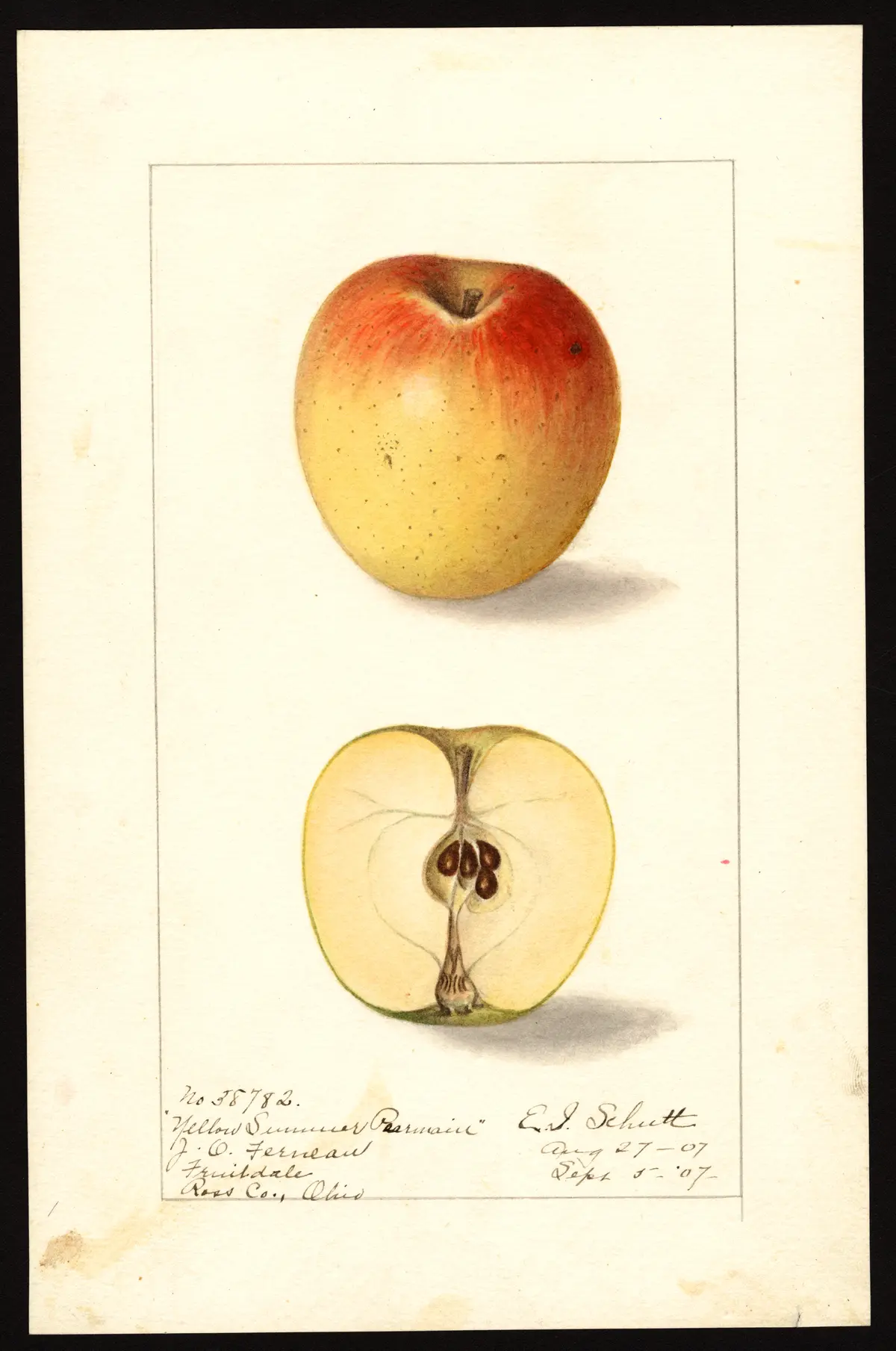
USDA Pomological Watercolor Collection
Porter
Origin/History
Porter originated about 1800 (Hovey gives "about fifty years ago" writing in 1852) in Sherburne, Massachusetts, on the grounds of the Rev. Samuel Porter. According to Hovey, the tree remained unnoticed for some years until a neighbor, passing through the orchard, had his attention accidentally attracted to the tree by some very beautiful specimens that had fallen off. He called upon the owner and apprized him of the valuable fruit on his grounds, requesting permission to cut a few scions. Mr. Porter, then somewhat advanced in life and not seeming to be aware of its excellence or of the importance of disseminating superior fruit, replied "that he might have the whole tree if he wished." The neighbor, content with scions, grafted them into trees in his own garden, and from that period Porter grew rapidly in favor.
Up to about 1850 its cultivation was confined principally to the vicinity of its origin (Beach; Hovey). Fifty years before Beach wrote (i.e., around 1855), it was the principal September apple in the Boston market, and in spite of the fact that it is not red it continued to sell well in that market. It gradually became very widely known and well disseminated in many of the more important apple-growing regions of the country. Old trees of it were occasionally found in New York orchards by Beach's time but it was then seldom planted there. Hedrick notes the variety is planted more or less wherever apples are grown in the United States. Elliott calls it "American: native of Massachusetts" and notes it "succeeds wherever grown — one of the best at South; hardy all West." Thomas notes it succeeds in the Northern and Middle States. Hovey adds that, as its qualities became more widely known, fine specimens always commanded a very high price.
Tree
Sources vary somewhat on tree vigor. Hovey: "Moderately vigorous, partially spreading and upright, the branches making a long curve upwards; old wood clothed with numerous short spurs." Downing: "hardy, a moderately vigorous grower, forming a low, round, spreading head, and producing abundantly, if in good soil, a fruit uniformly fair and even in size and form." Budd-Hansen: "tree of moderate vigor, with low, round, spreading head, an abundant bearer." Warder: "vigorous, healthy, productive." Beach: "medium to large, vigorous. Form roundish or somewhat spreading"; "compact, hardy, comes into bearing early and is a pretty reliable biennial cropper." Hedrick: "large, vigorous, round or spreading." Elliott describes it as "slender, slow growth, a regular, even bearer, requires strong soil in which there is good supply of lime and phosphates." Central Experimental Farm (Agassiz BC, planted Spring 1894): "a vigorous grower and a free producer."
Hovey describes early bearing and a handsome habit, making it a fine variety for cultivation as dwarf or pyramidal trees; he reports trees in his collection six years old and only eight feet high being in full bearing.
Wood (Hovey): Bright reddish chestnut, dotted with whitish specks, rather slender and very short-jointed; old wood dull pale brown. Twigs (Beach): rather slender, very short-jointed, with prominent shoulders.
Buds: Medium size, short, with prominent shoulders (Hovey); medium in size (Beach).
Leaves (Hovey): Large, oblong, tapering to the point, partially folded, and very regularly, deeply, and sharply serrated; petioles medium length, and moderately stout. Thomas notes leaves "sharp, serrate."
Flowers (Hovey): Medium size; petals tinged with pink.
Fruit
Size
Sources generally agree on large but note variability. Hovey: "Large, about two and a half inches broad, and three inches deep." Warder: "rather large." Downing: "rather large." Elliott: "medium to large." Thomas: "Above medium." Budd-Hansen: "medium." Beach: "small to large, usually rather large… It varies in size from large to small, with a considerable percentage of the crop undersized or otherwise unmarketable." Hedrick: "usually large." Central Experimental Farm: "medium size."
Form
Hovey: "oblong, largest about one third from the stem, slightly flattened at the base, narrowing to the crown, which is oblique and somewhat ribbed." Elliott: "oblong conical." Warder: "rather large, oblong, somewhat conic, often truncated." Downing: "regular, oblong, narrowing to the eye." Thomas: "oblong-ovate-conical, regular, often ribbed at apex." Budd-Hansen: "regular, oblong, tapering to calyx." Beach: "oblong inclined to conic, rather truncate at base and with apex oblique and somewhat ribbed." Hedrick: "oblong-conic, truncate at base and with apex oblique and ribbed." Central Experimental Farm: "oblong, largest in the middle, and tapering to the eye."
Stem
Hovey: "rather short, about three quarters of an inch long, slender, curved." Downing: "rather slender, not three-fourths of an inch long." Elliott: "slender." Thomas: "one inch long, slender." Warder: "medium." Budd-Hansen: "medium." Beach: "medium to rather short, moderately thick to slender, sometimes knobbed, curved." Hedrick: "short, thick, sometimes knobbed, curved."
Cavity
Hovey: "open, broad, and not very deep." Elliott: "shallow." Warder: "acute, wavy, brown." Thomas: "rather small." Budd-Hansen: "regular, acute, trace of russet." Beach: "acute to acuminate, medium to deep, medium in width to rather narrow, symmetrical or compressed, sometimes lipped, usually faintly russeted." Hedrick: "acute, deep, narrow, symmetrical or compressed, sometimes lipped, usually faintly russeted."
Calyx / Eye
Hovey: "Eye, rather large, open, and sunk in a moderately deep, ribbed hollow; segments of the calyx long, regularly formed, and reflexed at the ends." Warder: "Eye large, closed." Elliott: "medium, closed." Downing: "Calyx closed. Segments irregular." Budd-Hansen: "calyx closed; segments divergent." Beach: "Calyx rather large, closed or partly open; lobes usually separated at base, short, rather narrow, broadly acute." Hedrick: "calyx large, closed or open; lobes usually separated at base, short, narrow, acute."
Basin
Hovey: "moderately deep, ribbed hollow." Elliott: "narrow, deep." Warder: "abrupt, folded." Thomas: "narrow." Downing: "narrow and deep." Budd-Hansen: "narrow, smooth, or minutely wrinkled, rather shallow." Beach: "moderately deep to shallow, rather narrow, abrupt, broadly furrowed and wrinkled." Hedrick: "deep, shallow, narrow, abrupt, broadly furrowed and wrinkled."
Skin
Hovey: "very fair, smooth, clear bright yellow, faintly striped and marbled with dull blush on the sunny side near the base, and marked with a few crimson dots." Elliott: "bright, clear yellow — when exposed to sun, a fine blush cheek." Warder: "smooth, yellow, often faintly blushed; Dots few, sunken." Downing: "clear glossy bright yellow, and, when exposed, with a dull blush next the sun." Thomas: "bright yellow, sometimes a dull blush in the sun." Budd-Hansen: "surface glossy bright yellow, with a few dull stripes and splashes; dots very minute, whitish centres and green bases, numerous." Beach: "moderately thin, smooth, rather glossy, clear bright yellow with a faint blush, usually rather obscurely striped with darker red marked with scattering red dots. Dots usually medium to very small, often submerged, green with whitish center, sometimes russet." Hedrick: "thin, smooth, glossy, yellow with faint blush, usually obscurely striped with darker red, marked with scattering red dots; dots small, submerged, green with white center, sometimes russet." Central Experimental Farm: "clear rich yellow, with sometimes a dull blush." Beach also notes the skin "is rather tender and readily shows marks of handling," so the fruit does not stand shipping very well.
Flesh and Flavor
Hovey: "yellowish, fine, crisp, and tender: Juice, abundant, rich, subacid, very sprightly, and high-flavored." Elliott: "fine-grained, juicy, firm yet tender, acid." Warder: "yellowish white, breaking, tender, juicy; Flavor acid to sub-acid; Quality good to very good; Use, kitchen, table, market." Downing: "fine grained, and abounding with juice, sprightly, agreeable aromatic subacid. Very good to best." Thomas: "tender, rich, rather acid, of fine flavor… In some localities this fruit proves too acid for the table." Budd-Hansen: "yellow, with yellow veinings, fine-grained, juicy, sprightly subacid, very good." Beach: "yellow, fine, crisp, tender, juicy, subacid, agreeably aromatic, sprightly, good to very good for either dessert or culinary uses." Hedrick: "yellow, fine, crisp, tender, juicy, subacid, agreeably aromatic, sprightly; good to very good… crisp, tender, juicy, perfumed flesh, richly flavored and sufficiently acidulous to make it one of the most refreshing of all apples." Central Experimental Farm: "fine grained, very juicy, sprightly, aromatic, quality very good."
Hovey adds the variety's combination of "vigor of the tree—its compact form—the size of the fruit—its rich golden skin—and the brisk and vinous excellence of its abundant juice" form a combination of qualities few apples possess.
Core and Seeds
Hovey: "Core, medium size, slightly open: Seeds, rather large, acutely pointed." Warder: "Core medium, oval, regular, closed, meeting the eye; Seeds numerous, plump." Beach: "Calyx tube rather short, wide, broadly conical. Stamens median to basal. Core medium to large, axile to somewhat abaxile; cells partly open to wide open; core lines meeting or slightly clasping. Carpels broadly ovate to elliptical, mucronate. Seeds below medium to rather large, plump, rounded, acute." Budd-Hansen: "Core wide open, meeting; cells large, abaxile, roomy, elliptical, much slit; calyx-tube conical; stamens basal; seeds rounded, plump, short." Hedrick: "calyx-tube short, wide, broadly conical; stamens median; core large, axile or abaxile; cells partly open or wide open; core-lines meeting; carpels broadly ovate, mucronate; seeds medium to large, plump, rounded, acute."
Season
Sources broadly agree on early autumn. Hovey: "Ripe in September and October, and keeps well." Elliott: "September and October." Warder: "August to October." Downing: "Ripens in September." Thomas: "Early autumn." Budd-Hansen: "September." Beach: "It begins to ripen in September and continues in use till November or later." Hedrick: "September to November." Central Experimental Farm: "September and October."
Beach notes that "since it is quite variable in its season of ripening there is apt to be considerable loss from dropping unless more than one picking is made"; Hedrick likewise says "the season of ripening is long and variable, and the crop drops badly." Downing notes it "continues a long time in use."
Uses
Dessert, kitchen, table, and market (Warder). Beach: "of very fine dessert quality. It is also highly esteemed for canning and other culinary uses, because when it is cooked it is not only excellent in quality but it retains its form remarkably well." Beach also describes Porter as "decidedly attractive for an apple of its class," noting that it does not ship well due to tender skin showing marks of handling, and is "desirable for planting for home use or for some local markets, but generally it is not regarded as a profitable commercial variety by New York fruit growers." Hedrick characterizes it as "an apple for the connoisseur." Thomas notes that "in some localities this fruit proves too acid for the table." Hovey calls it "the very finest of our early fall apples" and "admirably adapted for garden cultivation."
Subtypes/Variants
Not described in source.
Other
Beach notes the variety "comes into bearing early and is a pretty reliable biennial cropper." Hovey observes that the tree's habit makes it suitable for dwarf or pyramidal training, citing trees six years old and only eight feet high in full bearing in his own collection.
Book Sources
Described in 8 period pomological works
- Beach, The Apples of New York Vol. 2 (1905)
- Warder, American Pomology: Apples (1867)
- Budd & Hansen, Systematic Pomology (1914)
- Downing, Fruits and Fruit Trees of America (1900)
- Hedrick, Cyclopedia of Hardy Fruits (1922)
- Elliott, The Western Fruit Book (1865)
- Thomas, The American Fruit Culturist (1903)
- Hovey, The Fruits of America (1852) — listed as The Porter Apple
Nursery Catalog Sources
Found in 30 catalogs (1845–1921) from California, Illinois, Maryland, Massachusetts, New Jersey, Oregon, Pennsylvania, Virginia, Washington
- Winship's Nursery (Brighton Nurseries , operated by the Winship family), Brighton (Boston) , Massachusetts — 1845
- Hovey & Co. , Cambridge , Massachusetts — 1849
- Azell Bowditch (Nursery / Fruit Catalog) , Boston , Massachusetts — 1850
- Joseph Breck & Co. , Boston , Massachusetts — 1855
- Felix Gillet , Barren Hill Nursery, Nevada City , California — 1884
- Felix Gillet , Barren Hill Nursery, Nevada City , California — 1888
- Felix Gillet , Barren Hill Nursery, Nevada City , California — 1889
- Felix Gillet , Barren Hill Nursery, Nevada City , California — 1890
- William H. Moon Co. , Morrisville, Bucks County , Pennsylvania — 1890
- Felix Gillet , Barren Hill Nursery, Nevada City , California — 1891
- Milwaukie-Canby Nurseries , Canby, OR (and Milwaukie, OR) — 1893
- Rogers Nursery Co. , Moorestown , New Jersey — 1893
- The Vineland Nurseries (Kelsey & Co. , Proprietors), St. Joseph, Missouri (Office: 13th and Atchison Sts., 2 Blocks East of the Citizens St. Car Line) — 1894
- Felix Gillet , Barren Hill Nursery, Nevada City , California — 1895
- Felix Gillet , Barren Hill Nursery, Nevada City , California — 1897
- The Salem Nursery (John A. Francis , Proprietor), Salem , Virginia — 1897
- Arthur J. Collins & Sons , Moorestown , New Jersey — 1898
- Reading Nursery , Jacob W. Manning, Proprietor, Reading , Massachusetts — 1898
- Brown Brothers Co. , Continental Nurseries, Rochester, NY (also operated from Toronto, Canada) — 1899
- Central Experimental Farm , Dominion Department of Agriculture, Agassiz, British Columbia (under test; Bulletin No. 3, Second Series) — 1900
- Brown Brothers Co. , Continental Nurseries, Rochester, NY (also operated from Toronto, Canada) — 1901
- Benjamin Buckman (personal inventory) , Farmingdale , Illinois — 1901
- Phoenix Nursery Company (W. E. Rossney , President; Sidney Tuttle, Vice-President), Bloomington , Illinois — 1904
- Wm. J. Corse (successor to Robert Sinclair / Sinclair Nurseries) , Baltimore , Maryland — 1909
- Island Nurseries & Fruit Farm , Vashon (Vashon Island) , Washington — 1911
- Ballygreen Nurseries , Hanford , Washington — 1912
- Vineland Nurseries Company , Clarkston , Washington — 1912
- Benjamin Buckman (personal inventory) , Farmingdale , Illinois — 1913
- Union Nurseries , J.B. Weaver & Sons, Union , Oregon — 1915
- Benedict Nursery Co. , Portland , Oregon — 1921
View original book sources (9)
— C.M. Hovey, The Fruits of America (1852)THE PORTER APPLE.
Porter. New American Orchardist.
The Porter is so well known in New England, as the very finest of our early fall apples, that it is almost unnecessary that we should say anything in its praise. Indeed, at the season of its maturity there is scarcely any other variety,—unless some of the recently introduced ones should prove so,—that will approach it in excellence. The vigor of the tree—its compact form—the size of the fruit—its rich golden skin—and the brisk and vinous excellence of its abundant juice, form a combination of qualities which few apples possess. To this may be added, early bearing and a handsome habit, which make it a fine variety for cultivation for dwarf or pyramidal trees.
The Porter originated in Sherburne, Mass., on the grounds of the Rev. Samuel Porter, about fifty years ago, and remained unnoticed for some years. A neighbor, passing through his orchard one day, had his attention accidentally attracted to the tree from some very beautiful specimens which fell off. He soon after called upon the owner, and apprized him of the valuable fruit he had upon his grounds, and requested that he might be permitted to cut a few scions. Mr. Porter, then somewhat advanced in life, and not seeming to be aware of its excellence, or of the importance of disseminating superior fruit, replied, "that he might have the whole tree if he wished." This, however, was not desired, but, content to possess the scions, his neighbor grafted them into trees in his own garden, and, from that period, the Porter grew rapidly in favor, and no orchard could be considered complete without it. As an early fall apple it has no superior, and few that equal it.
The cultivation of the Porter has been confined principally to the vicinity of its origin. Within a few years however, since its qualities have become more widely known, it has been much sought after; yet the supply for the market does not keep pace with the demand, and fine specimens always command a very high price. It is admirably adapted for garden cultivation; trees in our collection, six years old and only eight feet high, being in full bearing.
Tree.—Moderately vigorous, partially spreading and upright, the branches making a long curve upwards; old wood clothed with numerous short spurs. Our vignette is from a tree four years old.
Wood.—Bright reddish chestnut, dotted with whitish specks, rather slender and very short-jointed; buds medium size, short, with prominent shoulders; old wood dull pale brown.
Leaves.—Large, oblong, tapering to the point, partially folded, and very regularly, deeply, and sharply serrated; petioles medium length, and moderately stout.
Flowers.—Medium size; petals tinged with pink.
Fruit.—Large, about two and a half inches broad, and three inches deep: Form, oblong, largest about one third from the stem, slightly flattened at the base, narrowing to the crown, which is oblique and somewhat ribbed: Skin, very fair, smooth, clear bright yellow, faintly striped and marbled with dull blush on the sunny side near the base, and marked with a few crimson dots: Stem, rather short, about three quarters of an inch long, slender, curved, and inserted in an open, broad, and not very deep cavity: Eye, rather large, open, and sunk in a moderately deep, ribbed hollow; segments of the calyx long, regularly formed, and reflexed at the ends: Flesh, yellowish, fine, crisp, and tender: Juice, abundant, rich, subacid, very sprightly, and high-flavored: Core, medium size, slightly open: Seeds, rather large, acutely pointed.
Ripe in September and October, and keeps well.
— F.R. Elliott, The Western Fruit Book (1865)Porter.
Golden Pippin of Michigan.
American : native of Massachusetts. Tree, slender, slow growth, a regular, even bearer, requires strong soil in which there is good supply of lime and phosphates ; succeeds wherever grown — one of the best at South ; hardy all West,
Fruit, medium to large : form, oblong conical ; color, bright, clear yellow — when exposed to sun, a fine blush cheek ; stem, slender ; cavity, shallow ; calyx, medium, closed ; basin, narrow, deep ; flesh, fine-grained, juicy, firm yet tender, acid. September and October.
— John A. Warder, American Pomology: Apples (1867)Porter.
Native of Sherburne, Massachusetts. Tree vigorous, healthy, productive.
Fruit rather large, oblong, somewhat conic, often truncated; Surface smooth, yellow, often faintly blushed; Dots few, sunken.
Basin abrupt, folded; Eye large, closed.
Cavity acute, wavy, brown; Stem medium.
Core medium, oval, regular, closed, meeting the eye; Seeds numerous, plump; Flesh yellowish white, breaking, tender, juicy; Flavor acid to sub-acid; Quality good to very good; Use, kitchen, table, market; Season, August to October.
Fig. 277. — PORTER.
— A.J. Downing, The Fruits and Fruit Trees of America (1900)Porter.
A first-rate New England fruit, raised by the Rev. S. Porter, of Sherburne, Mass., and wherever grown a decided favorite. The tree is hardy, a moderately vigorous grower, forming a low, round, spreading head, and producing abundantly, if in good soil, a fruit uniformly fair and even in size and form. It is a valuable market fruit, and continues a long time in use.
Fruit rather large, regular, oblong, narrowing to the eye. Color clear glossy bright yellow, and, when exposed, with a dull blush next the sun. Calyx closed. Segments irregular, set in a narrow and deep basin. Stalk rather slender, not three-fourths of an inch long. Flesh fine grained, and abounding with juice, sprightly, agreeable aromatic subacid. Very good to best. Ripens in September, and deserves general cultivation.
— John J. Thomas, The American Fruit Culturist (1903)Porter.* Above medium, oblong-ovate-conical, regular, often ribbed at apex; bright yellow, sometimes a dull blush in the sun; stalk one inch long, slender, cavity rather small; basin narrow; flesh tender, rich, rather acid, of fine flavor. Fair and productive. Early autumn. Succeeds in the Northern and Middle States. Leaves sharp, serrate. In some localities this fruit proves too acid for the table. Fig. 371. Massachusetts.
— S.A. Beach, The Apples of New York, Vol. 2 (1905)PORTER.
REFERENCES. 1. Kenrick, 1832:27. 2. Mag. Hort., 1:363. 1835. 3. Manning, 1838:51. 4. Ib., Mag. Hort., 7:48. 1841. 5. Downing, 1845:92. fig. 6. Floy-Lindley, 1846:411 app. 7. Horticulturist, 1:196, 256. 1846. 8. Hovey, Mag. Hort., 14:116. 1848. fig. 9. Cole, 1849:107. fig. 10. Thomas, 1849:157. fig. 11. Waring, 1851:28. 12. Barry, 1851:285. 13. Emmons, Nat. Hist. N. Y., 3:37. 1851. col. pl. No. 27 and fig. 14. Hovey, 1:43. 1851. col. pl. and fig. 15. Horticulturist, 7:217. 1852. 16. Am. Pom. Soc. Cat., 1852. 17. Elliott, 1854:98. 18. Hooper, 1857:71. 19. Gregg, 1857:47. fig. 20. Warder, 1867:673. fig. 21. Fitz, 1872:153, 162. 22. Leroy, 1873:580. fig. 23. Downing, 1881:11, index, app. 24. Rural N. Y., 47:713. 1888. 25. Wickson, 1889:243. 26. Lyon, Mich. Hort. Soc. Rpt., 1890:296. 27. Bailey, An. Hort., 1892:246. 28. Burrill and McCluer, Ill. Sta. Bul., 45:336. 1896. 29. Waugh, Vt. Sta. An. Rpt., 14:303. 1901. 30. Budd-Hansen, 1903:152. fig.
SYNONYMS. Jennings (23). PORTER (1, 2, 3, 4, 5, 6, 7, 8, 9, 10, 11, 12, 13, 14, 15, 16, 17, 18, 19, 20, 21, 22, 23, 24, 25, 26, 27, 28, 29, 30). Yellow Summer Pearmain (23).
This fruit is of very fine dessert quality. It is also highly esteemed for canning and other culinary uses, because when it is cooked it is not only excellent in quality but it retains its form remarkably well. The fruit is yellow, faintly marked with red, decidedly attractive for an apple of its class. It does not stand shipping very well because the skin is rather tender and readily shows marks of handling. Since it is quite variable in its season of ripening there is apt to be considerable loss from dropping unless more than one picking is made. It varies in size from large to small, with a considerable percentage of the crop undersized or otherwise unmarketable. The tree is vigorous, compact, hardy, comes into bearing early and is a pretty reliable biennial cropper. Fifty years ago it was the principal September apple in the Boston market (1, 3, 5, 9, 18, 19), and in spite of the fact that it is not red it continues to sell well in that market (29). It is also in good demand in many local markets. It is desirable for planting for home use or for some local markets, but generally it is not regarded as a profitable commercial variety by New York fruit growers.
Historical. Originated about 1800 with Rev. Samuel Porter, Sherburne, Mass. (1, 3, 5, 14), and up to about 1850 its cultivation was confined principally to the vicinity of its origin. It gradually became very widely known and has become well disseminated in many of the more important apple-growing regions of the country. Old trees of it are occasionally found in New York orchards but it is now seldom planted here.
TREE.
Tree medium to large, vigorous. Form roundish or somewhat spreading. Twigs rather slender, very short-jointed, with prominent shoulders (14). Buds medium in size.
FRUIT.
Fruit small to large, usually rather large. Form oblong inclined to conic, rather truncate at base and with apex oblique and somewhat ribbed. Stem medium to rather short, moderately thick to slender, sometimes knobbed, curved. Cavity acute to acuminate, medium to deep, medium in width to rather narrow, symmetrical or compressed, sometimes lipped, usually faintly russeted. Calyx rather large, closed or partly open; lobes usually separated at base, short, rather narrow, broadly acute. Basin moderately deep to shallow, rather narrow, abrupt, broadly furrowed and wrinkled.
Skin moderately thin, smooth, rather glossy, clear bright yellow with a faint blush, usually rather obscurely striped with darker red marked with scattering red dots. Dots usually medium to very small, often submerged, green with whitish center, sometimes russet.
Calyx tube rather short, wide, broadly conical. Stamens median to basal. Core medium to large, axile to somewhat abaxile; cells partly open to wide open; core lines meeting or slightly clasping. Carpels broadly ovate to elliptical, mucronate. Seeds below medium to rather large, plump, rounded, acute.
Flesh yellow, fine, crisp, tender, juicy, subacid, agreeably aromatic, sprightly, good to very good for either dessert or culinary uses.
Season. It begins to ripen in September and continues in use till November or later.
— J.L. Budd & N.E. Hansen, American Horticultural Manual, Part II: Systematic Pomology (1914)Porter. — Originated by the Rev. S. Porter, of Sherburne, Massachusetts; tree of moderate vigor, with low, round, spreading head, an abundant bearer.
Fruit medium; form regular, oblong, tapering to calyx; surface glossy bright yellow, with a few dull stripes and splashes; dots very minute, whitish centres and green bases, numerous; cavity regular, acute, trace of russet; stem medium; basin narrow, smooth, or minutely wrinkled, rather shallow; calyx closed; segments divergent. Core wide open, meeting; cells large, abaxile, roomy, elliptical, much slit; calyx-tube conical; stamens basal; seeds rounded, plump, short; flesh yellow, with yellow veinings, fine-grained, juicy, sprightly subacid, very good. September.
Porter.
— U.P. Hedrick, Cyclopedia of Hardy Fruits (1922)PORTER. Summer Pearmain. A generation ago Porter took rank as one of the best of all yellow fall apples. If the fruits be judged by quality, the variety would still rank as one of the best of its season, but the apples are too tender in flesh to ship, the season of ripening is long and variable, and the crop drops badly. Porter must remain, then, an apple for the connoisseur, who will delight in its crisp, tender, juicy, perfumed flesh, richly flavored and sufficiently acidulous to make it one of the most refreshing of all apples. Porter originated about 1800 with Rev. Samuel Porter, Sherburne, Massachusetts. The variety is planted more or less wherever apples are grown in the United States. Tree large, vigorous, round or spreading. Fruit usually large, oblong-conic, truncate at base and with apex oblique and ribbed; stem short, thick, sometimes knobbed, curved; cavity acute, deep, narrow, symmetrical or compressed, sometimes lipped, usually faintly russeted; calyx large, closed or open; lobes usually separated at base, short, narrow, acute; basin deep, shallow, narrow, abrupt, broadly furrowed and wrinkled; skin thin, smooth, glossy, yellow with faint blush, usually obscurely striped with darker red, marked with scattering red dots; dots small, submerged, green with white center, sometimes russet; calyx-tube short, wide, broadly conical; stamens median; core large, axile or abaxile; cells partly open or wide open; core-lines meeting; carpels broadly ovate, mucronate; seeds medium to large, plump, rounded, acute; flesh yellow, fine, crisp, tender, juicy, subacid, agreeably aromatic, sprightly; good to very good; September to November.
— Central Experimental Farm, Central Experimental Farm, Agassiz BC — Catalogue of Fruit Trees under Test (Bulletin No. 3, 1900) (1900)Planted Spring 1894. Tree a vigorous grower and a free producer. Fruit of medium size, oblong, largest in the middle, and tapering to the eye. Skin clear rich yellow, with sometimes a dull blush. Flesh fine grained, very juicy, sprightly, aromatic, quality very good. Season September and October.