Primate
Apple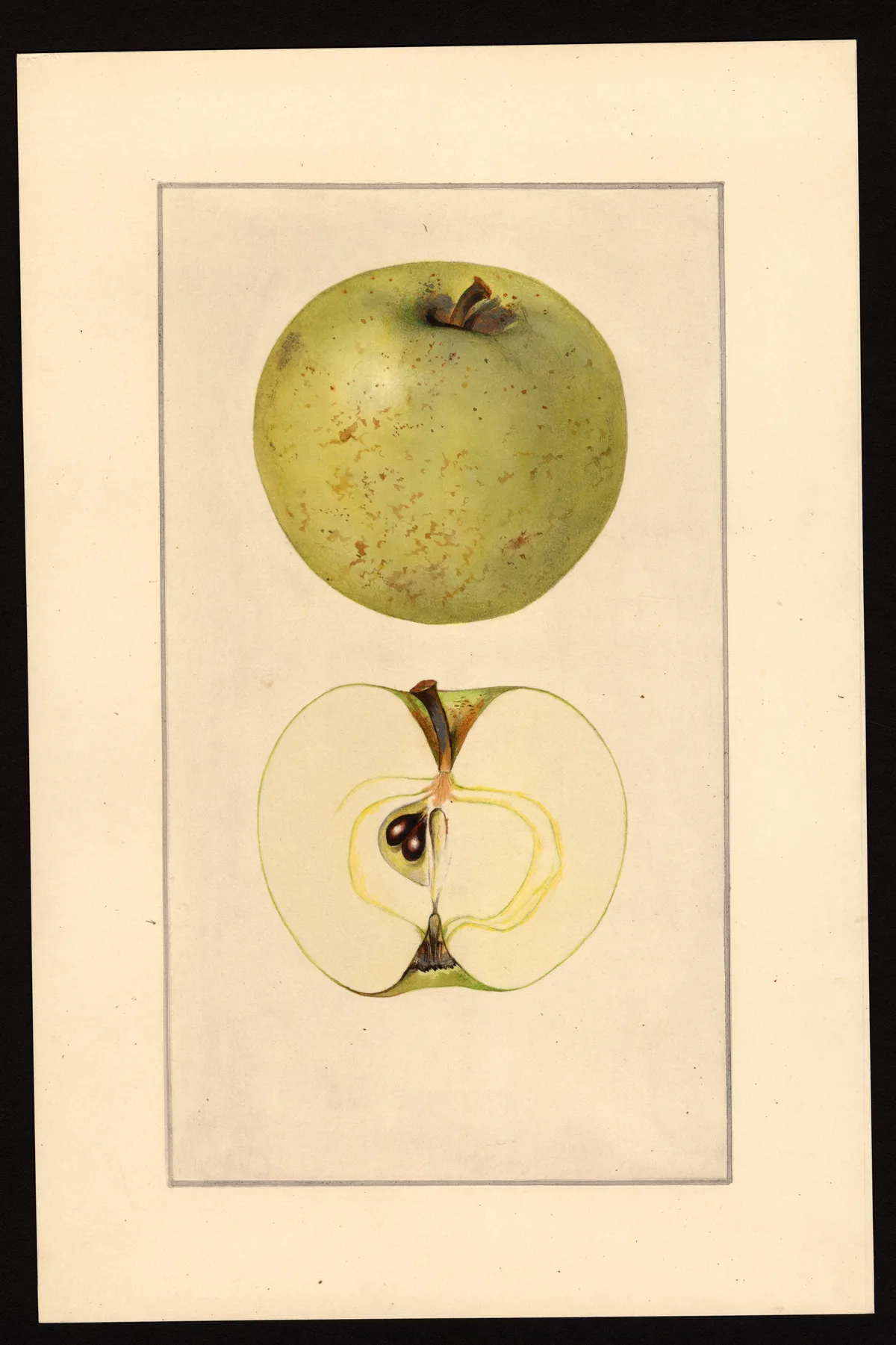
USDA Pomological Watercolor Collection
Primate
Origin / History
The true origin of Primate is unknown (Downing). Elliott notes it as "a variety lately come into favorable notice in Central New York, that may yet prove an old sort improved by soil and location." Downing observes that it "appears to have been long known and grown in various sections of our States under different names." Budd-Hansen likewise give the origin as unknown. Thomas attributes it to New York.
The most detailed history comes from Beach: the variety was disseminated by traveling grafters in Central and Western New York as much as fifty years before his 1905 writing. In 1850, Charles P. Cowles of Syracuse wrote to the Magazine of Horticulture: "As it is not known in this place, nor state, by the best judges, I safely think it is a seedling. I found a few trees in Onondaga county in a town of the same name which had been circulated by grafts but nothing further could be traced of its origin. * * * I propose to call it 'Rough and Ready' from the fact of its being first tested during that campaign. * * * Messrs. Downing, Barry and Thomas think it a new variety. * * * It is but little known as yet but where it is its qualities are much esteemed." The following year, A. Fahnstock, a nurseryman of Syracuse, showed that the variety had been disseminated in Ontario and Monroe counties as well as Onondaga county, and was generally known by the name of Primate. John T. Roberts of Syracuse later investigated the history and became convinced that the original seedling tree grew in the town of Camillus, Onondaga county; through his efforts a bronze tablet was erected to mark the spot, inscribed: "On this farm Calvin D. Bingham about 1840 produced the marvelous Primate apple, named by Charles P. Cowles. God's earth is full of love to man." Hedrick concurs that Primate "grew as a seedling on the farm of Calvin D. Bingham, Camillus, New York, about 1840."
In 1854 it was listed by the American Pomological Society as a valuable variety (Beach). Beach notes it was listed by various nurserymen from the Atlantic to the Middle West but was little known in the Southwest or Northwest. Lowther's reporting-station survey shows broad distribution: 25 stations in the Northern Division, 26 in the Central, and 14 in the Southern (each also reported in another division).
Tree
Sources broadly agree the tree is vigorous, stocky, strongly branched, and productive, though they vary on size:
- Warder: "thrifty, stocky, vigorous, strongly branched, productive."
- Downing: "hardy, a strong and stocky grower, and forms a beautiful head, very productive."
- Budd-Hansen: "vigorous, strong, and stocky, and very productive."
- Beach: "below medium to rather large, usually moderately vigorous."
- Hedrick: "large, vigorous, upright-spreading, dense."
Form (Beach): upright spreading to roundish, rather dense.
Shoots/twigs: Warder describes the shoots as "stout, short, light olive." Downing describes the young shoots as "short-jointed, reddish brown, quite downy." Beach gives twigs as "short, straight, stout with large terminal buds; internodes short."
Bark (Beach): dull brown mingled with green, heavily streaked with scarf-skin, pubescent and rather rough.
Lenticels (Beach): scattering, medium size, oblong, raised.
Buds: Warder calls them "prominent" with "pale green" foliage. Downing notes "Buds rather prominent." Beach: "prominent, large, broad, plump, acute, pubescent."
Bearing habits and longevity (Beach): in some localities the tree has proved somewhat tender, not very long-lived, and rather susceptible to the attacks of apple canker; but as grown throughout Central and Western New York, particularly where topworked upon good thrifty stock, it is a pretty good grower, moderately long-lived, and reliably productive. It often yields very heavy crops biennially with lighter crops, or none, on alternate years, but in some localities is almost an annual bearer. Hedrick echoes that "the trees are inviting prey to the canker-fungi, because of which they are often short-lived."
Fruit
Size
Medium (Elliott, Downing, Budd-Hansen, Hedrick, Lowther); "full medium" (Warder); "above medium" (Thomas); "medium or above, sometimes large" (Beach); "medium, sometimes large" (Hedrick).
Form
- Elliott: "roundish, tapering to the eye."
- Warder: "globular, angular, irregular."
- Downing: "roundish oblate conic."
- Thomas: "roundish-conical, somewhat ribbed."
- Beach: "roundish conic to oblate conic, often distinctly ribbed."
- Budd-Hansen: "roundish oblate, slightly conical, angular, irregular."
- Lowther: "round."
- Hedrick: "round-conic or oblate-conic, often distinctly ribbed."
Stem / Stalk
- Elliott: "varying."
- Warder: "medium to long, thick."
- Downing: "of medium length."
- Beach: "short to medium, thick."
- Budd-Hansen: "medium."
- Hedrick: "short, thick."
Cavity
- Elliott: "rather narrow."
- Warder: "acute, wavy, green."
- Downing: "rather large, deep, irregular."
- Beach: "acute, deep, broad, distinctly furrowed."
- Budd-Hansen: "large, deep, narrow, irregular."
- Hedrick: "acute, deep, broad, furrowed."
Calyx / Eye
- Elliott: "calyx, closed."
- Warder: "Eye small but long, closed; Segments reflexed."
- Downing: "Calyx closed."
- Beach: "medium size, closed; lobes long, narrow."
- Budd-Hansen: "small, closed."
- Hedrick: "closed; lobes long, narrow."
Basin
- Elliott: "deep."
- Warder: "abrupt, folded."
- Downing: "abrupt, open, somewhat corrugated."
- Beach: "moderately shallow to rather deep, medium in width to rather narrow, abrupt, furrowed and wrinkled."
- Budd-Hansen: "abrupt, somewhat corrugated."
- Hedrick: "shallow, medium in width, abrupt, furrowed and wrinkled."
Skin / Surface / Color
Sources generally agree on a pale yellow to whitish ground, sometimes faintly blushed:
- Elliott: "pale yellow—occasionally, blush red cheek."
- Warder: "Surface smooth, greenish-yellow, becoming almost white, sometimes faintly blushed; Dots minute."
- Downing: "greenish white, with a crimson blush on the exposed side."
- Thomas: "light green, becoming light yellow, often with a slight blush."
- Beach (skin): "thin, moderately tender, smooth, light green, often changing to whitish, sometimes with faint yellowish tinge, often slightly blushed but not striped. Dots scattering, numerous, rather small, submerged or russet."
- Budd-Hansen: "yellowish green, when ripe nearly white, with crimson blush."
- Lowther: "yellow-red."
- Hedrick (skin): "thin, tender, smooth, light green or yellow, blushed but not striped; dots scattering, numerous, small, submerged or russet."
Flesh and Flavor
- Elliott: "yellowish white, very tender, delicate, juicy, mild sub-acid; 'best.'"
- Warder: "greenish-white, very tender, fine-grained; Flavor mild sub-acid, very agreeable; Quality best; Use, the dessert."
- Downing: "white, very tender, sprightly, refreshing, mild subacid. Very good or best."
- Thomas: "fine grained, very juicy, with a very agreeable, mild, sub-acid flavor."
- Beach: "whitish, fine, crisp, very tender, juicy, subacid, aromatic, sprightly, very good to best."
- Budd-Hansen: "white, fine-grained, very tender, juicy, sprightly mild subacid, very good to best."
- Lowther: quality "good."
- Hedrick: "white, fine, crisp, very tender, juicy, subacid, aromatic, sprightly; very good to best."
Thomas adds: "Often water-cores."
Core and Seeds
- Elliott: "core, with open seed-capsules; seeds, pyriform."
- Warder: "Core medium, round, closed, clasping; Seeds numerous, angular, long, dark."
- Downing (Primate entry): not described.
- Downing (Early Tart Harvest entry): "Core medium."
- Beach: "Calyx tube rather large, rather long, broadly conical to somewhat funnelshape. Stamens median. Core medium to large, nearly axile to somewhat abaxile with hollow cylinder in the axis; cells symmetrical, open; core lines clasping. Carpels cordate. Seeds medium to rather large, moderately wide, plump, acute."
- Hedrick: "calyx-tube large, long, broadly conical; stamens median; core large, axile or abaxile with hollow cylinder in the axis; cells symmetrical, open; core-lines clasping; carpels cordate; seeds large, wide, plump, acute."
Season
Sources give slightly varying ranges, all centered on late summer through early fall:
- Elliott: "September and October."
- Warder: "July and August."
- Downing: "ripening the last of August, and continuing in use till October."
- Thomas: "Ripens for several weeks through the latter part of summer."
- Beach: "August and September."
- Budd-Hansen: "August to October."
- Lowther: "summer."
- Hedrick: "August and September"; "preceding Porter in season."
The fruit ripens unevenly and in succession, and Beach notes "it should be picked from time to time as it matures to prevent loss from the dropping of the fruit."
Uses
A dessert / table apple of the first rank, but unsuited to commercial trade.
- Warder: "This delicious table apple has strong claims upon our admiration, on account of its good qualities as a dessert fruit, for the extreme delicacy of its skin and flesh render it unfit for market; it is therefore not profitable for the commercial orchard." Use: "the dessert."
- Downing: "An excellent dessert Apple."
- Thomas: "Valuable for home use."
- Beach: "A dessert apple… well known throughout the state, but not much grown except for home use. It is commonly considered the best apple of its season for the home orchard… of fine flavor and excellent quality particularly for dessert use. Being less attractive than a red apple it is in demand in market only where its fine quality is known."
- Budd-Hansen: "one of the best dessert summer apples for the family orchard; too tender for distant shipment… better adapted for the home orchard."
- Lowther: use "both kitchen and market."
- Hedrick: "considered the best variety of its season, by reason of high quality of fruit and trees that grow vigorously and bear reliably and abundantly. The variety fails in commercial plantations because the crop ripens over a period of several weeks."
Subtypes / Variants
Downing carries an additional entry in the same volume for "Early Tart Harvest" (listed elsewhere as a synonym of Primate), describing it as follows:
Tree moderately vigorous, productive. Fruit medium, oblate, slightly conic, obscurely ribbed, waxen white, sometimes greenish, rarely a blush in sun. Stalk medium. Calyx closed. Flesh white, very tender, juicy, brisk subacid. Very good. Core medium. Ripe about two weeks later than Early Harvest.
Other
Beach notes that the original seedling tree was commemorated by a bronze tablet at the Bingham farm in Camillus, Onondaga county, New York, inscribed: "On this farm Calvin D. Bingham about 1840 produced the marvelous Primate apple, named by Charles P. Cowles. God's earth is full of love to man."
Book Sources
Described in 8 period pomological works
- Beach, The Apples of New York Vol. 2 (1905)
- Warder, American Pomology: Apples (1867)
- Budd & Hansen, Systematic Pomology (1914)
- Downing, Fruits and Fruit Trees of America (1900)
- Elliott, The Western Fruit Book (1865)
- Lowther (ed.), Encyclopedia of Practical Horticulture (1914)
- Hedrick, Cyclopedia of Hardy Fruits (1922)
- Thomas, The American Fruit Culturist (1903)
Nursery Catalog Sources
Found in 11 catalogs (1898–1913) from Illinois, Missouri
- Stark Bros. Nurseries & Orchards Co. , Louisiana , Missouri — 1898
- Brown Brothers Co. , Continental Nurseries, Rochester, NY (also operated from Toronto, Canada) — 1899
- Central Experimental Farm , Dominion Department of Agriculture, Agassiz, British Columbia (under test; Bulletin No. 3, Second Series) — 1900
- Brown Brothers Co. , Continental Nurseries, Rochester, NY (also operated from Toronto, Canada) — 1901
- Mountain Grove Nurseries (Tippin & Moore , Proprietors; Geo. T. Tippin, J. W. Tippin, J. C. Moore), Mountain Grove , Missouri — 1901
- Benjamin Buckman (personal inventory) , Farmingdale , Illinois — 1901
- Stark Bros. Nurseries & Orchards Co. , Louisiana , Missouri — 1906
- Stark Bros. Nurseries & Orchards Co. , Louisiana , Missouri — 1910
- Stark Bros. Nurseries & Orchards Co. , Louisiana , Missouri — 1911
- Stark Bros. Nurseries & Orchards Co. , Louisiana , Missouri — 1912
- Benjamin Buckman (personal inventory) , Farmingdale , Illinois — 1913
View original book sources (8)
— F.R. Elliott, The Western Fruit Book (1865)Primate.
Rough and Ready, | Summer Pippin, erroneously.
A variety lately come into favorable notice in Central New York, that may yet prove an old sort improved by soil and location. Fruit, medium, roundish, tapering to the eye—pale yellow—occasionally, blush red cheek; calyx, closed; basin, deep; stem, varying; cavity, rather narrow; core, with open seed-capsules; seeds, pyriform; flesh, yellowish white, very tender, delicate, juicy, mild sub-acid; "best." September and October.
— John A. Warder, American Pomology: Apples (1867)Primate.
This delicious table apple has strong claims upon our admiration, on account of its good qualities as a dessert fruit, for the extreme delicacy of its skin and flesh render it unfit for market; it is therefore not profitable for the commercial orchard.
Tree thrifty, stocky, vigorous, strongly branched, productive; Shoots stout, short, light olive; Buds prominent, foliage pale green.
Fruit full medium, globular, angular, irregular; Surface smooth, greenish-yellow, becoming almost white, sometimes faintly blushed; Dots minute.
Basin abrupt, folded; Eye small but long, closed; Segments reflexed.
Cavity acute, wavy, green; Stem medium to long, thick.
Core medium, round, closed, clasping; Seeds numerous, angular, long, dark; Flesh greenish-white, very tender, fine-grained; Flavor mild sub-acid, very agreeable; Quality best; Use, the dessert; Season, July and August.
— A.J. Downing, The Fruits and Fruit Trees of America (1900)Primate.
Rough and Ready. Early Tart Harvest. Sour Harvest. Zour Bough. July Apple. Powers. Scott. North American Best.
The true origin of this delicious amateur's Apple is unknown. It appears to have been long known and grown in various sections of our States under different names. The tree is hardy, a strong and stocky grower, and forms a beautiful head, very productive. Young shoots short-jointed, reddish brown, quite downy. Buds rather prominent.
Fruit medium, roundish oblate conic, greenish white, with a crimson blush on the exposed side. Stalk of medium length, inserted in a rather large, deep, irregular cavity. Calyx closed in an abrupt, open, somewhat corrugated basin. Flesh white, very tender, sprightly, refreshing, mild subacid. Very good or best. An excellent dessert Apple, ripening the last of August, and continuing in use till October.
[Additional entry in this volume: "Early Tart Harvest", pp. 183–183]
Early Tart Harvest. Tree moderately vigorous, productive. Fruit medium, oblate, slightly conic, obscurely ribbed, waxen white, sometimes greenish, rarely a blush in sun. Stalk medium. Calyx closed. Flesh white, very tender, juicy, brisk subacid. Very good. Core medium. Ripe about two weeks later than Early Harvest.
— John J. Thomas, The American Fruit Culturist (1903)Primate.* Above medium in size, roundish-conical, somewhat ribbed; light green, becoming light yellow, often with a slight blush; fine grained, very juicy, with a very agreeable, mild, sub-acid flavor. Ripens for several weeks through the latter part of summer. Often water-cores. Valuable for home use. New York. Fig. 366.
— S.A. Beach, The Apples of New York, Vol. 2 (1905)PRIMATE.
REFERENCES. 1. Cowles, Mag. Hort., 16:450. 1850. fig. 2. Ib., 17:506. 1851. 3. Am. Pom. Soc. Cat., 1854. 4. Mag. Hort., 20:241. 1854. 5. Elliott, 1854:153. fig. 6. Mag. Hort., 21:62. 1855. 7. Gregg, 1857:38. 8. Downing, 1857:93. fig. 9. Horticulturist, 14:471. 1859. 10. Mag. Hort., 27:69. 1861. 11. Horticulturist, 17:103, 150. 1862. 12. Mag. Hort., 32:17. 1866. 13. Warder, 1867:643. fig. 14. Downing, 1869:313. 15. Fitz, 1872:161. 16. Thomas, 1875:196. 17. Downing, 1881:11, index, app. 18. Barry, 1883:334. 19. Rural N. Y., 47:649. 1888. 20. Lyon, Mich. Hort. Soc. Rpt., 1890:296. 21. Blackwell, Rural N. Y., 50:447. 1891. 22. Bailey, An. Hort., 1892:247. 23. Hoskins, Rural N. Y., 53:248. 1894. 24. Can. Hort., 17:252. 1894. 25. Woolverton, Ont. Fr. Stas. An. Rpt., 8:9. 1901. figs. 26. Budd-Hansen, 1903:153. fig. 27. Rural N. Y., 62:740. 1903.
SYNONYMS. Belle Rose (17). Early Baldwin (17). Early Tart Harvest (14). Harvest (2). Highland Pippin (17). July Apple (14). NORTH AMERICAN BEST (9). North American Best (14). Powers (2, 14). PRIMATE (2, 3, 4, 5, 6, 7, 8, 10, 11, 12, 13, 14, 15, 16, 17, 18, 19, 20, 21, 22, 23, 24, 25, 26, 27). ROUGH AND READY (1). Rough and Ready (2, 5, 7, 8, 14). Scott (14). Sour Harvest (9, 14). Zour Bough (9, 14).
A dessert apple, pale yellow or whitish, often slightly blushed; in season in August and September. It is well known throughout the state, but not much grown except for home use. It is commonly considered the best apple of its season for the home orchard because the tree is a pretty good grower and a reliable cropper, and the fruit ripens in succession during a period of several weeks and is of fine flavor and excellent quality particularly for dessert use. Being less attractive than a red apple it is in demand in market only where its fine quality is known. The fruit ripens unevenly and it should be picked from time to time as it matures to prevent loss from the dropping of the fruit. In some localities the tree has proved somewhat tender, not very long-lived and rather susceptible to the attacks of the apple canker, but, generally speaking, as grown throughout Central and Western New York, particularly where it has been topworked upon good thrifty stock, the tree is a pretty good grower, moderately long-lived and reliably productive. Often it yields very heavy crops biennially with lighter crops, or none, on alternate years, but in some localities it is almost an annual bearer.
Historical. This variety was disseminated by traveling grafters in Central and Western New York as much as fifty years ago. In 1850, Charles P. Cowles of Syracuse in a communication to the Magazine of Horticulture stated: "As it is not known in this place, nor state, by the best judges, I safely think it is a seedling. I found a few trees in Onondaga county in a town of the same name which had been circulated by grafts but nothing further could be traced of its origin. * * * I propose to call it 'Rough and Ready' from the fact of its being first tested during that campaign. * * * Messrs. Downing, Barry and Thomas think it a new variety. * * * It is but little known as yet but where it is its qualities are much esteemed" (1). The following year Mr. A. Fahnstock, a nurseryman of Syracuse, showed that this variety had been disseminated in Ontario and Monroe counties as well as in Onondaga county and that it was generally known by the name of Primate. Recently John T. Roberts of Syracuse has taken the trouble to look up the history of this variety and is convinced that the original seedling tree grew in the town of Camillus, Onondaga county, and through his efforts a bronze tablet has been erected to mark the spot. The tablet bears the following inscription: "On this farm Calvin D. Bingham about 1840 produced the marvelous Primate apple, named by Charles P. Cowles. God's earth is full of love to man" (27). In 1854 it was listed by the American Pomological Society (3) as a valuable variety. It is listed by various nurserymen in the region from the Atlantic to the Middle West but apparently is but little known either in the Southwest or the Northwest (22).
TREE.
Tree below medium to rather large, usually moderately vigorous. Form upright spreading to roundish, rather dense. Twigs short, straight, stout with large terminal buds; internodes short. Bark dull brown mingled with green, heavily streaked with scarf-skin, pubescent and rather rough. Lenticels scattering, medium size, oblong, raised. Buds prominent, large, broad, plump, acute, pubescent.
FRUIT.
Fruit medium or above, sometimes large. Form roundish conic to oblate conic, often distinctly ribbed. Stem short to medium, thick. Cavity acute, deep, broad, distinctly furrowed. Calyx medium size, closed; lobes long, narrow. Basin moderately shallow to rather deep, medium in width to rather narrow, abrupt, furrowed and wrinkled. Skin thin, moderately tender, smooth, light green, often changing to whitish, sometimes with faint yellowish tinge, often slightly blushed but not striped. Dots scattering, numerous, rather small, submerged or russet. Calyx tube rather large, rather long, broadly conical to somewhat funnelshape. Stamens median. Core medium to large, nearly axile to somewhat abaxile with hollow cylinder in the axis; cells symmetrical, open; core lines clasping. Carpels cordate. Seeds medium to rather large, moderately wide, plump, acute. Flesh whitish, fine, crisp, very tender, juicy, subacid, aromatic, sprightly, very good to best. Season August and September.
— J.L. Budd & N.E. Hansen, American Horticultural Manual, Part II: Systematic Pomology (1914)Primate. — Origin unknown; one of the best dessert summer apples for the family orchard; too tender for distant shipment; tree vigorous, strong, and stocky, and very productive. The fruit ripens in succession, and hence it is better adapted for the home orchard.
Primate.
Fruit medium; form roundish oblate, slightly conical, angular, irregular; surface yellowish green, when ripe nearly white, with crimson blush; cavity large, deep, narrow, irregular; stem medium; basin abrupt, somewhat corrugated; calyx small, closed; flesh white, fine-grained, very tender, juicy, sprightly mild subacid, very good to best. August to October.
— Granville Lowther (ed.), Encyclopedia of Practical Horticulture (1914)Primate. Size: medium. Form: round. Color: yellow-red. Quality: good. Use: both kitchen and market. Season: summer. Northern Division: 25 reporting stations (also reported in another division). Central Division: 26 reporting stations (also reported in another division). Southern Division: 14 reporting stations (also reported in another division).
— U.P. Hedrick, Cyclopedia of Hardy Fruits (1922)PRIMATE. Fig. 43. Harvest. July Apple. Sour Harvest. Sour Bough. Primate is another choicely good fall apple, preceding Porter in season, and so different in most characters as to be hardly a rival. By many it is considered the best variety of its season, by reason of high quality of fruit and trees that grow vigorously and bear reliably and abundantly. The variety fails in commercial plantations because the crop ripens over a period of several weeks. Unfortunately, the trees are inviting prey to the canker-fungi, because of which they are often short-lived. The variety is a welcome addition in every home orchard to precede Porter. Primate grew as a seedling on the farm of Calvin D. Bingham, Camillus, New York, about 1840. Tree large, vigorous, upright-spreading, dense. Fruit medium, sometimes large, round-conic or oblate-conic, often distinctly ribbed; stem short, thick; cavity acute, deep, broad, furrowed; calyx closed; lobes long, narrow; basin shallow, medium in width, abrupt, furrowed and wrinkled; skin thin, tender, smooth, light green or yellow, blushed but not striped; dots scattering, numerous, small, submerged or russet; calyx-tube large, long, broadly conical; stamens median; core large, axile or abaxile with hollow cylinder in the axis; cells symmetrical, open; core-lines clasping; carpels cordate; seeds large, wide, plump, acute; flesh white, fine, crisp, very tender, juicy, subacid, aromatic, sprightly; very good to best; August and September.