Black Gilliflower
Apple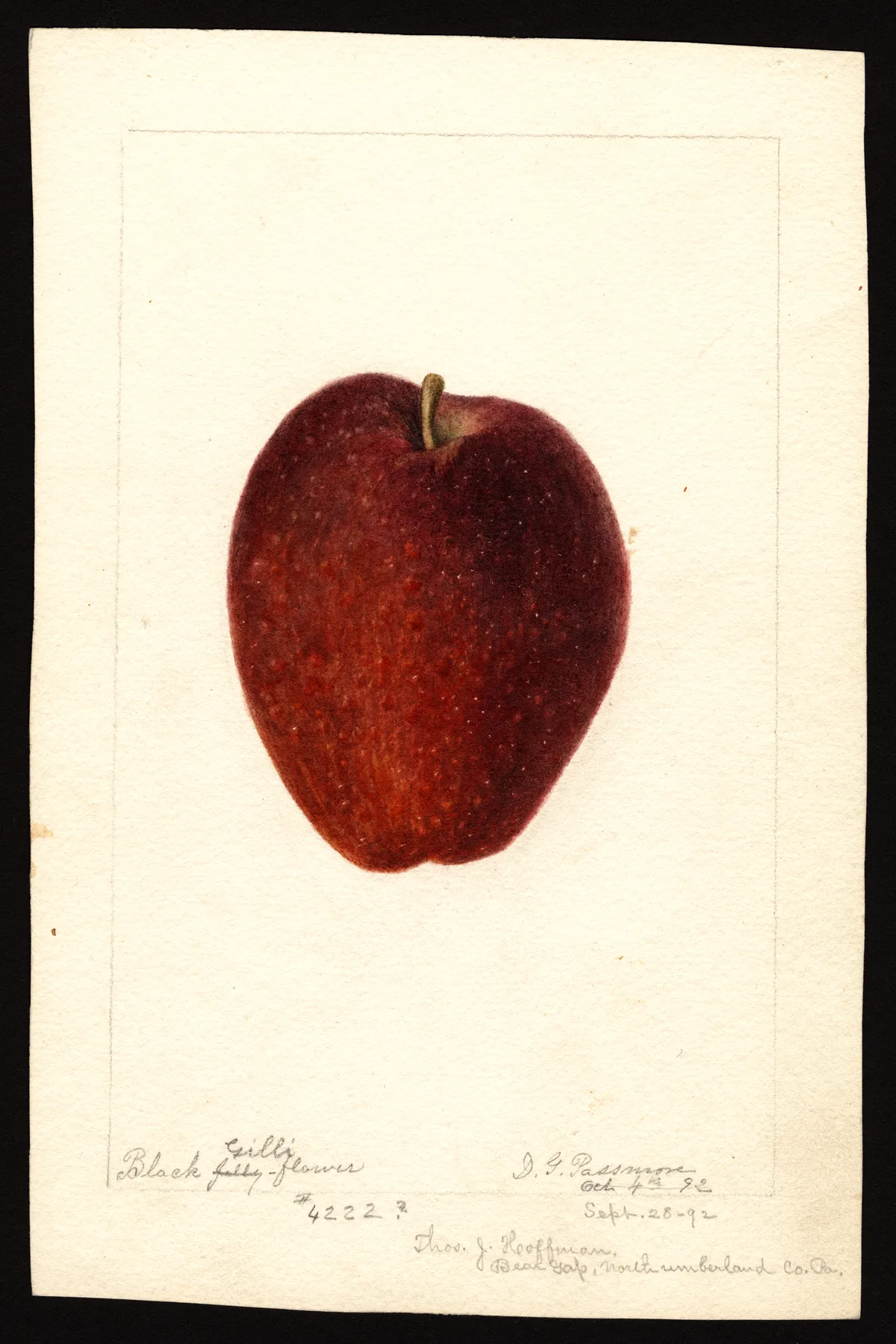
USDA Pomological Watercolor Collection
Black Gilliflower
Origin / History
Black Gilliflower is supposed to be an American variety. It was known in New England as early as the Revolutionary War, and its culture spread southward to the Carolinas and westward to the Mississippi (Hedrick). It was brought into the central and western portions of New York State more than a hundred years ago by the early settlers, and it is evident that it was known in Connecticut as early as the latter part of the eighteenth century (Beach, citing Bateman in the Ohio Cultivator, Aug. 1, 1846, and Warder, 1847:25). Manning mentioned it in 1841 under the name Red Gilliflower, and Hovey described it in 1850 under the same name, giving Black Gilliflower as a synonym. It has generally been known under the simple name Gilliflower, which name usually appears in the market quotations of this variety (Beach). Thomas notes that it is totally distinct from the Red or Cornish Gilliflower.
Tree
Tree large, moderately vigorous (Beach) to vigorous (Hedrick), healthy, and fruitful. Form rather upright-spreading with a moderately open top. On good soil the tree is a good, vigorous grower and a reliable cropper; very productive (Thomas, Warder). Shoots dark, rather crooked; fruit always fair (Thomas).
Twigs long, slender, pubescent; internodes short to medium. Bark dark olive-green and reddish-brown with thin gray scarf-skin. Lenticels rather numerous, small to medium, roundish or elongated, raised. Buds medium, obtuse or acute, quite pubescent, appressed. Leaves long, rather long, medium to above medium in size.
Fruit
Size and Form
Medium to large, seldom very large (Beach, Hedrick); Warder calls it "rather large," Thomas "rather large," and Elliott "large"; Downing gives "medium size." Very uniform in size and shape. The apples grow fair and smooth, and there is little loss from unmarketable fruit (Beach).
Form long ovate to oblong conic (Beach), oblong-conic (Hedrick), oblong-ovate, long conical, regular, obscurely ribbed (Thomas), oblong-ovate, regular (Warder), or oblong conical (Elliott, Downing); somewhat ribbed, with axis sometimes a little oblique.
Stem and Cavity
Stem long (Warder), medium to long, moderately thick (Beach), or long and thick (Hedrick); slender (Warder). Cavity deep, acute, brown (Warder); very narrow, acuminate (Thomas); usually acuminate, rather wide, moderately deep to deep, sometimes lipped but usually symmetrical, with red russet or greenish outspreading rays (Beach, Hedrick).
Calyx and Basin
Calyx medium or below, closed; eye small, closed (Warder). Basin very shallow, often plaited (Warder); very small, ribbed (Thomas); often oblique, usually very shallow and obtuse, varying sometimes to moderately deep and abrupt, furrowed and much wrinkled (Beach); shallow and obtuse to deep and abrupt, furrowed and wrinkled (Hedrick).
Skin
Skin thick, tough, nearly smooth (Beach) to smooth (Hedrick). Yellow or greenish-yellow, striped or mostly covered with red, deepening to dark purplish-red or almost black, obscurely striped with darker crimson, and with streaks of bluish-gray scarf-skin, especially toward the cavity, giving almost the effect of a dull bloom (Beach; Hedrick gives essentially the same description, calling the prevailing effect "dull gray-purple"). The surface is nearly covered with stripes of very deep red that make it look nearly black (Warder); dull reddish purple (Elliott); very dark, dull red (Downing); dark, dull, reddish purple, inclining to greenish yellow where densely shaded (Thomas). The color of the fruit is often much darker than it appears in the accompanying plate, and in highly colored specimens the prevailing effect is dull dark purplish (Beach). Beach further notes that in the variety the underlying color is yellowish or greenish, sometimes almost completely covered with red, which in highly colored specimens becomes dull purplish and very dark, as recognized in the name "Black" Gilliflower.
Dots numerous, gray, rather small, not conspicuous, somewhat rough (Beach); numerous, gray, small, rough (Hedrick).
Flesh and Flavor
Flesh whitish or slightly tinged with yellow (Beach), yellow (Hedrick), greenish white (Elliott, Thomas), whitish (Warder), or white (Downing); firm, rather tender (Beach) to firm and tender (Hedrick); rather coarse; moderately juicy, eventually becoming dry (Beach, Hedrick); dry (Elliott, Warder, Downing); dry when ripe (Thomas).
Flavor mild subacid, rich, peculiarly aromatic, good for dessert and special markets (Beach, Hedrick); rich, good, slightly sub-acid (Thomas); mild, subacid (Downing); sub-acid, poor (Elliott); only sweet (Warder). At its best the flesh is but moderately juicy and soon becomes dry, but it has a peculiar aroma which is pleasing to many. It is not sour enough to be very valuable for cooking, but it is sometimes used for baking (Beach). Hedrick adds that the apples, eaten out of hand or however cooked, have a rare, sweet flavor and aroma, most agreeable to many.
Thomas notes the variety is rejected by most cultivators on account of its very dry flesh, but is a good baking variety. Warder considers it "but an indifferent fruit," valuable chiefly on account of its productiveness and keeping properties.
Core and Seeds
Core large, decidedly axile, closed; core lines somewhat clasping (Beach), clasping (Hedrick). Warder describes the core as very large, oval, regular, meeting the eye. Calyx tube large, wide, cone-shape or funnel-form (Beach); large, wide, cone-shape (Hedrick). Stamens median or above (Beach); median (Hedrick). Carpels very long ovate, tapering both ways, emarginate, much tufted (Beach); long-ovate, tapering both ways, emarginate, tufted (Hedrick). Seeds often abortive; when well developed they are above medium (Beach) or of medium size (Hedrick), acute to acuminate, somewhat tufted (Beach), acuminate, tufted (Hedrick). Warder describes the seeds as numerous, plump or imperfect.
Season
October to January or February (Beach, Hedrick); November to February (Downing); November to March (Elliott, Warder). Keeps through winter and late into spring (Thomas). The apples keep very well in either cold-storage or the cellar (Hedrick).
Uses
A dessert apple, very distinct in color, form and flavor (Beach); fit for dessert, and excellent for cookery (Hedrick). Sometimes used for baking; a good baking variety (Beach, Thomas). Use essentially market; may be valuable for stock (Warder). Considered profitable for orchard planting on account of its productiveness and keeping properties (Warder). Downing notes that some call it a profitable market fruit, and Beach observes that, although fast becoming obsolete in most parts of New York State, in some sections the planting of it in commercial orchards is being extended because it is found profitable to grow in limited quantities for southern markets. Hedrick reports that Black Gilliflower, threatened with oblivion, is again being planted.
Subtypes / Variants
Not described in source.
Other
Beach and Downing both note in separate "Sheepnose" entries that the name "Sheepnose" has been applied to several different varieties of apples having a conical shape, and that in some localities Black Gilliflower is commonly known by the name Sheepnose. (Other varieties also called Sheepnose — including Yellow Bellflower, a Warder "Sheepnose of Mears," a New Jersey/Pennsylvania variety described by Downing, and Bullock as known in New Jersey in Coxe's time — are distinct from Black Gilliflower and are noted in those sources only as name confusions.)
Book Sources
Described in 6 period pomological works
Nursery Catalog Sources
Found in 3 catalogs (1893–1913) from Illinois
- Milwaukie-Canby Nurseries , Canby, OR (and Milwaukie, OR) — 1893
- Benjamin Buckman (personal inventory) , Farmingdale , Illinois — 1901
- Benjamin Buckman (personal inventory) , Farmingdale , Illinois — 1913
View original book sources (6)
— F.R. Elliott, The Western Fruit Book (1865)Black Gilliflower.
Large, oblong conical, dull reddish purple ; flesh, greenish white, dry, sub-acid, poor. November to March.
— John A. Warder, American Pomology: Apples (1867)Black Gilliflower.
An old variety, which cannot be very highly praised, for it is but an indifferent fruit, and yet, on account of its productiveness and keeping properties, it is considered profitable for orchard planting.
Fruit rather large, oblong-ovate, regular; Surface nearly covered with stripes of very deep red that make it look nearly black.
Basin very shallow, often plaited; Eye small, closed.
Cavity deep, acute, brown; Stem long, slender.
Core very large, oval, regular, meeting the eye; Seeds numerous, plump or imperfect; Flesh whitish, dry; Flavor only sweet; Use, essentially market, may be valuable for stock; Season, November to March.
— A.J. Downing, The Fruits and Fruit Trees of America (1900)Black Gilliflower.
Medium size, oblong conical. Skin very dark, dull red. Flesh white, dry, mild, subacid. Good. November to February. Very productive, and some call it a profitable market fruit.
[Additional entry in this volume: "Sheepnose", pp. 376–376]
Sheepnose.
There are several Apples to which this name has been applied : some are proved identical with well-known varieties ; others, of which no origin can be traced, may yet prove only synonyms of well-known kinds. Warder describes a Sheepnose as : Fruit medium, round, slightly conic, irregular, greenish yellow, white striae about the base. Dots minute. Flesh yellowish white, breaking, tender, juicy, subacid. Good. December, February. Another Sheepnose is grown in New Jersey and Pennsylvania, which is medium size, roundish conical, yellow, sometimes a blush in sun. Calyx closed. Flesh yellow, rather firm, juicy, subacid. Good. November, December.
— John J. Thomas, The American Fruit Culturist (1903)Black Gilliflower. Rather large, oblong-ovate, long conical, regular, obscurely ribbed; surface dark, dull, reddish purple, inclining to greenish yellow where densely shaded; cavity very narrow, acuminate; basin very small, ribbed; flesh greenish white, with a rich, good, slightly sub-acid flavor, becoming dry when ripe. Keeps through winter and late into spring. Shoots dark, rather crooked, fruit always fair; very productive. Rejected by most cultivators on account of its very dry flesh, but a good baking variety. Totally distinct from the Red or Cornish Gilliflower.
— S.A. Beach, The Apples of New York, Vol. 1 (1905)BLACK GILLIFLOWER.
References. 1. Manning, Mag. Hort., 7:49. 1841. 2. Mag. Hort., 13:106. 1847. 3. Thomas, 1849:164. 4. Cole, 1849:126. 5. Hovey, Mag. Hort., 16:64, 198. 1850. fig. 6. Emmons, Nat. Hist. N. Y., 3:61. 1851. col. pl. & fig. 7. Downing, 1857:208. 8. Hooper, 1857:18, 76. 9. Elliott, 1858:167. 10. Warder, 1867:662. fig. 11. Lyon, Mich. Hort. Soc. Rpt., 1890:288. 12. Bailey, An. Hort., 1892:235. 13. Waugh, Vt. Sta. An. Rpt., 14:289. 1901. 14. Powell and Fulton, U. S. B. P. I. Bul., 48:38. 1903. 15. Beach and Clark, N. Y. Sta. Bul., 248:113. 1904.
Synonyms. Black Gilliflower (5). Black Spitz (13). Gilliflower (14, 15). Red Gilliflower (1, 5).
A dessert apple which is very distinct in color, form and flavor. The color is yellowish or greenish, sometimes almost completely covered with red, which in highly colored specimens becomes dull purplish and very dark, as recognized in the name “Black” Gilliflower. The color of the fruit is often much darker than it appears in the accompanying plate. The flesh at its best is but moderately juicy and soon becomes dry, but it has a peculiar aroma which is pleasing to many. It is not sour enough to be very valuable for cooking, but it is sometimes used for baking. It is fast becoming obsolete in most parts of the state, but in some sections the planting of it in commercial orchards is being extended because it is found profitable to grow it in limited quantities for southern markets. On good soil the tree is a good, vigorous grower and a reliable cropper. The apples grow fair and smooth and there is little loss from unmarketable fruit.
Historical. Black Gilliflower is supposed to be an American variety. It was brought into the central and western portions of the state more than a hundred years ago by the early settlers. It is evident that it was known in Connecticut as early as the latter part of the eighteenth century (2).¹ Manning (1) mentions it in 1841 under the name Red Gilliflower and Hovey (5) described it in 1850 under the same name, giving Black Gilliflower as a synonym. It has generally been known under the simple name Gilliflower, which name usually appears in the market quotations of this variety.
Tree.
Tree large, moderately vigorous. Form rather upright spreading with moderately open top. Twigs long, slender, pubescent; internodes short to medium. Bark dark olive-green and reddish-brown with thin gray scarf-skin. Lenticels rather numerous, small to medium, roundish or elongated, raised. Buds medium, obtuse or acute, quite pubescent, appressed. Leaves rather long, medium to above medium in size.
Fruit.
Fruit medium to large, seldom very large; very uniform in size and shape. Form long ovate to oblong conic, somewhat ribbed; axis sometimes a little oblique. Stem medium to long, moderately thick. Cavity usually acuminate, rather wide, moderately deep to deep, sometimes lipped but usually symmetrical with red russet or greenish outspreading rays. Calyx medium or below, closed. Basin often oblique, usually very shallow and obtuse, varying sometimes to moderately deep and abrupt, furrowed and much wrinkled. Skin thick, tough, nearly smooth; yellow or greenish-yellow, striped or mostly covered with red, deepening to dark purplish-red or almost black, obscurely striped with darker crimson, and with streaks of bluish-gray scarfskin, especially toward the cavity, giving almost the effect of a dull bloom. Dots numerous, gray, rather small, not conspicuous, somewhat rough. Prevailing effect in highly colored specimens dull dark purplish. Calyx tube large, wide, cone-shape or funnel-form. Stamens median or above. Core large, decidedly axile, closed; core lines somewhat clasping. Carpels very long ovate, tapering both ways, emarginate, much tufted. Seeds often abortive; when well developed they are above medium, acute to acuminate, somewhat tufted. Flesh whitish or slightly tinged with yellow, firm, rather tender, rather coarse, moderately juicy eventually becoming dry, mild subacid, rich, peculiarly aromatic, good for dessert and special markets. Season October to January or February.
¹ Cited from Bateman, Ohio Cultivator, Aug. 1, 1846. Warder gives same citation, 1847:25.
[Additional entry in this volume: "Sheepnose", pp. 522–523]
SHEEPNOSE.
REFERENCES. 1. Coxe, 1817:125. 2. Warder, 1857:645. 3. Downing, 1869:351.
This name has been applied to several different varieties of apples having a conical shape. In some localities Yellow Bellflower is known by this name. In other places it is a common name for the Black Gilliflower. Warder (2) describes Sheepnose of Mears as a medium, roundish, slightly conic apple, smooth, greenish-yellow, in some respects resembling White Pearmain; flesh juicy, subacid, good; season December to February.
In the time of Coxe, Bullock was commonly known in New Jersey by the name of Sheepnose (1). Downing (3) describes another Sheepnose as grown in New Jersey and Pennsylvania the fruit of which is of medium size, roundish conical, yellow, sometimes blushed; flesh subacid, good; season November and December.
There are also other varieties which are known under the name Sheepnose.
— U.P. Hedrick, Cyclopedia of Hardy Fruits (1922)BLACK GILLIFLOWER. Fig. 11. Gilliflower. Red Gilliflower.
Black Gilliflower, threatened with oblivion, is again being planted. The distinct form, color, flavor, and aroma of the apples, as pictured in the technical description, mark it as an unusual and attractive fruit, fit for dessert, and excellent for cookery. The apples, eaten out of hand or however cooked, have a rare, sweet flavor and aroma, most agreeable to many. They are, also, usually perfect, uniform in size and shape, and keep very well in either coldstorage or the cellar. The trees are vigorous, healthy, and fruitful. Black Gilliflower was known in New England as early as the Revolutionary War; thence its culture has spread southward to the Carolinas and westward to the Mississippi.
Tree large, vigorous, upright-spreading. Leaves long. Fruit medium to large, uniform in size and shape, oblong-conic, ribbed, axis sometimes oblique; stem long, thick; cavity acuminate, wide, lipped but usually symmetrical, with red-russet or greenish outspreading rays; calyx closed; basin often oblique, shallow and obtuse to deep and abrupt, furrowed and wrinkled; skin thick, tough, smooth, yellow, striped or covered with red, deepening to almost black, obscurely striped with darker crimson and with streaks of scarf-skin, giving the effect of dull bloom; dots numerous, gray, small, rough; prevailing effect dull gray-purple; calyx-tube large, wide, cone-shape; stamens median; core large, axile, closed; core-lines clasping; carpels long-ovate, tapering both ways, emarginate, tufted; seeds often abortive, when developed of medium size, acuminate, tufted; flesh yellow, firm, tender, coarse, juicy becoming dry, mild subacid, rich, peculiarly aromatic, good; October to January or February.