Red Winter Pearmain
Apple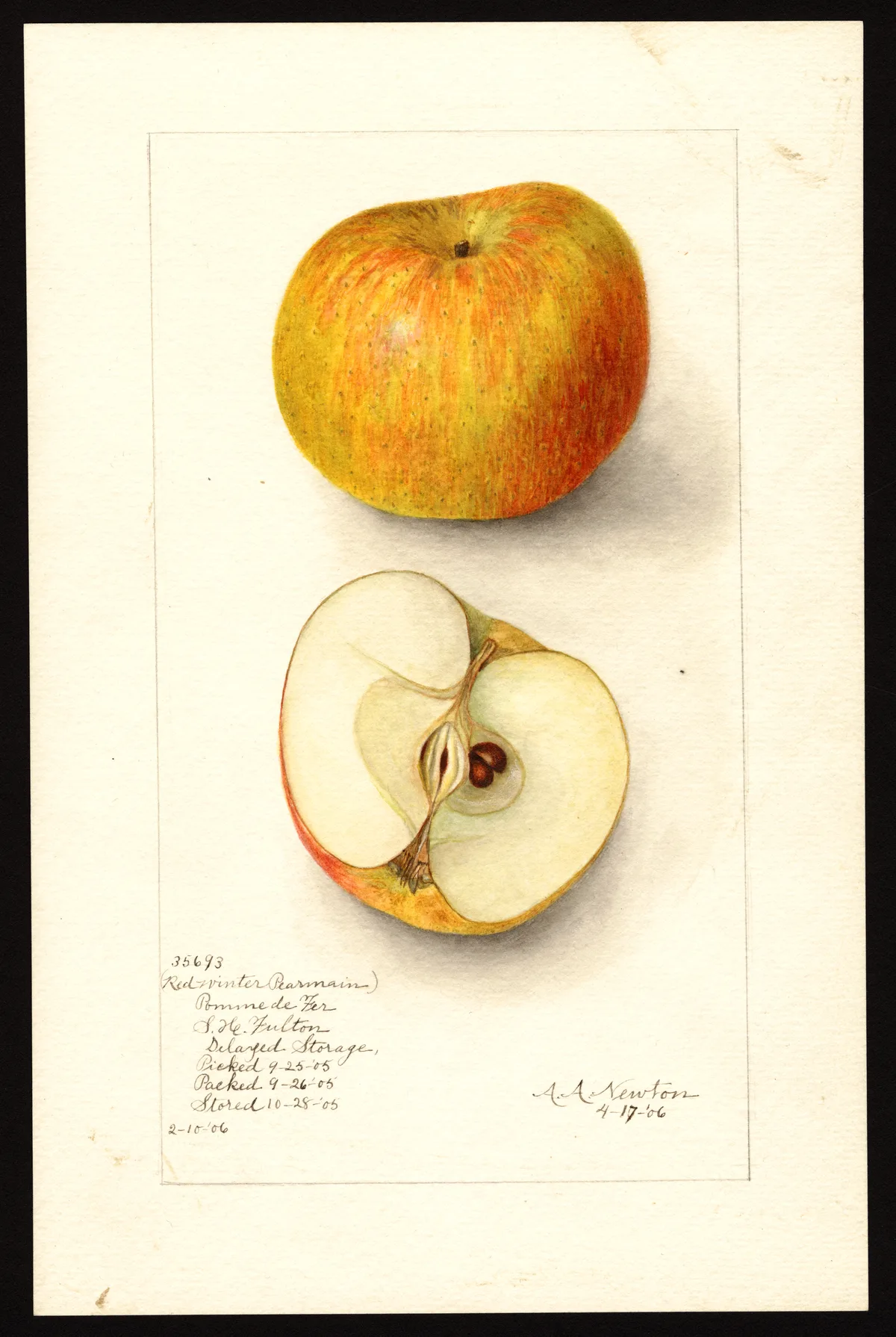
USDA Pomological Watercolor Collection
Red Winter Pearmain
Origin/History
Elliott's description is attributed to White's Gardening (White's Gard.) as the source text. The Central Experimental Farm at Agassiz, British Columbia recorded trees of Red Winter Pearmain planted in spring 1894, under trial as Bulletin No. 3 (1900).
Tree
Elliott does not describe the tree. The Central Experimental Farm records it as a vigorous grower.
Fruit
Size
Sources disagree: Elliott describes the fruit as large; the Central Experimental Farm describes it as medium in size.
Form
Both sources agree the fruit is oblong. Elliott adds that it narrows toward the eye and is sometimes slightly ribbed. The Central Experimental Farm further describes the form as conical.
Stem
Elliott: very short and thick. Not described by the Central Experimental Farm.
Cavity
Elliott: narrow and deep. Not described by the Central Experimental Farm.
Calyx
Elliott: small and closed. Not described by the Central Experimental Farm.
Basin
Elliott: narrow. Not described by the Central Experimental Farm.
Skin
Both sources agree the base color is yellow, though the Central Experimental Farm specifies pale yellow. The red coverage differs slightly in description: Elliott characterizes it as a marbling of red that mostly conceals the ground color; the Central Experimental Farm says the skin is nearly covered with red. Sources disagree on the dots: Elliott describes them as prominent yellow dots; the Central Experimental Farm describes them as whitish dots.
Flesh and Flavor
Elliott: yellowish white, tender, juicy, with a rich, slightly sub-acid flavor. The Central Experimental Farm: whitish, tender, moderately juicy, nearly sweet; quality rated good.
Core and Seeds
Not described in either source.
Season
Sources disagree significantly. Elliott gives the season as Autumn. The Central Experimental Farm places the season in January and February.
Uses
Not described in either source beyond the implied dessert quality noted by the Central Experimental Farm ("quality good").
Subtypes/Variants
Not described in either source.
Book Sources
Described in 1 period pomological work
Nursery Catalog Sources
Found in 2 catalogs (1900–1913) from Illinois
- Central Experimental Farm , Dominion Department of Agriculture, Agassiz, British Columbia (under test; Bulletin No. 3, Second Series) — 1900
- Benjamin Buckman (personal inventory) , Farmingdale , Illinois — 1913
View original book sources (2)
— F.R. Elliott, The Western Fruit Book (1865)Meigs. Fruit, large, regular oblong, narrowing to the eye, sometimes slightly ribbed; skin, yellow, but mostly concealed with a marbling of red, and sprinkled with prominent yellow dots; calyx, small and closed, set in a narrow basin; stem, very short, thick, in a narrow, deep cavity; flesh, yellowish white, tender, juicy, with a rich, slightly sub-acid flavor. Autumn. (White's Gard.)
— Central Experimental Farm, Central Experimental Farm, Agassiz BC — Catalogue of Fruit Trees under Test (Bulletin No. 3, 1900) (1900)Planted Spring 1894. Tree a vigorous grower. Fruit of medium size, oblong, conical. Skin pale yellow, nearly covered with red, and sprinkled with whitish dots. Flesh whitish, tender, moderately juicy, nearly sweet, quality good Season January and February.