Winter Queen
Apple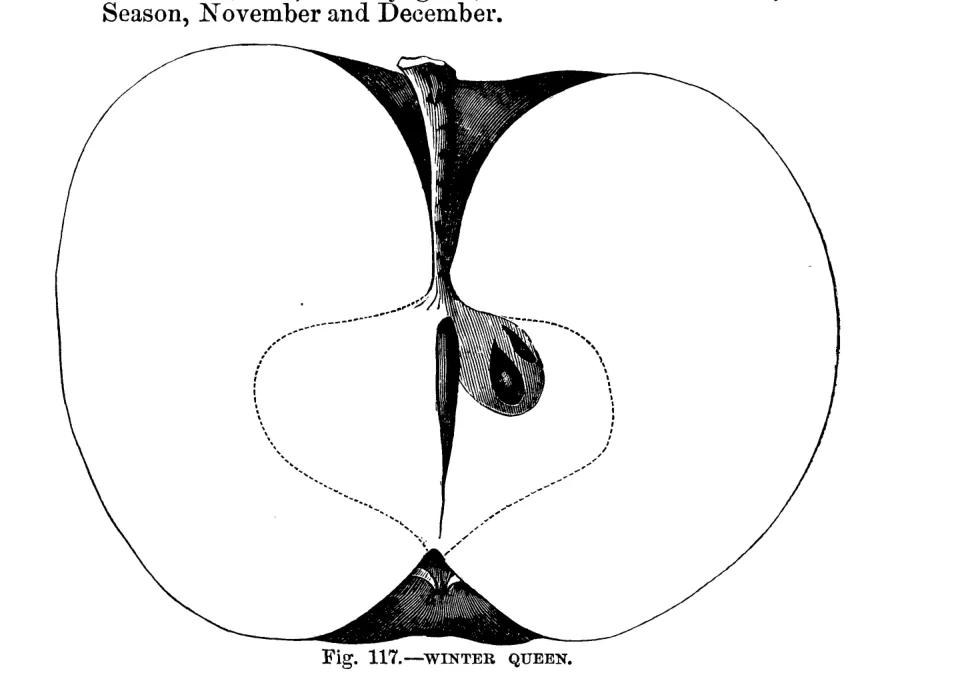
Winter Queen
Origin / History
Warder calls Winter Queen "a favorite, of southern origin," with many synonyms, and heads the entry "Winter Queen. — [Coxe.]". Coxe described it in 1817 (A View of the Cultivation of Fruit Trees, No. 81).
Tree
Tree upright, thrifty, productive, an early bearer (Warder). Coxe calls the form upright and tall, shooting out straight limbs, and an abundant bearer. Limbs long and parallel while young; shoots dark, stout; foliage large, broad, rather pale (Warder).
Fruit
Size: Large, often very large (Warder); above the middling size (Coxe).
Form: Globular-oblate, somewhat conic, regular (Warder); oblong, diminishing toward the blossom end (Coxe).
Stem: Medium.
Cavity: Deep, wide, green, wavy or regular.
Calyx: Eye medium, closed.
Basin: Deep, abrupt, narrow, often wavy or even ribbed.
Skin: Smooth, often polished. Yellow, almost wholly obscured with marbled dull red and darker stripes that are often lost in the depth of tint (Warder); Coxe gives lively bright red streaked with yellow. A slight bloom often covers the fruit but is easily removed, when the skin appears polished. A very showy fruit (Coxe).
Dots: Generally small, indented.
Flesh and flavor: Flesh greenish-white, tender, almost melting, juicy. Flavor mild subacid, agreeable. Coxe: taste "pleasant, but without any of the fine flavour of a very good table or cider apple." Quality good to very good (Warder).
Core and seeds: Core regular, closed, meeting, not clasping the eye; axis sometimes very short. Seeds large, plump.
Season
October to January (Warder). Coxe gives the time of ripening as November.
Uses
Dessert, kitchen and drying. Warder calls it an excellent apple for drying, for family use and for market.
Subtypes / Variants
Not described in source.
Other
Not described in source.
Book Sources
Described in 2 period pomological works
- Warder, American Pomology: Apples (1867)
- Coxe, A View of the Cultivation of Fruit Trees (1817) — listed as No. 81. Winter Queen
USDA Nomenclature (1905)
From W.H. Ragan, Nomenclature of the Apple, USDA Bulletin No. 56
Doubtless same as Buckingham.
Nursery Catalog Sources
Found in 1 catalog (1913) from Illinois
- Benjamin Buckman (personal inventory) , Farmingdale , Illinois — 1913
View original book sources (2)
— William Coxe, A View of the Cultivation of Fruit Trees (1817)NO. 81. WINTER QUEEN. This is a very showy fruit; above the middling size; of an oblong form, diminishing towards the blossom end: the skin is smooth, of a lively bright red streaked with yellow; the taste is pleasant, but without any of the fine flavour of a very good table or cider apple: the form of the tree is upright and tall, shooting out straight limbs; it is an abundant bearer; the time of ripening is November.
— John A. Warder, American Pomology: Apples (1867)Fig. 117.— WINTER QUEEN.
Winter Queen. — [Coxe.] FALL QUEEN — KENTUCKY QUEEN — ROBERTSON'S SUPERB (of Ga.)
This is a favorite, of southern origin, and has many synonims. An excellent apple for drying, for family use and for market. Tree thrifty, upright, productive, early bearer ; limbs long and parallel while young ; shoots dark, stout ; foliage large, broad, rather pale.
Fruit large, often very large, globular-oblate, somewhat conic, regular ; Surface smooth, often polished, yellow, almost wholly obscured with marbled dull red, and darker stripes that are often lost in the depth of tint ; Dots generally small, indented ; often a slight bloom covers the fruit, but it is easily removed, when the skin appears to be polished.
Basin deep, abrupt, narrow, often wavy or even ribbed ; Eye medium, closed.
Cavity deep, wide, green, wavy or regular ; Stem medium.
Core regular, closed, meeting, not clasping the eye axis is sometimes very short ; Seeds large, plump ; Flesh greenish-white, tender, almost melting, juicy ; Flavor mild sub-acid, agreeable ; Quality good to very good ; Use dessert, kitchen and drying ; Season October to January.