Finley
Apple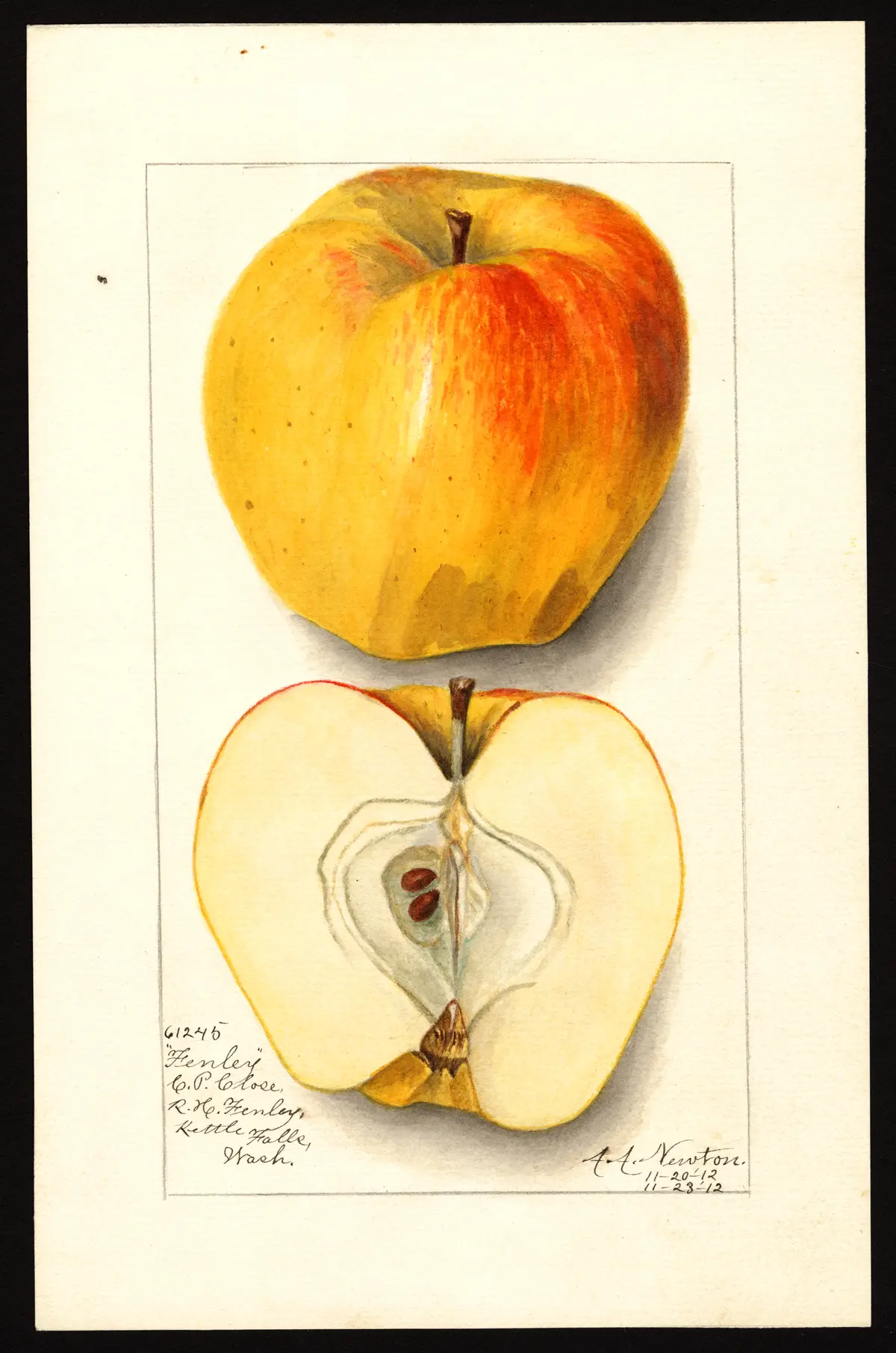
USDA Pomological Watercolor Collection
Finley
Origin/History
Finley originated in Kentucky and was first brought into notice by the gentleman after whose name it has been called. It is grown to considerable extent South and West, and counted valuable, especially for kitchen use. The variety is cultivated to some extent in Southern Indiana, where it is considered entitled to the meed of excellence and preferred to the Early Harvest on the one hand and to the Maiden's Blush on the other; in its season it competes with both, being useful in July for the kitchen and ripening gradually until September.
Warder lists "Abbott?" as a possible synonym. Downing records the names "Fenley," "Findley," and "Horse, erroneously" in historical context alongside the variety.
Tree
Habit and vigor: Warder describes the tree as large, spreading, vigorous, and productive. Downing describes it as vigorous, upright, and productive. (Warder and Downing thus agree on vigor and productivity but differ on habit: Warder gives "spreading," Downing gives "upright.")
Young wood: Young wood dark reddish, grayish, downy (Downing).
Fruit
Size and Form
Fruit large to very large (Warder); large (Downing; Thomas). Regular, globular-oblate, slightly conical (Warder); oblate, slightly conic (Downing); oblate, irregular (Thomas). All three sources agree on an oblate, somewhat conic form and large size. Thomas alone notes the fruit as irregular.
Stem
Stem long, yellow (Warder). Stalk short (Downing). (Warder and Downing conflict directly on stem length: Warder gives "long," Downing gives "short.")
Cavity
Cavity acute, medium to deep, regular, brown (Warder). Cavity broad, russeted (Downing). (The two sources conflict on cavity character: Warder describes it as acute and brown; Downing describes it as broad and russeted.)
Calyx
Calyx closed (Downing). Eye small, closed; segments reflexed (Warder).
Basin
Basin rather wide, wavy (Warder). Basin pretty large (Downing).
Skin
Surface smooth, greenish-yellow, becoming a clear lemon yellow at maturity (Warder). Pale yellow or yellowish, sprinkled with a few brown dots (Downing). Yellowish-white (Thomas). All sources agree on a yellow or yellowish-white ground color at maturity. Downing alone notes a sprinkling of brown dots. Warder describes the dots separately as minute, gray, and scattering; Downing's "brown clots" may refer to the same feature, though the descriptions differ in color (gray vs. brown).
Flesh and Flavor
Flesh yellow, breaking, fine-grained, juicy, acid, almost first quality (Warder). Flesh yellow, crisp, juicy, pleasant subacid; good to very good (Downing). Thomas rates the variety "very good." All sources agree on yellow flesh and high quality. Warder characterizes the flavor as acid; Downing as pleasant subacid. Warder uses "breaking" for texture; Downing uses "crisp." Both sources thus describe a firm, juicy flesh, though they differ slightly in their flavor characterization (acid vs. subacid).
Core and Seeds
Core heart-shaped, regular, closed, clasping the eye. Seeds few, large, plump, and some imperfect (Warder). Not described in Downing or Thomas.
Season
August and September (Warder). September (Downing; Thomas). Warder notes the fruit ripens gradually from as early as July for kitchen use through September. All sources place the main season in September.
Uses
Valuable for kitchen and market (Warder). Counted valuable, especially for kitchen use (Downing).
Subtypes/Variants
Not described in source.
Other
Not described in source.
Book Sources
Described in 3 period pomological works
- Warder, American Pomology: Apples (1867)
- Downing, Fruits and Fruit Trees of America (1900) — listed as Fenley
- Thomas, The American Fruit Culturist (1903) — listed as Fenley
View original book sources (3)
— John A. Warder, American Pomology: Apples (1867)Finley.
ABBOTT ?
This fine fruit originated in Kentucky and is cultivated to some extent in Southern Indiana, where it is considered entitled to the meed of excellence, and preferred to the Early Harvest on the one hand, and to the Maiden's Blush on the other; and in its season, it competes with both, being useful in July for the kitchen, and ripening gradually until September.
Tree large, spreading, vigorous and productive.
Fruit large to very large, regular, globular-oblate, slightly conical; Surface smooth, greenish-yellow, becoming a clear lemon yellow at maturity; Dots minute, gray, scattering.
Basin rather wide, wavy; Eye small, closed; Segments reflexed.
Cavity acute, medium to deep, regular, brown; Stem long, yellow.
Core heart-shaped, regular, closed, clasping the eye; Seeds few, large, plump, and some imperfect; Flesh yellow, breaking, fine grained, juicy, acid, almost first quality; Valuable for kitchen and market; Season August and September.
— A.J. Downing, The Fruits and Fruit Trees of America (1900)Fenley.
Finley. Findley. Horse, erroneously.
This Apple originated in Kentucky, and was first brought into notice by the gentleman after whose name it has been called. It is grown to considerable extent South and West, and counted valuable, especially for kitchen use. Tree vigorous, upright, and productive. Young wood dark reddish, grayish, downy.
Fruit large, oblate, slightly conic, pale yellow or yellowish, sprinkled with a few brown clots. Stalk short. Cavity broad, russeted. Calyx closed. Basin pretty large. Flesh yellow, crisp, juicy, pleasant subacid. Good to very good. September.
— John J. Thomas, The American Fruit Culturist (1903)Fenley. Large, oblate, irregular, yellowish-white; very good. September. Ky.