Maiden's Blush
Apple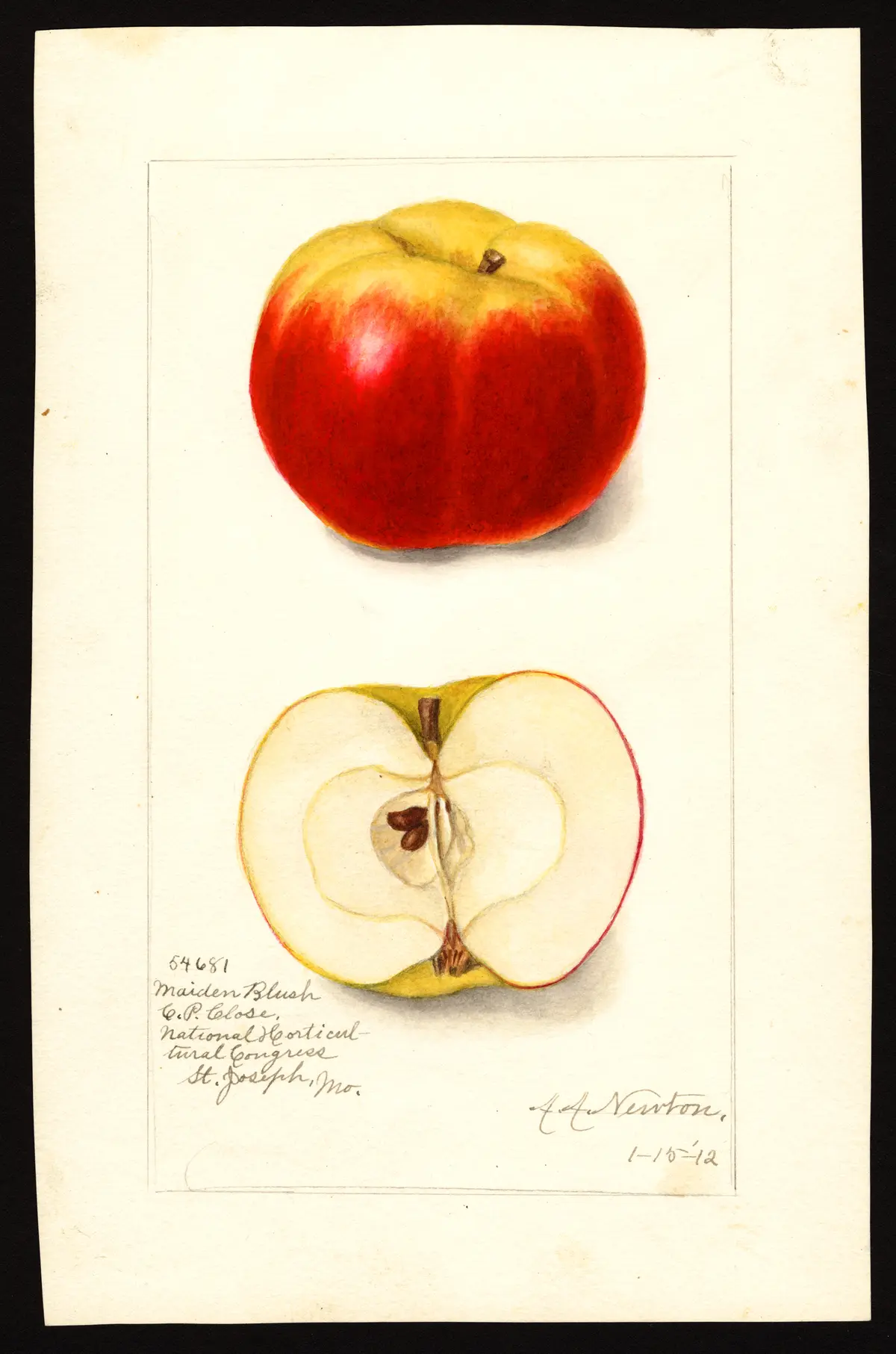
USDA Pomological Watercolor Collection
Maiden's Blush
Origin / History
Maiden's Blush is a native of New Jersey. Coxe (1817) describes it as named by Samuel Allinson, Esq., late of Burlington, who first brought it into notice, and as very popular in the Philadelphia market in his day — the best variety of its season for drying. Warder (1867) notes that it was still held in high repute in New Jersey as a market apple, and that thirteen of the eighteen States reporting to the American Pomological Society had given it their unqualified approbation. Beach (1905) records that in the American Pomological Society's Catalogue of Fruits it was reported as either "wholly successful or successful" in nearly all the important apple-growing districts of the United States, that it had long been well and favorably known in New York, and that it was still being planted both for commercial purposes and for home use. Hedrick (1922) calls it an old favorite, known by fruit-growers in America everywhere for over a century, and probably as widely disseminated in America as any other apple, holding its popularity chiefly by virtue of its distinctive and very handsome crimson-cheeked, lemon-yellow apples. It was first described in pomological literature by Coxe in 1817.
Tree
A handsome, hardy, rapid-growing, vigorous tree, forming a fine open and spreading head (Coxe; Elliott; Warder; Downing; Budd-Hansen). Beach calls the tree medium in size and moderately vigorous to vigorous, with form spreading and open; Hedrick repeats this — medium in size, vigorous, spreading, open. The tree comes into bearing rather young, is pretty long-lived, and is a reliable cropper, yielding good to heavy crops biennially or almost annually (Beach); it bears abundantly and constantly (Coxe), bears large crops (Downing), and is uniformly productive (Thomas). Elliott notes that it succeeds, so far as producing annually and abundantly, in all soils, but does much the best in those termed "limestone clay." The Central Experimental Farm at Agassiz, BC (planted spring 1890) describes the tree as a strong and spreading grower and a regular bearer.
Twigs long, curved, slender; internodes short. Bark brown or reddish-brown, lightly mottled with scarf-skin; slightly pubescent. Lenticels quite numerous, small, round, not raised. Buds medium size, plump, obtuse, free, slightly pubescent (Beach; partially repeated in Lowther).
Fruit
Size: Coxe describes the fruit as of large size. Elliott calls it medium to large; Warder, medium to large; Downing, medium; Thomas, rather large; Budd-Hansen, rather large; Beach and Hedrick, medium or above, sometimes large, uniform in size and shape; the Central Experimental Farm (Agassiz, BC), medium size. Beach notes that on unthrifty, old trees or under unfavorable circumstances a considerable amount of the fruit may be too small for market.
Form: Flat (Coxe); roundish flattened (Elliott); regular, flat and very handsome (Warder); very regularly shaped, and a little narrower towards the eye (Downing); oblate, smooth, and regular (Thomas); oblate, very regular, slightly conical (Budd-Hansen); oblate, a little inclined to conic, regular, symmetrical (Beach); oblate, sometimes conic, regular, symmetrical (Hedrick); round (Lowther's first entry); oblate, a little tapering at the stem end (Central Experimental Farm). Hedrick adds that the fruits are unique in form as well as color, each an oblate sphere.
Stem / Stalk and Cavity: The stalk is short (Coxe; Elliott; Downing; Thomas; Budd-Hansen) to medium (Warder; Beach), rather slender (Beach; Hedrick; Lowther). It grows in a deep hollow (Coxe), in a rather wide deep hollow (Downing), and the cavity is rather wide (Thomas; Budd-Hansen). Warder describes the cavity as wide and wavy. Beach: cavity rather large, acute to obtuse, medium to wide, moderately deep to shallow, usually symmetrical, sometimes russeted. Hedrick: cavity large, acute, medium to wide, shallow, usually symmetrical, sometimes russeted. Budd-Hansen: cavity rather wide, deep, with trace of russet. Lowther: cavity large, acute to obtuse, medium to wide, moderately deep to shallow.
Calyx and Basin: The eye/calyx is small and closed (Coxe describes the eye as set in a deep hollow like the stalk; Warder: eye small, closed; Elliott, Downing, Thomas, Budd-Hansen, Beach, Hedrick, and Lowther all describe the calyx as closed). Beach: lobes separated at base, medium length, moderately broad, acute; Hedrick: lobes separated at base, broad, acute. Budd-Hansen: segments erect convergent. The basin is medium and abrupt (Elliott), shallow, regular or wavy (Warder), moderately depressed (Downing), moderate, even (Thomas), wide, smooth, medium (Budd-Hansen), moderately shallow, medium to wide, obtuse, regular, smooth or slightly furrowed, symmetrical (Beach), or shallow, medium to wide, obtuse, regular, smooth or furrowed, symmetrical (Hedrick).
Skin / Color: A lively contrast — yellow ground with a bright red cheek, whence the name (Coxe). Elliott: clear lemon yellow with red cheek, varying from faint blush to rich crimson. Warder: surface very smooth, polished, of a pale waxen yellow and blushed with bright carmine; dots minute. Downing: skin smooth, with a delicate waxen appearance, pale lemon yellow in the shade, with a brilliant crimson cheek next the sun, the two colors often joining in brilliant red. Thomas: a fine, evenly shaded red cheek or blush on a clear pale yellow ground. Budd-Hansen: surface very smooth, polished, delicate waxen, clear pale yellow, with beautiful deep crimson cheek, the two colors often joining in brilliant red. Beach: skin thin, tough, smooth, pale waxen yellow with crimson blush; dots numerous, whitish and submerged or areolar. Hedrick: skin thin, tough, smooth, pale waxen yellow with crimson blush; dots numerous, white, submerged or areolar. Lowther's first entry calls the skin simply yellow. The Central Experimental Farm gives the skin as greenish-lemon yellow with a bright red cheek. Hedrick adds that the apples are unique in color as well as form, distinctive and very handsome — crimson-cheeked, lemon-yellow. Downing compares the beauty of color to that of the Lady Apple.
Flesh and Flavor: Flesh white (Coxe; Elliott; Warder; Downing; Thomas; Budd-Hansen; Central Experimental Farm), or white or with a slight yellow tinge (Beach; Hedrick). Texture: tender (Coxe; Elliott; Downing; Thomas; Budd-Hansen; Central Experimental Farm); fine-grained (Elliott; Thomas); breaking, fine grained, juicy (Warder); fine, moderately crisp, tender, very juicy (Beach); fine, crisp, tender, very juicy (Hedrick).
Flavor descriptions vary somewhat. Coxe: sprightly, remarkably light and fitted for drying. Elliott: sprightly, rather sharp sub-acid unless fully ripened. Warder: flavor acid, aromatic, and to most palates not agreeable at the dessert, but very good when cooked, and requiring but a short time to be reduced to a delicious pulp of light color. Downing: sprightly, pleasant subacid; rated "Good." Thomas: pleasant sub-acid, but not rich — "although deficient in richness, it is valued for its fair, tender, and beautiful fruit, and uniform productiveness." Budd-Hansen: brisk, pleasant aromatic subacid, not rich, good. Beach: subacid, good in quality especially for culinary uses. Hedrick: subacid; good — "the apples are not high enough in quality to relish out of hand, but are very good for cooking, evaporating, and for the markets." Lowther's second entry: sprightly and good in flavor when fully ripe; quality rated good. Central Experimental Farm: sprightly, sub-acid, quality good.
Core and Seeds: Core medium (Elliott); core regular, closed, meeting the eye, seeds numerous and brown (Warder); core medium size, axile or somewhat abaxile, broadly elliptical; cells closed or slightly open; core lines meeting or slightly clasping; carpels very broadly ovate; seeds medium brown, moderately wide, moderately long, plump, acute (Beach). Hedrick: core of medium size, axile or somewhat abaxile, broad-elliptical; cells closed or slightly open; core-lines meeting or clasping; carpels broad-ovate; seeds brown, wide, long, plump, acute. Budd-Hansen: core closed; cells ovate; tube short, conical; stamens marginal. Beach: calyx tube small, narrow, conical to funnel-shape; stamens median to marginal. Hedrick: calyx-tube small, narrow, conical; stamens median.
Season
Coxe: ripens in August and continues in perfection till the end of September. Downing: begins to ripen about the 20th of August and continues until the last of October. Warder: September and October, but may be used in the kitchen during August. Elliott: September and October. Budd-Hansen: September, October. Thomas: mid-autumn. Lowther's first entry: early autumn. Central Experimental Farm (Agassiz, BC): September and October. Beach: as grown in Western New York, in season from September to November or December; later than that, although the fruit may appear sound, it is deficient in quality. Hedrick: September to November or December.
Beach notes that the variety varies greatly in the time of maturing in different seasons, and that the earlier it matures the less satisfactory it is as a keeper. In cold storage its commercial limit appears to be about December 15th; it does not stand heat well before going into storage. The fruit does not mature uniformly, and there is considerable loss from drops unless more than one picking is made in gathering the crop (Beach; echoed by Lowther and Hedrick — Hedrick: "the crop does not mature uniformly, is very susceptible to the scab-fungus, and does not keep well in either ordinary or cold storage"). Beach notes that the variety is sometimes badly injured by scab but that this may readily be prevented by proper treatment.
Uses
Fit both for pies and the table; particularly prized for drying, for which it is preferred to any apple of the season (Coxe). Valued for cooking, for drying, and salable in market on account of its handsome appearance (Elliott). Much cultivated and admired both for the table and for cooking, and very highly esteemed for drying (Downing). Much esteemed for table, market, cooking, and evaporating (Budd-Hansen). Used for the kitchen and the market (Lowther). Warder: very good when cooked and requiring but a short time to be reduced to a delicious pulp of light color; also used for drying, making a very light colored product much admired by dealers. Beach: valued especially for market and culinary uses; makes very white evaporated stock; recognized as a standard market variety and usually sells above the average prices for varieties of its class; in many localities a very satisfactory variety for the commercial orchard. Hedrick: very good for cooking, evaporating, and for the markets, but not high enough in quality to relish out of hand. Lowther (second entry): one of the very best apples for use in September and October; a good market variety, especially good for cooking, and usually sells above the average of apples in its season.
Subtypes / Variants
Bachelor's Blush. Warder (1867): "Bachelor's Blush appears to be a variety of the above; found in Burlington County, New Jersey, and exhibited before the American Pomological Society at the Rochester meeting in 1864, by Wm. Parry, as a valuable and distinct variety. Having examined the trees as they grew together in the orchard, the resemblance to Maiden's Blush was very apparent. The fruit is larger, and for market purposes is considered more profitable. The two may be different, but are very much alike."
Other
Lowther's first entry notes that the variety is reported by 10 stations in the Northern Division of the American Pomological Society, and that an asterisk indicates the variety is also reported in more than one division; the Central Division and Southern Division columns are blank. Warder's plate is Fig. 77; Thomas references Fig. 400; Hedrick references Fig. 34. Downing compares its beauty of color to that of the Lady Apple.
Book Sources
Described in 9 period pomological works
- Warder, American Pomology: Apples (1867)
- Downing, Fruits and Fruit Trees of America (1900)
- Beach, The Apples of New York Vol. 2 (1905) — listed as Maiden Blush
- Hedrick, Cyclopedia of Hardy Fruits (1922) — listed as MAIDEN BLUSH
- Coxe, A View of the Cultivation of Fruit Trees (1817) — listed as Maidens Blush
- Elliott, The Western Fruit Book (1865)
- Lowther (ed.), Encyclopedia of Practical Horticulture (1914)
- Thomas, The American Fruit Culturist (1903)
- Budd & Hansen, Systematic Pomology (1914) — listed as Maiden Blush
Nursery Catalog Sources
Found in 63 catalogs (1845–1932) from Alabama, Arkansas, California, Illinois, Kansas, Maryland, Massachusetts, Missouri, Nebraska, New Jersey, Oregon, Pennsylvania, Virginia, Washington
- Winship's Nursery (Brighton Nurseries , operated by the Winship family), Brighton (Boston) , Massachusetts — 1845
- Hovey & Co. , Cambridge , Massachusetts — 1849
- Azell Bowditch (Nursery / Fruit Catalog) , Boston , Massachusetts — 1850
- Hutchison Nursery , James Hutchison, Oakland , California — 1881
- Felix Gillet , Barren Hill Nursery, Nevada City , California — 1884
- Fancher Creek Nursery , Fresno , California — 1886
- Felix Gillet , Barren Hill Nursery, Nevada City , California — 1888
- California Nursery Co. , Niles , California — 1889
- Felix Gillet , Barren Hill Nursery, Nevada City , California — 1889
- Felix Gillet , Barren Hill Nursery, Nevada City , California — 1890
- William H. Moon Co. , Morrisville, Bucks County , Pennsylvania — 1890
- Felix Gillet , Barren Hill Nursery, Nevada City , California — 1891
- Puyallup & Yakima Nurseries , Puyallup, Washington (Lock Box 191) and North Yakima , Washington — 1892
- Milwaukie-Canby Nurseries , Canby, OR (and Milwaukie, OR) — 1893
- Rogers Nursery Co. , Moorestown , New Jersey — 1893
- Sherwood Hall Nursery Co. , Timothy Hopkins (Menlo Park Nurseries), San Francisco / Menlo Park , California — 1893
- Multnomah Nurseries , Russellville , Oregon — 1894
- The Vineland Nurseries (Kelsey & Co. , Proprietors), St. Joseph, Missouri (Office: 13th and Atchison Sts., 2 Blocks East of the Citizens St. Car Line) — 1894
- Woodburn Nurseries , Woodburn, Marion Co. , Oregon — 1894
- Felix Gillet , Barren Hill Nursery, Nevada City , California — 1895
- Stark Bros. Nurseries & Orchards Co. , Louisiana , Missouri — 1896
- The Lovett Company , Little Silver , New Jersey — 1896
- Felix Gillet , Barren Hill Nursery, Nevada City , California — 1897
- The Salem Nursery (John A. Francis , Proprietor), Salem , Virginia — 1897
- Arthur J. Collins & Sons , Moorestown , New Jersey — 1898
- Reading Nursery , Jacob W. Manning, Proprietor, Reading , Massachusetts — 1898
- Stark Bros. Nurseries & Orchards Co. , Louisiana , Missouri — 1898
- Brown Brothers Co. , Continental Nurseries, Rochester, NY (also operated from Toronto, Canada) — 1899
- Alabama Nursery Co. , Huntsville , Alabama — 1900
- Central Experimental Farm , Dominion Department of Agriculture, Agassiz, British Columbia (under test; Bulletin No. 3, Second Series) — 1900
- Washington Nursery Co. , Toppenish , Washington — 1901
- Brown Brothers Co. , Continental Nurseries, Rochester, NY (also operated from Toronto, Canada) — 1901
- Mountain Grove Nurseries (Tippin & Moore , Proprietors; Geo. T. Tippin, J. W. Tippin, J. C. Moore), Mountain Grove , Missouri — 1901
- S.L. Watkins , Grizzly Flats, El Dorado County , California — 1901
- Yarbrough Bros. , Stephens , Arkansas — 1901
- Benjamin Buckman (personal inventory) , Farmingdale , Illinois — 1901
- Pacific Nursery Company (W. O. Hudson & A. D. Hudson) , Tangent , Oregon — 1903
- Russellville Nursery Co. , Russellville, OR (three miles east of Portland, one mile from Montavilla car line) — 1903
- Phoenix Nursery Company (W. E. Rossney , President; Sidney Tuttle, Vice-President), Bloomington , Illinois — 1904
- The Dalles Nurseries , The Dalles , Oregon — 1906
- Stark Bros. Nurseries & Orchards Co. , Louisiana , Missouri — 1906
- J.B. Pilkington , Portland , Oregon — 1907
- Russellville Nursery Co. , Montavilla Station, Portland, OR (three miles east of Portland, one mile from Montavilla car line) — 1907
- Carlton Nursery Co. , Carlton , Oregon — 1909
- Milton Nursery Co. (A. Miller & Sons , Proprietors), Milton , Oregon — 1909
- Wm. J. Corse (successor to Robert Sinclair / Sinclair Nurseries) , Baltimore , Maryland — 1909
- Washington Nursery Company , Toppenish , Washington — 1909
- C.F. Lansing , Salem , Oregon — 1910
- Stark Bros. Nurseries & Orchards Co. , Louisiana , Missouri — 1910
- Galbraith Nursery Co. (DeWitt Hansen , Pres.-Mgr.), Fairbury , Nebraska — 1911
- Stark Bros. Nurseries & Orchards Co. , Louisiana , Missouri — 1911
- Ballygreen Nurseries , Hanford , Washington — 1912
- Pacific Nursery Company , Portland , Oregon — 1912
- Vineland Nurseries Company , Clarkston , Washington — 1912
- Washington Nursery Company , Toppenish , Washington — 1912
- Van Holderbeke Nursery Co. , Incorporated, Spokane, Washington (nurseries at Otis Orchards WA, Pasadena WA, Kennewick WA) — 1913
- Benjamin Buckman (personal inventory) , Farmingdale , Illinois — 1913
- Union Nurseries , J.B. Weaver & Sons, Union , Oregon — 1915
- Holsinger Bros. Nurseries (Holsinger Brothers Nursery) , Rosedale , Kansas — 1916
- Stark Bros. Nurseries & Orchards Co. , Louisiana , Missouri — 1918
- Oregon Nursery Co. , Orenco , Oregon — 1920
- Benedict Nursery Co. , Portland , Oregon — 1921
- Stark Bro's Nurseries , Louisiana , Missouri — 1932
View original book sources (10)
— William Coxe, A View of the Cultivation of Fruit Trees (1817)NO. 10. MAIDENS BLUSH.
This is an apple of large size, and great beauty; exhibiting a lively contrast: a yellow ground, with a bright red cheek, whence it derives its name, given to it by Samuel Allinson Esq. late of Burlington, who first brought it into notice: the form is flat, the skin smooth, the flesh white, tender and sprightly, remarkably light and fitted for drying, for which it is preferred to any apple of the season: the stalk is short, and grows in a deep hollow, as does the eye—the fruit ripens in August, and continues in perfection till the end of September, and is fit both for pies and the table: the tree is uncommonly handsome, as well as vigorous in its growth, forming a fine open and spreading head; it bears abundantly and constantly, and is a very popular apple in the Philadelphia market.
— F.R. Elliott, The Western Fruit Book (1865)Maiden's Blush. American. Tree a rapid grower, forming a fine spreading head; succeeds, so far as producing annually and abundantly, in all soils; much the best, however, in those termed "limestone clay." Valued for cooking, for drying, and salable in market on account of its handsome appearance. Fruit, medium to large; form, roundish flattened; color, clear lemon yellow, with red cheek, varying from faint blush to rich crimson; stem, short; calyx, closed; basin, medium, abrupt; core, medium; flesh, white, fine-grained, tender, sprightly, rather sharp sub-acid unless fully ripened. September and October.
— John A. Warder, American Pomology: Apples (1867)Maiden's Blush.
This beautiful and profitable fruit has received the unqualified approbation of thirteen out of the eighteen States that have reported to the American Pomological Society. It is a native of New Jersey, and is still held in high repute there as a market apple. The tree is hardy, vigorous, spreading and productive, beginning to bear quite early.
Fruit medium, to large, regular, flat and very handsome; Surface very smooth, polished, of a pale waxen yellow and blushed with bright carmine; Dots minute.
Basin shallow, regular or wavy; Eye small, closed.
Cavity wide, wavy; Stem medium to short.
Core regular, closed, meeting the eye; Seeds numerous, brown; Flesh white, breaking, fine grained, juicy; Flavor acid, aromatic, and to most palates not agreeable at the dessert, but very good when cooked, and requiring but a short time to be reduced to a delicious pulp of light color. This apple is also used for drying and makes a very light colored product, that is much admired by dealers. Season September and October, but may be used in the kitchen during August.
Fig. 77.—Maiden's Blush.
Bachelor's Blush appears to be a variety of the above; found in Burlington County, New Jersey, and exhibited before the American Pomological Society at the Rochester meeting in 1864, by Wm. Parry, as a valuable and distinct variety. Having examined the trees as they grew together in the orchard, the resemblance to Maiden's Blush was very apparent. The fruit is larger, and for market purposes is considered more profitable. The two may be different, but are very much alike.
— A.J. Downing, The Fruits and Fruit Trees of America (1900)Maiden's Blush.
A remarkably beautiful Apple, a native of New Jersey, and first described by Coxe. It begins to ripen about the 20th of August, and continues until the last of October. It has all the beauty of color of the pretty little Lady Apple, and is much cultivated and admired, both for the table and for cooking. It is also very highly esteemed for drying.
Maiden's Blush.
This variety forms a handsome, rapid-growing tree, with a fine spreading head, and bears large crops. It is very valuable as a profitable market sort.
Fruit of medium size, very regularly shaped, and a little narrower towards the eye. Skin smooth, with a delicate waxen appearance, pale lemon yellow in the shade, with a brilliant crimson cheek next the sun, the two colors often joining in brilliant red. Stalk short, planted in a rather wide deep hollow. Basin moderately depressed. Calyx closed. Flesh white, tender, sprightly, pleasant subacid. Good.
— John J. Thomas, The American Fruit Culturist (1903)Maiden's Blush.* Rather large, oblate, smooth, and regular; with a fine, evenly shaded red cheek or blush on a clear pale yellow ground; stalk short; cavity rather wide; basin moderate, even; flesh white, fine-grained, tender, pleasant sub-acid, but not rich. Mid-autumn. Tree spreading. Although deficient in richness, it is valued for its fair, tender, and beautiful fruit, and uniform productiveness. Fig. 400. Valuable at the West. New Jersey.
— S.A. Beach, The Apples of New York, Vol. 2 (1905)MAIDEN BLUSH.
REFERENCES. 1. Coxe, 1817:106. fig. 2. Buel, N. Y. Bd. Agr. Mem., 1826:476. 3. Wilson, 1828:136. 4. Fessenden, 1828:131. 5. London Hort. Soc. Cat., 1831:No. 704. 6. Kenrick, 1832:27. 7. Thacher, 1822:130. 8. Mag. Hort., 11:363, 396. 1835. 9. Downing, 1845:90. fig. 10. Thomas, 1849:157. fig. 11. Cole, 1849:113. fig. 12. Emmons, Nat. Hist. N. Y., 3:40. 1851. col. pl. No. 30 and fig. 13. Barry, 1851:285. 14. Hovey, Mag. Hort., 18:544. 1852. fig. 15. Elliott, 1854:469 app. 16. Hooper, 1857:57. 17. Am. Pom. Soc. Rpt., 1860:240. 18. Warder, 1867:412. fig. 19. Fitz, 1872:143, 164. 20. Hogg, 1884:138. 21. Rural N. Y., 47:713. 1888. 22. Wickson, 1889:244. 23. Lyon, Mich. Hort. Soc. Rpt., 1890:294. 24. Bailey, An. Hort., 1892:243. 25. Can. Hort., 15:65. 1892. 26. Ark. Sta. An. Rpt., 6:55. 1893. 27. Ib., 7:44. 1894. 28. Hoskins, Rural N. Y., 53:279. 1894. 29. Ib., 55:7. 1896. 30. Ill. Sta. Bul., 45:331. 1896. 31. Waugh, Vt. Sta. An. Rpt., 14:299. 1901. 32. Va. Sta. Bul., 130:124. 1901. 33. Am. Pom. Soc. Cat., 1901:18. 34. Powell and Fulton, U. S. B. P. I. Bul., 48:48. 1903. 35. Budd-Hansen, 1903:122. fig. 36. Beach and Clark, N. Y. Sta. Bul., 248:130. 1904.
SYNONYMS. Lady Blush (36). MAIDEN BLUSH (1, 2, 3, 4, 5, 6, 7, 8, 9, 10, 11, 12, 13, 14, 15, 16, 17, 18, 19, 20, 21, 22, 23, 24, 25, 26, 27, 28, 29, 30, 31, 32, 33, 34, 35, 36). Red Cheek (11).
This is a beautiful apple of pale lemon-yellow color with crimson cheek. The flesh is white, sprightly, not superior in flavor but good in quality. It is valued especially for market and culinary uses. It makes very white evaporated stock. As grown in Western New York it is in season from September to November or December. Later than this although the fruit may appear sound it is deficient in quality. In cold storage its commercial limit appears to be about December 15th. It does not stand heat well before going into storage. It varies greatly in the time of maturing in different seasons. The earlier it matures the less satisfactory is it as a keeper (36). It is recognized as a standard market variety and usually sells above the average prices for varieties of its class. In many localities it has proven a very satisfactory variety for the commercial orchard, because the tree is a fine grower, hardy, pretty long-lived, comes into bearing rather young and is a reliable cropper, yielding good to heavy crops biennially or almost annually. In many cases the fruit does not mature uniformly and there is considerable loss from drops unless more than one picking is made in gathering the crop. Usually the fruit is pretty uniform in size but on unthrifty, old trees or under unfavorable circumstances a considerable amount of the fruit may be too small for market. It is sometimes badly injured by scab but this may readily be prevented by proper treatment.
Historical. Coxe described this variety in 1817 as very popular in the Philadelphia market and the best variety of its season for evaporating. He stated that it was named by Samuel Allinson, of Burlington, N. J., who first brought it to notice. In the American Pomological Society's Catalogue of fruits it is reported as either "wholly successful or successful" in nearly all the important apple-growing districts of the United States (33). It has long been well and favorably known in New York and it is still being planted both for commercial purposes and for home use.
TREE.
Tree medium size, moderately vigorous to vigorous. Form spreading, open. Twigs long, curved, slender; internodes short. Bark brown or reddish-brown, lightly mottled with scarf-skin; slightly pubescent. Lenticels quite numerous, small, round, not raised. Buds medium size, plump, obtuse, free, slightly pubescent.
FRUIT.
Fruit medium or above, sometimes large, uniform in size and shape. Form oblate a little inclined to conic, regular, symmetrical. Stem short to medium, rather slender. Cavity rather large, acute to obtuse, medium to wide, moderately deep to shallow, usually symmetrical, sometimes russeted. Calyx medium size, closed; lobes separated at base, medium length, moderately broad, acute. Basin moderately shallow, medium to wide, obtuse, regular, smooth or slightly furrowed, symmetrical. Skin thin, tough, smooth, pale waxen yellow with crimson blush. Dots numerous, whitish and submerged or areolar. Calyx tube small, narrow, conical to funnel-shape. Stamens median to marginal. Core medium size, axile or somewhat abaxile, broadly elliptical; cells closed or slightly open; core lines meeting or slightly clasping. Carpels very broadly ovate. Seeds medium brown, moderately wide, moderately long, plump, acute. Flesh white or with slight yellow tinge, fine, moderately crisp, tender, very juicy, subacid, good in quality especially for culinary uses. Season September to November or December.
— J.L. Budd & N.E. Hansen, American Horticultural Manual, Part II: Systematic Pomology (1914)Maiden Blush.—Origin, New Jersey; tree vigorous, productive; fruit much esteemed for table, market, cooking, and evaporating.
Fruit rather large, oblate, very regular, slightly conical; surface very smooth, polished, delicate waxen, clear pale yellow, with beautiful deep crimson cheek, the two colors often joining in brilliant red; cavity rather wide, deep, with trace of russet; stem short; basin wide, smooth, medium; calyx closed; segments erect convergent. Core closed; cells ovate; tube short, conical; stamens marginal; flesh white, tender, brisk, pleasant aromatic subacid, not rich, good. September, October.
— Granville Lowther (ed.), Encyclopedia of Practical Horticulture (1914)Maiden's Blush is a medium-sized fruit of round form with yellow skin. Quality is rated good. Its use is both kitchen and market. Season is early autumn. It is reported by 10 stations in the Northern Division; the asterisk indicates the variety is also reported in more than one division of the American Pomological Society. The Central Division and Southern Division columns are blank.
[Additional entry in this volume: "Maiden Blush", pp. 239–239]
Maiden Blush
The Maiden Blush is one of the very best apples for use in September and October. It is pale yellow, with crimson cheeks, flesh white, sprightly and good in flavor when fully ripe. It is a good market variety, especially good for cooking, and usually sells above the average of apples in its season. It does not mature uniformly, and requires several pickings to get the best results.
The tree is moderately vigorous, form spreading, twigs long and curved, internodes short, bark brown or reddish brown, lightly mottled with scarf skin.
Fruit medium or above in size, form oblate, inclined to conic, regular and symmetrical. Stem short, medium, rather slender. Cavity large, acute to obtuse, medium to wide, moderately deep to shallow. Calyx medium sized, closed.
Historical. Coxe described this variety in 1817 as very popular in the Philadelphia market, and the best variety of its season for evaporating. In the American Pomological Society's Catalogue of Fruits it is reported as either wholly successful or successful in nearly all the important apple growing districts of the United States.
— U.P. Hedrick, Cyclopedia of Hardy Fruits (1922)MAIDEN BLUSH. Fig. 34. Lady Blush. Red Cheek. This old favorite, known by fruit-growers in America everywhere for over a century, attained and holds its popularity chiefly by virtue of its distinctive and very handsome crimson-cheeked, lemon-yellow apples. The fruits are unique in form as well as color, each an oblate sphere. The apples are not high enough in quality to relish out of hand, but are very good for cooking, evaporating, and for the markets. The crop does not mature uniformly, is very susceptible to the scab-fungus, and does not keep well in either ordinary or cold storage. The trees are above the mark in most characters. The variety was named by Coxe as very popular in Philadelphia as long ago as 1817. It is probably as widely disseminated in America as any other apple. Tree medium in size, vigorous, spreading, open. Fruit medium, sometimes large, uniform in size and shape, oblate, sometimes conic, regular, symmetrical; stem short, slender; cavity large, acute, medium to wide, shallow, usually symmetrical, sometimes russeted; calyx closed; lobes separated at base, broad, acute; basin shallow, medium to wide, obtuse, regular, smooth or furrowed, symmetrical; skin thin, tough, smooth, pale waxen yellow with crimson blush; dots numerous, white, submerged or areolar; calyx-tube small, narrow, conical; stamens median; core of medium size, axile or somewhat abaxile, broad-elliptical; cells closed or slightly open; core-lines meeting or clasping; carpels broad-ovate; seeds brown, wide, long, plump, acute; flesh white or with yellow tinge, fine, crisp, tender, very juicy, subacid; good; September to November or December.
— Central Experimental Farm, Central Experimental Farm, Agassiz BC — Catalogue of Fruit Trees under Test (Bulletin No. 3, 1900) (1900)Planted Spring 1890. Tree a strong and spreading grower, and a regular bearer of fruit. Fruit of medium size, oblate, a little tapering at the stem end. Skin a greenish-lemon yellow, with a bright red cheek. Flesh white, tender, sprightly, sub-acid, quality good. Season September and October.