Orange
Apple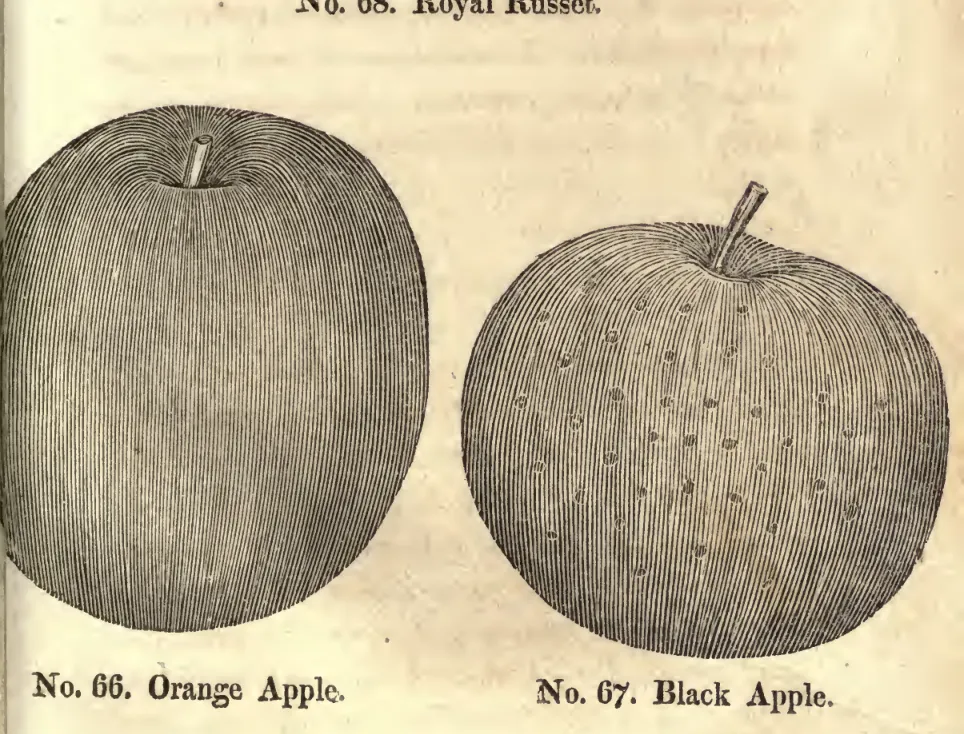
Orange
Origin / History
Several apples have been grown under the name Orange. Downing (1900) holds it almost impossible to decide which has prior right to the name and describes them in the order they are known to him: the Orange of New Jersey origin, the Orange of Reading, Pa., and the Orange of France. Beach (1905) adds that the Fall Orange, described separately, is a different apple, and that Orange has sometimes been used as a synonym for Lowell.
The Orange of New Jersey is the form noted in the earliest references (M'Mahon, 1806; Coxe, 1817). Coxe calls it "a highly estimable apple" and says it "is much cultivated in several of the middle counties of New-Jersey." Emmons (1851), Hooper (1857), Downing (1857, 1869), Warder (1867) and Bailey (1892) also list it. Downing rates it "Very good."
Tree
Tree of moderate size, growth upright (Coxe). Downing calls it a vigorous grower. Young shoots clear, reddish brown; buds reddish, prominent. Coxe gives fruitfulness as great; Downing calls it moderately productive.
Fruit
Size: Small (Coxe); above medium (Downing).
Form: Oblong (Coxe); roundish oblate (Downing).
Stem: Short (Downing).
Cavity: Large (Downing).
Calyx: Closed (Downing).
Basin: Moderate (Downing).
Skin: Greenish yellow (Coxe); orange yellow, sometimes with patches of russet (Downing).
Dots: A few, gray (Downing).
Flesh and flavor: Flesh yellow, rich, juicy, sprightly (Coxe); juicy, subacid, pleasant (Downing). Coxe: "a fine table fruit." Downing: "Very good."
Core and seeds: Not described in source.
Season
Fall and early winter (Coxe); September and October (Downing).
Uses
A fine table fruit, and "thought to be a good cider fruit" (Coxe).
Subtypes / Variants
Orange of Reading, Pa. Fruit medium size, roundish, slightly oblate, faintly ribbed, of a warm yellow orange color, "nearly orange-yellow" in the Pennsylvania Horticultural Society report. Flesh yellowish, sprightly. Quality "Good." It originated at Reading and was brought to notice under the name Orange in the ad interim report of the Fruit Committee of the Pennsylvania Horticultural Society in 1853. Beach had no reports of it from his correspondents and knew of no cultivation of it in New York.
Orange of France. Received by Downing from A. Leroy, Angers. Fruit medium size, roundish, fine yellow, shaded with crimson in the sun, moderately sprinkled with gray and light dots. Stalk short. Calyx small, closed. Flesh white, tender, juicy, mild, pleasant subacid. Quality "Good." October, November.
Other
Not described in source.
Book Sources
Described in 3 period pomological works
View original book sources (3)
— William Coxe, A View of the Cultivation of Fruit Trees (1817)NO. 66. ORANGE APPLE.
This is a fine table fruit in the fall and early winter months; and is thought to be a good cider fruit: the size is small, the form oblong—the colour a greenish yellow—the flesh yellow, rich, juicy, and sprightly; the tree is of moderate size, the growth upright, and its fruitfulness great. It is much cultivated in several of the middle counties of New-Jersey as a highly estimable apple.
— A.J. Downing, The Fruits and Fruit Trees of America (1900)Orange.
There are several Apples under this name ; but as it is almost impossible to decide which has prior right to the name, we enumerate and describe in the order they are known to us.
The Orange of New Jersey origin is a vigorous grower, and moderately productive. Young shoots clear, reddish brown, buds reddish, prominent.
Fruit above medium, roundish oblate. Skin orange yellow, with a few gray dots, and sometimes patches of russet. Stalk short, in a large cavity. Calyx closed. Basin moderate. Flesh yellow, juicy, subacid, pleasant. Very good. September, October.
The Orange of Reading, Pa., has fruit roundish, slightly oblate, faintly ribbed, of a warm yellow orange color. Flesh yellowish, sprightly. Good.
The Orange of France, received from A. Leroy, Angers, is of medium size, roundish, fine yellow, shaded with crimson in the sun, moderately sprinkled with gray and light dots. Stalk short. Calyx small, closed. Flesh white, tender, juicy, mild, pleasant subacid. Good. October, November.
— S.A. Beach, The Apples of New York, Vol. 2 (1905)ORANGE.
REFERENCES. 1. M'Mahon, Am. Gard. Cal., 1806:585. 2. Coxe, 1817:139. 3. Emmons, Nat. Hist. N. Y., 3:91. 1851. 4. Horticulturist, 8:247. 1853. 5. Mag. Hort., 19:172. 1853. 6. Hooper, 1857:67. 7. Downing, 1857:178. 8. Warder, 1867:728. 9. Downing, 1869:294. 10. Bailey, An. Hort., 1892:245.
SYNONYMS. None.
Different varieties of the apple have been known under the name Orange. The Fall Orange has already been described on page 60. Orange has sometimes been used as a synonym for Lowell which is described on page 128.
ORANGE OF NEW JERSEY (1, 2, 3, 6, 7, 8, 9, 10). Coxe (2) gives the following description of this variety: "This is a fine table apple in the fall and early winter months; and is thought to be a good cider fruit; the size is small, the form oblong the colour a greenish-yellow the flesh yellow, rich, juicy and sprightly; the tree is of moderate size, the growth upright, and its fruitfulness great. It is much cultivated in several of the middle counties of New-Jersey as a highly estimable apple."
Downing (7, 9) states that the tree is vigorous and moderately productive; the fruit pleasant subacid; very good; season September and October.
ORANGE OF PENNSYLVANIA. A variety which originated at Reading, Pa., was brought to notice under the name Orange by the ad interim report of the Fruit Committee of the Pennsylvania Horticultural Society in 1853 (4, 5). The fruit is described as medium size, roundish, nearly orange-yellow, sprightly, good (4, 5, 8, 9). We have received no reports concerning this variety from any of our correspondents and so far as we know it is not in cultivation in New York.