Summer Pound Royal
Apple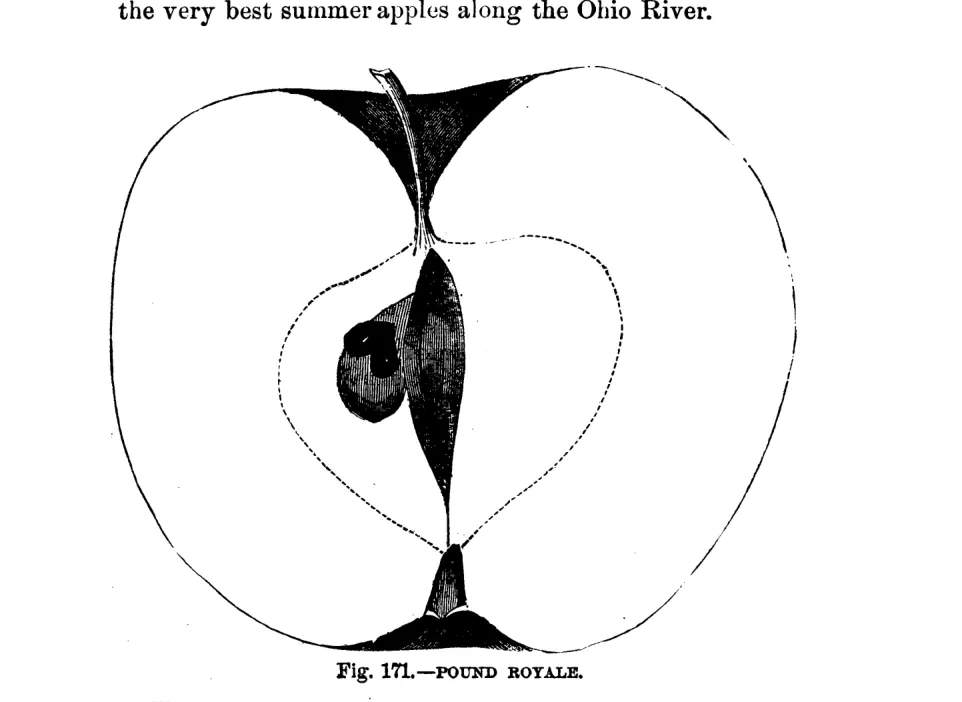
Summer Pound Royal
Origin/History
An old variety whose origin has not been traced (Downing). It was, by the early 20th century, fairly widely disseminated in some parts of Michigan, Ohio, and in the South and West (Downing); Thomas likewise records it as grown in Ohio and Michigan. Warder received his stock from H. N. Gillett of Lawrence County, Ohio, and notes it had long been considered one of the very best summer apples along the Ohio River. Warder explicitly distinguishes this variety from the "Pound Royal of Downing," which is a winter-keeping fruit, whereas Summer Pound Royal is a summer apple.
Tree
A pretty good grower (Warder); Downing describes it more emphatically as a strong, vigorous, upright spreading grower, hardy and productive. It is an early and constant bearer, very productive (Warder). Young shoots are dark — Warder calls the shoots dark and the foliage dark; Downing specifies the young shoots are very dark brown.
Fruit
Size: Large (Warder, Downing, Lowther, Thomas).
Form: Conical and slightly angular (Warder); roundish conical, sometimes roundish oblate conical (Downing); roundish-conic (Thomas); round-conical, a composite of round and conical (Lowther).
Stem: Medium, sometimes knobby (Warder); rather short (Downing).
Cavity: Warder describes it as acute, wavy, and brown; Downing describes it as large, deep, and slightly russeted.
Calyx/Eye: Eye medium and closed (Warder); calyx closed (Downing). Segments long and reflexed (Warder), or medium and erect (Downing).
Basin: Medium and folded (Warder); abrupt and rather deep (Downing).
Skin: Surface smooth, glossy, and greenish (Warder); greenish white (Downing); greenish-white (Thomas); skin color yellow (Lowther). Dots small, green, and indented (Warder); moderately sprinkled with green and light dots (Downing). (Lowther's color column carries the codes 'f' and 'u', which are not defined in that source's legend.)
Flesh/Flavor: Flesh white, very tender, juicy (Warder); white, fine-grained, tender, juicy (Downing); fine-grained, tender (Thomas). Flavor very mild sub-acid and delicious (Warder); mild, sprightly subacid (Downing); sub-acid (Thomas). Quality very good to best (Warder); good to very good (Downing); very good (Thomas); good (Lowther).
Core/Seeds: Core small, closed or slightly open, meeting the eye (Warder); core small (Downing). Seeds numerous, pointed, and dark (Warder).
Season
August (Warder); August–September (Downing); early autumn (Lowther); end of summer (Thomas).
Uses
Table and kitchen (Warder); a profitable orchard and market variety (Downing); profitable (Thomas); primary use market (Lowther).
Subtypes/Variants
Not described in source.
Other
Lowther's tabulated station reports: the Northern Division reports 2 stations with cross-division reporting; the Central Division reports 2 stations with cross-division reporting; the Southern Division is not reported. Warder's account is accompanied by an illustration, "Fig. 171.—POUND ROYALE."
Book Sources
Described in 4 period pomological works
Nursery Catalog Sources
Found in 2 catalogs (1901–1913) from Illinois
- Benjamin Buckman (personal inventory) , Farmingdale , Illinois — 1901
- Benjamin Buckman (personal inventory) , Farmingdale , Illinois — 1913
View original book sources (4)
— John A. Warder, American Pomology: Apples (1867)Pound Royale.
This fine summer apple, received from H. N. Gillett, of Lawrence County, Ohio, has long been considered one of the very best summer apples along the Ohio River.
Fig. 171.—POUND ROYALE.
Tree a pretty good grower, an early and constant bearer, very productive; Shoots dark, foliage dark.
Fruit large, conical, slightly angular; Surface smooth, glossy, greenish; Dots small, green, indented.
Basin medium, folded; Eye medium, closed; Segments long, reflexed.
Cavity acute, wavy, brown; Stem medium, sometimes knobby.
Core small, closed or slightly open, meeting the eye; Seeds numerous, pointed, dark; Flesh white, very tender, juicy; Flavor very mild sub-acid, delicious; Quality very good to best; Use, table, kitchen; Season, August.
Different from Pound Royal of Downing, which is a winter-keeping fruit.
— A.J. Downing, The Fruits and Fruit Trees of America (1900)Summer Pound Royal. Pound Royale. Pound Royal of the Putnam List. Summer R. I. Greening. Orange.
An old variety, the origin of which has not been traced. It is now pretty widely disseminated in some parts of Michigan, Ohio, and in the South and West. Tree a strong, vigorous, upright spreading grower, hardy and productive. Young shoots very dark brown.
Fruit large, roundish conical, sometimes roundish oblate conical, greenish white, and moderately sprinkled with green and light dots. Stalk rather short. Cavity large, deep, slightly russeted. Calyx closed. Segments medium, erect. Basin abrupt, rather deep. Flesh white, fine-grained, tender, juicy, mild, sprightly subacid. Good to very good. Core small. August, September. A profitable orchard and market variety.
— Granville Lowther (ed.), Encyclopedia of Practical Horticulture (1914)Summer Pound Royal is large in size. The form is round-conical (composite of round and conical). The skin color is yellow; color codes 'f' and 'u' appear in the color column but are not defined in the legend. Quality is good. Primary use is market. Season of ripening is early autumn. The Northern Division reports 2 stations with cross-division reporting; the Central Division reports 2 stations with cross-division reporting. The Southern Division is not reported.
— John J. Thomas, The American Fruit Culturist (1903)Summer Pound Royal. Large, roundish-conic, greenish-white; fine-grained, tender, sub-acid, very good. End of summer. Profitable. Grown in Ohio and Mich.