Richard's Graft
Apple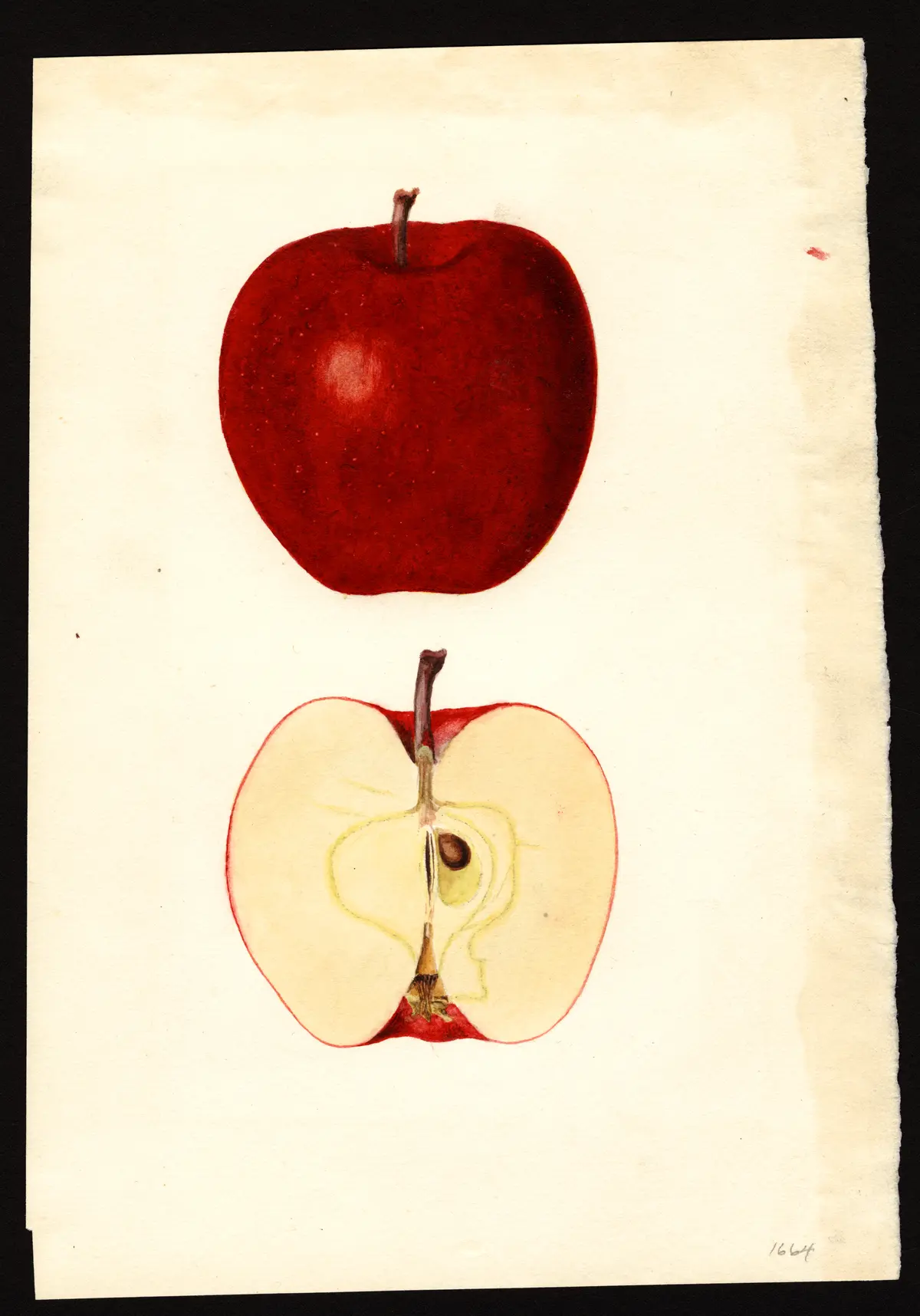
USDA Pomological Watercolor Collection
Richard's Graft
Origin / History
Sources differ on the precise origin. Elliott (1865) and Warder (1867) state it was "supposed" to have originated in Ulster County, New York. Downing (1900), Beach (1905), and Budd-Hansen (1914) place its origin at Greenport, Columbia County, New York. Beach specifies that it was originated there by Richard Delamatter and introduced about 1860 by E. G. Studley, a nurseryman of Claverack, Columbia County, N. Y.; Hedrick (1922) likewise credits introduction in 1860 by E. G. Studley of Claverack, New York. Elliott calls it "an old fruit... but as yet little known." Beach notes that its cultivation was being extended somewhat in Columbia county but as yet was little known outside the Hudson valley. Hedrick states the variety is "a product of the Hudson Valley, New York, and at present is grown only there." Budd-Hansen note it was "Cultivated on the Hudson River" and quote Downing: "one of the best apples of its season." Warder likewise quotes Downing: "One of the best dessert apples of its season."
Tree
Elliott: a free, upright grower, good bearer. Warder: vigorous, upright, very productive. Downing: a free, upright spreading grower, productive; young shoots very dark reddish brown, downy. Beach: tree of medium size, moderately vigorous, long-lived and a reliable cropper yielding good crops biennially; form upright or roundish, open. Twigs moderately long, curved, moderately stout; internodes medium. Bark dark brown, lightly streaked with scarf-skin; pubescent. Lenticels quite numerous, medium size, round, not raised. Buds medium size, broad, acute to obtuse, free, pubescent. Hedrick: tree of medium size, vigorous, upright, open; satisfactory except in bearing biennially.
Fruit
Size. Elliott: above medium. Warder: medium to large. Downing: medium. Beach: medium size. Budd-Hansen: above medium to large. Hedrick: medium size. Lowther: medium-sized.
Form. Elliott: roundish flattened. Warder: regular, oblate. Downing: roundish oblate. Beach: roundish oblate. Budd-Hansen: roundish, regular, truncated. Hedrick: round-oblate. Lowther: roundish (oblate).
Stem / Stalk. Elliott: inch long. Warder: long, red. Downing: medium length, slender. Beach: medium length, slender. Budd-Hansen: long, red. Hedrick: medium length, slender.
Cavity. Elliott: deep, broad. Warder: wide, regular. Downing: large. Beach: large. Budd-Hansen: wide, deep, obtuse, with much stellate russet. Hedrick: small, closed. (Note conflict: most sources describe the cavity as large/wide/deep, while Hedrick uniquely reports it as "small, closed.")
Calyx / Eye. Elliott: calyx closed; segments reflexed. Warder: eye small, closed. Downing: calyx small, closed; segments sometimes recurved. Beach: calyx small, closed. Budd-Hansen: calyx small, closed; segments erect convergent. (Note conflict on segment orientation: Elliott — reflexed; Downing — sometimes recurved; Budd-Hansen — erect convergent.)
Basin. Elliott: deep. Warder: medium, abrupt, folded. Downing: medium, slightly uneven. Beach: medium size. Budd-Hansen: abrupt, medium, nearly smooth. Hedrick: medium size.
Skin / Surface. Elliott: yellow, striped with red. Warder: surface smooth, greenish-yellow, mixed and splashed red; dots numerous, white. Downing: color yellow, nearly covered with splashes, marblings, and shades of rich red. Beach: skin yellow, nearly covered with stripes and splashes of deep red. Budd-Hansen: surface smooth, yellow, nearly covered with splashed, striped, marbled, and dotted rich red, overlaid with whitish; dots many, obscure, whitish. Hedrick: skin yellow, covered with stripes and splashes of deep red. Lowther: yellow-red skin.
Flesh / Flavor. Elliott: flesh fine grained, tender, juicy, vinous. Warder: flesh yellowish-white, fine-grained, tender, juicy; flavor rich, sub acid; quality best; use for the dessert. Downing: flesh yellowish, tender, juicy, pleasant, rich, aromatic subacid. Very good. Beach: flesh yellowish, very tender, juicy, aromatic, subacid, very good; "a very fine fall apple of superior dessert quality." Budd-Hansen: flesh yellowish, white, tender, juicy, fine-grained, rich, pleasant aromatic subacid; very good to best. Hedrick: flesh yellow, very tender, juicy, aromatic, subacid; very good; "superior because choicely good in quality." Lowther: quality very good.
Core / Seeds. Warder: core small, closed, clasping the eye; seeds numerous, plump. Budd-Hansen: core half open, small; cells ovate, entire; tube funnel-shaped; stamens median; seeds many, plump.
Season
Elliott: September to October. Warder: September and October. Downing: September, October. Beach: begins to ripen during late August or early September; the crop ripens in succession during a period of several weeks, and some portion of the fruit may be kept till late autumn; several pickings are required in order to secure the fruit in prime condition. Season September. Budd-Hansen: September and October. Hedrick: a fall apple, September; the crop ripens in a succession of several weeks. Lowther: season winter. (Note conflict: Lowther uniquely reports the season as winter; all other sources place it in early-to-mid fall, August through October.)
Uses
Elliott: fine for the dessert. Warder: use for the dessert. Beach: "an excellent variety for home use and is being grown to a limited extent in commercial orchards with profit." Hedrick: "suitable for a home product only, as the crop ripens in a succession of several weeks." Budd-Hansen: very good to best. Lowther: use is both kitchen and market.
Subtypes / Variants
Not described in source.
Other
Beach (1905) cites references to the variety in Mag. Hort. 18:492 (1852); Downing (1857:101, fig.); Warder (1867:457, fig.); Thomas (1875:204); Am. Pom. Soc. Cat. (1877:14); Barry (1883:340); Mich. Hort. Soc. Rpt. (1888); Hendricks, Rural N. Y., 47:759, 811 (1888); Bailey, An. Hort. (1892:248); and Budd-Hansen (1903:166). Warder's account is accompanied by Fig. 110. Lowther adds that the Northern Division of the American Pomological Society reports the variety at 2 stations, with the asterisk indicating the variety is reported in more than one division.
Book Sources
Described in 8 period pomological works
- Warder, American Pomology: Apples (1867)
- Beach, The Apples of New York Vol. 2 (1905) — listed as Richard Graft
- Budd & Hansen, Systematic Pomology (1914) — listed as Richards Graft
- Downing, Fruits and Fruit Trees of America (1900)
- Elliott, The Western Fruit Book (1865)
- Lowther (ed.), Encyclopedia of Practical Horticulture (1914)
- Thomas, The American Fruit Culturist (1903) — listed as Richards' Graft
- Hedrick, Cyclopedia of Hardy Fruits (1922) — listed as RICHARD GRAFT
Nursery Catalog Sources
Found in 2 catalogs (1901–1913) from Illinois
- Benjamin Buckman (personal inventory) , Farmingdale , Illinois — 1901
- Benjamin Buckman (personal inventory) , Farmingdale , Illinois — 1913
View original book sources (8)
— F.R. Elliott, The Western Fruit Book (1865)Richard's Graft. Derrick's Graft, | Wine Strawberry, Red Spitzenberg. An old fruit, supposed from Ulster County, N. Y., but as yet little known. Tree, a free, upright grower, good bearer of an apple, fine for the dessert. Fruit, above medium, roundish flattened; yellow, striped with red; stem, inch long; cavity, deep, broad; calyx, closed; segments reflexed; basin, deep; flesh, fine grained, tender, juicy, vinous. September to October.
— John A. Warder, American Pomology: Apples (1867)Richard's Graft.
RED SPITZENBERG — STRAWBERRY — WINE.
Supposed to have originated in Ulster County, New York. Tree vigorous, upright, very productive.
Fig. 110. — Richard's graft.
Fruit medium to large, regular, oblate ; Surface smooth, greenish-yellow, mixed and splashed red ; Dots numerous, white. Basin medium, abrupt, folded ; Eye small, closed. Cavity wide, regular ; Stem long, red. Core small, closed, clasping the eye ; Seeds numerous, plump ; Flesh yellowish-white, fine-grained, tender, juicy ; Flavor rich, sub acid ; Quality best ; Use for the dessert ; Season September and October. Downing says : "One of the best dessert apples of its season."
— A.J. Downing, The Fruits and Fruit Trees of America (1900)Richard's Graft.
Derrick's Graft. Red Spitzenburgh. Derrikinan. Strawberry. Wine. Dirck's Graft. Uncle Richard's Graft.
Originated at Greenport, Columbia Co., N. Y. An excellent fall Apple, worthy of extended cultivation. Tree a free, upright spreading grower, productive. Young shoots very dark reddish brown, downy. Fruit medium, roundish oblate. Color yellow, nearly covered with splashes, marblings, and shades of rich red. Stalk medium length, slender. Cavity large. Calyx small, closed. Segments sometimes recurved. Basin medium, slightly uneven. Flesh yellowish, tender, juicy, pleasant, rich, aromatic subacid. Very good. September, October.
— John J. Thomas, The American Fruit Culturist (1903)Richards' Graft, p. 314.
— S.A. Beach, The Apples of New York, Vol. 2 (1905)RICHARD GRAFT.
References. 1. Mag. Hort., 18:492. 1852. 2. Downing, 1857:101. fig. 3. Warder, 1867:457. fig. 4. Thomas, 1875:204. 5. Am. Pom. Soc. Cat., 1877:14. 6. Barry, 1883:340. 7. Mich. Hort. Soc. Rpt., 1888. 8. Hendricks, Rural N. Y., 47:759, 811. 1888. 9. Bailey, An. Hort., 1892:248. 10. Budd-Hansen, 1903:166.
Synonyms. Derrick and Ann (8). Derrick's Graft (2, 4). Red Spitzenburg (3). Red Spitsenburgh (2, 4, 6). Richard (1). Richard Graft (2, 3, 4, 5, 6, 7, 8, 9). Strawberry (2, 3). Wine (2, 3).
This is a very fine fall apple of superior dessert quality. It begins to ripen during late August or early September; the crop ripens in succession during a period of several weeks, and some portion of the fruit may be kept till late autumn. Several pickings are required in order to secure the fruit in prime condition. The tree is upright, of medium size, moderately vigorous, long-lived and a reliable cropper yielding good crops biennially. It is an excellent variety for home use and is being grown to a limited extent in commercial orchards with profit.
Historical. This variety was originated at Greenport, Columbia county, N. Y., by Richard Delamatter. It was introduced about 1860 by E. G. Studley, a nurseryman of Claverack, Columbia county, N. Y. Its cultivation is being extended somewhat in Columbia county, but as yet it is but little known outside of the Hudson valley.
Tree. Tree of medium size, moderately vigorous. Form upright or roundish, open. Twigs moderately long, curved, moderately stout; internodes medium. Bark dark brown, lightly streaked with scarf-skin; pubescent. Lenticels quite numerous, medium size, round, not raised. Buds medium size, broad, acute to obtuse, free, pubescent.
Fruit (2, 8). Fruit medium size. Form roundish oblate. Stem of medium length, slender. Cavity large. Calyx small, closed. Basin medium size. Skin yellow, nearly covered with stripes and splashes of deep red. Flesh yellowish, very tender, juicy, aromatic, subacid, very good. Season September.
— J.L. Budd & N.E. Hansen, American Horticultural Manual, Part II: Systematic Pomology (1914)Richards Graft. — Originated at Greenport, New York. Downing said "one of the best apples of its season." Cultivated on the Hudson River.
Fruit above medium to large, roundish, regular, truncated; surface smooth, yellow, nearly covered with splashed, striped, marbled, and dotted rich red, overlaid with whitish; dots many, obscure, whitish; cavity wide, deep, obtuse, with much stellate russet; stem long, red; basin abrupt, medium, nearly smooth; calyx small, closed, segments erect convergent. Core half open, small; cells ovate, entire; tube funnel-shaped; stamens median ; seeds many, plump; flesh yellowish, white, tender, juicy, fine-grained, rich, pleasant aromatic subacid; very good to best. September and October.
— Granville Lowther (ed.), Encyclopedia of Practical Horticulture (1914)Richard's Graft is a medium-sized apple of roundish (oblate) form with yellow-red skin. Quality is very good. Use is both kitchen and market. Season is winter. The Northern Division of the American Pomological Society reports 2 stations, with the asterisk indicating the variety is reported in more than one division.
— U.P. Hedrick, Cyclopedia of Hardy Fruits (1922)RICHARD GRAFT. Red Spitzenberg. Strawberry. Wine. Richard Graft is a product of the Hudson Valley, New York, and at present is grown only there. It is a fall apple, superior because choicely good in quality, but suitable for a home product only, as the crop ripens in a succession of several weeks. The trees are satisfactory except in bearing biennially. The variety was introduced in 1860 by E. G. Studley, Claverack, New York.
Tree of medium size, vigorous, upright, open. Fruit of medium size, round-oblate; stem of medium length, slender; cavity small, closed; basin of medium size; skin yellow, covered with stripes and splashes of deep red; flesh yellow, very tender, juicy, aromatic, subacid; very good; September.