Newtown Spitzenburg
Apple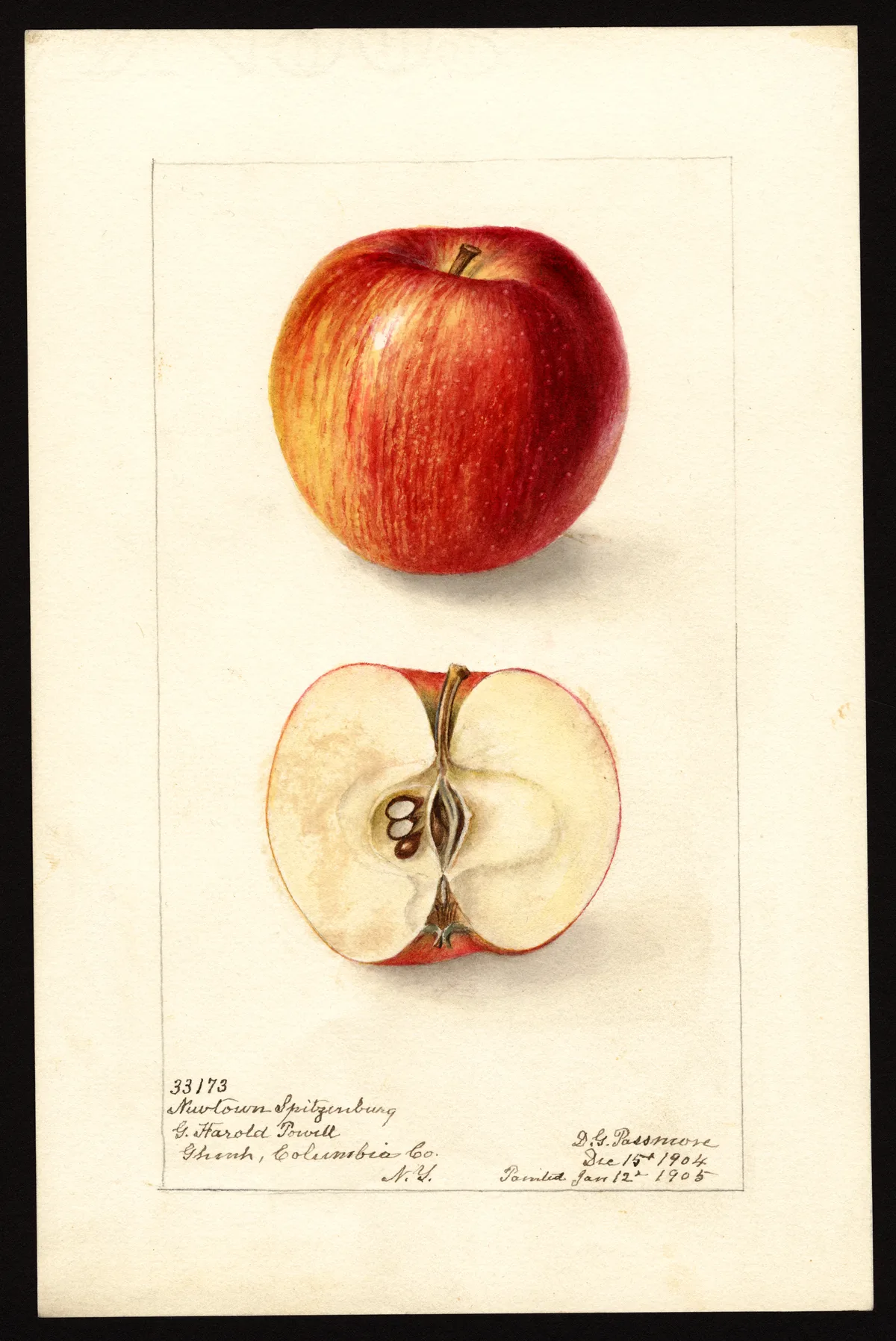
USDA Pomological Watercolor Collection
Newtown Spitzenburg
Origin / History
Newtown Spitzenburg originated in Newtown, Long Island (Elliott; Warder; Downing; Beach; Budd-Hansen; Hedrick). It was first described by Coxe in 1817 (Elliott; Downing; Hedrick; Beach reference 1). Downing notes that this old and valuable apple had long been known in New York as the Vandevere, but because Coxe first described it as Newtown Spitzenburg, that name was continued; it is not, however, the true Vandevere (Downing; Beach; Hedrick), and must not be confounded with the Esopus Spitzenburg, which among New York fruit growers is commonly known by the simple name "Spitzenburg" (Beach; Hedrick). Elliott further observes that when Downing wrote his description of "Vandervere," he evidently had this apple before him and was not acquainted with the true Vandervere.
The variety was at one time quite popular in some sections of New York, particularly in the districts along the Hudson, but by Beach's writing (1905) it was seldom planted and was gradually going out of cultivation. Beach notes it is not a good commercial sort because it is an unreliable cropper, has too large a percentage of fruit of unmarketable size, and is not especially attractive in general appearance on account of its rather dull color. Hedrick likewise states that "the trees are so unreliable in growth and bearing and so fastidious as to soils that the variety has no commercial value." Elliott records that it has been extensively and successfully grown in the West as "Ox-Eye," and highly esteemed there. Bunyard reports that it was probably introduced into England by William Cobbett, and was very little grown in England by 1920.
Tree
Tree moderate to vigorous, spreading, and productive in rich, light soil (Downing; Budd-Hansen). Warder describes the tree as sufficiently vigorous but not of the largest size, spreading, compact, with a round head; foliage rather small, curled, showing the whitish underside; productive. Beach gives tree medium to large, vigorous or moderately vigorous, with long, moderately stout, curved branches; form spreading or roundish, rather dense. Hedrick concurs: tree medium to large, vigorous, spreading, dense, with long, stout, curved branches. Bunyard describes growth as moderate and fertility moderate.
Twigs moderately long to short, straight, rather erect, geniculate, slender to moderately stout; internodes medium to long (Beach). Bark dull brown, rather heavily streaked with scarf-skin, pubescent in spots (Beach). Lenticels rather inconspicuous, quite numerous, small to medium, oblong or roundish, slightly raised (Beach). Buds medium to small, wide, plump, obtuse, free, with little pubescence or none (Beach).
Warder notes the fruit is apt to be scabby and defective on old trees, and falls badly.
Fruit
Size
Medium (Elliott; Downing; Budd-Hansen; Lowther); medium to large (Warder; Bunyard, "3¼ by 2¼"; Hedrick "of medium size"). Beach's first entry gives about medium size; Beach's additional entry gives large or above medium. Beach notes pretty regular and uniform in shape and size.
Form
Sources broadly agree on a roundish, somewhat flattened apple but differ in emphasis. Elliott: round, flattened. Warder: regular, globular-oblate, often inclined or lop-sided when overgrown in young orchards. Downing: oblate, slightly conic. Budd-Hansen: regular, roundish oblate, slightly conical. Lowther: oblate. Bunyard: round, regular. Beach (first entry): roundish approaching cylindrical or somewhat oblate; pretty regular and uniform. Beach (additional entry): flat at base, oblate, narrowing and often somewhat ribbed toward the basin, often oblique. Hedrick: round-oblong or somewhat oblate, regular and uniform in shape and size.
Stem
Sources disagree on stem length. Elliott describes the stem as long and slender. Warder, Downing, Budd-Hansen, and Bunyard describe it as short (Bunyard: "very short, in a deepish cavity"). Beach (first entry) and Hedrick give stem very short to rather long, rather slender, pubescent. Beach (additional entry): stem short.
Cavity
Elliott: narrow, deep, regular. Warder: regular, medium, brown. Downing: wide. Budd-Hansen: wide, deep, regular, lined with russet. Bunyard: deepish. Beach (first entry) and Hedrick: acute, deep, broad, indistinctly furrowed, sometimes russeted. Beach (additional entry): large, acute, deep to very deep, broad, occasionally lipped, sometimes russeted.
Calyx
Elliott: small, segments erect. Warder: eye small, closed. Downing: small, closed. Budd-Hansen: small, closed. Bunyard: open, in a shallow basin. Beach (first entry) and Hedrick: small, closed, sometimes partly open; lobes broad, obtuse. Beach (additional entry): large to medium, usually open, sometimes closed; lobes leafy, broad, long, acute.
Basin
Elliott: open, regular, not deep. Warder: medium, regular. Downing: regular, of moderate depth. Budd-Hansen: wide, smooth, medium deep. Bunyard: shallow. Beach (first entry): small to medium, wide to rather narrow, shallow and obtuse to rather deep and abrupt, slightly furrowed. Beach (additional entry): usually rather large, sometimes oblique, moderately deep, varying from narrow or compressed to moderately wide, abrupt, often somewhat furrowed and irregular. Hedrick: small, wide, shallow to deep, furrowed.
Skin / Color
Sources broadly agree on a yellow ground washed and striped with red and overspread with a bloom or whitish cast. Elliott: yellow ground, mostly striped and splashed with red, which often has the appearance of a bloom; russet dots and lines that near the calyx look like the crests of waves. Warder: surface smooth, deep red, mixed and striped, on rich yellow ground, often overspread with whitish, giving the fruit a gray appearance; dots numerous, minute, fawn color on dark specimens. Downing: fine yellow, washed with light red, striped and splashed with deeper red, and richly shaded with carmine on the sunny side, covered with a light bloom, and sprinkled with peculiar gray specks. Budd-Hansen: surface clear, rich yellow, shaded with light red, with deep red stripes and splashes, often overlaid with whitish; dots many, minute, russet, with some peculiar gray specks. Lowther: yellow-red. Bunyard: clear yellowish-red with red flush and faint stripes. Beach (first entry): skin smooth, tough, eventually becoming deep yellow blushed and mottled with dull red striped with carmine, streaked with grayish scarf-skin and often overspread with a light bloom giving it a peculiarly bluish cast; dots characteristic, conspicuous, very numerous, yellowish or peculiarly gray, often with russet center, small, very numerous and crowded about the basin but less numerous, larger and irregular toward the cavity. Beach (additional entry): skin thin, tough, smooth, rather glossy, yellow or greenish blushed with orange-red and mottled and striped with pinkish-red over a large part of the surface; dots inconspicuous, medium to small, pale gray or russet; prevailing effect striped red. Hedrick: smooth, tough, deep yellow blushed and mottled with dull red, striped with carmine, streaked with gray scarf-skin and overspread with light bloom; dots characteristic, conspicuous, very numerous, yellow, often with russet center, small, very numerous and crowded about the basin but less numerous, larger and irregular toward the cavity.
Flesh and Flavor
Elliott: flesh yellow, tender, slightly sweet, rich, aromatic. Warder: rich, yellow, very fine-grained, very tender, juicy; flavor rich sub-acid and saccharine, aromatic, eminently satisfying; quality best, for table and kitchen, in December. Downing: yellow, crisp, tender, with a rich, sprightly, vinous flavor, scarcely subacid; "Best." Budd-Hansen: flesh yellow, firm, crisp, tender, juicy, rich, sprightly aromatic flavor, scarcely subacid, best. Lowther: quality very good. Bunyard: yellow, crisp, aromatic. Beach (first entry): flesh yellowish, firm, fine-grained, crisp, tender, juicy, mild subacid mingled with sweet, rich, aromatic, very good to best in flavor and quality. Beach (additional entry): flesh whitish tinged with yellow, firm, moderately fine-grained, crisp, tender, juicy or very juicy, mild subacid becoming nearly sweet, aromatic, good. Beach summarizes the character overall as "crisp, aromatic, rich, and mildly subacid mingled with sweet," and quotes Downing's remark that it is a most excellent fruit, suited to more tastes than any other apple of its season. Hedrick: flesh yellow, firm, fine-grained, crisp, tender, juicy, mild subacid, rich, aromatic; very good in quality. Hedrick adds that, once in hand, the apples are most excellent — crisp and tender of flesh, and having a delectable, rich, aromatic flavor.
Core and Seeds
Elliott: core small; seeds few, ovate pointed. Warder: core regular, wide, somewhat open, meeting and sometimes clasping the eye; seeds numerous, angular. Budd-Hansen: core half open; cells wide open, obovate; tube conical; stamens median; seeds many, angular. Beach (first entry): calyx tube cone-shape or approaching funnel-form with short, truncate cylinder; stamens median; core above medium to rather small, more or less abaxile; cells usually pretty symmetrical and partly open, sometimes closed; core lines meeting or somewhat clasping; carpels smooth or nearly so, approaching elliptical, often nearly truncate at the base and narrowing somewhat toward the apex; seeds numerous, below medium to rather large, rather narrow, plump, acute. Beach (additional entry): calyx tube remarkably large, varying from conical to long funnel-form and extending to the core; stamens basal or nearly so; core very small to nearly medium, varying from axile to somewhat abaxile; cells sometimes unsymmetrical and open but usually closed; core lines meeting when the calyx tube is conical but clasping if it is funnel-form; carpels roundish, slightly emarginate; seeds few, dark, medium in size, wide, sometimes slightly tufted. Hedrick: calyx-tube cone-shape with short, truncate cylinder; stamens median; core small, abaxile; cells symmetrical and partly open; core-lines meeting or clasping; carpels smooth, elliptical; seeds numerous, large, narrow, plump, acute.
Season
December to February (Elliott). December (Warder, quality best for table and kitchen). October to February (Downing; Budd-Hansen). Winter (Lowther). Dessert, till January (Bunyard). November to March (Hedrick). Beach (first entry): in Southeastern New York late fall or early winter; in Western New York it is easily kept till February or March in ordinary storage, and often some portion of the fruit remains in fairly good condition till the close of April. Beach (additional entry): October to February or March; commercial limit January.
Uses
Warder gives quality "best, for table and kitchen." Lowther gives use as "family." Bunyard classes it as a dessert apple. Beach and Hedrick concur on quality very good to best, though Beach and Hedrick both note its lack of commercial value due to unreliable cropping, fastidiousness as to soil, and dull color. Elliott reports it is highly esteemed in the West (where it is grown as "Ox-Eye").
Subtypes / Variants
Not described in source.
Other
Beach reports the variety extensively, with thirty-one references spanning Coxe (1817) through Beach and Clark, N. Y. Sta. Bul., 248:134 (1904), and notes its inclusion in the American Pomological Society catalogues of 1852 and 1871. Bunyard observes it was very little grown in England by 1920.
Book Sources
Described in 9 period pomological works
- Budd & Hansen, Systematic Pomology (1914)
- Beach, The Apples of New York Vol. 1 (1905)
- Downing, Fruits and Fruit Trees of America (1900)
- Elliott, The Western Fruit Book (1865) — listed as Newtown Spitzenberg
- Lowther (ed.), Encyclopedia of Practical Horticulture (1914)
- Hedrick, Cyclopedia of Hardy Fruits (1922)
- Thomas, The American Fruit Culturist (1903)
- Warder, American Pomology: Apples (1867) — listed as Newtown Spitzenberg
- Bunyard, A Handbook of Hardy Fruits (1920) — listed as Newtown Spitzenberg
Nursery Catalog Sources
Found in 6 catalogs (1864–1913) from Illinois, Oregon
- St. Helena Nursery , Howell's Prairie, Marion County , Oregon — 1864
- Central Experimental Farm , Dominion Department of Agriculture, Agassiz, British Columbia (under test; Bulletin No. 3, Second Series) — 1900 — listed as Burlington
- Benjamin Buckman (personal inventory) , Farmingdale , Illinois — 1901
- Phoenix Nursery Company (W. E. Rossney , President; Sidney Tuttle, Vice-President), Bloomington , Illinois — 1904
- Benjamin Buckman (personal inventory) , Farmingdale , Illinois — 1913
- Benjamin Buckman (personal inventory) , Farmingdale , Illinois — 1913 — listed as Burlington
View original book sources (9)
— F.R. Elliott, The Western Fruit Book (1865)Newtown Spitzenberg.
Spiced Ox-eye, Ox-eye, Burlington Spitzenberg, Matchless, Kountz, Joe Berry, Vandervere of New York, and Eastern States.
American. From Newtown, Long Island. Originally described by Coxe, in 1817. It is extensively and successfully grown in the West as Ox-Eye, and highly estimated. When Mr. Downing wrote his description of Vandervere, he evidently had this apple before him; and was not acquainted with the true Vandervere.
Fruit, medium; form, round, flattened; color, yellow ground, mostly striped and splashed with red, which often has appearance as of a bloom; russet dots and lines that near the calyx look like the crests of waves; stem, long, slender; cavity, narrow, deep, regular; calyx, small, segments erect; basin, open, regular, not deep; flesh, yellow, tender, slightly sweet, rich, aromatic; core, small; seeds, few, ovate pointed. December to February.
— John A. Warder, American Pomology: Apples (1867)Newtown Spitzenberg.—[COXE.]
VANDERVERE, OF NEW YORK (Downing)—OX-EYE—JOE BERRY, ETC.
Origin, Newtown, Long Island. Tree sufficiently vigorous, not of the largest size, spreading, compact, round head, foliage rather small, curled, showing the whitish underside. Productive. Fruit medium to large, regular, globular-oblate, often inclined or lop-sided when overgrown in young orchards, apt to be scabby and defective on old trees, and falls badly; Surface smooth, deep red, mixed and striped, on rich yellow ground, often over-spread with whitish, giving the fruit a gray appearance; Dots numerous, minute, fawn color on dark specimens. Basin medium, regular; Eye small, closed. Cavity regular, medium, brown; Stem short. Core regular, wide, somewhat open, meeting and sometimes clasping the eye; Seeds numerous, angular; Flesh rich, yellow, very fine-grained, very tender, juicy; Flavor rich sub-acid and saccharine, aromatic, eminently satisfying; Quality best, for table and kitchen, in December.
— A.J. Downing, The Fruits and Fruit Trees of America (1900)Newtown Spitzenburg.
Vandevere of New York Spitzenburgh. Ox Eye. Burlington. Matchless. Kountz. Joe Berry. Barrett's Spitzenburgh. Spiced Ox Eye. Wine, erroneously.
This old and valuable Apple has been long known in New York as the Vandevere, but as it was first described by Coxe as Newtown Spitzenburg, we continue that name. It had its origin in Newtown, Long Island. Tree moderate, vigorous, spreading, and productive in rich, light soil, of most excellent fruit, which is suited to more tastes than any other Apple of its season.
Fruit medium, oblate, slightly conic, fine yellow, washed with light red, striped and splashed with deeper red, and richly shaded with carmine on the sunny side, covered with a light bloom, and sprinkled with peculiar gray specks. Stalk short, inserted in a wide cavity. Calyx small, closed, set in a regular basin of moderate depth. Flesh yellow, crisp, tender, with a rich, sprightly, vinous flavor, scarcely subacid. Best. October to February.
— John J. Thomas, The American Fruit Culturist (1903)Joe Berry. See Newtown Spitzenburgh.
— S.A. Beach, The Apples of New York, Vol. 1 (1905)NEWTOWN SPITZENBURG.
REFERENCES. 1. Coxe, 1817:126. 2. Thacher, 1822:137. 3. Duel, N. Y. Bd. Agr. Mem., 1826:476. 4. Lindley, Pom. Mag., 3: No. 144. 1830. col. pl. 5. Cat. Hort. Soc. London, 1831:36. 6. Ronalds, 1831:19. 7. Floy-Lindley, 1833:40. 8. Manning, 1838:58. 9. Downing, 1845:139. 10. Downing, Horticulturist, 1:341. 1847. 11. Thomas, 1849:173. 12. Cole, 1849:125. 13. Hovey, Mag. Hort., 15:539. 1849. fig. 14. Emmons, Nat. Hist. N. Y., 3:73. 1851. col. pl. fig. 15. Ib., 3:63. 1851. 16. Am. Pom. Soc. Cat., 1852. 17. Elliott, 1854:94. fig. 18. Hooper, 1857:65. 19. Warder, 1867:445. 20. Am. Pom. Soc. Cat., 1871:8. 21. Fitz, 1872:121, 149, 153. 22. Downing, 1872:285. 23. Barry, 1883:350. 24. Hogg, 1884:156. 25. Wickson, 1889:246. 26. Lyon, Mich. Hort. Soc. Rpt., 1890:294. 27. Bailey, An. Hort., 1892:245. 28. Powell and Fulton, U. S. B. P. I. Bul., 48:50. 1903. 29. Budd-Hansen, 1903:134. fig. 30. Bruner, N. C. Sta. Bul., 182:21. 1903. 31. Beach and Clark, N. Y. Sta. Bul., 248:134. 1904.
SYNONYMS. Barretts Spitzenburgh (22). Burlington (22). Burlington Spitzemberg (1). Burlington Spitzenberg (9, 17, 24). English Spitzemberg (1). English Spitzenberg (3, 24). Flushing (18) but incorrectly. Joe Berry (17, 19, 22). Kountz (17, 22). Matchless (4, 7, 9, 17, 22, 24). NEWTON SPITZEMBERG (1). NEWTON SPITSZENBURGH (2). NEWTOWN SPITZEMBERG (7). NEWTOWN SPITZENBERG (3, 4, 12, 17, 19, 20, 24). NEWTOWN SPITZENBERGH (10). NEWTOWN SPITZENBURGH (15, 22, 23). Newtown Spitsenburgh (25). Ox Eye (17, 19, 22). Spiced Ox Eye (22). SPITZENBERG, NEWTOWN (9). SPITZENBURGH, NEWTOWN (11). Spitzenburgh (22). Staalclubs (13) but erroneously. VANDEVERE (13, 21, 25). Vandevere of New York (20, 22, 23, 26). VANDERVERE (14, 16). Vandervere of New York (19). Wine (erroneously, 22).
This is the old Vandevere of New York, but it is not the true Vandevere. It is quite different also from the Esopus Spitzenburg which is commonly known among New York fruit growers by the simple name of Spitzenburg. The Newtown Spitzenburg is not a good commercial sort because it is an unreliable cropper, has too large a percentage of fruit of unmarketable size, and is not especially attractive in general appearance on account of its rather dull color. It is crisp, aromatic, rich, and mildly subacid mingled with sweet. Downing remarks that it is a most excellent fruit, suited to more tastes than any other apple of its season (22).
Historical. This variety originated in Newtown, Long Island. It was at one time quite popular in some sections of this state, particularly in the districts along the Hudson, but is now seldom planted and is gradually going out of cultivation.
TREE. Tree medium to large, vigorous or moderately vigorous with long, moderately stout, curved branches. Form spreading or roundish, rather dense. Twigs moderately long to short, straight, rather erect, geniculate, slender to moderately stout; internodes medium to long. Bark dull brown, rather heavily streaked with scarf-skin, pubescent in spots. Lenticels rather inconspicuous, quite numerous, small to medium, oblong or roundish, slightly raised. Buds medium to small, wide, plump, obtuse, free, with little pubescence or none.
FRUIT. Fruit about medium size. Form roundish approaching cylindrical or somewhat oblate; pretty regular and uniform in shape and size. Stem very short to rather long, rather slender, pubescent. Cavity acute, deep, broad, indistinctly furrowed, sometimes russeted. Calyx small, closed, sometimes partly open; lobes broad, obtuse. Basin small to medium, wide to rather narrow, shallow and obtuse to rather deep and abrupt, slightly furrowed. Skin smooth, tough, eventually becoming deep yellow blushed and mottled with dull red striped with carmine, streaked with grayish scarf-skin and often overspread with a light bloom giving it a peculiarly bluish cast. Dots characteristic, conspicuous, very numerous, yellowish or peculiarly gray; often with russet center, small, very numerous and crowded about the basin but less numerous, larger and irregular toward the cavity. Calyx tube cone-shape or approaching funnel-form with short, truncate cylinder. Stamens median. Core above medium to rather small, more or less abaxile; cells usually pretty symmetrical and partly open, sometimes closed; core lines meeting or somewhat clasping. Carpels smooth or nearly so, approaching elliptical, often nearly truncate at the base and narrowing somewhat toward the apex. Seeds numerous, below medium to rather large, rather narrow, plump, acute. Flesh yellowish, firm, fine-grained, crisp, tender, juicy, mild subacid mingled with sweet, rich, aromatic, very good to best in flavor and quality.
Season in Southeastern New York late fall or early winter; in Western New York it is easily kept till February or March in ordinary storage and often some portion of the fruit remains in fairly good condition till the close of April (31).
[Additional entry in this volume: "Newtown Spitzenberg", pp. 380–382]
NEWTOWN SPITZENBERG
FRUIT.
Fruit large or above medium. Form flat at base, oblate, narrowing and often somewhat ribbed toward the basin, often oblique. Stem short. Cavity large, acute, deep to very deep, broad, occasionally lipped, sometimes russeted. Calyx large to medium, usually open, sometimes closed; lobes leafy, broad, long, acute. Basin usually rather large, sometimes oblique, moderately deep, varying from narrow or compressed to moderately wide, abrupt, often somewhat furrowed and irregular. Skin thin, tough, smooth, rather glossy, yellow or greenish blushed with orange-red and mottled and striped with pinkish-red over a large part of the surface. Dots inconspicuous, medium to small, pale gray or russet. Prevailing effect striped red. Calyx tube remarkably large, varying from conical to long funnel-form and extending to the core. Stamens basal or nearly so. Core very small to nearly medium, varying from axile to somewhat abaxile; cells sometimes unsymmetrical and open but usually closed; core lines meeting when the calyx tube is conical but clasping if it is funnel-form. Carpels roundish, slightly emarginate. Seeds few, dark, medium in size, wide, sometimes slightly tufted. Flesh whitish tinged with yellow, firm, moderately fine-grained, crisp, tender, juicy or very juicy, mild subacid becoming nearly sweet, aromatic, good.
Season October to February or March; commercial limit January.
— J.L. Budd & N.E. Hansen, American Horticultural Manual, Part II: Systematic Pomology (1914)Newtown Spitzenburg. — Origin, Newtown, Long Island; tree moderate, vigorous, spreading, and productive.
Fruit medium, regular, roundish oblate, slightly conical; surface clear, rich yellow, shaded with light red, with deep red stripes and splashes, often overlaid with whitish; dots many, minute, russet, with some peculiar gray specks; cavity wide, deep, regular, lined with russet; stem short; basin wide, smooth, medium deep; calyx small, closed. Core half open; cells wide open, obovate; tube conical; stamens median; seeds many, angular; flesh yellow, firm, crisp, tender, juicy, rich, sprightly aromatic flavor, scarcely subacid, best. October to February.
— Granville Lowther (ed.), Encyclopedia of Practical Horticulture (1914)Newtown Spitzenburg is medium in size, oblate in form, and yellow-red in color. Quality is very good. Use is family. Season is winter.
— E.A. Bunyard, A Handbook of Hardy Fruits (1920)NEWTOWN SPITZENBERG. Ronalds, p. 10. (Burlington, English Spitzenberg.) Dessert, till January, medium to large, 3¼ by 2¼, round, regular. Colour, clear yellowish-red with red flush and faint stripes. Flesh, yellow, crisp, aromatic. Eye, open, in a shallow basin. Stem, very short, in a deepish cavity. Growth, moderate; fertility moderate. Origin, probably introduced into England by William Cobbett. Very little grown in England nowadays.
— U.P. Hedrick, Cyclopedia of Hardy Fruits (1922)NEWTOWN SPITZENBURG. English Spitzenberg. Vandevere. Possibly this apple is as well known under the name "Vandevere" as that here given it. This is not, however, the true Vandevere, and neither must it be confounded with Esopus Spitzenburg. Once in hand, the apples are most excellent crisp and tender of flesh, and having a delectable, rich, aromatic flavor. But the trees are so unreliable in growth and bearing and so fastidious as to soils that the variety has no commercial value. It originated in Newtown, Long Island, and was first described in 1817. Tree medium to large, vigorous, spreading, dense, with long, stout, curved branches. Fruit of medium size, round-oblong or somewhat oblate, regular and uniform in shape and size; stem very short to long, slender, pubescent; cavity acute, deep, broad, indistinctly furrowed, sometimes russeted; calyx small, closed, sometimes partly open; lobes broad, obtuse; basin small, wide, shallow to deep, furrowed; skin smooth, tough, deep yellow blushed and mottled with dull red, striped with carmine, streaked with gray scarf-skin and overspread with light bloom; dots characteristic, conspicuous, very numerous, yellow, often with russet center, small, very numerous and crowded about the basin but less numerous, larger and irregular toward the cavity; calyx-tube cone-shape with short, truncate cylinder; stamens median; core small, abaxile; cells symmetrical and partly open; core-lines meeting or clasping; carpels smooth, elliptical; seeds numerous, large, narrow, plump, acute; flesh yellow, firm, fine-grained, crisp, tender, juicy, mild subacid, rich, aromatic; very good in quality; November to March.