Summer Queen
Apple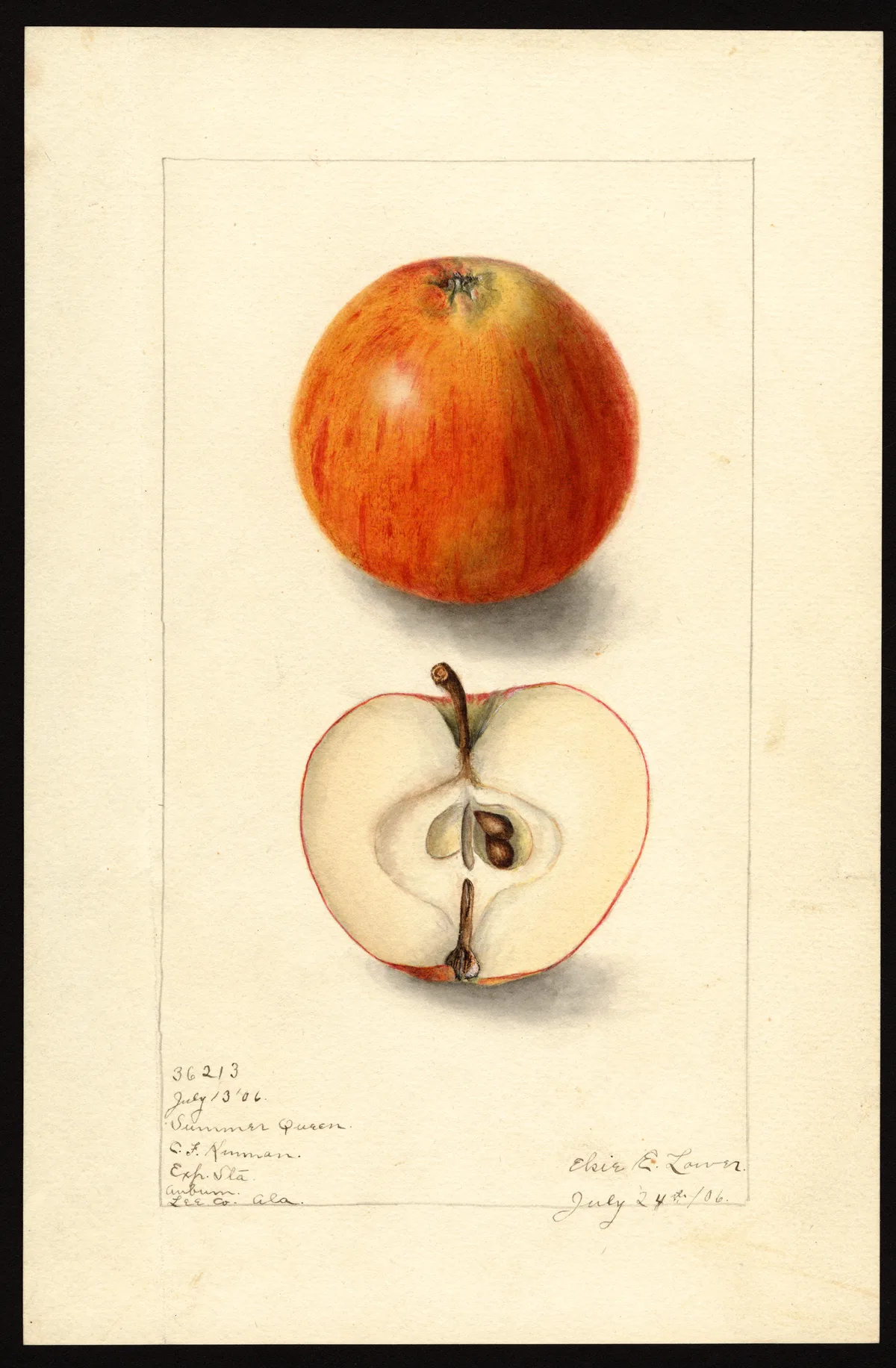
USDA Pomological Watercolor Collection
Summer Queen
Origin/History
Summer Queen is an old American variety, supposed to have originated in this country (Beach; Warder; Budd & Hansen). It was first described in 1806 (Hedrick) and was at one time rather largely grown in eastern United States, but by the early 20th century was seldom planted except in the Pacific states, where it was still offered by several nurserymen (Hedrick). Beach notes it is commonly listed by nurserymen in most parts of the country but is not often grown in New York and is seldom planted in that state. Elliott describes it as "popular and profitable in some sections of the Southwest," and Beach notes that in regions farther west it is a very popular variety for home use and is also considered by some desirable for market.
Tree
A large tree, vigorous, spreading, with somewhat pendent boughs, and productive (Downing; Warder; Budd & Hansen). Beach describes the tree as a moderate grower with rather spreading habit and productive, yielding good crops almost annually. Hedrick gives a contrasting account: "lacking in vigor, rather small, spreading, productive, bearing annually." The Central Experimental Farm (Agassiz BC, planted Spring 1895) reports the tree "a strong grower." Thomas notes the shoots are light colored and the leaves finely crenate, and that the variety is hardy far West. Thomas also observes it does well on warm, sandy soils but performs poorly on cold clay.
Fruit
Size
Medium to large (Elliott; Beach; Hedrick); large and broad at the crown (Downing); large (Budd & Hansen; Lowther; Central Experimental Farm); rather large (Thomas); medium (Warder).
Form
Roundish conical, tapering to the eye (Elliott; Downing); roundish-conical, somewhat ribbed (Thomas); round-conic, angular (Warder); roundish conical, somewhat angular (Beach); roundish conical, somewhat angular and ribbed (Budd & Hansen); round-conic, somewhat angular (Hedrick). Lowther gives form as "re." Central Experimental Farm: "broad and tapering to the eye."
Stem
Medium (Elliott); long, slender (Warder; Budd & Hansen); rather long (Downing); an inch and a half long (Thomas); medium to long, slender (Beach; Hedrick).
Cavity
Narrow (Elliott); wide, regular, brown (Warder); rather deep, sometimes partially closed (Downing); small, acute (Thomas); narrow to rather wide, regular, pretty deep (Beach); acute, regular, rather deep, russeted (Budd & Hansen); narrow to wide, regular, deep (Hedrick).
Calyx
Large, open (Elliott); medium, closed (Warder; Budd & Hansen); but little sunk (Downing); medium to large, open or closed (Beach); large, open or closed (Hedrick).
Basin
Furrowed (Elliott; Thomas; Beach; Hedrick); none or very shallow, folded or plaited (Warder); narrow, plaited (Downing); narrow, flat or very shallow, plaited (Budd & Hansen); small, furrowed (Thomas); shallow or none, furrowed (Beach; Hedrick).
Skin
Yellow, striped and splashed with purplish red (Elliott). Yellow, covered mixed red, striped, splashed scarlet (Warder). Fine deep yellow in its ground, well striped and clouded with red (Downing). Striped with bright red on rich yellow ground (Thomas). Yellow, striped, splashed and shaded with mixed red (Beach; Hedrick). Fine deep yellow, mostly covered with clouded and mixed red, with bright red splashes and stripes (Budd & Hansen). Yellow-red skin (Lowther). Yellow with red streaks (Central Experimental Farm).
Dots
Minute, yellow (Warder; Beach; Budd & Hansen); small, yellow (Hedrick).
Flesh and Flavor
Yellowish, sometimes a pink tinge, juicy, aromatic, sub-acid; "very good" (Elliott). Firm, yellow, breaking; flavor acid, very aromatic, spicy; quality first rate (Warder). Aromatic, yellow, rich, and of good flavor (Downing). Yellowish, rather acid, spicy, very rich (Thomas). Whitish-yellow, sometimes with tinge of pink, firm, aromatic, juicy, subacid, good to very good for culinary use (Beach). Yellow, firm, very aromatic, rich, rather acid, excellent for cooking (Budd & Hansen). Whitish-yellow, sometimes with a tinge of pink, firm, aromatic, juicy, subacid; quality good to very good for culinary purposes (Hedrick). Yellow, crisp, juicy, aromatic (Central Experimental Farm).
Core and Seeds
Core medium, regular, open; seeds numerous, pointed, brown (Warder). Core medium size; cells open; seeds numerous, acute, brown (Beach). Core medium, open; seeds many, pointed (Budd & Hansen). Core medium in size with cells open; seeds numerous, acute, brown (Hedrick).
Season
August to September (Elliott; Downing; Beach; Budd & Hansen; Hedrick); July, August (Warder); late summer (Thomas); August (Central Experimental Farm); ripening in summer (Lowther). Hedrick notes the fruits ripen over a long season and do not ship or keep well.
Uses
Excellent for cooking / culinary use (Thomas; Beach; Budd & Hansen; Hedrick). Suited for both kitchen and market use (Lowther); kitchen use (Warder). Hedrick notes it is of value only for home use and local markets. Beach notes that in regions farther west it is popular for home use and considered by some desirable for market.
Subtypes/Variants
Not described in source.
Other
Lowther reports the variety from 4 stations in the Northern Division, 4 stations in the Central Division, and 4 stations in the Southern Division; the asterisk on each division count indicates the variety is reported as adapted to more than one division. The Central Experimental Farm trial at Agassiz BC was planted Spring 1895.
Book Sources
Described in 8 period pomological works
- Warder, American Pomology: Apples (1867)
- Beach, The Apples of New York Vol. 2 (1905)
- Budd & Hansen, Systematic Pomology (1914)
- Downing, Fruits and Fruit Trees of America (1900)
- Elliott, The Western Fruit Book (1865)
- Lowther (ed.), Encyclopedia of Practical Horticulture (1914)
- Hedrick, Cyclopedia of Hardy Fruits (1922)
- Thomas, The American Fruit Culturist (1903)
Nursery Catalog Sources
Found in 18 catalogs (1864–1921) from Illinois, Missouri, Nebraska, Oregon, Virginia, Washington
- St. Helena Nursery , Howell's Prairie, Marion County , Oregon — 1864
- Milwaukie-Canby Nurseries , Canby, OR (and Milwaukie, OR) — 1893
- Multnomah Nurseries , Russellville , Oregon — 1894
- The Vineland Nurseries (Kelsey & Co. , Proprietors), St. Joseph, Missouri (Office: 13th and Atchison Sts., 2 Blocks East of the Citizens St. Car Line) — 1894
- The Salem Nursery (John A. Francis , Proprietor), Salem , Virginia — 1897
- Central Experimental Farm , Dominion Department of Agriculture, Agassiz, British Columbia (under test; Bulletin No. 3, Second Series) — 1900
- Washington Nursery Co. , Toppenish , Washington — 1901
- Mountain Grove Nurseries (Tippin & Moore , Proprietors; Geo. T. Tippin, J. W. Tippin, J. C. Moore), Mountain Grove , Missouri — 1901
- Benjamin Buckman (personal inventory) , Farmingdale , Illinois — 1901
- Carlton Nursery Co. , Carlton , Oregon — 1909
- Washington Nursery Company , Toppenish , Washington — 1909
- Galbraith Nursery Co. (DeWitt Hansen , Pres.-Mgr.), Fairbury , Nebraska — 1911
- Pacific Nursery Company , Portland , Oregon — 1912
- Washington Nursery Company , Toppenish , Washington — 1912
- Benjamin Buckman (personal inventory) , Farmingdale , Illinois — 1913
- Union Nurseries , J.B. Weaver & Sons, Union , Oregon — 1915
- Oregon Nursery Co. , Orenco , Oregon — 1920
- Benedict Nursery Co. , Portland , Oregon — 1921
View original book sources (9)
— F.R. Elliott, The Western Fruit Book (1865)Summer Queen.
Sharpens Early, | Lancaster Queen, | Homony.
Popular and profitable in some sections of the Southwest. Fruit, medium to large, roundish conical, tapering to the eye, yellow, striped and splashed with purplish red; stem, medium; cavity, narrow; calyx, large, open; basin, furrowed; flesh, yellowish, sometimes a pink tinge, juicy, aromatic, sub-acid; "very good." August to September.
— John A. Warder, American Pomology: Apples (1867)Summer Queen.
American. Tree vigorous, large, spreading, productive. Fruit medium, round-conic, angular; Surface yellow,
covered mixed red, striped, splashed scarlet; Dots minute, yellow. Basin none or very shallow, folded or plaited; Eye medium, closed. Cavity wide, regular, brown; Stem long, slender. Core medium, regular, open; Seeds numerous, pointed, brown; Flesh firm, yellow, breaking; Flavor acid, very aromatic, spicy; Quality first rate; Use, kitchen; Season, July, August.
— A.J. Downing, The Fruits and Fruit Trees of America (1900)Summer Queen.
Sharpe's Early. Lancaster Queen. Polecat.
This variety forms a large tree with somewhat pendent boughs, and is a profitable sort for orchards and marketing over a large territory.
The fruit is large and broad at the crown, tapering towards the eye. The stalk is rather long, and is planted in a pretty deep cavity, sometimes partially closed. Calyx but little sunk, in a narrow plaited basin. Skin fine deep yellow in its ground, though well striped and clouded with red. Flesh aromatic, yellow, rich, and of good flavor. August and September.
— John J. Thomas, The American Fruit Culturist (1903)Summer Queen. Rather large, roundish-conical, somewhat ribbed; striped with bright red on rich yellow ground; stalk an inch and a half long; cavity small, acute; basin small, furrowed; flesh yellowish, rather acid, spicy, very rich. Fine for cooking. Late summer. Good on warm, sandy soils, poor on cold clay. Shoots light colored, leaves finely crenate. Hardy far West.
— S.A. Beach, The Apples of New York, Vol. 2 (1905)SUMMER QUEEN.
REFERENCES. 1. M'Mahon, Amer. Gard. Cat., 1806:584. 2. Coxe, 1817:102. 3. Thacher, 1822:133. 4. Buel, N. Y. Bd. Agr. Mem., 1826:476. 5. Wilson, 1828:136. 6. Kenrick, 1832:28. 7. Manning, 1838:46. 8. Downing, 1845:77. 9. Hovey, Mag. Hort., 14:489. 1848. fig. 10. Thomas, 1849:141. 11. Cole, 1849:103. 12. Barry, 1851:282. 13. Waring, 1851:28. 14. Emmons, Nat. Hist. N. Y., 3:14. 1851. 15. Elliott, 1854:158. 16. Hooper, 1857:88, 107. 17. Gregg, 1857:39. 18. Am. Pom. Soc. Cat., 1860:240. 19. Warder, 1867:545. fig. 20. Downing, 1869:370. fig. 21. Fitz, 1872:143, 161. 22. Ill. Hort. Soc. Rpt., 1874:295. 23. Wickson, 1889:243. 24. Lyon, Mich. Hort. Soc. Rpt., 1890:298. 25. Bailey, An. Hort., 1892:250. 26. Budd-Hansen, 1903:183. fig.
SYNONYMS. Lancaster Queen (15, 20). Polecat (20). QUEEN (3, 13). Queen (6). Sharpe's Early (20). SUMMER QUEEN (2, 4, 5, 6, 7, 8, 9, 10, 11, 12, 14, 15, 16, 17, 18, 19, 20, 21, 22, 23, 24, 25, 26). Summer Queen (3, 13). SWEET'S HARVEST (1). Sweet's Harvest (3, 4, 6). Swell's Harvest (2).
A striped red apple of good size and excellent quality for culinary use, in season during late summer. In regions farther west it is a very popular variety for home use and is also considered by some desirable for market. The tree is a moderate grower with rather spreading habit and productive, yielding good crops almost annually.
Historical. This is an old variety which is supposed to have originated in this country (4, 19, 26). It is commonly listed by nurserymen in most parts¹
¹ Ragan, U. S. B. P. I. Bul., 66:300. 1905.
of the country (25). So far as we have been able to learn it is not often grown in New York and is now seldom planted in this state.
FRUIT (10, 12, 15, 19). Fruit medium to large. Form roundish conical, somewhat angular. Stem medium to long, slender. Cavity narrow to rather wide, regular, pretty deep. Calyx medium to large, open or closed. Basin shallow or none, furrowed. Skin yellow, striped, splashed and shaded with mixed red. Dots minute, yellow. Core medium size; cells open. Seeds numerous, acute, brown. Flesh whitish-yellow, sometimes with tinge of pink, firm, aromatic, juicy, subacid, good to very good for culinary use. Season August and September.
— J.L. Budd & N.E. Hansen, American Horticultural Manual, Part II: Systematic Pomology (1914)Summer Queen.—Of American origin; tree vigorous, large, spreading, with somewhat pendent boughs, productive.
Summer Queen.
Fruit large, roundish conical, somewhat angular and ribbed; surface fine deep yellow, mostly covered with clouded and mixed red, with bright red splashes and stripes; dots minute, yellow; cavity, acute, regular, rather deep, russeted; stem long, slender; basin narrow, flat, or very shallow, plaited; calyx medium, closed. Core medium, open; seeds many, pointed; flesh yellow, firm, very aromatic, rich, rather acid, excellent for cooking. August, September.
— Granville Lowther (ed.), Encyclopedia of Practical Horticulture (1914)Summer Queen is a large apple with form "re", yellow-red skin, good quality, suited for both kitchen and market use, ripening in summer. It was reported by 4 stations in the Northern Division, 4 stations in the Central Division, and 4 stations in the Southern Division; the asterisk on each division count indicates the variety is reported as adapted to more than one division.
— U.P. Hedrick, Cyclopedia of Hardy Fruits (1922)SUMMER QUEEN. Sweet Harvest. Queen. Summer Queen is an old variety, at one time rather largely grown in eastern United States, but now seldom planted except in the Pacific states, where it is still offered by several nurserymen. It is of value only for home use and local markets; the fruits ripen over a long season and do not ship or keep well. The variety seems to have been first described in 1806.
Tree lacking in vigor, rather small, spreading, productive, bearing annually. Fruit medium to large, round-conic, somewhat angular; stem medium to long, slender; cavity narrow to wide, regular, deep; calyx large, open, or closed; basin shallow or none, furrowed; skin yellow, striped, splashed and shaded with mixed red; dots small, yellow; core medium in size with cells open; seeds numerous, acute, brown; flesh whitish-yellow, sometimes with a tinge of pink, firm, aromatic, juicy, subacid; quality good to very good for culinary purposes; August and September.
— Central Experimental Farm, Central Experimental Farm, Agassiz BC — Catalogue of Fruit Trees under Test (Bulletin No. 3, 1900) (1900)Planted Spring 1895. Tree a strong grower. Fruit large, broad and tapering to the eye. Skin yellow with red streaks. Flesh yellow, crisp, juicy, aromatic. Season August.