Sweet Bough
Apple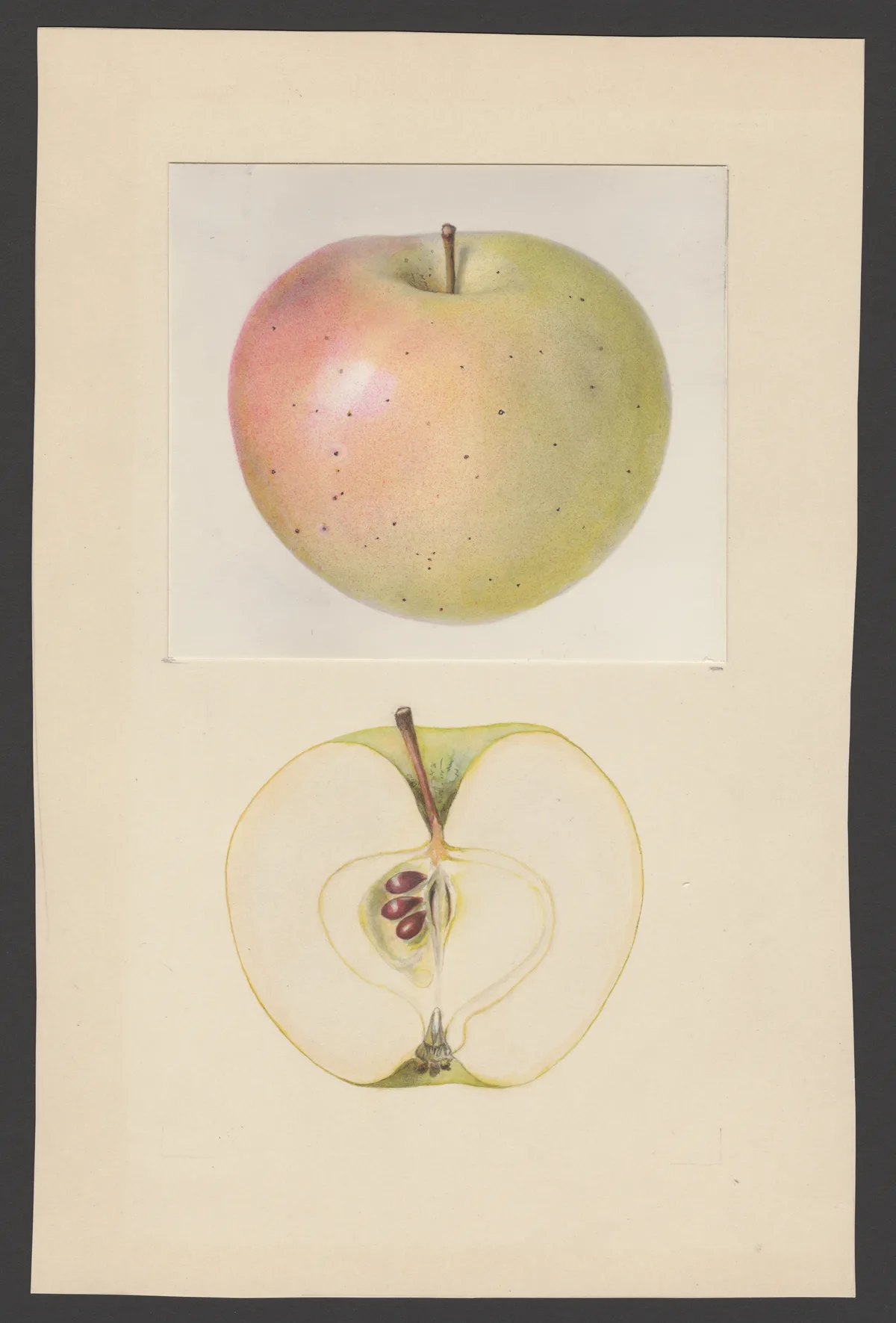
USDA Pomological Watercolor Collection
Sweet Bough
Origin / History
A native American variety, first described by William Coxe in 1817 under the name "Bough Apple" (Coxe, Beach, Hedrick); Elliott notes that he and others added "Sweet" as expressive of its character. It is now well distributed throughout the United States. Beach (1905) records it as a universal favorite throughout New York state for the home orchard, while noting that because the fruit is too soft to stand shipping to distant markets, it cannot be ranked among the profitable commercial varieties. Under favorable conditions the tree is long-lived — Beach cites specimens sixty to eighty years old still quite productive. Hedrick (1922) calls it "acknowledged by all to be the best summer sweet apple." Hovey (quoted in Beach, 1848) wrote: "The Bough is one of our finest summer apples, having all the good qualities which should recommend a fruit for general cultivation. The tree is moderately vigorous, making a handsome head, and bears abundant crops of large, very fair fruit, which begins to ripen the last of July, and remains in eating till the first of September. As a table apple, it will not rank as high as the Early Harvest; but, as a kitchen fruit, in its honied sweetness and tender flesh, it has no equal of its season. It should be found in every good collection." Beach (in his supplementary "Bough Sweet" entry) records the nomenclatural confusion of the period: the variety has been listed in late American Pomological Society catalogues as "Bough, Sweet," but most nurserymen list it as Sweet Bough, and Beach accordingly adopted Sweet Bough as the working name.
Tree
Coxe describes the tree as growing vigorously, of round form, with luxuriant foliage of a deep green colour. Elliott calls it a moderate, annual bearer, succeeding in all good soils not wet, with young shoots yellowish, somewhat irregular, and ascending. Warder calls it vigorous, with a compact head, rather productive. Downing (1900) describes it as moderately vigorous, bearing abundantly, forming a round head, with young shoots grayish brown and very slightly downy. Thomas notes shoots yellowish, irregular, ascending; tree round-headed; leaves obtusely crenate. The Central Experimental Farm (Agassiz, 1900) catalogue likewise records a vigorous grower and regular bearer.
Beach (1905) gives the most detailed tree description: moderately vigorous; form upright spreading to roundish, dense; twigs short, straight, moderately stout with large terminal buds; internodes short; bark clear brown mingled with olive-green, lightly mottled with scarf-skin, not pubescent; lenticels scattering, small, round, not raised; buds medium in size, plump, acute, free, not pubescent. Hedrick (1922) summarizes the tree as vigorous, upright-spreading, dense. Beach also notes that the tree comes into bearing rather young; that in unfavorable locations it is sometimes injured by winter; and that the branches are attacked somewhat by apple canker. Hedrick adds that the trees are "all that could be desired, falling short only in hardiness."
Fruit
Size
Above medium to large, and uniform in size and shape (Beach, Hedrick). Coxe notes that on young trees in rich ground it is sometimes large. Downing places it above the middle size. Elliott calls it large (noting his own figure was hardly medium). Budd-Hansen and Thomas also describe it as above medium / large. Lowther simply records it as large in size. The Stark Bros. catalogue (1910) describes it as "a large just-breaking one of the really good summer dessert apples." The Central Experimental Farm catalogue (1900) also records the fruit as large.
Form
Sources broadly agree on roundish-conic or ovate, but with notable variation:
- Coxe: "rather oblong; full, even, and fair."
- Elliott: "roundish, conical ovate."
- Warder: "round-conic, regular, very light."
- Downing (1900): "oblong ovate."
- Thomas: "roundish, remotely conical-ovate, sometimes distinctly conical."
- Budd-Hansen: "regular, oblong ovate, slightly conical."
- Beach: "roundish conic or ovate to sometimes slightly oblong conic with broad and rather flat base, pretty regular; sides often unequal."
- Hedrick: "round-conic or ovate, sometimes oblong-conic with broad and flat base, regular, sides often unequal."
- Central Experimental Farm (1900): "oblong, tapering to the eye."
- Lowther disagrees with the rest, calling the form oblate — this stands out as inconsistent with every other source and may reflect a typographical or terminological error in the Encyclopedia of Practical Horticulture.
Stem
Elliott: "varying in length." Warder: medium. Downing (1900): "rather long." Thomas: "one-half to an inch long." Budd-Hansen: "long to very long." Beach: "short to medium, moderately thick, usually not exserted." Hedrick: "short, thick, usually not exserted." Sources disagree noticeably here — Downing and Budd-Hansen describe a longer stem, while Beach and Hedrick describe a short to medium one.
Cavity
Elliott: deep. Warder: acute, regular, deep, sometimes brown. Budd-Hansen: regular, deep, sometimes russeted. Beach: acuminate, deep, rather broad, sometimes furrowed or compressed, usually smooth. Hedrick: acuminate, deep, broad, sometimes furrowed, usually smooth.
Calyx / Eye
Elliott: calyx open. Warder: eye small, closed. Downing (1900): "the eye narrow and deep." Budd-Hansen: calyx closed; segments erect convergent. Beach: small to medium, closed or partly open; lobes often leafy, sometimes separated at base, long, narrow, acute. Hedrick: small, closed or partly open; lobes often leafy, sometimes separated at the base, long, narrow, acute. Sources differ on whether the calyx is open (Elliott) or closed (Warder, Budd-Hansen); Beach and Hedrick describe it as closed or partly open.
Basin
Elliott: narrow, deep. Warder: rather shallow, regular. Thomas: narrow, deep. Budd-Hansen: smooth, regular, narrow, shallow. Beach: rather small, medium to rather shallow, narrow, a little abrupt, smooth or slightly wrinkled. Hedrick: small, shallow, narrow, abrupt, smooth or wrinkled.
Skin
Coxe: "a very pale yellow." Elliott: "greenish, becoming pale yellow when fully ripe." Warder: "smooth, white or pale yellow." Downing (1900): "smooth, pale greenish yellow." Thomas: "pale greenish yellow." Budd-Hansen: "surface smooth, clear, pale greenish yellow." Beach: "rather thick, tough, smooth, pale greenish-yellow often changing to yellowish-white, sometimes faintly blushed." Hedrick: "thick, tough, smooth, pale yellow, sometimes faintly blushed." Lowther calls the color "green-yellow." Central Experimental Farm (1900): "pale yellow."
Dots
Warder: "minute, dark, indented, few." Budd-Hansen: "distinct, numerous, minute, russet, with green bases." Beach: "numerous, small, often light colored and submerged, sometimes russet." Hedrick: "numerous, small, light-colored and submerged, sometimes russet." Note the disagreement: Warder reports few dark dots, while Budd-Hansen, Beach, and Hedrick report numerous dots — light or russet. Downing (1900) does not describe dots on Sweet Bough but, in his note on "Pound's July" (treated by him as a related entry), describes that fruit as thinly sprinkled with brown dots.
Flesh / Flavor
Coxe: "white, sweet, tender, juicy and well flavoured; it is the finest early table apple we have." Elliott: "white, tender, crisp, sprightly, sweet." Warder: "white, very soft, light, juicy; flavor very sweet when ripe, somewhat bitter when green." Downing (1900): "white, very tender and crisp when fully ripe, and with a rich, sweet, sprightly flavor." Thomas: "white, very tender, with an excellent sweet flavor." Budd-Hansen: "white, very tender, juicy, very sweet, too sweet for cooking, good." Beach: "white, moderately firm, fine, somewhat crisp, very tender, juicy, sweet, slightly aromatic, good to very good." Hedrick: "white, firm, fine, crisp, very tender, juicy, sweet, aromatic; good to very good." Central Experimental Farm (1900): "yellowish, tender, juicy, crisp, with a rich sweet flavour, quality good." (Note: the Agassiz catalogue gives flesh as "yellowish" — all other sources call it white.) Quality assessments vary: Coxe calls it the finest early table apple; Warder rates it "only good — by some called best"; Beach and Hedrick rate it good to very good; Hovey (in Beach) holds that for kitchen use "in its honied sweetness and tender flesh, it has no equal of its season." Warder uniquely notes the fruit becomes "tasteless when cooked," while Budd-Hansen and Downing both note it is too sweet for cooking.
Core / Seeds
Elliott: "core, medium, open capsules; seeds, ovate, light brown." Warder: "core regular, nearly closed, clasping; seeds medium, dark." Budd-Hansen: "core nearly closed, clasping; tube conical; stamens median." Beach: "calyx tube long, wide at top, conical to funnel-shape; stamens median; core rather large to medium, abaxile to nearly axile; cells closed or open; core lines clasping; carpels roundish to cordate, slightly emarginate, slightly tufted; seeds light brown, medium to rather small, plump, acute." Hedrick: "calyx-tube long, wide at top, conical; stamens median; core large, abaxile; cells closed or open; core-lines clasping; carpels round or cordate, emarginate, tufted; seeds light brown, small, plump, acute." Warder uniquely describes seeds as "dark," while Elliott, Beach, and Hedrick all give them as light brown.
Season
Coxe: July and August. Elliott: August. Warder: July and August. Downing (1900): ripens from the middle of July to the tenth of August. Thomas: ripens from the middle to the end of summer. Budd-Hansen: July and August. Beach: August and early September. Hedrick: August and early September. Hovey (quoted in Beach): begins to ripen the last of July, and remains in eating till the first of September. Central Experimental Farm (1900): August. Lowther: summer. Stark Bros. (1910) describes it as ripening "through a long season."
Uses
A dessert / table apple of the first quality (Coxe, Elliott, Downing, Budd-Hansen). Coxe calls it "the finest early table apple we have" and says it "is preferred to any other at the season in which it ripens." Downing notes it is "second [in dessert quality] only to the Early Harvest" but "not so much esteemed for the kitchen, as it is too sweet for pies and sauce." Warder lists its use as "market, stock and dessert — tasteless when cooked." Hovey (in Beach) reverses this, calling it unequaled as a kitchen fruit for its honied sweetness and tender flesh. Lowther lists use as both kitchen and market. Beach notes it is handled to a limited extent in local markets but is too soft for distant shipping, ruling it out as a commercial variety. Hedrick concurs: ideal for home use or local market, but too tender for distant shipment. Stark Bros. (1910) markets it as a "really good summer dessert apple."
Subtypes / Variants
Not described in source as distinct sports or strains. (The variety circulated under numerous synonyms across nineteenth-century sources; these are tracked separately.)
Other
Downing (1900) attaches a second, distinct entry to this volume — "Pound's July" — without explicitly equating the two; Beach (1905), however, lists "Pound's July" among the synonyms of Sweet Bough (citing Downing, 1881 index/appendix). Downing describes Pound's July as: origin Kentucky; tree vigorous, upright spreading; young shoots light reddish brown; fruit large, roundish conic, sides unequal, greenish white, with a dull blush, and thinly sprinkled with brown dots; stalk very short; cavity deep, russeted; calyx closed; basin small, narrow; flesh white, fine-grained, tender, not very juicy, rich, pleasant, sweet; good to very good; July, August. The discrepancies between this and Downing's main Sweet Bough description (very short vs. rather long stalk; russeted cavity; "not very juicy" vs. the consistently juicy main entry; dull blush and brown dots) suggest the conflation is uncertain.
Lowther (1914) gives geographic distribution data: reported by 14 stations in the Northern Division, 15 stations in the Central Division, and 6 stations in the Southern Division, with the variety reported as adapted to more than one division.
The Central Experimental Farm (Agassiz, BC) record notes the tree was planted Spring 1890, demonstrating the variety's reach into the Pacific Northwest / British Columbia by the late nineteenth century.
Book Sources
Described in 9 period pomological works
- Beach, The Apples of New York Vol. 2 (1905)
- Warder, American Pomology: Apples (1867) — listed as Large Bough
- Coxe, A View of the Cultivation of Fruit Trees (1817) — listed as Bough Apple
- Elliott, The Western Fruit Book (1865)
- Lowther (ed.), Encyclopedia of Practical Horticulture (1914)
- Hedrick, Cyclopedia of Hardy Fruits (1922)
- Thomas, The American Fruit Culturist (1903)
- Budd & Hansen, Systematic Pomology (1914) — listed as Bough, Sweet (Large; Yellow Bough)
- Downing, Fruits and Fruit Trees of America (1900) — listed as Large Yellow Bough
USDA Nomenclature (1905)
From W.H. Ragan, Nomenclature of the Apple, USDA Bulletin No. 56
This may be Bough.
Nursery Catalog Sources
Found in 48 catalogs (1886–1936) from Alabama, California, England, Illinois, Missouri, New Jersey, Oregon, Washington
- Huntsville Wholesale Nurseries (Jessie S. Moss , Proprietor; W.F. Heikes, Manager), Huntsville , Alabama — 1886
- California Nursery Co. , Niles , California — 1889
- Missouri Nursery Co. , Louisiana , Missouri — 1891 — listed as Early Sweetheart
- Milwaukie-Canby Nurseries , Canby, OR (and Milwaukie, OR) — 1893
- Sherwood Hall Nursery Co. , Timothy Hopkins (Menlo Park Nurseries), San Francisco / Menlo Park , California — 1893
- Multnomah Nurseries , Russellville , Oregon — 1894
- The Vineland Nurseries (Kelsey & Co. , Proprietors), St. Joseph, Missouri (Office: 13th and Atchison Sts., 2 Blocks East of the Citizens St. Car Line) — 1894
- Stark Bros. Nurseries & Orchards Co. , Louisiana , Missouri — 1896
- The Lovett Company , Little Silver , New Jersey — 1896
- Brown Brothers Co. , Continental Nurseries, Rochester, NY (also operated from Toronto, Canada) — 1899
- Central Experimental Farm , Dominion Department of Agriculture, Agassiz, British Columbia (under test; Bulletin No. 3, Second Series) — 1900 — listed as Early Sweetheart
- George Bunyard & Co. , Royal Nurseries, Maidstone, Kent , England — 1900 — listed as Washington
- Central Experimental Farm , Dominion Department of Agriculture, Agassiz, British Columbia (under test; Bulletin No. 3, Second Series) — 1900 — listed as Washington
- Benjamin Buckman (personal inventory) , Farmingdale , Illinois — 1901 — listed as Early Sweetheart
- Washington Nursery Co. , Toppenish , Washington — 1901
- Mountain Grove Nurseries (Tippin & Moore , Proprietors; Geo. T. Tippin, J. W. Tippin, J. C. Moore), Mountain Grove , Missouri — 1901
- Brown Brothers Co. , Continental Nurseries, Rochester, NY (also operated from Toronto, Canada) — 1901
- Benjamin Buckman (personal inventory) , Farmingdale , Illinois — 1901 — listed as Washington
- Pacific Nursery Company (W. O. Hudson & A. D. Hudson) , Tangent , Oregon — 1903
- Russellville Nursery Co. , Russellville, OR (three miles east of Portland, one mile from Montavilla car line) — 1903
- Stark Bros. Nurseries & Orchards Co. , Louisiana , Missouri — 1906
- Russellville Nursery Co. , Montavilla Station, Portland, OR (three miles east of Portland, one mile from Montavilla car line) — 1907
- Washington Nursery Company , Toppenish , Washington — 1909
- Island Nurseries & Fruit Farm , Vashon (Vashon Island) , Washington — 1910
- Stark Bros. Nurseries & Orchards Co. , Louisiana , Missouri — 1910
- Island Nurseries & Fruit Farm , Vashon (Vashon Island) , Washington — 1911
- Stark Bros. Nurseries & Orchards Co. , Louisiana , Missouri — 1911
- James Veitch & Sons , Ltd., Royal Exotic Nursery, Chelsea, London (also Coombe Wood, Langley, and Feltham) , England — 1911 — listed as Washington
- Ballygreen Nurseries , Hanford , Washington — 1912
- Pacific Nursery Company , Portland , Oregon — 1912
- Stark Bros. Nurseries & Orchards Co. , Louisiana , Missouri — 1912
- Vineland Nurseries Company , Clarkston , Washington — 1912
- Washington Nursery Company , Toppenish , Washington — 1912
- Benjamin Buckman (personal inventory) , Farmingdale , Illinois — 1913 — listed as Early Sweetheart
- Thomas Rivers & Son , Sawbridgeworth, Hertfordshire , England — 1913 — listed as Washington
- Benjamin Buckman (personal inventory) , Farmingdale , Illinois — 1913 — listed as Washington
- Island Nurseries & Fruit Farm , Vashon (Vashon Island) , Washington — 1914
- George Bunyard & Co. , Royal Nurseries, Maidstone, Kent , England — 1914 — listed as Washington
- Union Nurseries , J.B. Weaver & Sons, Union , Oregon — 1915
- Island Nurseries & Fruit Farm , Vashon (Vashon Island) , Washington — 1915 — listed as Sweetbough
- Island Nurseries & Fruit Farm , Vashon (Vashon Island) , Washington — 1916 — listed as Sweetbough
- Island Nurseries & Fruit Farm , Vashon (Vashon Island) , Washington — 1917 — listed as Sweetbough
- George Bunyard & Co. , Royal Nurseries, Maidstone, Kent , England — 1917 — listed as Washington
- Stark Bros. Nurseries & Orchards Co. , Louisiana , Missouri — 1918
- Oregon Nursery Co. , Orenco , Oregon — 1920
- Benedict Nursery Co. , Portland , Oregon — 1921
- Stark Bro's Nurseries , Louisiana , Missouri — 1932
- Hudson's Wholesale Nurseries , Tangent , Oregon — 1936
View original book sources (11)
— William Coxe, A View of the Cultivation of Fruit Trees (1817)NO. 3. BOUGH APPLE.
The size of this apple when on young trees, in rich ground, is sometimes large—the form is rather oblong; full, even, and fair—the skin is a very pale yellow, the flesh white, sweet, tender, juicy and well flavoured; it is the finest early table apple we have; and as an eating apple, is preferred to any other at the season in which it ripens, which is in July and August. The tree grows vigorously; the form is round, the foliage luxuriant, and of a deep green colour.
— F.R. Elliott, The Western Fruit Book (1865)Sweet Bough.
Bough, | Large Yellow Bough, | Washington, Early Sweet Bough, | Sweet Harvest, | Nyack Pippin.
American. First described by Coxe as Bough ; we add Sweet, as expressive of its character. Valued as a dessert fruit. Young shoots, yellowish, somewhat irregular, ascending. Tree, a moderate, annual bearer, succeeding in all good soils not wet.
Fruit, large (our figure hardly medium) ; form, roundish, conical ovate, color, greenish, becoming pale yellow when fully ripe ; stem, varying in length ; cavity, deep ; calyx, open ; basin, narrow, deep ; flesh, white, tender, crisp, sprightly, sweet ; core, medium, open capsules ; seeds, ovate, light brown. August.
— John A. Warder, American Pomology: Apples (1867)Large Bough. LARGE YELLOW BOUGH, ETC.
A native fruit, much admired as an early sweet apple. Tree vigorous, compact head, rather productive.
Fruit round-conic, regular, very light; Surface smooth, white or pale yellow; Dots minute, dark, indented, few. Basin rather shallow, regular; Eye small, closed. Cavity acute, regular, deep, sometimes brown; Stem medium. Core regular, nearly closed, clasping; Seeds medium, dark; Flesh white, very soft, light, juicy; Flavor very sweet when ripe, somewhat bitter when green; Quality only good—by some called best; Use, market, stock and dessert—tasteless when cooked; Season, July and August.
— A.J. Downing, The Fruits and Fruit Trees of America (1900)Large Yellow Bough.
Early Sweet Bough. Sweet Harvest. Bough. August Sweet. Washington, incorrectly. Sweet Bough.
A native Apple, ripening in harvest time, and one of the first quality, only second as a dessert fruit to the Early Harvest. It is not so much esteemed for the kitchen as the latter, as it is too sweet for pies and sauce, but it is generally much admired for the table, and is worthy of a place in every collection.
Fruit above the middle size, and oblong ovate in form. Skin smooth, pale greenish yellow. Stalk rather long, and the eye narrow and deep. Flesh white, very tender and crisp when fully ripe, and with a rich, sweet, sprightly flavor. Ripens from the middle of July to the tenth of August. Tree moderately vigorous, bears abundantly, and forms a round head. Young shoots grayish brown, very slightly downy.
[Additional entry in this volume: "Pound's July", pp. 336–336]
Pound's July. Origin, Kentucky. Tree vigorous, upright spreading. Young shoots light reddish brown. Fruit large, roundish conic, sides unequal, greenish white, with a dull blush, and thinly sprinkled with brown dots. Stalk very short. Cavity deep, russeted. Calyx closed. Basin small, narrow. Flesh white, fine-grained, tender, not very juicy, rich, pleasant, sweet. Good to very good. July, August.
— John J. Thomas, The American Fruit Culturist (1903)Sweet Bough.* (Large Yellow Bough, Early Sweet Bough.) Large, roundish, remotely conical-ovate, sometimes distinctly conical; pale greenish yellow, stalk one-half to an inch long; basin narrow, deep; flesh white, very tender, with an excellent sweet flavor. Ripens from the middle to the end of summer. A moderate and regular bearer. Shoots yellowish, irregular, ascending; tree round-headed; leaves obtusely crenate. Fig. 351.
— S.A. Beach, The Apples of New York, Vol. 2 (1905)SWEET BOUGH.
REFERENCES. 1. (?) Amer. Gard. Cal., 1806:584. 2. Coxe, 1817:101. fig. 3. (?) Thacher, 1822:121. 4. Buel, N. Y. Bd. Agr. Mem., 1826:477. 5. Wilson, 1828:136. 6. Fessenden, 1828:131. 7. Kenrick, 1832:26. 8. Floy-Lindley, 1833:84. 9. Manning, 1838:46. 10. Downing, 1845:74. 11. Hovey, Mag. Hort., 14:486. 1848. fig. 12. Cole, 1849:99. 13. Thomas, 1849:135. 14. Phoenix, Horticulturist, 4:472. 1850. 15. Barry, 1851:279. 16. Am. Pom. Soc. Cat., 1852. 17. Elliott, 1854:109. fig. 18. Hooper, 1857:20. 19. Ib., 1857:107, 111. 20. Gregg, 1857:35. 21. Warder, 1867:494. fig. 22. Downing, 1869:250. 23. Fitz, 1872:143. 24. Ib., 1872:161. 25. Leroy, 1873:154. fig. 26. Downing, 1881:11 index, app. 27. Hogg, 1884:129. 28. Wickson, 1889:243. 29. Bailey, An. Hort., 1892:235. 30. Ib., 1892:243. 31. Ib., 1892:250. 32. Amer. Gard., 15:404. 1894. fig. 33. Taylor, Am. Pom. Soc. Rpt., 1895:192. 34. Lyon, Mich. Sta. Bul., 143:200, 202. 1897. 35. Woolverton, Ont. Fr. Stas. An. Rpt., 4:4. 1897. figs. 36. Beach, W. N. Y. Hort. Soc. Rpt., 1901:76. 37. Budd-Hansen, 1903:155.
SYNONYMS. August Sweet (22). August Sweeting (12). Autumn Bough (11). BOUGH (4, 5, 11, 13, 24, 25, 29, 34). Bough (7, 10, 12, 17, 22, 27). BOUGH APPLE (2, 6, 8, 20). BOUGH, Early Sweet (18). BOUGH, Sweet (37). (Bow Apple 1, 3)? EARLY BOUGH (7, 9). Early Bough (11, 25, 27). Early French Reinette (4). Early Sweet Bough (10, 11, 13, 17, 22). Early Sweetheart (36). LARGE BOUGH (21). LARGE EARLY BOUGH (28). Large Early Yellow Bough (27). LARGE SWEET BOUGH (19, 30). Large Sweet Bough (15). LARGE YELLOW BOUGH (10, 16, 22, 23, 26, 27, 33). Large Yellow Bough (11, 13, 15, 17, 20, 21, 25, 30, 31, 34, 35, 37). Niack Pippin (17). Pound's July (26). SWEET BOUGH (12, 14, 17, 31, 32, 35, 36). Sweet Bough (7, 13, 20, 22, 24, 25, 27, 33, 34). Sweetbough (28). Sweet Harvest (10, 11, 17, 22, 25, 27). Yellow Bough (12). Washington (17, 25, incorrectly 22).
This variety is a universal favorite throughout the state for the home orchard. Hovey (11) well says of it: “The Bough is one of our finest summer apples, having all the good qualities which should recommend a fruit for general cultivation. The tree is moderately vigorous, making a handsome head, and bears abundant crops of large, very fair fruit, which begins to ripen the last of July, and remains in eating till the first of September. As a table apple, it will not rank as high as the Early Harvest; but, as a kitchen fruit, in its honied sweetness and tender flesh, it has no equal of its season. It should be found in every good collection.”
It is handled to a limited extent in local markets, but is too soft to stand shipping to distant markets. It cannot be ranked among the profitable commercial varieties. The tree comes into bearing rather young, and under favorable conditions is long-lived, specimens being found sixty to eighty years old which are still quite productive. In unfavorable locations the tree is sometimes injured by winter, and the branches are attacked somewhat by the apple canker.
Historical. This was described by Coxe in 1817 under the name Bough apple (2). It is evidently of American origin.
TREE.
Tree moderately vigorous. Form upright spreading to roundish, dense. Twigs short, straight, moderately stout with large terminal buds; internodes short. Bark clear brown mingled with olive-green, lightly mottled with scarf-skin; not pubescent. Lenticels scattering, small, round, not raised. Buds medium in size, plump, acute, free, not pubescent.
FRUIT.
Fruit above medium to large, uniform in size and shape. Form roundish conic or ovate to sometimes slightly oblong conic with broad and rather flat base, pretty regular; sides often unequal. Stem short to medium, moderately thick, usually not exserted. Cavity acuminate, deep, rather broad, sometimes furrowed or compressed, usually smooth. Calyx small to medium, closed or partly open; lobes often leafy, sometimes separated at base, long, narrow, acute. Basin rather small, medium to rather shallow, narrow, a little abrupt, smooth or slightly wrinkled. Skin rather thick, tough, smooth, pale greenish-yellow often changing to yellowish-white, sometimes faintly blushed. Dots numerous, small, often light colored and submerged, sometimes russet. Calyx tube long, wide at top, conical to funnel-shape. Stamens median. Core rather large to medium, abaxile to nearly axile; cells closed or open; core lines clasping. Carpels roundish to cordate, slightly emarginate, slightly tufted. Seeds light brown, medium to rather small, plump, acute. Flesh white, moderately firm, fine, somewhat crisp, very tender, juicy, sweet, slightly aromatic, good to very good. Season August and early September.
[Additional entry in this volume: "BOUGH SWEET", pp. 47–47]
BOUGH SWEET.
This variety is also known as Bough Apple, Large Yellow Bough, Sweet Bough and Summer Sweet Bough. It is listed in the late catalogues of the American Pomological Society as Bough, Sweet but most nurserymen list it as Sweet Bough. We prefer to recognize the name commonly accepted by nurserymen and accordingly have described the variety under the name Sweet Bough. See page 216.
— J.L. Budd & N.E. Hansen, American Horticultural Manual, Part II: Systematic Pomology (1914)Bough, Sweet (Large; Yellow Bough).—Origin, America; an excellent early sweet apple, especially for dessert use in harvest-time. Fruit above medium, regular, oblong ovate, slightly conical; surface smooth, clear, pale greenish yellow; dots distinct, numerous, minute, russet, with green bases; cavity regular, deep, sometimes russeted; stem long to very long; basin smooth, regular, narrow, shallow; calyx closed; segments erect convergent. Core nearly closed, clasping; tube conical; stamens median; flesh white, very tender, juicy, very sweet, too sweet for cooking, good. July and August.
— Granville Lowther (ed.), Encyclopedia of Practical Horticulture (1914)Sweet Bough is large in size, oblate in form, and green-yellow in color. Quality is very good. Use is both kitchen and market. Season is summer. Reported by 14 stations in the Northern Division, 15 stations in the Central Division, and 6 stations in the Southern Division; the asterisk on each division count indicates the variety is reported as adapted to more than one division.
— U.P. Hedrick, Cyclopedia of Hardy Fruits (1922)SWEET BOUGH. Fig. 53. August Sweet. Autumn Bough. Bough. Early Bough. Yellow Bough.
Sweet Bough is acknowledged by all to be the best summer sweet apple. The tender flesh and honied sweetness of the fruits as eaten from the hand remain in whatever way the apple may be prepared for the table. The fruits are large and handsome, and the trees are all that could be desired, falling short only in hardiness. The apples are too tender for distant shipment, but they are ideal for home use or local market. Sweet Bough is an old variety of American origin, described first in 1817, and now well distributed throughout the United States.
Tree vigorous, upright-spreading, dense. Fruit medium to large, uniform in size and shape, round-conic or ovate, sometimes oblong-conic with broad and flat base, regular, sides often unequal; stem short, thick, usually not exserted; cavity acuminate, deep, broad, sometimes furrowed, usually smooth; calyx small, closed or partly open; lobes often leafy, sometimes separated at the base, long, narrow, acute; basin small, shallow, narrow, abrupt, smooth or wrinkled; skin thick, tough, smooth, pale yellow, sometimes faintly blushed; dots numerous, small, light-colored and submerged, sometimes russet; calyx-tube long, wide at top, conical; stamens median; core large, abaxile; cells closed or open; core-lines clasping; carpels round or cordate, emarginate, tufted; seeds light brown, small, plump, acute; flesh white, firm, fine, crisp, very tender, juicy, sweet, aromatic; good to very good; August and early September.
— Central Experimental Farm, Central Experimental Farm, Agassiz BC — Catalogue of Fruit Trees under Test (Bulletin No. 3, 1900) (1900)Planted Spring 1890. Tree a vigorous grower, and a regular bearer. Fruit large, oblong, tapering to the eye. Skin pale yellow. Flesh yellowish, tender, juicy, crisp, with a rich sweet flavour, quality good. Season August.
— Stark Bros. Nurseries & Orchards Co., Stark Bros. Year Book (1910) (1910)A large just-breaking one of the really good summer dessert apples. Ripens through a long season...